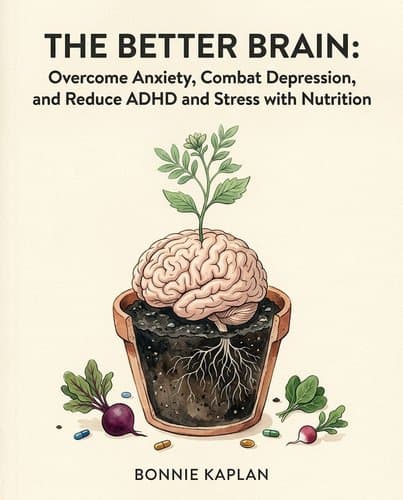
53968468_the-better-brain
by Bonnie Kaplan
Psychiatry spent 70 years prescribing drugs for what are actually symptoms of nutrient deficiency — and the clinical trials proving that broad-spectrum…
In Brief
The Better Brain: Overcome Anxiety, Combat Depression, and Reduce ADHD and Stress with Nutrition (2021) makes the case that most mental health conditions stem from nutrient deficiencies the modern food supply has created — and that the brain cannot function without the 30+ minerals and vitamins it needs to produce its own neurotransmitters.
Key Ideas
Mediterranean diet feeds brain neurotransmitter production
Eat a Mediterranean-style diet built around seafood, leafy greens, cruciferous vegetables, legumes, and whole grains — these are the densest food sources of the 30+ minerals and vitamins the brain requires to manufacture its own neurotransmitters
Normal blood tests don't guarantee brain nutrition
A blood test showing 'normal' nutrient levels does not mean your brain is well-fed — circulating levels reflect homeostatic mechanisms, not brain availability; 40% of people with clinically normal values still showed substantial benefit from broad-spectrum supplementation in Julia Rucklidge's RCTs
Only broad-spectrum formulas show psychiatric benefit
Single-nutrient supplements and small 'favorite few' combinations have not shown psychiatric benefit in clinical trials; the positive evidence is specifically for broad-spectrum formulas containing 30+ minerals and vitamins at doses above the RDA (such as EMPowerplus or Daily Essential Nutrients) — not the multivitamins available at a drugstore
Supervise nutrient-medication interactions like grapefruit
If you are on psychiatric medication, do not add broad-spectrum supplements without telling your prescriber — nutrients amplify medication effects through liver enzyme pathways (the same mechanism as grapefruit and 85+ medications), and the dose reduction must be supervised and gradual
Organic reduces toxins but not mineral depletion
Eating organic food for six days reduces urinary glyphosate by 70% — but organic farming means pesticide-free, not mineral-dense; adjacent organic and conventional fields show identical mineral depletion levels; reducing chemical burden and restoring mineral intake are two separate problems that may both require attention
Diet change achieves depression remission without medication
Dietary change alone produced a 32% depression remission rate in the SMILES trial versus 8% for social support — this is a first-line intervention with no side effects and a negative cost compared to processed food; improving diet before reaching for medication is supported by multiple RCTs
Who Should Read This
Curious readers interested in Nutrition and Mental Health and the science of how the mind actually works.
The Better Brain: Overcome Anxiety, Combat Depression, and Reduce ADHD and Stress with Nutrition
By Bonnie Kaplan & Julia J. Rucklidge
9 min read
Why does it matter? Because the medication your doctor prescribed can't manufacture a single neurotransmitter — and your brain can't either, without nutrients your food no longer contains.
You probably assume mental health treatment works like this: something breaks, a professional names it, a drug corrects it. That assumption has driven fifty years of psychiatric prescriptions, and suicide rates are higher now than when it started. Recovery rates haven't budged either. Not because the drugs are necessarily wrong, but because the question being asked is wrong. Your brain doesn't run on serotonin the way a car runs on gasoline. It manufactures serotonin — and dopamine, GABA, adrenaline — from raw ingredients it cannot make itself. Those ingredients are minerals and vitamins. The same ones that have been quietly disappearing from the food supply for seventy years. This book is about what happens when two researchers, Canadian psychologist Bonnie Kaplan and New Zealand clinical psychologist Julia Rucklidge, spent decades asking why — and what the medical establishment did to them for asking.
Antidepressants Became the Standard of Care While Suicide Rates and Recovery Rates Stayed the Same
The prescriptions have tripled since 2000. The outcomes have not moved.
About 40 million Americans, one in six adults, take some form of psychiatric medication. Fifteen and a half million have been on antidepressants for at least five years. You would expect outcomes to track that investment. Instead, CDC data shows US suicide rates climbed steadily from 2000 to 2016. Recovery and relapse rates for depression look the same as they did before psychiatric medication existed.
The standard explanation for this gap is that mental illness is complex, stigma keeps people from seeking help early, and the drugs need more refinement. What the standard explanation skips is who writes the guidelines telling doctors what to prescribe in the first place.
Clinical practice guidelines, the documents that define approved treatment, are produced by expert committees. Psychiatrist Allen Frances, who later turned critic of his own committee, chaired the task force that created the DSM-IV, the diagnostic manual that shaped how American psychiatry categorized mental illness for a generation. When he examined his own committee's composition, he found that 56 percent of its members had financial ties to pharmaceutical companies. A 2017 Globe and Mail investigation found the same pattern in the panels writing Canadian mental health treatment guidelines: 59 percent of the twenty-two members received pharma funding.
The remaining nine who declared no conflicts sound reassuring until you look at who they were. Seven of the nine were psychologists — professionals who cannot legally prescribe in Canada and therefore draw no pharmaceutical interest. That leaves two genuinely independent voices out of twenty-two. One panelist had ties to seventeen different companies.
The circle is closed, and the prescriptions keep climbing, and the outcomes stay the same.
Your Brain Consumes 40% of Everything You Eat — and Needs 11 Specific Nutrients Just to Make One Neurotransmitter
Imagine a factory running short on raw materials. Output drops. You have two choices: slow down how quickly the finished product leaves the building, so whatever's already made stays available longer, or restock the supply line so the factory can make more. The first approach manages scarcity. The second resolves it.
That distinction matters when you hear the word "serotonin."
The standard account of antidepressants goes something like this: depression involves low serotonin, SSRIs keep more of it circulating by blocking its reabsorption between brain cells, mood improves. It sounds like chemistry correcting a chemistry problem. What the explanation skips is that serotonin is not something your brain receives from outside. Your brain manufactures it, continuously, from raw materials you supply through what you eat.
The starting material is tryptophan, an amino acid. But tryptophan does not become serotonin on its own. The conversion requires enzymes, and enzymes cannot function without cofactors (specific micronutrients that enable the reaction). Converting tryptophan into serotonin requires three minerals (iron, phosphorus, and calcium) and one vitamin (B6). Track every reaction involved in producing and breaking down serotonin, and the count reaches eleven micronutrients: four vitamins and seven minerals, all of which must be present for the chemistry to run.
Eleven. For a single neurotransmitter pathway.
The brain's appetite for raw material is not limited to serotonin. It is only about two percent of your body weight, yet it claims twenty to forty percent of every nutrient that enters your bloodstream. Every minute, roughly a quart of blood flows through it. Laid end to end, those vessels would stretch four hundred miles. For an organ this small, the metabolic demands are extraordinary — and everything those demands require comes from food.
Ultra-processed foods supply carbohydrates, fats, and proteins while stripping out most of the micronutrients. You can eat enough to feel full and still be withholding from your brain the cofactors it needs to run the chemistry that governs your mood, your focus, and your resilience. The brain does not receive serotonin. It builds it. And it can only build what you give it the materials to make.
The Minerals Your Brain Needs Were Removed From Your Food Before It Reached You
If you eat fresh vegetables, choose whole grains, and avoid junk food most days, you are feeding your brain the minerals it needs — right?
Not necessarily. The problem may not be your choices. It may be the soil those choices grew from.
British agricultural records going back to 1940 show that crop mineral content has declined sharply: calcium down 29 percent, iron down 37 percent, copper down 62 percent. The food looks the same. What it contains has eroded. Then there is glyphosate. Before it became the world's most widely used herbicide, glyphosate was patented in 1964 as an industrial descaling agent — its original job was to dissolve mineral buildup inside pipes and boilers. That function did not change when it moved to farming. It now covers roughly 95 percent of North American farmland and makes iron, manganese, and nickel in crops less available to the body, doing in food what it was engineered to do in plumbing. Glyphosate is also a patented antibiotic that disrupts a key biochemical pathway in the gut microbiome, an ecosystem researchers now know communicates directly with the brain.
One finding closes the case. Bonnie Kaplan's 2018 analysis of soil samples covering 30 percent of Canada's arable land found 12 of 14 minerals below acceptable levels across most tested sites. The sharpest detail: an organic field adjacent to a conventional one showed identical mineral levels. Decades of depletion left no difference between them. This is a soil problem, not a pesticide one.
Organic farming means pesticide-free. It does not mean mineral-dense. A six-day organic diet reduced urinary glyphosate by 70 percent in study participants — genuine progress on chemical burden. But it cannot restore what decades of depleted soil have already removed. The gap between what your brain needs and what your food delivers was built into the supply chain before you made a single shopping decision.
The Evidence Is Already at RCT Level — It Just Wasn't Funded by Anyone With a Financial Stake in the Outcome
At 12:51 p.m. on February 22, 2011, Julia Rucklidge was on the fifth floor of a Christchurch psychology building when the earthquake hit. She dropped under her desk as the room came apart — shelves emptying, pictures down, cabinets sliding. When it stopped, she walked out into a city rearranged. The roads had liquefied. A twenty-minute drive took four hours. Her house, when she finally reached it, was uninhabitable. One of her former students was among the 185 who didn't survive.
Within weeks, her research team was running a randomized controlled trial out of a colleague's borrowed house: no office, no phones, aftershocks still arriving daily. They enrolled 91 people across three groups: a B-complex formula, a high dose of a broad-spectrum mineral-and-vitamin supplement called EMPowerplus (EMP), and a lower dose of the same. A fourth group of 25 received whatever care Christchurch was offering: counseling, medication, or nothing. The study ran three months. Thousands of additional aftershocks rattled the city during that time.
The results: across all three nutrient groups, the rate of probable PTSD dropped from 65 percent to 19 percent. The untreated group stayed near 50 percent. High-dose EMP showed further advantages: twice as many participants rated as much or very much improved, five times more likely to continue after the trial ended, and fewer intrusive trauma-related thoughts than those on B-complex alone.
Rucklidge replicated the design after the 2013 Alberta flood and the 2019 Christchurch mosque shootings, where 51 people died. In that last study, 77 percent of community members receiving supplements met the threshold for probable PTSD before treatment. Five weeks later: 23 percent. Standard trauma therapies like CBT and EMDR require months of treatment and still leave roughly half of patients with significant symptoms. Five weeks of micronutrients produced what those therapies, at their best, rarely achieve.
The pattern holds outside disaster contexts. In Bonnie Kaplan's year-long Canadian ADHD trial, children on broad-spectrum nutrients showed 80 percent remission. Children on standard medication: 40 percent. Children on nothing: 20 percent. A twelve-week Australian depression trial produced 32 percent remission through Mediterranean diet coaching versus 8 percent from social befriending — the coaching totaled seven hours with a dietitian.
None of this evidence is hidden. It sits in peer-reviewed journals. What you won't find is anyone with financial resources to translate it into guideline recommendations and physician education.
When Bonnie contacted an American supplement company to propose independent research on their product, she eventually reached the scientific director. She explained the idea. A pause followed. "Why would we do that?" he said. "We're making money."
That exchange explains the information gap more cleanly than any other detail. Pharmaceutical companies fund the clinical trials that become guidelines and the continuing education that shapes prescribing. They have no financial stake in minerals and vitamins, which cannot be patented. Supplement companies have no incentive to fund research that might reveal their specific product doesn't work. Truehope and Hardy Nutritionals, two Alberta companies that have accumulated more than fifty peer-reviewed studies on their formulas, are anomalies. Most of the industry operates exactly the way that scientific director described: profitably, without evidence.
The trials Rucklidge and Kaplan assembled were run in borrowed houses, after earthquakes, by researchers who believed the data was worth gathering. The remission rates are in the journals. The only thing missing is someone with money to make when the results succeed.
Your Doctor Didn't Learn This Because No One With the Money to Teach It Had a Reason To
Before schizophrenia, Ginger had been well. Then, for five years, she was bedridden — watching bugs crawl up the walls, unreachable by anything her doctors tried. The broad-spectrum nutrients Rucklidge had been studying produced near-complete recovery. A psychiatrist witnessed the transformation. When Rucklidge asked if he would co-author the case report, he declined: "This would really hurt my reputation."
That answer reveals more about the information gap than any scientific argument could.
Medical education is one mechanism. Andrew Weil trained at Harvard Medical School in the 1960s — he later founded the University of Arizona Center for Integrative Medicine. Four years of medical training produced thirty minutes of nutrition instruction: a hospital dietitian, grudgingly allowed to discuss patient diets. US medical schools today average fewer than twenty hours in a four-year degree.
Pharma cannot patent vitamins and minerals; there's no motive to fund the trials. Supplement companies are already profitable without scrutiny. Medical schools keep teaching the same thing. And psychiatrists who might change their practice — who have personally watched the evidence transform a patient — look at the professional cost and walk away.
The evidence has been accumulating for a century. What it never had was an institution with something to gain by transmitting it.
What the Evidence Actually Recommends: Whole Food First, Then a Supplement That Contains Everything
The question most readers land on: can I just buy a multivitamin at the drugstore and get what the earthquake trials produced? The gap between a standard supermarket supplement and a research-grade formula is the difference between a therapeutic dose and a near-invisible one.
Start with food. The case for eating Mediterranean-style (fish, legumes, leafy greens, olive oil, very little that comes in a package) is also a case against the idea that eating well costs more. Twenty participants in the ModiMed depression trial tracked their grocery spending before and after switching to a whole-foods diet. The weekly average dropped from AUD $138 to $112. Restaurant food, convenience food, and processed products cost more, consistently, than vegetables and lentils cooked at home.
Dosing is the other gap. RDAs, the daily amounts on every supplement label, were set during WWII to prevent deficiency diseases, not to optimize brain chemistry. Research-grade formulas contain roughly 30 nutrients — 15 minerals, 15 vitamins — because the brain's chemical pathways require all of them. A systematic comparison of B12 content across commercial children's supplements and research-grade formulas found the commercial amounts were barely visible. The reference points are the two Alberta products with more than fifty peer-reviewed studies: EMP and Daily Essential Nutrients.
One warning, and it is medical rather than theoretical: nutrients amplify the effect of psychiatric medications through the same liver enzyme pathway as grapefruit. Add a broad-spectrum supplement to an existing prescription without supervision and the medication can suddenly hit much harder. The safe path is gradual cross-titration (a supervised process of slowly raising the supplement dose while simultaneously tapering the medication) under a prescriber's guidance. The supplements themselves carry a decades-long safety record; no deaths from vitamin supplements have ever appeared in U.S. poison control data.
Long-term follow-up of participants on these formulas, some tracked for over a decade, showed 80 to 85 percent in remission. The comparable figure for antidepressants is roughly 25 percent.
The 264-Year Question
James Lancaster proved that lemon juice cured scurvy in 1601. British sailors didn't receive guaranteed citrus until 1865 — 264 years of preventable deaths, bridged by two government mandates and one controlled trial. The nutritional psychiatry evidence trail starts in the 1920s, when researchers tied psychosis in the American South to pellagra, a niacin deficiency. RCTs have been accumulating since 2000. You are already a century into a wait that no institution with a financial stake in the outcome has decided to end.
The scurvy sailors weren't killed by ignorance. They were killed by the slow machinery of institutional inertia, and by the absence of anyone with the money and motive to move it. That same machinery is running now.
What this book asks is that you not wait for it. The evidence is in peer-reviewed journals. The food is in grocery stores. Whether the current generation of psychiatric patients will be remembered as casualties of something entirely preventable — the way we now remember those sailors — is not yet settled. You now know the gap: 25% remission on standard care, 80% with a dietary overhaul. Lancaster knew the answer in 1601. The Navy didn't act for 264 years. This time, you don't need the Navy.
Notable Quotes
“Which nutrient should I take to feel better?”
“That is the wrong question!”
“The Pressure of Big Pharma,”
Frequently Asked Questions
- What does The Better Brain book say about nutrition's role in mental health?
- The Better Brain (2021) argues that most mental health conditions stem from nutrient deficiencies created by modern food supply, as the brain requires 30+ minerals and vitamins to produce neurotransmitters. Authored by Bonnie Kaplan and Julia J. Rucklidge and grounded in decades of clinical research, the book presents a nutrition-first framework for supporting mental health before or alongside medication. It specifically recommends eating a Mediterranean-style diet built around seafood, leafy greens, cruciferous vegetables, legumes, and whole grains—the densest food sources of required brain nutrients. The authors emphasize dietary intervention as a first-line, side-effect-free approach with negative cost compared to processed food.
- Why does The Better Brain recommend broad-spectrum supplements instead of single nutrients?
- Single-nutrient supplements and small 'favorite few' combinations have not shown psychiatric benefit in clinical trials. The book emphasizes that positive evidence is specifically for broad-spectrum formulas containing 30+ minerals and vitamins at doses above the RDA, such as EMPowerplus or Daily Essential Nutrients. Importantly, even if blood tests show 'normal' nutrient levels, the brain may still be undernourished—circulating levels reflect homeostatic mechanisms, not brain availability. In Julia Rucklidge's RCTs, 40% of people with clinically normal values still showed substantial benefit from broad-spectrum supplementation, supporting this broader formula approach over standard drugstore multivitamins.
- How effective is dietary change alone for treating depression according to The Better Brain?
- Dietary change alone produced a 32% depression remission rate versus 8% for social support in the SMILES trial cited by the authors. This finding positions improving diet as a first-line intervention with no side effects and a negative cost compared to processed food. Multiple RCTs support dietary intervention before reaching for medication, demonstrating that nutrition-focused approaches can deliver substantial mental health benefits independently. The Better Brain uses this evidence to argue that dietary modification should be prioritized as an initial treatment strategy for depression, offering both efficacy and practical advantages over pharmaceutical approaches alone.
- Can you safely combine broad-spectrum supplements with psychiatric medication?
- If you are on psychiatric medication, do not add broad-spectrum supplements without telling your prescriber—nutrients amplify medication effects through liver enzyme pathways, the same mechanism as grapefruit and 85+ medications. The Better Brain treats this interaction seriously, emphasizing that dose reduction must be supervised and gradual to avoid adverse effects. Professional oversight is essential when combining supplements with psychiatric drugs. This precaution reflects the authors' recognition that nutrient-medication interactions are biochemically significant and require medical management rather than self-directed supplementation.
Related Book Summaries


Read the full summary of 53968468_the-better-brain on InShort