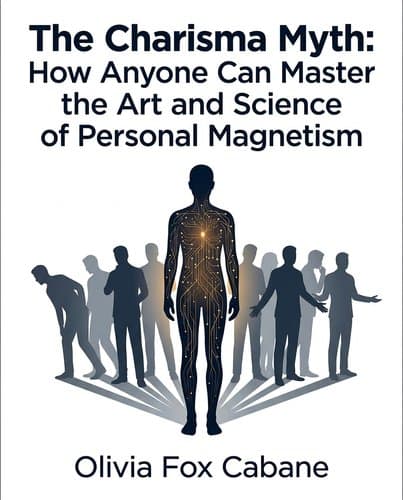
11910905_the-charisma-myth
by Olivia Fox Cabane
Charisma isn't a gift—it's a skill built from three internal states: presence, power, and warmth. Master the science-backed mental techniques that make your…
In Brief
The Charisma Myth: How Anyone Can Master the Art and Science of Personal Magnetism (2012) dismantles the idea that charisma is an innate trait, showing instead that it emerges from three learnable internal states: presence, power, and warmth.
Key Ideas
Authentic mental state enables real charisma
You cannot reliably fake charisma through external performance — your body broadcasts your internal state through thousands of micro-signals read in 17 milliseconds, so the only durable fix is to actually engineer the right mental state, not perform it
Responsibility Transfer lowers cortisol during stakes
Use the Responsibility Transfer before high-stakes moments: close your eyes, visualize lifting your anxiety off your shoulders and handing it to a benevolent entity. The outcome doesn't change, but your cortisol does — and that changes what your face broadcasts
Two-second pause multiplies listening effectiveness
The two-second pause after someone finishes speaking is the single highest-leverage listening technique: let your face absorb their words, react, then respond. It makes people feel heard, intelligent, and valued with almost no effort
Big Gorilla posture shifts hormonal balance
Before any high-stakes interaction, use an expansive 'Big Gorilla' posture for two minutes — feet wide, arms stretched to ceiling and walls. Harvard/Columbia research shows this raises assertiveness hormones by 19% and lowers anxiety hormones by 25%
Context determines which charisma style works
Match the charisma style to the context: Focus (intense presence) for consultants and negotiators, Visionary (bold conviction) for organizational change, Kindness (warmth and acceptance) for emotional connection, Authority (status and power signals) for command situations — and test new styles in low-stakes settings before deploying them when it counts
Opinion requests activate Ben Franklin Effect
When dealing with an adversary, ask for their opinion rather than their advice — it costs them nothing but forces them to rationalize their helpfulness as evidence they like you (the Ben Franklin Effect)
Reciprocal vulnerability prevents emotional hangover
Protect people from the vulnerability hangover: when someone in your presence starts sharing more than they'll be comfortable with tomorrow, interrupt with a 'me too' story to level the field and slow their descent into waters they're not ready for
Who Should Read This
People working on personal growth in Persuasion and Social Psychology, especially those tired of generic motivational advice.
The Charisma Myth: How Anyone Can Master the Art and Science of Personal Magnetism
By Olivia Fox Cabane
10 min read
Why does it matter? Because the charisma you envy in others is something your body is already doing — just pointed in the wrong direction.
You probably think the magnetic people in your life were just built that way — some fortunate factory setting that left the rest of us shuffling through rooms, forgettable. Here's what's actually happening: charisma isn't a trait, it's a transmission. Your body is running thousands of micro-signals every second — muscle tension around the eyes, fractional delays in your reactions, the precise way your voice drops or rises — and other people are reading every one of them, mostly without knowing it. You cannot consciously fake your way through all of that. What you can do is change the source material. Because those signals aren't broadcasting your personality. They're broadcasting your current mental state. Which means the problem isn't who you are. It's what's running in the background when you walk into a room. You can change the source material. This is how.
Marilyn Monroe Could Turn It Off. So Can You.
In the summer of 1955, Marilyn Monroe descended into Grand Central Terminal with a photographer in tow and promptly disappeared. Not into a crowd — into anonymity. She rode the subway through a packed car and nobody looked twice. No gasps, no double-takes, no autograph hunters. Just a woman on a train.
Then she came back up to the sidewalk and asked her photographer a question: "Do you want to see her?" She fluffed her hair. She shifted her posture. That was it. Within moments, she was engulfed — the crowd pressed in so fast it took several frightening minutes to get her out.
Same face. Same clothes. Same woman. Two completely different effects on the people around her, separated by nothing but a deliberate change in how she held herself.
That story dismantles the assumption most of us carry about charisma — that certain people simply have it, wired in at birth, and the rest of us are watching from the outside. If charisma were innate, it couldn't be switched off. Monroe couldn't have gone unrecognized. She would have been magnetic on the subway whether she wanted to be or not.
But she wasn't. Because charisma isn't a trait; it's a behavior. And behaviors can be turned on, turned off, and learned.
You're watching people who learned what you're about to learn.
Your Body Is Broadcasting Your Mind Whether You Like It Or Not
Here's what's actually happening when someone reads you: thousands of micro-signals leak from your face, posture, and voice — blink rate, minute tension around the eyes, the precise timing of a smile — and the people around you are reading all of it. Not consciously. But accurately.
The mechanism is faster than you'd expect. Neuroscience research shows the brain processes facial expressions in roughly seventeen milliseconds — fast enough to catch a microexpression that crosses your face and vanishes before you're even aware it happened. If your performed expression and your actual internal state don't match, observers won't consciously think "that person is faking it" — they'll just feel, somewhere in their gut, that something's off. Trust evaporates. Rapport doesn't form. Charisma is impossible.
Trying to perform charisma from the outside in doesn't work because you cannot consciously manage thousands of signals simultaneously. The only real lever is the internal state those signals are reflecting.
Consider what happened to Tom. He'd spent months preparing for a lunch meeting with a CEO whose company he was trying to win as a client — a $4 million deal, a potential turning point in his career. He had answers ready for every hard question. What he hadn't prepared for was the weather. He wore a heavy black wool suit on a hot day, and as the sun beat down on that terrace, his eyes tightened, his face went rigid, he started tugging at his collar. The CEO, watching him across the table, got a bad feeling. Tom looked tense and uncomfortable. In the absence of any other explanation, the CEO's brain did what all our brains do: it assumed the tension was about the conversation. About him. About something Tom wasn't saying.
Physical discomfort, anxiety, self-doubt — it doesn't matter what's generating the signal. The signal is the signal. Tom's suit nearly cost him the deal not because he was dishonest, but because his body was broadcasting a state his mind didn't intend to reveal.
Get the internal state right, and the body language follows without effort — because it was never in your conscious control to begin with.
The Anxiety You're Hiding Is Already on Your Face — Here's How to Actually Remove It
White-knuckling through anxiety doesn't suppress the signal — it just means you're no longer in control of what gets sent. The body keeps broadcasting anyway.
The only move that works is to change what's happening inside. And the brain hands you a surprisingly useful tool for this: it genuinely cannot distinguish between vividly imagined reality and the real thing.
The night before a high-stakes presentation to three hundred senior executives in Bogotá — a ninety-minute session, in Spanish, for a CEO who expected his entire leadership team to walk out transformed — Cabane was awake at four in the morning, nauseated and pacing her hotel room. She'd already tried everything she knew. So she sat down with a pen and paper and asked herself a question that felt almost absurd: what if this is actually perfect?
She started writing answers. Maybe going through this sleepless, sick, terrified, and still delivering something useful would prove to herself that she could handle anything. Maybe that knowledge would matter more than the presentation itself. She kept going, making the imagined outcome increasingly specific — what the audience looked like when they laughed, the moments when heads nodded. The nausea didn't vanish, but the anxiety loosened enough that she eventually slept. In the morning, she gave what she describes as a triumphant speech. The delusional version she'd written down came true.
What Cabane calls rewriting reality works because the brain processes a vividly constructed story the same way it processes an actual event. The physiological relief is real even when the scenario is invented. And this isn't suppression: you're not pushing the anxiety down, you're replacing the story generating it. That's why the cortisol actually clears, and why the face stops broadcasting distress.
Your Brain Can't Tell Imagination From Reality. That's Not a Bug — It's the Whole Toolkit.
Think of a flight simulator. The plane never leaves the hangar, but the pilot's body doesn't know that — elevated heart rate, tightening grip, real stress hormones flooding the system in response to a screen. That's not a quirk of the nervous system. That's the mechanism. And it's why every technique in this section actually works.
Research by Stephen Kosslyn shows that imagining yourself playing the piano — with enough repetition and vividness — produces actual physical changes to the brain regions that control movement. Not metaphorical changes. Physical ones. The brain processes a vivid mental rehearsal the same way it processes the real event, which means you can install an internal state through imagination just as reliably as through experience. This is why Olympic skiers visualize the entire course before a run — not to psych themselves up, but to run the neural pathways they'll need. The body follows the mind because, neurologically, it can't tell the difference.
That gives you something useful to work with. Start with deliberate visualization: close your eyes and reconstruct a moment of genuine triumph — the sounds, the handshakes, the specific warmth of it — and your subconscious sends the same confidence signals it would in the real moment. From there, you can extend the same logic outward. Wishing someone well — actually pausing to find three things you appreciate about them, or briefly imagining them with some quality that softens your instinctive reaction — floods your system with oxytocin and serotonin. Your body language shifts before you say a word. Then run the whole chain in reverse: posture creates the feeling rather than expressing it. Amy Cuddy and Dana Carney found that holding an expansive, grounded stance for two minutes raises testosterone by 19% and drops cortisol by 25%. Adopt the posture of someone who has nothing to prove, and your brain starts generating the chemistry to match.
None of these are rituals. They're inputs. Feed the brain a vivid enough signal — through imagery, through intention, through the position of your own shoulders — and it produces the corresponding internal state. The body broadcasts that state automatically. The signal reaching the person across from you is real because the brain event that generated it was real.
There Is No Single Charismatic Personality — There Are Four, and You're Not Stuck with One
Charisma is not a single personality type you either have or don't. It's a family of four distinct styles, each built from a different combination of presence, power, and warmth — and the right style depends on who you are and what the moment requires.
The four break down like this. Focus charisma, the style Elon Musk embodies, is almost entirely presence: when he steps out from behind his monitor cocoon at Tesla, you feel the full weight of his attention, as though nothing else exists. Visionary charisma — Steve Jobs territory — runs on conviction. Jobs didn't sell computers; he sold a better world, and people believed because his certainty soothed their discomfort with an uncertain one. Kindness charisma operates through warmth and unconditional acceptance, the quality that makes the Dalai Lama feel like he's genuinely delighted to see you specifically. And authority charisma is the most visceral of all — it hijacks judgment before the conscious mind catches up.
That last one is worth pausing on. A researcher approached shoppers in a mall asking them to complete a survey, wearing either a sweater with a prominent designer logo or an otherwise identical plain one. With the logo: 52 percent agreed. Without it: 13 percent. Nobody in that mall was thinking about the sweater. Their brains read the status signal and adjusted behavior accordingly, in under a second, before deliberation had a chance to enter the picture. That's how deep authority charisma runs — it operates below awareness, which makes it both the most powerful style and the most dangerous. It can suppress the critical thinking of everyone around you, meaning you'll win arguments you should lose.
The useful move is treating these as a repertoire rather than a fixed identity. You don't need to become someone else. You need to know which part of yourself the situation is asking for, and practice accessing it deliberately enough that the switch feels natural when the stakes are real.
The Two-Second Pause That Makes People Feel Brilliant
A Victorian journalist once tested a theory by dining separately with the two most powerful politicians in Britain — William Gladstone and Benjamin Disraeli. After her evening with Gladstone, she came away convinced he was the most brilliant person she'd ever encountered. After her evening with Disraeli, she came away convinced that she was. Disraeli won the next election.
That gap — between feeling impressed and making others feel impressive — is the whole game. Most people walk into conversations trying to say the right thing, land the perfect insight, be remembered as sharp. What actually creates charisma is the opposite move: subordinate yourself entirely to the other person's experience of being heard.
The mechanics are specific. When someone finishes speaking, don't answer immediately. Let your face absorb what they said — actually process it, let the reaction show — and then, only after a visible beat, respond. Two seconds. The sequence is: they finish, your face absorbs, your face reacts, then you speak. JFK was described by nearly everyone who met him as making them feel like the only person in the room. This was the technique. It communicates that what someone just said was worth sitting with.
Both traps that undermine this are easy to fall into without noticing. The first is treating listening as waiting — mentally composing your next point while the other person is still talking. The absence of genuine attention shows up on your face before you're aware of it; the other person feels the gap without knowing why. The second is interrupting, even warmly. No matter how enthusiastic the interjection, it leaves a residue of frustration that the speaker can't quite name.
The strangest part: you don't need to be particularly interesting, articulate, or impressive to pull this off. You need to make them feel that way. Stop trying to impress people and let them impress you — and they will like you for it in a way that no clever remark could produce. Presence, not performance, is what charisma is actually built from.
Darius Got Everything He Wanted Without Giving Up Anything. Here's the Uncomfortable Reason Why.
Darius walked into that Nairobi boardroom knowing he had one shot at a partnership that could legitimize his entire organization. The director, Nathan, arrived stiff and deliberate — leaning back, legs crossed, speaking slowly. So Darius stopped trying to win him over and started mirroring him: pulled his own chair back, leaned away, recrossed his legs, matched Nathan's measured pace. When Nathan turned sideways and dropped an arm on the table, Darius waited, then did the same. The atmosphere, Darius noticed, grew oddly comfortable. When Nathan finally announced a position that was nothing like what Darius had hoped for, Darius didn't argue. He waited, then sat forward, faced the table, and tapped it firmly with each point — exactly as Nathan had. Nathan looked around the room and agreed to everything. Including things Darius had privately written off as impossible.
The unsettling part isn't that it worked. It's the reason it worked. Nathan wasn't persuaded by better arguments. He wasn't given new information. His position reversed because his body changed first, and his mind followed. As long as someone's body is locked in a defensive posture, their mind is nearly inaccessible — and the reverse is equally true.
What this means is that the outcomes of negotiations, difficult conversations, and first impressions are often decided before the substantive part of the exchange begins. That Harvard Business Review finding — that employees receive a harsh performance review better when it's delivered with warm body language than they receive a glowing review delivered coldly — isn't an anomaly. Sit with that for a second. The actual content of the review barely moves people. What moves them is the signal your body is broadcasting while you deliver it. In high-stakes moments, when stress activates the brain's more primitive circuitry, that signal is almost all that lands.
The question this raises isn't really about technique. It's about whether you're comfortable using tools that operate below the other person's awareness. Darius was copying Nathan's every move, and Nathan had no idea. The honest answer is that these mechanics are already running constantly — you're already affecting people with your posture, your eye tension, the stillness or restlessness of your hands. What you do with that is a harder question, and not one that resolves tidily.
Charisma Has a Shadow Side Nobody Talks About
What if the thing you're building could become its own liability? Charisma is almost universally framed as an asset to acquire — more influence, more trust, more rooms that open. But the executives who seek out coaching once they're already magnetic aren't coming to get more of it. They're coming because it's creating problems they didn't anticipate.
The most psychologically strange of these is what happens when warmth or focus charisma gets turned up all the way. Cabane spent years puzzled by a pattern: clients would have a breakthrough session — genuine, deep, revelatory — and then vanish. No follow-up, no reply to emails, nothing. A veteran coach eventually explained it to her. The strength of her presence had created something like a force field, an altered state where people felt so safe and so seen that they disclosed far more than they'd intended. A few hours later, or the next morning, the spell broke. Their ego surveyed the damage — all the fears and insecurities laid out for a relative stranger — and recoiled. The shame drove them away. Her charisma, at full strength, had made the room feel safe enough to say things that didn't feel safe to have said. The higher the warmth, the harder the morning after.
Then there's the envy problem, which runs in the opposite direction. Charismatic people absorb credit the way a room fills with the smell of whatever's cooking — automatically, without intent. When a team succeeds, the magnetic leader is the face the organization puts on it. Colleagues who contributed equally start doing the math, and the math breeds resentment. The countermeasure is specific: give people genuine ownership of your success by finding real ways their influence shaped you, then telling them so in detail. Not flattery — actual credit, traceable to actual moments. People who feel responsible for your rise become invested in your continued ascent rather than threatened by it.
And underneath all of this sits Peter Drucker's cold observation: the most charismatic leaders of the twentieth century were Hitler, Stalin, Mao, and Mussolini. Charisma doesn't select for good destinations. It's an accelerant — it gets you there faster, wherever there is. The tools you've been building across these pages are real, and they work on real people. What you do with that belongs entirely to you.
The Question the Science Leaves Open
Here's the question the book can't answer for you: if visualization rewires your cortisol, and posture reshapes your hormones, and the warmth you radiate afterward is neurologically indistinguishable from the real thing — what exactly is fake about it? Cabane's implicit answer is that nothing is. The state is real. The signal is genuine. The person across from you isn't receiving a performance; they're receiving a you who prepared.
But Peter Drucker's list doesn't go away. History's most magnetically destructive figures presumably felt genuine conviction too.
So the science is settled, and the ethics aren't — and that's exactly where they should be. Tom's arc is real and repeatable. The two-second pause, the posture, the responsibility transfer: they work. What they work toward is the only question that was ever yours to answer.
Notable Quotes
“Do you want to see her?”
“fluffed up her hair, and struck a pose.”
“it took several shoving, scary minutes”
Frequently Asked Questions
- What is The Charisma Myth about?
- The Charisma Myth dismantles the idea that charisma is an innate trait, demonstrating instead that it emerges from three learnable internal states: presence, power, and warmth. Olivia Fox Cabane argues that genuine charisma cannot be reliably faked through external performance, since your body broadcasts your internal state through thousands of micro-signals read in 17 milliseconds. Rather than relying on performance techniques, the book provides concrete methods—from posture and visualization to listening habits—that help readers deliberately engineer the right mental states. The core insight is that durably mastering charisma requires changing your internal psychology, not just your external behavior.
- What listening technique does The Charisma Myth recommend?
- The two-second pause after someone finishes speaking is identified as the single highest-leverage listening technique for projecting charisma. When someone finishes speaking, pause, let your face absorb their words, react visibly, then respond. This simple technique makes people feel heard, intelligent, and valued with almost no effort. It signals genuine attention and presence, which are core components of charisma. The pause demonstrates that you're not waiting for your turn to speak—you're actually processing what they said. This technique works because it provides the internal state of presence that makes charisma authentic and powerful.
- What are the different charisma styles in The Charisma Myth?
- The Charisma Myth identifies four distinct charisma styles matched to different contexts. Focus delivers intense presence for consultants and negotiators who need undivided attention. Visionary projects bold conviction for leaders driving organizational change. Kindness emphasizes warmth and acceptance for emotional connection and relationship building. Authority conveys status and power signals for command situations requiring decisiveness. Rather than trying to be charismatic in a general sense, the book recommends matching your style to the situation. Cabane also advises testing new styles in low-stakes settings before deploying them in high-stakes moments where success matters most.
- What is the Responsibility Transfer technique in The Charisma Myth?
- The Responsibility Transfer is a pre-interaction visualization technique for managing anxiety before high-stakes moments. Close your eyes and visualize lifting your anxiety off your shoulders and handing it to a benevolent entity. The technique acknowledges that the actual outcome doesn't change, but your cortisol levels do—and that neurochemical shift determines what your face and body broadcast to others. Since charisma is ultimately a function of your internal state rather than external performance, reducing anxiety biochemically creates authentic presence. This technique transforms a mental state by using visualization and metaphorical release.
Related Book Summaries

Read the full summary of 11910905_the-charisma-myth on InShort