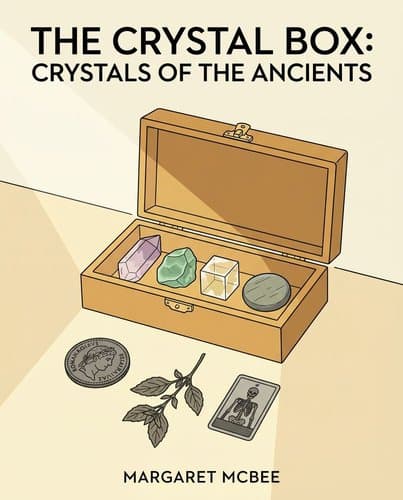
50831829_the-crystal-box
by Margaret McBee
Crystal magic isn't superstition—it's applied attention: knowing a stone's geology, etymology, and crystalline structure is what transforms it from decoration…
In Brief
The Crystal Box: Book 1 of Crystals of the Ancients (2019) teaches crystal magic through geology, etymology, and cultural history, arguing that informed understanding is what transforms a stone into an effective tool.
Key Ideas
Word origin reveals correspondence magic
Before choosing a stone for a spell, research its etymology and cultural history — the word origin often contains the correspondence logic already (salarium → 'salary' → salt → prosperity spells). McBee treats historical use as the spell's justification, not decoration.
Structure matters more than color
Match a stone's crystalline structure to your magical intent: cubic structure (garnet, pyrite, gold) for grounding and practical work; trigonal (all quartz varieties) for stimulating and initiating; triclinic (kyanite, labradorite, turquoise) for balance. Color is secondary to structure.
Match stones to Fool's Journey
When working with tarot and crystals together, identify the card's position in the Fool's Journey arc before choosing a stone — the psychological stage matters more than the card's surface keywords. The Death card calls for transformation stones, not protection stones.
Moon phases direct spell timing
Trust the moon phase logic: waning or dark moon for banishing and releasing (counterclockwise energy, dispersal); waxing or full moon for drawing in (clockwise, accumulation). Most spells specify one or the other, and the timing is part of the mechanism.
Visualization and intent drive spells
Use rhymed chants as scaffolding for visualization, not as the operative magic. McBee is explicit: intent and mental focus are the active ingredient. The chant gives your mind a rhythm to concentrate around; silently maintaining the same visualization works equally well.
Regular rotation maintains stone power
Rotate which stones you use actively. When a collection grows past 100 specimens, favorites dominate and others go neglected — and neglected stones, by the book's own logic, hold no power. Open the boxes, handle the overlooked ones, re-establish connection on a regular cycle.
Who Should Read This
Readers interested in Spirituality and Cultural Studies, looking for practical insights they can apply to their own lives.
The Crystal Box: Book 1 of Crystals of the Ancients
By Margaret McBee
8 min read
Why does it matter? Because crystal magic turns out to have a logic — and this book teaches you to read it.
Most people approach crystal selection the way they approach a farmers market — wander, handle things, buy what feels right. Margaret McBee thinks this misses most of the point. In The Crystal Box, choosing a stone is a research act. The salary spell uses green salt because the Romans literally paid soldiers in salt — salarium is where English gets "salary," which makes salt self-evidently a currency stone. The Death card pairs with specific stones because those stones fit what the card actually describes: ego release, not physical death. A stone's crystalline structure (cubic, trigonal, hexagonal) determines what kind of magical work it's suited for. By the time McBee writes a chant, you already understand the argument behind it. Her quiet thesis turns out to be about attention more than materials, but getting to that thesis requires understanding why the material choices aren't arbitrary.
Salt Is a Crystal — and the History That Made It Currency Is Exactly Why the Spell Works
The history behind a spell ingredient isn't decoration around the magic — it is the magic. McBee builds this argument from the first chapter using salt, and the move governs everything that follows.
Salt is a crystal. Specifically, it's halite, a member of the halide mineral group and the only mineral humans consume in pure form. That reframe changes what salt is doing in a spell jar. You're not pouring in a cooking ingredient for symbolic effect; you're working with a crystal that carries millennia of human meaning, baked in through actual use.
The etymology chain McBee traces for the Salary Spell is the clearest demonstration. Roman soldiers weren't paid in coins; they were paid in salt rations, a practice the Romans called salarium. That word became "salary." Then Latin sal traveled into French as solde, meaning "pay," and solde produced "soldier." The word for the person who fights is, at root, the word for salt. Meanwhile, Latin salax ("in a salted state") described a man in love, because ancient Egyptians believed salt aroused desire; their priests abstained from it to protect their celibacy. Salax became "salacious."
That chain sits behind the Salary Spell: green Bamboo Jade Salt, a coin, and dried basil in a drawstring bag. The green is beside the point. The salt is there because the material itself has functioned as money. Two thousand years of that function don't disappear when you move the salt from a soldier's rations into a spell bag; McBee's argument is that they concentrate there. You're not making a green symbol of abundance. You're handling the thing that once was abundance.
Knowing why an ingredient appears tells you what you can substitute and what you can't. McBee is generous about substitution — she says repeatedly that table salt works fine when you need volume. But a Salary Spell built around the salt-as-currency history has a logic. You can swap the bamboo jade for any green salt; you probably don't want to swap the salt for sugar.
Two Crystals Can Share a Color and Mean Opposite Things — the Difference Is in the Atoms
Graphite and diamond are both pure carbon. Hold them next to each other and the color comparison tells you nothing — they share an element, not a structure. What separates them is how their atoms are arranged, and that arrangement determines everything: one writes on paper; the other cuts glass.
McBee applies the same principle to crystals in an appendix that functions less like reference material and more like a grammar key. Every stone in the book belongs to one of seven crystalline systems, patterns describing how atoms organize at the microscopic level, and each system carries a behavioral tendency that holds regardless of color.
The clearest case involves two purple stones sitting side by side in any collection: amethyst and purple fluorite. A casual buyer could easily treat them as interchangeable, both loosely filed under spiritual and calming third-eye work. Their internal geometries are opposite. Amethyst belongs to the trigonal system: triangular atomic patterning that carries fire-element energy, initiating and stimulating. Purple fluorite has a cubic structure: six perfectly equal faces, an arrangement McBee associates with grounding, stability, and firm practical foundation — earth, not fire.
McBee recommends fluorite specifically for experienced psychic practitioners, noting that it tends to move faster than amethyst. The beginner gets the fire-element stone; the veteran gets the earth-element stone, and it accelerates the work. The cubic structure's stabilizing quality doesn't slow psychic development; it provides a platform steady enough to withstand greater intensity. Amethyst's trigonal fire offers a gentle ignition for someone just beginning to work with the third eye. Fluorite's cubic earth holds a practitioner anchored while the work goes deeper and faster. The earth isn't opposed to the third eye. It's what prevents the third eye from opening so quickly that the experience becomes disorienting.
That specificity is what distinguishes McBee's appendix from a standard crystal reference. The cubic designation attached to fluorite isn't a cataloging label; it's a prediction about how the stone will interact with you. Knowing this, you can look at any unfamiliar stone in the table and ask not just which chakra it serves, but what the internal geometry will do to the experience of serving that chakra. Two purple stones. Different atoms. Different outcomes, and none of it is arbitrary. The same logic governs her tarot correspondences in the chapter that follows.
The Death Card Doesn't Mean Death — and the Crystal List Is How You Know What It Actually Means
You lay out your first solo reading and turn over the Death card in position three. You know the standard reassurance: it doesn't mean literal death. But knowing what it isn't doesn't tell you what it is. You reach for McBee's crystal correspondence list expecting black stones. Dark card, dark crystals: the keyword logic. What you find instead is Labradorite, Lepidolite, Malachite, and Petrified Wood. Apache Tear Obsidian is there, but listed among transformation stones, not isolated as a color match.
The list is a map. McBee's key to reading it is the French phrase la petite mort — orgasm as "the little death," a moment when ordinary consciousness briefly dissolves and the ego loses its grip. She invokes it as the structural parallel for card 13. The Death card sits in a three-part transition within the Fool's Journey — the narrative arc the Major Arcana traces from innocence through trials to wisdom: Justice (11) demands honest self-assessment, the Hanged Man (12) asks you to trust the process of change, and Death closes it by requiring you to release whatever version of yourself you've outgrown. Not annihilation. Ego dissolution. The crystal list follows directly: Lepidolite for emotional unbinding, Labradorite for navigating the threshold, Petrified Wood for the long view of cycles, Malachite for transformation that demands you move through something rather than around it.
The sequence logic sharpens one card later. Card 15, the Devil, sits immediately after Temperance (14), and McBee argues the placement is deliberate: you can face your own devils safely only after internalizing Temperance's lessons about moderation and middle-path navigation. Without that foundation, confrontation with deep fears risks entrapment rather than liberation. The Devil's crystal list carries that charge: Jet, black Tourmaline, Obsidian, Quartz with Black Tourmaline. These aren't chosen because the card is ominous. They're chosen for practitioners ready to hold something difficult without being consumed by it.
What the tables reveal, once you read them developmentally, is that they're position markers on an arc, not a catalog of associations. The crystal list for Death tells you the card is about transformation, not loss. The list for the Devil tells you the card is about confrontation, not evil. The sequence tells you that one position prepares you for the next. Pull the stones and you've decoded the card's actual work.
She Knows the Label Is Wrong. She Uses the Stone Anyway.
How much does a name matter? If the label on a stone is scientifically wrong — not approximate, not simplified, actually incorrect — do you set it down and walk away, or use it anyway?
McBee's answer is neither. She corrects the record, then uses the stone, and the correction is what makes the spell work.
Turritella Agate is the clearest example. The stone occurs in swirling brown patterns that, under magnification, reveal themselves as fossilized snail shells, millions of them compressed into chalcedony over fifty million years. The name Turritella comes from the genus scientists thought they'd identified when they first studied the fossils. They were wrong. The snails are actually Elimia tenera, a different genus entirely. The error was discovered, acknowledged, and quietly ignored, because "Turritella Agate" had already entered circulation.
McBee notes the mistake, then turns to what the correction reveals: these are fifty-million-year-old rocks composed almost entirely of the shells of living creatures. That's not a footnote. That's the spell.
Her ritual for this stone releases worry. Before any chanting or visualization, she asks you to sit with what you're actually holding: a stone that formed while the Rocky Mountains were still reshaping their drainage patterns, while the lakes that once filled the American West were young. Then she asks: is your problem as large as you thought? The geological scale isn't decoration around the magic. It is the mechanism. You can't get to that mechanism through the original wrong name. The correction earns it.
Aqua Aura Quartz runs the same logic from a different angle. McBee avoided this stone for years because the intense blue looked artificial. She was right that it's processed: the color comes from gold vapor bonded to clear quartz under extreme heat in a laboratory. But the gold doesn't coat the surface and wash off. It bonds at the molecular level, becoming part of the crystal's structure. That distinction changes everything: the stone inherits both quartz properties and gold's ancient associations with purity, nobility, and material success. Not as metaphors. As materials.
In both cases, she finds the accurate account of what a stone actually is, then builds the spell on that account. The label's error doesn't stop the work — getting the label right is how the work gets better. She corrects names and keeps using them because geological accuracy and practical usefulness are different questions, and she argues both matter.
The Only Thing Standing Between You and Effective Crystal Magic Is Whether You Pay Attention
McBee's entire reference system (the correspondence tables, the crystal systems, the planetary associations) is scaffolding for a single claim she saves for the conclusion: crystals hold only the power you give them.
The proof arrives quietly in the appendix, in one editorial decision: she refuses to list "receptive or projective energy" for each stone in her correspondence table. Every comparable reference assigns each crystal a fixed directional quality. McBee declines. Which quality a stone expresses, she argues, depends entirely on what the practitioner is doing. The mineral's charge is irrelevant next to the intent brought to it.
That's a substantial claim to embed in what looks like a catalog. The appendix runs dozens of stones, each paired with planetary rulers, elemental associations, astrological signs, chakra positions — a taxonomy precise enough to suggest that correct matching is the whole game. Choose the right stone for the right purpose and the correspondences do the work. But the omission of that one field quietly dismantles that reading. If the stone's direction of force is set by the practitioner, then the practitioner is the mechanism. The stone is a vessel for whatever quality of attention she brings.
Neglect, then, is the only thing McBee names as genuinely defeating the practice. Not skepticism, not wrong correspondences. She confesses it from personal experience: once a collection exceeds 100 specimens, favorites get handled while others sit in decorative boxes stacked on shelves, untouched for months. Her remedy is to treat crystal practice the way a cook treats a spice rack — rotate, revisit, open the boxes you haven't opened. Not because the crystals diminish from inattention, but because a crystal that receives none has nothing to amplify. The stone holds the power you give it. Giving it nothing is the only way to fail.
The Stone Is the Occasion. You Are the Instrument.
After all the etymology chains and crystalline taxonomies, McBee's final move is disarmingly quiet: a crystal holds only the power you give it. That sentence arrives after five chapters of evidence that the system matters — the Roman salary buried in that salt jar, the cubic geometry that grounds where trigonal ignites, the Death card's transformation logic embedded in its mineral list. And the system does matter. But it turns out to be a vehicle for something simpler: sustained attention. Most of us rarely bring that to anything, let alone to a box of rocks on a shelf. McBee's closing instruction: open the box you haven't opened in months, pick up what you've been ignoring, and look at it. That's the practice. Everything else was getting you ready to do that.
Notable Quotes
“In addition, the Latin word sal became the French world solde (meaning”
“This is where our word”
“healer, according to Melody, it can”
Frequently Asked Questions
- What is 'The Crystal Box' by Margaret McBee about?
- 'The Crystal Box: Book 1 of Crystals of the Ancients' (2019) teaches crystal magic through geology, etymology, and cultural history. The book argues that informed understanding is what transforms a stone into an effective tool. McBee provides practitioners with a systematic framework covering crystalline structure as a guide to magical intent, moon phase timing, and tarot integration. Rather than relying on guesswork, the book offers deliberate, intentional work grounded in scientific and historical knowledge. This approach connects the physical properties of crystals to their magical applications.
- How does crystalline structure relate to magical intent according to 'The Crystal Box'?
- Match a stone's crystalline structure to your magical intent: cubic structure (garnet, pyrite, gold) for grounding and practical work; trigonal (all quartz varieties) for stimulating and initiating; triclinic (kyanite, labradorite, turquoise) for balance. Color is secondary to structure. This geometric correspondence forms the core of choosing appropriate stones for spellwork. By understanding the internal ordering of atoms in a crystal, practitioners can select stones that naturally align with their magical goals, making the match between intention and tool intuitive rather than arbitrary.
- What does Margaret McBee say about the role of chants in crystal magic?
- McBee is explicit: intent and mental focus are the active ingredient. Use rhymed chants as scaffolding for visualization, not as the operative magic. The chant gives your mind a rhythm to concentrate around; silently maintaining the same visualization works equally well. This reframes ritual language as a tool for the practitioner's focus rather than the source of power. Effectiveness depends on clarity and strength of mental intent directed toward the goal, regardless of whether that focus is supported by spoken words or internal silence.
- Why does 'The Crystal Box' emphasize etymology and cultural history when choosing crystals?
- Research a stone's etymology and cultural history before choosing it for a spell — the word origin often contains the correspondence logic already. McBee gives the example of salarium → 'salary' → salt → prosperity spells. Historical use justifies the spell, not merely decorates it. By tracing how a stone was understood and used across cultures and time, practitioners understand why that stone was chosen, which deepens their connection to the work. This historical grounding makes magical correspondence feel inevitable rather than random.
Related Book Summaries

Read the full summary of 50831829_the-crystal-box on InShort