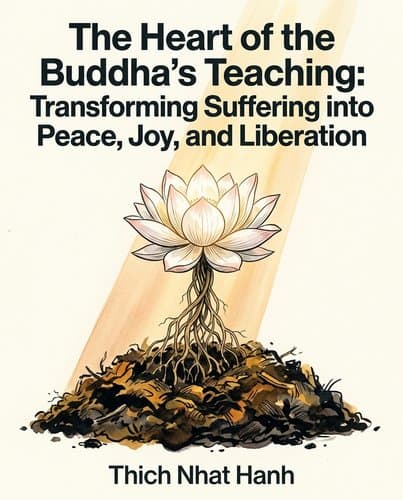
209574_the-heart-of-the-buddha-s-teaching
by Thich Nhat Hanh
Suffering isn't the enemy of happiness—it's the raw material. Thich Nhat Hanh translates 2,500 years of Buddhist wisdom into precise, actionable practices for…
In Brief
The Heart of the Buddha's Teaching: Transforming Suffering into Peace, Joy, and Liberation (1998) presents the core teachings of Buddhism — the Four Noble Truths, the Eightfold Path, and the nature of suffering — as practical tools for daily life.
Key Ideas
Process Strong Emotions in Five Steps
When a strong emotion arises, try the five-stage sequence: name it (Recognition), accept it's there (Acceptance), hold it like a mother holds a crying baby (Embracing), ask what caused it (Looking Deeply), and wait for understanding to arrive (Insight) — don't try to suppress it or solve it before completing the first three stages.
See Empty Boat, Release Blame
Before reacting to someone who has hurt you, ask 'Am I sure?' — not as a rhetorical pause but as a genuine investigation. Most of the suffering in the empty-boat story dissolves the moment you see no one is steering.
Mindfully Choose What You Consume
Extend 'consumption' to everything that enters through your senses: the news you read, the conversations you have, the shows you watch. Ask whether each is watering seeds of understanding or seeds of anxiety, and treat the answer as information rather than guilt.
Appreciate Loved One's Precious Presence
The next time you are with someone you love, try saying — silently or aloud — 'I know you are here, and your presence is precious to me.' This is not sentiment; it is the Third Miracle of Mindfulness, and it reverses the slow forgetting that erodes relationships.
Name Habit Energy, Lose Its Grip
When you feel the pull of habit energy — the horse galloping without a destination — greet it: 'Hello, habit energy, I know you are there.' Naming it without fighting it strips it of momentum. You don't need to defeat the horse; you just need to stop being surprised that it's in charge.
Desperate Loss Reveals Deep Gratitude
Practice the non-toothache: identify one thing that would make you desperate if you lost it — your eyesight, the use of your legs, a specific relationship — and spend two minutes genuinely appreciating its presence. This is not gratitude as performance; it is the First Turning of the Third Noble Truth.
Joy Indicates Correct Spiritual Practice
If your practice is producing mainly guilt, effort, and self-criticism, it is probably wrong diligence. The Buddha told the musician-monk Sona: strings too tight will break. Joy and ease are not side effects of correct practice — they are diagnostics of it.
Who Should Read This
Thoughtful readers interested in Buddhism and Mindfulness willing to slow down and wrestle with ideas.
The Heart of the Buddha's Teaching: Transforming Suffering into Peace, Joy, and Liberation
By Thich Nhat Hanh
10 min read
Why does it matter? Because the suffering you've been trying to escape is the only door to what you actually want.
Most people come to Buddhism looking for a way out — out of anxiety, out of grief, out of the low-grade ache of a life that won't quite settle. The promise seems to be serenity: a cushion, a breath, some tasteful distance from the noise. Thich Nhat Hanh's teaching is almost exactly the reverse. The noise is where you start. The ache is not the thing blocking your path — it is the path. The Buddha spent forty-five years teaching one thing: how to face suffering so directly, so carefully, that it stops being a wall and becomes a door. This book is the most careful map of that process assembled for a reader who has never sat in a monastery — not as theology, but as a working method for transforming the specific, textured pain of your actual life into something that might, improbably, become the source of your deepest joy.
The First Noble Truth Is Not a Verdict — It's an Invitation
Most people walk into Buddhism expecting a philosophy of gloom — a tradition that looks at life and concludes it's mostly miserable. That reading gets the First Noble Truth exactly backwards.
When the Buddha arrived at Deer Park in Sarnath to give his very first teaching, he did not announce a verdict. He offered a diagnosis — and a diagnosis, unlike a verdict, implies a cure. His entire forty-five years of teaching, he said, came down to one thing: suffering, and its transformation. Not suffering as an endpoint. Suffering as a starting point.
The distinction matters enormously, and the gardener's compost pile makes it vivid. A gardener who finds organic waste in her garden doesn't haul it to the curb. She knows that rotting material is exactly what will feed next season's flowers. The relationship between waste and bloom isn't a contradiction — it's a cycle. Thich Nhat Hanh uses this image to describe what the First Noble Truth actually asks of us: not to wallow in what's rotting, but not to throw it out either. Your grief, your loneliness, your barely-named anxiety — this is the compost. Turn away from it, and you also turn away from the flowers it could become.
Most people read this exactly backwards. They assume that acknowledging suffering is a kind of surrender, a decision to camp out in the worst of things. But the Buddha's instruction was almost the opposite: look at it. Name it. The recognition itself — clear-eyed, unclenched — is already the beginning of movement.
Suffering earns the word 'noble' not because pain is glorious, but because looking at it honestly is an act of courage that opens something. Ignore it, and you're simply drowning. Sit with it, see where it came from, and you've put your foot on the path. The First Noble Truth isn't the whole journey. It's the door.
Suffering, Its Cause, Its End, and the Path Are Actually One Thing
Picture a seed. Inside it, invisibly, is the full tree — roots, trunk, every leaf it will ever grow. Nothing is missing; it's just not unfolded yet. The Four Noble Truths work exactly this way. Most people hear them as a sequence of problems: first there's suffering, then we locate its cause, then somehow we extinguish it, then we walk the path. Four steps, four items to check off. But Thich Nhat Hanh insists the sequence is a loop, and each station contains all the others.
Here is the clearest way in: consider a toothache. When the throbbing starts, you know with absolute precision what happiness is — it is the absence of this. The definition couldn't be more vivid. Then the dentist fixes it, and within a week you've stopped noticing your perfectly comfortable jaw entirely. The non-toothache vanishes from your awareness even though it's still there, still precious, still the thing you desperately wanted. Well-being doesn't arrive at the end of suffering. It was present the moment the pain stopped, and actually present before that too, in every part of your mouth that didn't ache. The Third Noble Truth — the cessation of suffering — isn't a reward waiting downstream. It's in the room right now, chronically overlooked.
This is why Nhat Hanh can reorder the Four Truths without changing them: well-being first, the path to well-being second, suffering third, the causes of suffering fourth. The moment you do this, the architecture shifts. The truths aren't a staircase you climb; they're four windows in the same house. Look through any one of them and you see the same courtyard. Nhat Hanh makes this explicit: understand any single truth deeply enough and you understand all four, because each one implies and requires the others.
There's something quietly liberating here. You don't have to finish dealing with suffering before you're allowed to touch well-being. You don't have to wait until the compost fully breaks down before the garden is alive. The path and the destination are the same ground, walked differently. The seed doesn't become the tree by ceasing to be a seed — the tree is just what the seed looks like when it's had water and light. Your suffering contains, folded inside it, everything needed for its own transformation.
You Can't See Clearly Until You Stop Running
A man is galloping on a horse, moving fast enough that someone watching from the roadside calls out: where are you going? The rider shouts back, honestly: I don't know — ask the horse. This is Thich Nhat Hanh's opening image for shamatha, the practice of stopping, and it lands because most of us recognize the ride. The horse is habit energy: the accumulated momentum of every anxious thought you've rehearsed, every emotional reaction you've repeated until it runs on its own. You didn't choose to gallop. The horse just started, years ago, and you've been holding on since.
The reason stopping has to come before insight is right there in the metaphor: you cannot see where you are while you are flying past it. Meditation isn't a technique for achieving calm after you've arrived somewhere quiet. It is the act of taking the reins back — and the first step is simply noticing that the horse is in charge at all.
That noticing has a specific texture. Nhat Hanh describes it as meeting your habit energy the way you'd greet a familiar neighbor: Hello, I know you're here. Not fighting it, not analyzing it, just naming it. This strips habit energy of the automatic quality that makes it powerful — the spell breaks the moment you see it.
For stronger storms, like anger or grief, he offers a sequence: recognize what's present, accept that it's real, then hold it the way a mother holds a crying baby. That last step is the one most people skip. The instinct is to extinguish the emotion or explain it away. But mindfulness that embraces rather than manages is what actually calms the room.
And then — this is the part that surprises most people — you rest. Not sleep, not distraction. Rest like a pebble dropped into a river, sinking without effort to the riverbed and staying there while the current moves past. Nhat Hanh's point is that healing happens on its own when you stop interfering with it. The body knows how. The practice is permission, not achievement — which turns out to be its own kind of discipline to learn.
What You Consume Is Quietly Eating You
The question this section opens on follows naturally from stopping: once you pause, you have to ask what you've been taking in.
A young couple, starving in the middle of a desert, make the most desperate calculation imaginable: they kill their small child and eat his flesh, rationing it carefully so they might survive to the other side. The Buddha told this story, then asked his listeners whether the couple enjoyed their meal. Obviously not, they said. He replied: and yet many people eat the flesh of their parents and their children and their grandchildren without knowing it.
That reply is the whole argument. What you consume is not limited to what passes your lips. The Buddha identifies four kinds of food: what you eat and drink, sense impressions, volition — the desire that propels you forward each day — and consciousness itself, the medium in which all experience swims. The couple's suffering didn't begin when they raised their hands against their child. It began with whatever choices, structures, and blindnesses brought them to that desert with nothing left. We are always already eating something. The question is whether we know what it is.
Sense impressions are where this gets uncomfortable. Every billboard your eyes cross, every anxious news cycle you scroll through, every conversation soaked in contempt or despair — these enter you the way food does. They become the quality of your attention, the texture of your dreams, the speed at which you reach for anger. Nhat Hanh's image for the unguarded mind is a cow whose skin disease has left her raw to the air itself — wherever she goes, insects swarm and feed, through water, against ancient bark, even in the open field. What the gardener does differently is notice, before reaching for anything, which seeds that thing will water. That noticing is what Nhat Hanh means by intelligent gardening.
Every experience leaves a seed — anger, compassion, fear, joy, the capacity for addiction, the capacity for generosity. A violent film doesn't plant something new so much as it irrigates what was already waiting. Mindful consumption, then, isn't willpower. It's knowing which seeds you're feeding before you reach for the next thing.
Your Perceptions Are Almost Always Wrong, and That's Where the Suffering Lives
A man is rowing his boat upstream when another vessel drifts into him and nearly capsizes his craft. He erupts — shouting, furious, ready to fight whoever's responsible. Then he looks. The other boat is empty. No one steered it into him; it simply came loose and floated downriver on its own. He laughs out loud.
Thich Nhat Hanh uses this scene to make the most uncomfortable argument in the whole teaching: the boat that rams you is almost always empty. Your coworker who belittled you, your partner who went quiet, the slight you've been turning over for three weeks — the story you're telling about what they intended is almost certainly wrong. And the suffering isn't coming from what happened. It's coming from the story.
The Chinese character for perception is built from two parts: 'mark' on top, 'mind' on bottom. A perception isn't a clean recording of reality. It's reality filtered through every previous wound, habit, and assumption your mind has accumulated — the mark you bring to the thing. Think of the mark as a template already cut before you arrive: a childhood friend who lied, a parent who left, a meeting that ended badly. When something new touches it, the template fires first. Ten people watch the same cloud and see ten different shapes, because the cloud is half theirs. When the angry rower saw the other boat, he perceived an attacker, because his mind had that mark ready. The moment he saw no one was steering, the mark dissolved — and so did the rage.
This is where nearly all unnecessary suffering lives. Not in what happened but in the mark we laid over it before we finished looking. Nhat Hanh's practice is a single question, asked with real sincerity rather than rhetorical defiance: Am I sure? Not as a way of dismissing what you feel, but as a way of loosening the mark long enough to see whether anyone is actually in the boat. Most of the time, when you look closely, the boat is empty. And when you see that — really see it — the anger doesn't have to be argued out of you. It simply goes.
That shift, from story to clear seeing, is exactly what the next teaching builds on: what happens when perception itself becomes a kind of craving.
The Wave Doesn't Need to Die to Become Water
Picture a wave approaching shore. It has been a wave its whole life — it has a height, a speed, a particular shape. It can see the beach getting closer, and it is afraid, because it knows what happens when waves hit the shore. They disappear. Then something shifts in the wave's understanding: it realizes it has always been water. Water doesn't end when the wave does. The fear was never about what was actually happening. It was a case of mistaken identity.
This image carries the whole of what Buddhism calls nonself and nirvana — two concepts that sound, from the outside, like they require years in a monastery to approach. They don't. They require seeing clearly what you already are.
Most people hear nonself and imagine erasure — the self dissolving into nothing, all personality and particularity gone. But the wave doesn't lose anything when it recognizes it is water. It loses only the fear that was built on the misunderstanding. What looked like a death — the wave ending at the shore — turns out to be nothing of the sort. Water doesn't die when a wave breaks. It just stops being that wave.
The cookies help here. At Tassajara Zen Mountain Center in California, Thich Nhat Hanh first tasted peanut butter cookies and loved them. He imagined what happens in the bowl of batter before baking: the batter is one thing, continuous, undivided. Then it gets spooned onto the tray, and the moment each cookie lands in its separate spot, something happens — the conviction that their separateness is the deepest fact about them — and they suffer for it. They have forgotten the batter.
Liberation is not some elevated achievement reserved for people who sit still for decades. It is remembering the batter. It is the wave touching its own water-nature. And the radical claim tucked inside this teaching is that there is nowhere to go to find it. Thich Nhat Hanh is direct about this: if you heard the Buddha was holding a public walking meditation on Vulture Peak and flew halfway across the world to attend, you still might not walk with the Buddha. But if you simply walk from your kitchen to your front door, fully present, knowing where your feet land — the Buddha is right there with you. The wave is already water. It always was.
Presence Is the Greatest Gift You Can Give — and Almost No One Gives It
When did you last look at someone you love — really look, the way you would at something you'd never seen before — and ask who they actually are?
Most of us assume love is a feeling we carry around, something we already have and occasionally dispense. Thich Nhat Hanh says that assumption is quietly lethal. His term for what happens when you sit beside someone you love while your mind is elsewhere is 'a kind of killing.' Not neglect. Killing. The person in front of you, unwitnessed, begins to wither.
The antidote sounds almost embarrassingly simple: be here. Look into her eyes and ask, who are you? Not rhetorically. With your whole attention, meaning it. What this question opens, according to Nhat Hanh, is the Third Miracle of Mindfulness — nourishing another person through genuine presence. Not compliments, not grand gestures. Just the quality of your attention, unhurried and unjudging, which tells the other person: I see that you are here. That alone can do more than years of well-intentioned advice.
The same principle runs through what he says about listening. When no one truly hears us, something dangerous accumulates — not metaphorically but physiologically, the way pressure builds. Ten minutes of compassionate listening, without interrupting, without forming a response, without the subtle performance of already knowing what they're going to say, can release that pressure entirely. The listening is the medicine. The words you say afterward barely matter.
The Next Buddha May Be a Community, Not a Person
Spiritual practice is ultimately personal — a private matter between you and your cushion, your breath, your interior weather. That assumption, Thich Nhat Hanh argues, is precisely what needs transforming. The liberation of one person and the liberation of the world turn out to be the same movement, and the vehicle for both is the Sangha.
Here is the scene that makes this undeniable. The Buddha was walking with Ananda through a monastery when they found a monk lying alone in his own filth, sick with dysentery, his robes unwashed, the room reeking. Everyone else had gone out for the morning alms round. The monk explained, a little sheepishly, that he had told his brothers not to bother — he would manage himself. The Buddha and Ananda didn't philosophize about this. They bathed the man, cleaned the room, washed his robes, and found him fresh ones. When the other monks returned, the Buddha said: if we do not look after each other, who will look after us? When you look after each other, you are looking after the Tathagata — looking after the Buddha himself.
The Sangha is not a support group assembled around a teacher. It is the teacher's body, literally the place where the Buddha can be found. You cannot care for the Dharma in theory and neglect the person coughing in the next room. The three jewels — Buddha, Dharma, Sangha — are not separate items on a list. Each one contains the other two, so that when you make peace with someone in your community, you are, without exaggeration, tending to the Buddha.
Nhat Hanh's forecast for the twenty-first century carries real weight for exactly this reason: Maitreya, the Buddha of Love, may arrive not as an individual but as a community. Picture a Sangha sitting together on an ordinary Tuesday evening — no celebrity teacher, no retreat center, just people practicing kindness in a living room — and that practice quietly feeding everyone in the room's capacity to go back out and do the same. One awakened person pointing at the moon has limits. That kind of community doesn't. The compost becomes the flower, and the flower drops back into the earth. That cycle is not personal. It never was.
The Gardener Already Has Everything She Needs
The gardener doesn't wait until she understands the chemistry of decomposition before she begins. She just doesn't throw the waste away. That's the whole instruction — not a self-improvement project, not a pilgrimage to somewhere more enlightened than here, just the decision to stop discarding what's difficult and start letting it break down into something useful. Your anxiety, your anger, the grief you've been managing rather than holding — this is the material. Not the obstacle to the life you want. The material.
And you don't do this alone, because you can't. The wave that recognizes it is water doesn't keep that recognition to itself — it changes the ocean. Whatever community you belong to, whatever room you walk into tomorrow, that is your practice ground. The transformation of one person's suffering and the transformation of the world run on the same current. So start there: the next room, the next step, the water you already are.
Notable Quotes
“Ananda, please invite him in.”
“World-Honored One, are the other religious teachers in Magadha and Koshala fully enlightened?”
“Subhadda, it is not important whether they are fully enlightened. The question is whether you want to liberate yourself. If you do, practice the Noble Eightfold Path. Wherever the Noble Eightfold Path is practiced, joy, peace, and insight are there.”
Frequently Asked Questions
- What is the five-stage process Thich Nhat Hanh teaches for handling strong emotions?
- Thich Nhat Hanh teaches a five-stage sequence for handling strong emotions without suppression. When a strong emotion arises, first name it (Recognition), then accept it's there (Acceptance), hold it like a mother holds a crying baby (Embracing), ask what caused it (Looking Deeply), and wait for understanding to arrive (Insight). This approach emphasizes that you shouldn't try to suppress or solve the emotion before completing the first three stages. By moving through these stages mindfully, emotional suffering transforms into understanding and clarity.
- What is the 'Am I sure?' practice in The Heart of the Buddha's Teaching?
- Before reacting to someone who has hurt you, the 'Am I sure?' practice asks you to pause and genuinely investigate your assumptions rather than proceeding from a rhetorical pause. Thich Nhat Hanh illustrates this with the empty boat story: if you imagine a boat hitting yours, anger floods you; but the moment you realize no one is steering it, the anger dissolves. This reveals that most suffering arises from stories we tell ourselves, not from objective harm. Practicing 'Am I sure?' creates space between perception and reaction.
- What is the non-toothache practice?
- The non-toothache practice is a gratitude technique that trains you to recognize what you take for granted. You identify one thing that would make you desperate if you lost it—your eyesight, the use of your legs, or a specific relationship—and spend two minutes genuinely appreciating its presence. This practice is 'the First Turning of the Third Noble Truth,' not gratitude performed for appearance's sake, but authentic recognition of what sustains you. By regularly practicing this, you shift from taking health and relationships for granted to actively valuing them.
- Why is joy important in spiritual practice according to Thich Nhat Hanh?
- Thich Nhat Hanh teaches that joy and ease are not side effects of correct spiritual practice—they are diagnostics of it. If your practice produces mainly guilt, effort, and self-criticism, 'it is probably wrong diligence.' He illustrates this with the Buddha's advice to the musician-monk Sona: 'strings too tight will break,' meaning excessive austerity damages the practice. When you find yourself struggling within your practice, that is information that your approach needs adjustment. The presence of peace and joy indicates you are on the right path.
Related Book Summaries


Read the full summary of 209574_the-heart-of-the-buddha-s-teaching on InShort