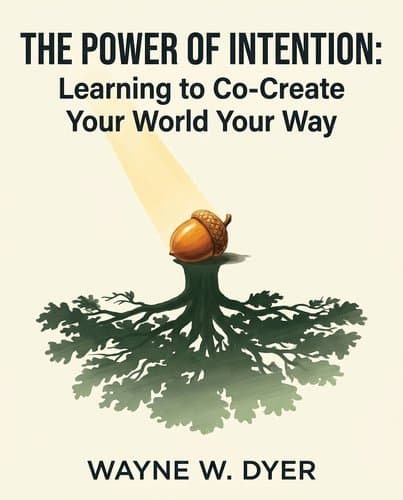
19793_the-power-of-intention
by Wayne W. Dyer
Intention isn't willpower—it's a universal frequency you either align with or block. Dyer reveals how your inner dialogue, emotional state, and ego-driven…
In Brief
Intention isn't willpower—it's a universal frequency you either align with or block. Dyer reveals how your inner dialogue, emotional state, and ego-driven resistance are the precise mechanisms determining what you attract, and how shifting your internal frequency transforms relationships, health, and creativity.
Key Ideas
Your thoughts broadcast vibrational frequency signals
Notice your inner speech in real time: statements like 'I never have enough' or 'this probably won't work out' are not just pessimism — they are the vibrational signal you're transmitting, and the Source reflects them back as experience. Replacing them with 'I intend to attract abundance' is not affirmation but a frequency adjustment.
Embody the emotion of achieved outcomes
'Think from the end' means inhabiting the emotional state of someone for whom the outcome is already real — not visualizing a future you hope for, but behaving and feeling as someone who already has what they intend. The difference in internal sensation is the entire mechanism.
Become what you wish to attract
When you want a quality in another person — understanding in a publisher, kindness in a colleague, patience in a partner — your primary job is to embody that quality yourself in the interaction. You attract what you are, not what you desire.
Stress signals ego misalignment with source
Treat stress, anxiety, and the need to be right as signals, not problems. They indicate a drift from Source — an overidentification with the ego's agenda. The intervention is not to solve the stressful situation but to re-establish internal alignment first.
Your vibration influences thousands of others
Your vibrational state is not a private matter. According to Dyer's framework, a single person operating at high frequency (love, optimism, reverence) actively counterbalances the low-frequency states of thousands of others — making personal spiritual maintenance a form of social contribution.
Resistance, not scarcity, blocks abundance
Resistance, not lack, is the obstacle. Abundance is described as a constant stream that never pauses. If something desired isn't appearing, the diagnostic question is not 'how do I get more of it' but 'where am I generating friction against what is already being supplied.'
Who Should Read This
People working on personal growth in Spirituality and Motivation, especially those tired of generic motivational advice.
The Power of Intention: Learning to Co-Create Your World Your Way
By Wayne W. Dyer
10 min read
Why does it matter? Because the harder you chase what you want, the more you signal to the universe that you don't have it.
Most of us have been running the same strategy our whole lives: want something badly enough, work hard enough, push through the resistance — and eventually the world bends. Wayne Dyer spent years teaching exactly that. Then a passage he read in a waiting room rearranged everything he thought he knew. The insight that stopped him cold: urgency is not fuel. The feeling of needing something, of straining toward it, is a frequency — and it broadcasts lack. The universe, being a perfect mirror, reflects lack back. Dyer's argument in this book is that intention was never yours to summon through force. It's a field that already exists, already flows, already knows what to do. Your only real job is to stop blocking it.
Intention Isn't Something You Do — It's Something You Tune Into
Castaneda's claim was this: intent is a force that already exists in the universe, and what he called sorcerers — people who live close to the Source — don't manufacture it through sheer determination. They recognize it and let it come to them. Dyer found this so disorienting that he had the passage laminated and carried it into the catheter lab.
The acorn is what makes the idea stick. No acorn decides to become an oak tree. It doesn't visualize the outcome, set quarterly goals, or push through resistance. The intelligence of the oak is already encoded in the seed — invisibly, infallibly — and it moves toward expression without doubt or deviation. An acorn never produces a pumpkin. An apple blossom never yields an orange. Every living thing in nature carries a built-in directional force, and that force doesn't ask the organism to try. It only asks the organism not to get in the way.
Humans are the one part of nature that manages to get in the way. We build something called ego — a story about who we are, defined by what we own, what we've accomplished, what others think of us — and that story pulls us out of alignment with the field that everything else moves through without a second thought. The problem isn't that we lack access to that field. It's that we've convinced ourselves we're separate from it.
Dyer's redefinition, then, is less a self-help technique than a perceptual shift: intention isn't something you muster. It's something you're already attached to, whether you know it or not. The only real work is learning to stop pulling away from it.
The Ego Is the Only Thing Standing Between You and Infinite Supply
What if your self-doubt isn't a psychological problem but a physics problem?
Dyer's answer is that it functions exactly like radio static — not a character flaw to be worked on but a frequency mismatch that jams the signal between you and everything you want to create. The ego, in his framing, is a collection of false identifications, and one of the most common goes like this: you are what you've accomplished. If you've had a good year, you feel connected, worthy, capable. If you've failed recently — lost the deal, shelved the project, watched someone less qualified get the promotion — you carry that into every room. Your frequency drops, not because your circumstances changed your value, but because you let your résumé define your signal. That belief alone, Dyer argues, is enough to form a wall of interference between your daily life and the all-supplying field of intention.
The practical consequence shows up in your inner speech. Dyer runs what he calls the match game: every thought you carry either harmonizes with the creative Source or contradicts it.
Silent Knowledge: What Happens When You Stop Clinging to Reason
On a beach in Maui, Dyer knelt over a woman pulled from the surf who would not be revived. While CPR continued and her Japanese friends wept nearby, something unusual happened: he felt, with complete certainty, that her spirit was hovering just above the scene. He stood up, pressed his palms together, and walked away — not grief-stricken but peaceful, still sensing her presence the following day as he sat down to write. He hadn't reasoned his way to that peace. He hadn't weighed evidence or consoled himself with philosophy. He simply knew, and the knowing arrived before any thought could form around it.
Silent knowledge, in Dyer's framing, is not intuition as a lesser substitute for hard data. It's an older mode of awareness that exists before the ego sorts experience into manageable categories. Castaneda's description is useful here: silent knowledge is something every person carries — a total mastery of everything that can't be named or spoken because naming and speaking belong to the thinking mind. The moment we hand the controls to reason, clinging to proof and demanding explanation, we shrink the field and make intention drift out of reach.
What that scene keeps pointing at is this: reason doesn't refine our access to the Source; it filters it. Dyer wasn't hallucinatory on that beach. He wasn't unmoored. In his framing, he was more fully tuned in than the people still running the resuscitation. The woman's spirit, the sense of divine order, the absence of grief — none of it came through analysis. It came through the kind of receptive stillness that reason crowds out.
What silent knowledge opens up is the realization that intention was never a cognitive act. The field is already there, already creative, already moving. And because it moves through people, not just through solitary moments of beach-side stillness, the question becomes what happens when more than one person stops obstructing the signal at the same time.
Your Spiritual Frequency Is Other People's Problem Too
Think of your emotional state as a tuning fork. Strike it, and every other tuning fork in the room that shares its frequency begins to vibrate in sympathy — not because you willed it, but because resonance is physics, not intention. Dyer's argument is that the same principle governs human beings: your internal frequency is not a private matter. It is something that happens to the people around you.
The researcher he leans on is Dr. David Hawkins, whose career was devoted to mapping what he called the hidden determinants of human behavior. Hawkins's core finding is that high-energy consciousness doesn't just improve the individual who carries it — it cancels out low-energy consciousness in others, and the math is staggering. A single person consistently vibrating at optimism and nonjudgment counterbalances roughly 90,000 people stuck in shame, guilt, and rage. Someone living at pure love neutralizes 750,000. A consciousness at the level history assigns to figures like Buddha or Christ would, in Hawkins's calculation, offset the collective negativity of every person alive today. I'll be honest: the first time you encounter these numbers, the instinct is to dismiss them. The second time, you start doing uncomfortable arithmetic about your own Tuesday afternoons.
The implication Dyer draws is not abstract. Your irritability at the grocery store, your need to be right during Sunday dinner, your quiet inner rehearsal of everything that has been done to you — these are not private psychological events. They are frequencies you are broadcasting into a shared field, and the field responds. The ego's familiar arsenal — complaint, superiority, the itch to win every argument — turns out to be structurally costly, functioning as drag on the very current you're trying to move through.
The concrete test case is Dyer's own in-laws. He used to arrive at Sunday visits having already guaranteed their failure — running mental previews of every offense, every ignorant comment, every thing that would prove his assessments right. And they reliably were. Then he reversed the only variable he actually controlled: instead of matching a racial slur with contempt, he met it with "That's interesting — when did you first come to think that?" Not surrender, not agreement, but a refusal to drag the field down to where the low energy lives. Over years, the slurs themselves disappeared. His in-laws began expressing tolerance they hadn't shown before. He hadn't lectured them into changing. He had simply declined to reinforce the frequency they were broadcasting, and the vacuum filled with something better.
The stakes, once you feel them, are hard to shrug off. Every moment you spend at the level of resentment or self-importance, you are — in Hawkins's arithmetic — adding weight to the low-energy side of the scale, the side that is already numerically winning. Every moment you hold the higher frequency, you are doing the opposite, for thousands of people you will never meet. Which is where the question of practice stops being about your own peace and starts being about something considerably larger.
'Thinking from the End' Is Not Wishful Thinking — It's a Frequency Shift
The year Skye Dyer was twenty-one, she walked into a conversation with her father carrying a specific kind of dread — the dread of someone who knows exactly what they need to do and has convinced themselves they can't. She was deep into a university music program, surrounded by theory courses, and the gap between what she was studying and what she felt pulled to create had become impossible to ignore. She asked her father whether he'd be disappointed if she left. His answer was the one thing he'd been telling audiences for years and couldn't now refuse his own daughter: follow the knowing that has been there since you were a toddler.
But leaving school didn't resolve anything by itself. Skye spent the next stretch of time thinking about not having a finished CD — visualizing the absence, feeling the frustration, sending out that particular signal. Nothing materialized. The shift came when Dyer pressed her to stop thinking about the gap and start inhabiting the other side of it: picture the studio already booked, the musicians already there, the finished disc already real. This is the distinction Dyer keeps returning to across these chapters, and it's easy to misread. Thinking from the end isn't conjuring a future scene while standing in the present feeling its absence. It's occupying the emotional state of someone for whom the outcome is already settled — someone who isn't hoping, because hoping is a frequency that signals uncertainty back to the Source. Once Skye made that shift, the studio appeared. The collaborators showed up. The album, titled This Skye Has No Limits, was finished and selling at his lectures.
What this means practically: pray for abundance while feeling scarcity and you're not sending abundance — you're sending need, and the Source confirms that back with precision.
This is why willpower, for all its drama, doesn't reach the field. Willpower is the ego insisting it can close the gap through force. Imagination — in the specific sense Dyer means — collapses the gap by refusing to acknowledge it. You don't will the outcome into existence. You settle into the state of someone for whom it's already arrived.
You Must Be What You're Looking For
You don't attract what you want. You attract what you are. That's the more demanding version of the law Dyer spends these middle chapters making concrete, and the story that lands it hardest involves a meeting he almost blew by succeeding at something more important than the meeting.
Three decades before writing these chapters, Dyer was an unknown author trying to get Your Erroneous Zones in front of a major publisher. His agent arranged a meeting with a senior editor in New York — call him George — and Dyer walked in ready to pitch. Within minutes it was obvious George was devastated. His wife had announced the night before that she wanted a divorce, and the news had flattened him. Dyer made a decision: he set aside everything he'd come to accomplish and spent the next four hours simply listening. He became, in that office, exactly the qualities he'd hoped to find in a publisher — understanding, patient, willing to sit with an uncertain situation. He left without ever mentioning his book. His agent was convinced he'd destroyed his one shot. The next morning, George called and said he didn't even know what the proposal contained, but he wanted that man as one of his authors.
Dyer's read on this, sharpened over years of thinking about it: the right people arrive precisely when you're able to match the frequency you're hoping to receive. He hadn't performed understanding while privately hoping to close a deal. He had genuinely become it, which meant the ego's agenda — get the contract — had to go quiet entirely. That's the mechanism. Dyer extends it into creative genius by the same logic. Laurence Olivier, after the greatest Hamlet of his career, was inconsolable. He had no idea where the performance had come from or whether it would ever return. Most people read that as the anxiety of a perfectionist. Dyer reads it as confirmation: the not-knowing is the proof. When the ego steps back far enough, the Source takes over, and what flows through you is no longer something you can take credit for, explain, or reproduce on demand. Olivier's distress was the distress of a man who understood, dimly, that his best work had nothing to do with him.
The practical demand is the same across both stories and genuinely uncomfortable: stop performing the pursuit and become the thing itself.
The Connector Doesn't Try Harder — They Stop Arguing with Their Source
What does the person on the other side of all this actually look like? Not in a meditation hall, not at the moment of enlightenment, but on a Tuesday afternoon in a slow pharmacy line or sitting across from someone broadcasting low-energy complaint? Dyer's answer, in the final chapter, is less glamorous and more useful than you might expect: the connector doesn't glow. They don't debate you out of your pessimism. They've simply stopped generating the one thing that was blocking them all along: resistance.
The operating principle, illustrated through a parable Dyer borrows from Benjamin Zander, the conductor, is called Rule Number 6. Three times in one afternoon, furious people burst into a meeting between two prime ministers. Each time, the host defuses the eruption with five words: "Kindly remember Rule Number 6." When his guest finally asks what this rule is, the answer comes: "Don't take yourself so goddamn seriously." And the other rules? "There aren't any." The joke lands because the structure of ego-generated stress is always the same — some version of I am too important for this to be happening to me. The rule doesn't require wisdom or willpower. It requires only the recognition that the ego's complaint is the whole problem.
The universe, in Dyer's framing, is always in the act of supplying — continuously, without interruption. The connector doesn't manufacture this supply or earn it through discipline. They just decline to transmit the frequencies that jam the signal: scarcity thinking, pessimism, the need to be right. Remove that static, and what was already on its way arrives. The connector calls it Tuesday.
This is the portrait Dyer leaves you with — not a saint but someone practicing one specific thing: catching the moment they start arguing with their Source, and choosing not to.
What the Connector Already Knows
The question worth carrying away isn't how to want more skillfully or pursue more efficiently. It's simpler and more unsettling than that: what are you currently transmitting? Because the universe, in Dyer's account, isn't a slow bureaucracy weighing your application — it's a mirror, instantaneous and indifferent to what you claim to want, reflecting back the precise frequency you're broadcasting. The connector's life looks like luck from the outside because it is, in a sense — the luck of someone who stopped generating static long enough to notice what was already arriving. Not a saint. Not someone with a cleaner past or a stronger will. Just someone who caught themselves arguing with their Source one more time, and chose not to. That choice, made quietly and repeatedly, is apparently the whole of it.
Notable Quotes
“Do you think they’ll let me play?”
“We’re losing by six runs, and the game is in the eighth inning. I guess he can be on our team, and we’ll try to put him up to bat in the ninth inning.”
“Shaya, run to first. Run to first.”
Frequently Asked Questions
- What is intention according to Wayne Dyer in The Power of Intention?
- In The Power of Intention, Dyer reframes intention as a universal energy field rather than an act of willpower. He argues that your inner frequency either harmonizes with or blocks the creative Source behind all life. Drawing on spiritual principles, the book shows how to align your thoughts, emotions, and behavior with that Source to attract health, relationships, and abundance. Rather than a goal you force yourself toward, intention becomes a vibrational state you inhabit that naturally attracts aligned outcomes.
- How does your inner speech affect reality in The Power of Intention?
- According to Dyer, statements like 'I never have enough' or 'this probably won't work out' are not just pessimism — they are the vibrational signal you're transmitting, and the Source reflects them back as experience. These inner statements create your reality through frequency adjustment rather than affirmation. By replacing limiting self-talk with aligned statements like 'I intend to attract abundance,' you shift your vibrational signal and fundamentally change what the Source reflects back to you as your lived experience.
- What does "think from the end" mean in The Power of Intention?
- "Think from the end" means inhabiting the emotional state of someone for whom the outcome is already real — not visualizing a future you hope for, but behaving and feeling as someone who already has what you intend. The difference in internal sensation is the entire mechanism. By occupying this present emotional state rather than longing from lack, you shift your vibrational frequency to match the reality you seek, making it naturally attract circumstances and opportunities aligned with that achieved state.
- How do you attract what you want according to The Power of Intention?
- You attract what you are, not what you desire. When you want a quality in another person — understanding in a publisher, kindness in a colleague, patience in a partner — your primary job is to embody that quality yourself in the interaction. The principle extends beyond relationships: resistance, not lack, is the true obstacle. Abundance is described as a constant stream that never pauses. The diagnostic question becomes not 'how do I get more of it' but 'where am I generating friction against what is already being supplied.'
Related Book Summaries



Read the full summary of 19793_the-power-of-intention on InShort