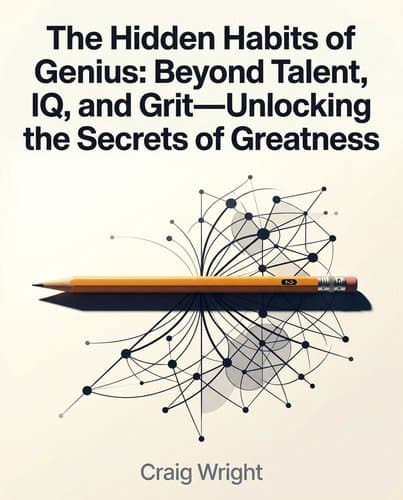
46159080_the-hidden-habits-of-genius
by Craig Wright
Darwin, Einstein, and Beethoven all failed conventional talent metrics—yet changed the world. Discover the overlooked habits of curiosity, cross-domain…
In Brief
The Hidden Habits of Genius: Beyond Talent, IQ, and Grit—Unlocking the Secrets of Greatness (2020) challenges the idea that genius is innate. Through historical case studies, it shows that the traits separating great innovators — curiosity, cross-domain thinking, and resilience under rejection — can be deliberately cultivated, and gives readers a practical framework for building them.
Key Ideas
Curiosity and resilience beat IQ scores
Stop measuring creative potential by IQ or grades. Terman's 1,500 high-IQ children produced zero geniuses; the list of genius false negatives includes Darwin, Einstein, Edison, Churchill, and Beethoven. Track curiosity, passion, and resilience instead — these predict far more.
Independence trumps early prodigy status
Don't confuse early prodigious performance with long-term creative capacity. Deliberately push children (and yourself) toward independence, global learning, and comfort with failure rather than narrow specialization and constant validation.
Cross-domain thinking generates breakthrough insights
Cross into unfamiliar fields on purpose. The combinatorial insight almost never arrives from inside a single domain — Darwin's evolutionary breakthrough came from reading population economics 'for amusement.' Schedule time to wander.
Unfocused time is legitimate creative work
Treat walking, napping, and showering as creative work, not escapes from it. Keep a notebook by your bed and near the shower. Tesla's greatest engineering insight came during a park walk; McCartney's most covered song arrived in a dream. The unfocused brain is doing real work.
Evaluate ideas blind to author identity
If you run any selection process — hiring, funding, publishing — design a Catherine Nichols test for your own operation. The same work is evaluated dramatically differently depending on perceived author identity, and the bias is active, not historical.
Build identity through rejection recovery
Expect to be publicly wrong for a long time and build your identity around recovery, not avoidance. Cézanne was rejected by the Paris Salon for twenty years before producing his greatest work. Rejection that doesn't kill the project is evidence you're aiming at a target others can't see yet.
Adopt genius habits without destructive pathology
The habits of genius — childlike curiosity, cross-domain thinking, deliberate unfocus, resilience under rejection — are separable from the pathologies. You don't have to destroy the people around you to borrow the tools.
Who Should Read This
Curious readers interested in Habit Formation and Creative Thinking and the science of how the mind actually works.
The Hidden Habits of Genius: Beyond Talent, IQ, and Grit—Unlocking the Secrets of Greatness
By Craig Wright
9 min read
Why does it matter? Because the genius you picture in your head never existed.
The image most people carry of a genius: impossibly smart from birth, probably a prodigy, struck at some decisive moment by an insight no ordinary mind could generate. Eccentric, difficult, operating in a category apart.
Yale musicologist Craig Wright spent twelve years systematically testing that picture against the evidence — and found that nearly every element of it is wrong. IQ turns out to be an almost comically poor predictor. The eureka moment is a Hollywood invention. The prodigy is usually a cautionary tale. What actually produces world-changing work is stranger, darker, and considerably more available than anyone assumes: a collision of learnable habits, structural luck, and a particular obsession that society tolerates precisely because the damage eventually stops and the output doesn't.
Genius Isn't About Hitting Targets Better — It's About Seeing Targets No One Else Can
Genius is the capacity to see possibilities invisible to everyone else — and almost every tool we've built to identify it measures the wrong thing entirely.
Arthur Schopenhauer drew the distinction in 1819: a talented person hits a target no one else can hit; a genius hits a target no one else can see. Talent means mastering what's already in front of you. Genius means perceiving what isn't there yet. In 1919, Nikola Tesla described a personal wireless device not bigger than a watch that would one day connect all of humanity — decades before the technology existed to make it remotely plausible. He wasn't solving a known problem; he was seeing a future nobody else could make out.
So why do we keep searching for this capacity using IQ tests? Lewis Terman at Stanford spent decades tracking 1,500 children with IQs above 135. When Melita Oden reviewed the results, the findings were unsparing: not one Nobel Prize, not one Pulitzer Prize, no Picasso. Meanwhile, two scientists who eventually did win Nobel Prizes, William Shockley and Luis Alvarez, had been rejected by Terman's own screening for scoring too low. The list of geniuses who would have flunked the same test is almost comic: Darwin, whose father predicted he'd disgrace the family; Beethoven, who never learned to multiply; Picasso, who couldn't remember the order of the alphabet; Edison, who sat at the foot of his class.
IQ tests measure something real but limited: the ability to find correct answers to problems that already have them. Genius points somewhere else: toward questions nobody has thought to ask yet. You can't standardize your way to that.
The Prodigy Is Often the Enemy of the Genius
Paris, 1778. Wolfgang Mozart is twenty-two and everything has collapsed. His father Leopold had dispatched him to the city to find work, but the French still pictured the charming seven-year-old they'd applauded fifteen years earlier and had no use for this grown man before them. His mother, sent along as chaperone, contracted typhus and died slowly. His girlfriend back home had forgotten him. No money, no position, no one — only an accusatory letter from Leopold, blaming him for her death.
What follows is the hinge of Wright's argument. That total catastrophe — stripped of Leopold's approval, stripped of the prodigy identity that had defined his entire life — forced Mozart to rely on something his father couldn't teach or take away: his own creative voice. The grief poured directly into his music. Violin Sonata K. 304, written in the months after his mother's death, carries an emotional weight absent from everything before it, his only instrumental work in the stark, unresolved key of E minor. He limped back to Salzburg, then quietly left his father's orbit for good, relocating to Vienna, where he would write the works that actually defined him. Ninety-five percent of the masterpieces we associate with Mozart came after he escaped what Wright calls the "prodigy bubble."
The prodigy bubble (unbroken praise, rigid rules, narrow focus, a hovering parent optimizing for performance) is precisely the environment that prevents genius. Leopold was a superb early guide: he taught the fundamentals, opened doors to royalty, managed the logistics of a barnstorming European tour. But no mentor has ever said "move as far from me as possible, think contrary to everything I've taught you, build a vision that looks nothing like mine." Mentors transmit the status quo. Genius requires rupture.
The data Wright cites makes this uncomfortable in the best way. The psychologist Howard Gardner studied the twentieth century's seven most defining creators: Freud, Einstein, Picasso, Stravinsky, Eliot, Martha Graham, and Gandhi. Only Picasso was a prodigy. Graham didn't dance until twenty. Eliot took up poetry at twenty. Freud changed fields several times and arrived at psychoanalysis only at forty. The actual profile of genius turns out to be less "child star" and more "late, stubborn, crisis-tempered."
The Habit No One Prescribes: Never Fully Grow Up
On the evening of June 1, 1816, eighteen-year-old Mary Godwin sat at Lord Byron's villa near Lake Geneva while Byron challenged his guests (Percy Shelley, a physician, her half-sister) to each write a ghost story. She had no publications, no formal education, no claim to genius. What happened next had less to do with what she knew and more to do with what she hadn't yet learned to suppress.
After a dinner discussion of galvanism — the then-popular idea that electricity could reanimate dead tissue — she lay down but couldn't sleep. Her imagination took over: she saw a pale student kneeling beside something assembled from dead matter, watched the creature stir, saw it stand at the student's bedside and peer down with yellow, watery eyes. She woke in terror — then recognized what she had: what had terrified her would terrify others. She only needed to describe it.
That vision became Frankenstein. Published anonymously in 1818, its "original genius" was attributed to Percy Shelley. Surely such a work could only come from a man. Mary Godwin wasn't credited as author until the second edition, five years later.
The point isn't injustice, though it is that. The point is what produced the work: not mastery or expertise, but willingness to surrender completely to an unguarded, terrifying imagination. She was young enough to still be frightened by her own mind. That was the advantage.
Biologists have a word for this: neoteny, the tendency to carry childlike traits well into adult life. Baudelaire, in 1863, put it plainly: "Genius is only childhood recovered at will." The capacity isn't lost when we grow up. It's practiced away.
The Breakthrough Almost Always Arrives Through a Side Door
Imagine trying to start a fire by staring harder at a single log. The spark doesn't come from more attention; it comes from friction — two different materials meeting at speed. Depth-only thinking has a structural problem: the breakthrough you're after is built from pieces that live in different categories, and friction requires motion.
No biography illustrates this more cleanly than Darwin's. For five years he sailed on the Beagle, but spent two-thirds of that time on land, prowling Patagonia, threading the Amazon, scaling the Andes, working simultaneously as zoologist, botanist, geologist, and paleontologist. He'd absorbed transmutation theory: the idea, traced through his grandfather Erasmus and Lamarck, that species adapt to local environments and pass those adaptations forward. He'd watched species after species in the Galápagos. He had the first piece.
The second piece arrived from a completely different direction. In October 1838, fifteen months into his systematic inquiry, Darwin picked up Malthus's essay on population, as he later wrote, "for amusement." Malthus argued that human populations outpace resources, so famine, disease, and war act as brutal filters on survival. Darwin, primed by years of cross-domain wandering, felt the two ideas collide. If resources are always scarce and competition always fierce, favorable variations survive and unfavorable ones disappear. Species don't just adapt — they get selected. He had the theory he'd been circling for years, and it arrived through a side door.
It's not a quirk of Darwin's biography. Leonardo da Vinci's to-do lists read like the notes of someone who hadn't yet learned which subjects were supposed to stay separate: describe the tongue of the woodpecker, square a triangle, measure Milan, obtain a skull. No department, no lane. Nobel Prize–winning scientists are nearly three times as likely to practice a fine art as their less celebrated peers, and twenty-two times as likely to do amateur performance. The wandering isn't a hobby that competes with the serious work. It's how the serious work gets done.
The Game Has Always Been Rigged — and It's Still Costing Us
Why does the historical record show so few female geniuses? The default answer — that women simply produced less world-altering work — turns out to be exactly backward. The scarcity is manufactured.
No case in the twentieth century makes this clearer than Rosalind Franklin's. By 1952, she had produced the sharpest X-ray images ever taken of a DNA molecule, photographs that revealed its helix structure, its precise dimensions, the number of base pairs per turn. The work required years of painstaking crystallography at King's College London, and it was decisive. Without her "Photograph 51," Watson and Crick had no path to their 1953 paper on the double helix. They saw that photograph because Franklin's supervisors shared it without her knowledge or permission.
Watson later published his account of the collaboration. His description of Franklin, who "did not emphasize her feminine qualities" and whose clothes "showed all the imagination of English blue-stocking adolescents," concludes with the assessment: "Clearly Rosy had to go or be put in her place." In 1962, the Nobel Committee awarded the prize to Watson, Crick, and Maurice Wilkins. Franklin couldn't appeal the decision. She had died of ovarian cancer four years earlier, at thirty-seven, and Nobel statutes explicitly prohibit posthumous awards.
The photo theft makes a good anecdote, but Wright's argument is that it was never an exception — it was the rule. The barriers were structural and layered: academic credit denied as a matter of routine, institutional posts closed to women by policy, publication gatekeepers who decided whose names appeared on papers and whose didn't. Psychologist Dean Keith Simonton's data captures the outcome: women account for under one percent of scientists the canonical ledger credits, not because women weren't doing the work, but because the system that confers recognition was built by the people who benefited from restricting access to it. The question isn't whether female geniuses existed. It's how many Rosalind Franklins we'll never know about.
The Insight Doesn't Come When You're Trying — It Comes When You Stop
Budapest, late afternoon, 1882. Nikola Tesla was strolling through the city park with a friend, reciting Goethe's Faust from memory (at that age he had entire books committed word-for-word to heart) when the setting sun called to mind a passage about the earth's rotation, the day's labor retreating. As the German word rücken ("to shift") crossed his lips, the solution arrived like a physical shock. Seven years of failed attempts to build a workable alternating current motor collapsed into a single complete vision: a rotating magnetic field, induced by alternating current, would spin a drive shaft continuously in one direction. He sketched the design in the dirt with a stick. That image became the polyphase AC induction motor, the engine inside every washing machine, electric fan, and industrial drill built since.
Seven years of deliberate effort at the drafting table had hit a wall. The relaxed, wandering mind — occupied with poetry and a setting sun — solved it in seconds.
During REM sleep and in the twenty minutes after waking, the brain's alerting chemistry retreats; a more associative mode takes over, ranging freely across the entire memory bank and pulling distant material into unexpected contact. Harvard and Berkeley studies showed people solve problems 15–35% better after REM sleep than from a fully wakeful state. The same state is reproducible in a shower, a walk, or a train ride: any activity that occupies the body while releasing the mind from directed effort.
Geniuses recognized this and built habits around it. Einstein kept a notepad at his bedside. Salvador Dalí slept with a spoon in his hand, jolting awake the instant he nodded off to capture half-waking visions before they dissolved. The concentrated mind gets you most of the way there. Deliberate unfocus closes the gap — and that, unlike raw genius, is something you can practice.
The Genius and the Wreckage: Why They're Often the Same Story
The destructive behavior of geniuses and their greatest work aren't separate facts sharing a biography. They draw from the same source.
We assume that when brilliant people are also cruel, we're witnessing a character flaw that happened to coexist with talent. Pablo Picasso makes that assumption impossible to hold. Over six decades he maintained seven overlapping relationships (wives, mistresses, partners) whom he struck, dragged by the hair, burned with lit cigarettes, and psychologically tormented, sometimes arranging rivals to come to blows for his entertainment. He put his preference plainly: "Every time I change wives I should burn the last one." Three of these women took the wreckage to its terminus: Marie-Thérèse Walter hanged herself in 1977; Jacqueline Roque shot herself in 1986; Dora Maar underwent electroconvulsive therapy and retreated to a convent for the rest of her life.
What Marie-Thérèse said about his method makes the connection impossible to avoid. He would terrorize the woman first, she said, and then go paint. The cruelty wasn't competing with the art — it was generating it. The same drive that refused to accommodate anyone else's needs, that treated the people around him as irrelevant obstacles easily swept aside, also produced more than 20,000 works across seventy-five years.
The argument isn't that we tolerate the abuse. It's a structural observation Wright makes about every major figure in his study: the obsessive drive that produces work of this kind tends to displace empathy not as an accident but as a functional consequence. You cannot be simultaneously consumed by a vision no one else can see and reliably attentive to the people who need you to see them.
Wright's Yale students arrive at this the slow way. At the start of his genius course, three-quarters say they want to be one. By the final session, after a semester in close company with these figures, only a quarter still do. One student's explanation: so many of them seem like "obsessive, self-centered jerks," not someone you'd want near you. Wright agrees, and adds only this: almost no one loved these people while they were alive. Once dead, we forget the wreckage and keep the work — and quietly, generation by generation, life gets better.
You Don't Have to Become the Monster to Borrow the Habits
Curiosity without a leash. Wandering into fields that aren't yours. Lying in the dark until the solution arrives uninvited. The habits aren't the pathology. The obsession that let Picasso see something no one else could also let him treat the people beside him as props — those aren't separate facts; it was the same compulsion, doing both jobs. None of that requires you to burn anything down. Three-quarters of Wright's Yale students walked out of that course relieved they didn't want to be a genius anymore. That's not defeat — that's the moral accounting the semester had been quietly doing. You get to inherit the lens from people whose lives you'd never have wanted, and use it without becoming them. That is the strangest gift genius leaves behind.
Notable Quotes
“The $250 Million Race to Qatar.”
“he has a glorious and brilliant future ahead of him.”
“He was way ahead of the other students, who were all five or six years older. Although he paid no apparent attention to what the professors were saying, he instantly grasped what he was taught.”
Frequently Asked Questions
- What is "The Hidden Habits of Genius" about?
- "The Hidden Habits of Genius" challenges the conventional belief that genius is innate and unchangeable. Craig Wright argues that the defining traits of great innovators—curiosity, cross-domain thinking, and resilience under rejection—can be deliberately developed. Through historical case studies of geniuses like Darwin, Einstein, and Tesla, the book provides a practical framework for cultivating these habits. Rather than relying on talent or IQ as predictors of success, Wright emphasizes that deliberate practice, independence, global learning, and comfort with failure are what truly separate exceptional innovators from the rest.
- Does "The Hidden Habits of Genius" challenge IQ as a measure of genius?
- Yes, the book directly challenges IQ as a predictor of genius. Wright presents a compelling case: Terman's study of 1,500 high-IQ children produced zero geniuses. Meanwhile, the list of genius false negatives includes Darwin, Einstein, Edison, Churchill, and Beethoven—individuals rejected or overlooked by traditional IQ measures but who became some of history's greatest minds. Instead, Wright recommends tracking curiosity, passion, and resilience as far more reliable indicators of creative potential. These traits better predict long-term innovation capacity than standardized test scores.
- What specific habits does "The Hidden Habits of Genius" identify as essential to creativity?
- Craig Wright identifies four core habits that are separable from pathology: childlike curiosity, cross-domain thinking, deliberate unfocus, and resilience under rejection. Cross-domain thinking is particularly powerful—insights rarely come from within a single field. Darwin's evolutionary breakthrough came from reading population economics "for amusement." Deliberate unfocus means treating walking, napping, and showering as creative work. Tesla's greatest engineering insight came during a park walk, and McCartney's most covered song arrived in a dream. These seemingly unproductive activities are where genuine innovation occurs.
- How does "The Hidden Habits of Genius" address the role of rejection in creative work?
- Wright argues that rejection is integral to genius, not antithetical to it. His advice is direct: "Expect to be publicly wrong for a long time and build your identity around recovery, not avoidance." Cézanne was rejected by the Paris Salon for twenty years before producing his greatest work. Rejection that doesn't kill the project is evidence you're aiming at a target others can't see yet. This reframes failure not as proof of inadequacy but as validation that you're pursuing work ambitious enough to challenge existing standards and conventions.
Related Book Summaries
Read the full summary of 46159080_the-hidden-habits-of-genius on InShort