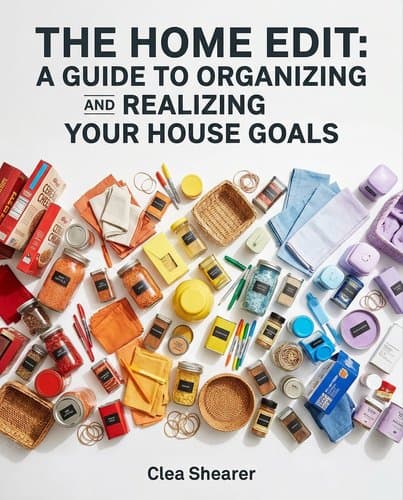
40712502_the-home-edit
by Clea Shearer
Clutter isn't a willpower problem—it's a design failure. Learn the visual, aesthetic-first system that makes organizing so intuitive and beautiful that every…
In Brief
The Home Edit: A Guide to Organizing and Realizing Your House Goals (2019) reframes home organization as a design problem rather than a willpower problem.
Key Ideas
Start Small to Build Momentum
Start with one drawer — the exact same steps apply as for a full room, but the scale is non-threatening enough to actually begin. Momentum is the point, not coverage.
Empty Everything Before Organizing
Take everything out before organizing anything — this is non-negotiable. Organizing in-place means building on a faulty foundation. The floor dump is the method, not a side effect.
Bold Labels Make Systems Work
Labels are instructions, not decoration — they're what makes a system work for everyone in the household, not just the person who built it. Make them big and bold.
Transparency Ensures Visibility and Maintenance
Use transparent containers wherever possible — if you can't see it, you won't maintain it. Opacity is a hiding system, not an organizing system.
Use Color Spectrum for Quick Finding
Apply ROYGBIV when you have multiples — color order isn't vanity; the brain recognizes the spectrum, making items faster to find and easier to return correctly without thinking.
Decide Without Asking or Explaining
Never ask your children 'do you still like this?' — the question triggers irrational attachment to objects they hadn't noticed in months. Trust your gut, keep moving, and execute when they're out of the house.
Keep Organization Plans Completely Silent
Never announce you're clearing your closet until it's done — friends want giveaways, family members will audit for their gifts, and partners will check in and 'annoy you endlessly.' Operational silence is a strategy.
Reserve 20% Empty Space Always
Leave roughly 20% of any organized space empty — a full system has no flexibility for normal accumulation and collapses under ordinary life. The 80/20 rule applies to storage, not just eating.
Who Should Read This
People working on personal growth in Self-Improvement and Habit Formation, especially those tired of generic motivational advice.
The Home Edit: A Guide to Organizing and Realizing Your House Goals
By Clea Shearer & Joanna Teplin
9 min read
Why does it matter? Because your home is either designed to work for you or quietly working against you — and most homes, right now, are working against you.
There is a cabinet in your home you open only with your body blocking it, just in case someone walks by. Maybe it's the hall closet. Maybe it's the space under the kitchen sink — the one you've reorganized twice, watched collapse by the following Tuesday, and quietly filed as evidence that you are simply not an organized person.
The actual problem: the system was built for the person you intend to be, not the one who actually lives there. When a system isn't beautiful enough to make anyone want to maintain it, order lasts about as long as good intentions in January. Household chaos is not a character flaw but a design failure — and the fix starts smaller, and works better, than you've been led to believe.
Your Mess Isn't a Character Flaw — Your System Was Built for the Wrong Person
Clea Shearer and Joanna Teplin, founders of The Home Edit, organize homes for people like Gwyneth Paltrow and Mindy Kaling. They once poured an enormous collection of tiny beads, charms, and crystals onto a cookie sheet to begin sorting them. The logic seemed sound. The beads magnetized into a fused, irreversible tangle. There was nothing to be done. They spent three days hand-sorting pieces small enough to lose between your fingers, and relationships in the room went touch and go.
This is not a story about beads. It's a story about what organizing actually looks like when the best in the business do it: messy, longer than expected, occasionally strained, and ultimately worth it. The professionals created one of the more spectacular catastrophes imaginable in pursuit of a tidy jewelry studio. They're not ashamed of it. They put it in the book.
Think about the last time you tried to organize something. Maybe you started with real momentum: a Saturday morning, matching bins, a plan. You got halfway through the closet, ran out of time, and stuffed everything back in worse than before. Or you finished, it looked great for three weeks, and then real life (kids, work, the particular chaos of a household that's actually used) undid all of it. You've probably told yourself the same story: not disciplined enough, not consistent enough, not the kind of person who stays on top of this.
Shearer and Teplin say the story is wrong. The failure wasn't yours. It was the system's — specifically, a system built for a version of you that doesn't exist. One who has infinite time, no children underfoot, and the patience to return every item to its designated spot after every use. Real life runs through organizing systems like water through sand. The system needs to be designed for the real you: the one who has forty-five minutes on a Tuesday and a household that actively generates disorder.
Their answer is what they call the Low-Bar Lifestyle: the organizing equivalent of counting a walk to the corner store as cardio. Take the chair in your bedroom (every home has one) that collects clothes too clean for the hamper and too worn to re-hang. A system designed to eliminate that chair will fail. One that gives it a basket lasts. Projects that feel manageable get done. Systems that tolerate human imperfection get maintained. The pantry organized for a fictional household falls apart within weeks. The one organized for the household that actually exists, including the cereal boxes that never quite make it into the canisters, stays standing.
You've probably failed at organizing before. So did the organizers, with three days of hand-sorting to show for it. They understood the failure as information, not indictment. The system needed adjusting. So does yours — just not in the direction you thought.
The Mess Has to Get Bigger Before It Gets Smaller — This Is Not a Warning, It's the Method
The adjustment is counterintuitive: the mess has to get bigger before it gets better. Every organizing attempt that fell apart did so at the same point, when you decided to work around what was already in the space instead of emptying it first.
The Home Edit's non-negotiable rule is to remove everything — not most things, not the obvious stuff, everything. Shearer and Teplin call leaving items in place "building a faulty foundation," and the logic is structural, not motivational. You cannot design a system for contents you haven't fully seen. Previous arrangements collapsed because they were built on a partial inventory. The system looked complete because you thought you knew what was in there. You didn't.
The pantry is where this hits hardest. When you pull everything off those shelves and set it on the floor, the volume is genuinely shocking — not because you own more than you thought, but because the shelves had been maximized in the wrong direction. Everything was stacked on top of everything else, shoved to the back. More stuff fit, but none of it was findable. Shearer and Teplin confess they've panicked at the sight of their own floor dumps. The mess around you isn't evidence that you're disorganized. It's evidence that the previous system was working against you while looking like order.
Grouping comes after the floor dump, not during it: like with like before you touch a single bin. All breakfast things together. All cleaning supplies in one pile. All the condiments in a heap. That's how you discover you own thirteen white T-shirts, or four half-empty bottles of the same pantry staple, or duplicates you've been buying for years because you couldn't see what you already had. You can't make good decisions about what stays until you can see the full count.
Only after that do you pare down. Empty, then group, then edit. Each step creates the conditions for the next one. Skip the floor dump to avoid the disruption, and you're rearranging a problem you haven't fully diagnosed. The mess has to get bigger first. That is the process.
The Only System Anyone Actually Maintains Is One That Looks Good — And That's Not a Coincidence
Why do some organizing systems hold for years while others fall apart in weeks, even when both were built with equal care and good intentions?
The Home Edit's answer is counterintuitive: the ones that last are almost always the beautiful ones. Not because beautiful people are more disciplined — because a visually logical system removes the need for discipline entirely.
Consider a drawer full of crayons in a child's playroom. The standard approach is to divide them into sections — one per color family, or one per type. Functional, reasonable, doomed. Children don't naturally think in categories. They grab what they want and drop it back wherever gravity suggests. The system lasts about a week.
Shearer and Teplin arranged a school supply drawer's crayons in full rainbow sequence — red into orange into yellow through to violet. The result looked striking. It also did something the categorical system couldn't: it gave every crayon a specific, visually obvious home. A child returning a blue crayon doesn't need to remember a rule. The blues cluster visibly between green and indigo. The crayon goes back where it belongs because the pattern shows you where it belongs. The visual logic enforces the behavior without anyone enforcing it.
Shearer and Teplin call this a marriage of form and function, which makes it sound like a polite compromise. It's not. The beautiful thing is doing the functional work. Strip the beauty and you strip the mechanism.
Ugly systems fail for the opposite reason. An unlabeled shelf of mismatched bins demands a small decision every time — which bin was it? did I move it? — and that friction adds up fast. Enough of those micro-decisions and you just stop caring which bin is right. Things go wherever there's room, categories blur, and within two months you're back to the same pile you started with. That's not a willpower failure. It's a design failure: a system that stored all the maintenance load in memory rather than in the visible structure of the space.
Shearer and Teplin want your pantry to look like a photograph because a pantry that looks like a photograph is one you'll actually maintain. The visual appeal and the functional durability are the same property, viewed from different angles.
The First Rule of Cleaning Your Closet Is Never Talk About Cleaning Your Closet
You've decided to clean out your closet. You mention it to your mother-in-law over dinner, and by Tuesday she's texting to ask how it went. By Thursday she's stopped by, ostensibly for other reasons, doing a slow visual sweep of your coat rack. The cashmere scarf she gave you three Christmases ago (the one you've never worn) is noticeably absent.
Shearer and Teplin call it Rule One, and it sounds more like operational security than organizing advice: don't tell anyone you're doing it. Not your friends, who want first claim on whatever you're giving away. Not your daughter, who will suddenly develop an intense attachment to a vintage blazer she hasn't glanced at in four years. And definitely not your spouse, who will check on your progress and annoy you endlessly. The advice exists because everyone in your orbit has competing interests in your belongings, interests they didn't know they had until you announced things were up for review. The moment the cleanout becomes public, it becomes a negotiation.
The social pressure is just the entry fee, though. The hard part of decluttering is other people, guilt, and the stories you're telling yourself about who you'll be someday.
The guilt piece gets its own rule. When you find something expensive, or something someone gave you, the instinct is to feel bad about letting it go. Shearer and Teplin flip the moral direction: feel bad that it's holding the place of something you'd actually use. Three ways out: sell it, give it to someone who'd want it, donate it to someone who needs it. Every one of them is better than keeping something you don't use in a closet you resent opening.
The quieter obstacle is the pre-pregnancy jeans sitting at the back of the closet for three years, still there because you might fit them again someday. The authors' advice is brief: those jeans belonged to someone with a different life. Making room for who you actually are isn't a concession. It's the point.
No bin or label can do this work. The whole system — the labeled containers, the organized categories, the carefully maintained breathing room — depends on one thing the organizers can't install for you: honest accounting of who you are now versus who you've been telling yourself you might become. A system stocked for a future self fails the present one. Tell no one. Do the work. Once something lands in the donation pile, leave it there.
You Can Have the Item or You Can Have the Space — the Physics Won't Let You Have Both
Imagine a perfectly organized pantry three months after you built it. You didn't slip into bad habits. You didn't abandon your system. You just lived there, buying olive oil when you ran low, picking up pasta on sale, accepting a spice rack insert as a gift. Normal accumulation, each addition individually reasonable, collectively fatal to the breathing room you started with.
Shearer and Teplin compare a crammed storage space to eating well past the point of comfort — that reaching-for-the-waistband moment when you've gone past satisfied into stuffed. The sensation arrives gradually, one item at a time. But the result is the same: a system that felt light and navigable at 80% capacity fills to 110%, and you find yourself back at the beginning, wondering what happened to your discipline.
Nothing happened to your discipline. Space has a carrying capacity. It doesn't negotiate. A pantry physically at its limit cannot absorb anything new without ejecting something old. When it doesn't eject — when the new pasta gets shoved toward the back — categories blur, visibility drops, and the visual logic that was quietly doing your maintenance work for you disappears under the pile.
The architectural fix is one in, one out: when something enters a space, something leaves. Not as a willpower exercise, but as an acknowledgment of physics. The authors frame it as a binary: you can have the item or you can have the space, but the geometry won't allow both. The corollary: the system should never reach its physical limit in the first place. Leaving roughly 20% empty isn't aesthetic luxury; it's the slack that allows normal life to happen without breaking what you built. A pantry stocked to exactly its limits has no tolerance for a Tuesday sale or a holiday gift. A pantry with breathing room absorbs both without a crisis.
That's the long game. A system that survives only under perfect conditions isn't a system. It's a hope. The one that lasts is designed to accommodate the next twelve months of ordinary living: the extra item, the impulse purchase, the things that land in your kitchen because you're actually using it. Build in the slack. Honor the capacity. What you built was real. The physics just wants you to remember it.
The One Metric Worth Keeping: Does It Still Look Like This Next Year?
The real test isn't the day you finish. It's twelve months later, when the cereal boxes have multiplied and someone left scissors in the snack bin and everything still, somehow, mostly holds. That's what Shearer and Teplin are actually building toward — not the photograph, but the Tuesday in February when putting something back correctly is the path of least resistance. The clear bin shows you where it goes. The bold label removes the question. The rainbow pulls the crayon home without anyone asking. None of it is magic; it's just infrastructure, built one space at a time. The catch, and they're honest about it, is that the physics never changes: you can have the item or you can have the space, and the geometry won't negotiate. But that constraint, once you accept it, is a kind of freedom. Start with the drawer. That's enough.
Notable Quotes
“WHOA, WAIT. I have another friend named Joanna—also Jewish, also has two kids, also has a husband in the music industry, also just moved to Nashville—and she wants to start an organizing company here, too!”
“No way, no how, no thank you.”
“I just don't want a business partner. I'm fine going to lunch with her and MAYBE even having a new friend, but I've never had a partner before and it just won't work.”
Frequently Asked Questions
- What is The Home Edit about?
- The Home Edit frames home organization as a design problem rather than a willpower problem. Published in 2019 by Clea Shearer and Joanna Teplin, the book provides a step-by-step system for organizing spaces, moving from an initial full-category edit through implementing labeled, color-ordered, transparent storage solutions. The goal is creating spaces that are functional enough to maintain long-term while being aesthetically beautiful enough that people actually want to use and maintain them. This approach balances practicality with visual appeal in home organization.
- What are the key takeaways from The Home Edit?
- The Home Edit's core principles begin with starting small—one drawer applies the same system as a full room but feels less overwhelming and builds momentum. Critical practices include taking everything out before organizing (the floor dump method), using big, bold labels as functional instructions, and choosing transparent containers for visibility. The authors emphasize applying ROYGBIV color ordering to multiples, never asking children if they want items to avoid irrational attachment, and maintaining operational silence during decluttering. Finally, leave roughly 20% of any organized space empty for flexibility and natural accumulation.
- How should you start organizing according to The Home Edit?
- The Home Edit recommends starting with one drawer as your entry point to organization. Using the same system that applies to full rooms, a single drawer feels non-threatening enough to actually begin, with momentum as the goal rather than comprehensive coverage. The critical first step is non-negotiable: "Take everything out before organizing anything." This floor dump method creates a proper foundation—organizing in-place builds on a faulty base. Once emptied, you can properly sort and return items. This scaled-down approach removes paralysis and builds confidence for tackling larger spaces.
- What does The Home Edit say about storage containers and organization?
- The Home Edit prioritizes transparent containers based on the principle that "if you can't see it, you won't maintain it." The authors view labels as functional instructions that must be "big and bold" to help everyone in the household maintain the system, not just its creator. Color organization through ROYGBIV is equally important: when applied to multiples, "the brain recognizes the spectrum, making items faster to find and easier to return correctly without thinking." Together, these principles create systems that people can actually maintain long-term without relying on memory or special knowledge.
Related Book Summaries

Read the full summary of 40712502_the-home-edit on InShort