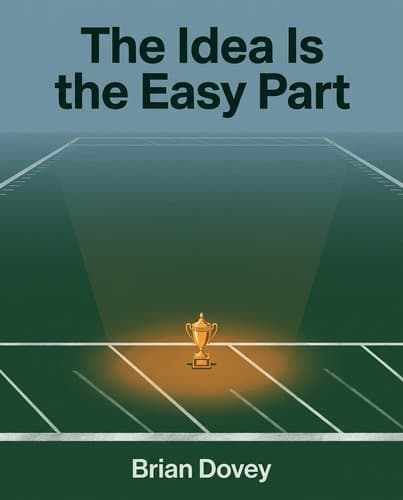
123006399_the-idea-is-the-easy-part
by Brian Dovey
Most startups don't die from bad ideas—they die from failed execution. Brian Dovey reveals the precise frameworks seasoned venture capitalists use to test…
In Brief
Most startups don't die from bad ideas—they die from failed execution. Brian Dovey reveals the precise frameworks seasoned venture capitalists use to test hypotheses cheaply, hire ruthlessly, and avoid the partnership traps that sink promising companies before they ever scale.
Key Ideas
Cheap failures free resources for next bets
Test ideas for under $100,000 before committing: a cheap, fast failure is nearly as good as a success, because it frees resources for the next hypothesis.
Multiply problem probabilities, not add them
When vetting a startup opportunity, multiply the success probabilities of each unsolved technical problem together — if you need to solve five things at 90% odds each, your actual probability of success is 59%, not 90%.
Interview direct reports to assess leadership
Never interview only a candidate's former bosses. Their former direct reports will tell you whether they freeze without complete information, hoard credit, or actually develop the people around them.
Invert the merger failure playbook
The four-step merger failure playbook (let dust settle, winner takes all, top-down decisions, need-to-know secrecy) is a checklist to invert — not follow.
Would you take this deal for nothing?
Before seeking VC, ask yourself Dovey's litmus test: 'Would I take this deal for nothing?' If the answer is no, it's a bad deal at any price — don't let valuation seduce you into a bad partnership.
Strengthen strengths, staff around weaknesses
'Strengthen your strengths; make your weaknesses acceptable' is more actionable than 'work on your weaknesses.' Know which problems you're uniquely suited to solve, and staff or partner around the rest.
VC transforms company into financial instrument
The moment you take venture capital, your company is no longer your baby — it's a financial instrument with a ticking clock. Know this before you sign, not after.
Who Should Read This
Business operators, founders, and managers interested in Startups and Business Strategy who want frameworks they can apply this week.
The Idea Is the Easy Part
By Brian Dovey
10 min read
Why does it matter? Because the startup advice you've been given is optimized for the 20-yard line, not the end zone.
Everyone remembers the pitch. The room, the deck, the moment someone wrote a check and suddenly you were a founder. What nobody talks about — what Brian Dovey has spent thirty years watching people discover the hard way — is that the pitch is roughly the first twenty yards of an eighty-yard drive. The glamorous part is also the easy part. What comes after is messier, more probabilistic, and almost entirely dependent on people making unglamorous decisions under pressure with incomplete information. Dovey has been on both sides of that table: as a founder, as the president of a large company, and as a venture capitalist who has watched brilliant ideas die and mediocre ones scale into billion-dollar enterprises. His conclusion, earned through real failures and improbable wins, is quietly devastating.
Getting Funded Is the 20-Yard Line, Not the Touchdown
Funding is not the finish line. It's barely the starting gun. Brian Dovey, who spent decades as a venture capitalist at Domain Associates after careers as a founder and a large-company executive, puts it bluntly: when a startup closes its first round, it's standing on its own 20-yard line with eighty yards still to go. The check arrives, and the real work begins.
The hard part is accepting that the real work has almost nothing to do with the quality of the original idea. Dovey's favorite illustration is Zappos. Tony Hsieh built the company on a business model that, by conventional logic, was genuinely terrible. Customers could order five pairs of shoes, try them all on at home, and ship back four at no cost. The shipping and return expenses alone made profitability nearly impossible, and the numbers bore that out — even as the company grew rapidly, it was barely breaking even. Amazon still bought it for over a billion dollars. The idea wasn't clever. The unit economics were a disaster. What Zappos had was ferocious execution, a culture obsessed with customer experience, and a founder willing to run toward the problems everyone else flagged as fatal.
Contrast that with a company Dovey's own firm funded: a startup that figured out how to splice human genes into mice. Genuine scientific innovation, the kind that makes researchers excited at conferences. Domain invested, then spent years searching for a business to hang on the science. A product-testing lab using the humanized mice? Existing animal-testing methods were too entrenched to displace. Growing replacement organs? The biological gap between mice and humans was too vast. The science was real. The company was not.
The lesson cuts both ways. A mediocre idea executed with intensity and customer focus can end up worth a billion dollars, while a breathtaking innovation with no viable application is just an expensive experiment. You're not selling the idea. You're building everything that comes after it — and that part, nobody hands you a map for.
The Math of Ambition: Why Complexity Kills More Startups Than Competition
Imagine you're trying to pick a combination lock with five dials, and you can crack each individual dial nine times out of ten. Your odds of opening the entire lock in one attempt — all five dials correct simultaneously — drop to just 59 percent. Slip that per-dial success rate to 85 percent and you're looking at a coin flip. This is arithmetic, not exotic probability theory. And it's what killed TransCell.
TransCell had a genuinely compelling idea: harvest pancreatic cells from pigs, whose pancreas closely resembles the human version, enclose them in a mesh bag implanted in a diabetic patient, and let the cells do what they evolved to do — detect blood glucose and release insulin. No injections. No constant monitoring. A near-cure. Dovey and Domain invested.
The device required solving five separate engineering problems. The mesh bag had to be porous enough for glucose to enter but fine enough to block the patient's immune system from attacking the pig cells inside. Strong enough to survive implantation but biocompatible enough not to trigger rejection. Each problem was theoretically solvable — engineers had cracked versions of them individually, in other contexts. But every time the TransCell team tightened one opening in the mesh to block white blood cells, the insulin couldn't get out. Widen it to let the insulin flow, and the immune system found its way back in. Fixing one dial scrambled the others. They iterated for years before everyone admitted it was finished.
What Dovey took away wasn't that TransCell's scientists were inadequate. The project's ambition was the trap. Five problems at 90 percent each. The math was never on their side, and no one had done the math. He's said since that the phrase 'it's just engineering' — meaning the science is solved and now it's mere implementation — is some of the most frightening language he hears in a pitch.
The Defibrillator Doctor and Other Delusions: What VCs Are Actually Screening For
A doctor walks into a meeting with Brian Dovey and pitches a home defibrillator — a device families could pull off the shelf during a cardiac emergency. The market he described was every household in the country. When Dovey asked how he planned to reach that customer base, the doctor's answer was instant and serene: marketing wasn't a concern. The appeal was self-evident. The product would sell itself. His only worry, he said, was whether there would be enough trucks to distribute all those millions of units.
Dovey passed immediately.
Not because the product was bad. A home defibrillator that walks a panicked non-medic through exactly when to activate it is a genuinely useful device. The doctor was rejected because of what his answer revealed: he had no model of how a product moves from invention to customer. He'd skipped the entire middle of the business — awareness, distribution, trust, price sensitivity — and arrived at a fantasy where demand was a force of nature rather than something you build. That kind of blind spot doesn't shrink after funding. It compounds.
Most founders misread venture capital as a transaction where the best pitch wins. Dovey is explicit that Domain Associates has never funded a cold pitch in thirty-five years. Every deal has come through a trusted introduction. By the time a founder sits across from a VC, the pitch is almost beside the point. What's actually being evaluated is whether this person can be a reliable partner through the years of difficulty that follow the check. Dovey says he almost always ignores the numbers in a business plan and reads the assumptions underneath them instead. Founders who inflate their projections to signal ambition accomplish the opposite: they flag themselves as people who can't distinguish hope from analysis.
The defibrillator doctor had never seriously stress-tested his own thinking, which meant Dovey would be the first person to do it — on the startup's dime, with the startup's equity. Self-awareness is the one thing that predicts whether a founder can fix everything else.
Hire for the Version of the Job You Can't See Yet
The most instructive case against prestige hiring isn't a startup. It's Theranos. Elizabeth Holmes assembled a board that included Henry Kissinger and George Shultz — names that signaled legitimacy to every investor who glanced at the deck. The problem was that neither man had any background in blood diagnostics, which meant neither was equipped to notice when the science stopped adding up. The board wasn't governance. It was wallpaper. Because no one in the room could ask the right technical question, Holmes operated without a real check for years.
Dovey's response to that failure mode is almost embarrassingly simple: when you're evaluating a candidate, skip the former bosses and call the former direct reports. Bosses see what the candidate wants them to see — attentiveness, initiative, results framed favorably. Subordinates see what happens when the pressure is real and the answers aren't clear. Does this person freeze when information is incomplete? Do they hoard credit? Do they make the people under them better, or smaller? A startup can't wait for certainty before moving, and a candidate's former reports will tell you, often without realizing it, whether this person has ever made a call without a full deck.
The board you build and the team you hire aren't marketing to future investors. They're the load-bearing structure. Prestige is what you reach for when you haven't done the harder work of finding out who someone really is.
Execution Is What Happens After Your Plan Gets Punched in the Mouth
Zia Chishti had a problem that couldn't be managed around: it was 1999, the dot-com boom was eating every programmer in California, and Align Technology needed a small army of coders to build the software behind its clear dental aligners. The wait-and-hope approach — post the jobs, pay the going rate, cross your fingers — was the kind of conservative thinking that kills companies. So Chishti proposed something that alarmed the board immediately: move the entire coding operation to Pakistan, where his family had connections and a skilled programmer cost $15,000 a year instead of $100,000. The resistance was instant. Pakistan had shaky infrastructure. The politics were uncertain. It felt reckless.
Dovey pushed back on the resistance, not the proposal. Staying in Silicon Valley, he argued, was the truly dangerous option. Thinking aggressively looks radical until you compare it to the cost of doing nothing. They rented the ballroom of the Ritz-Carlton in Karachi — expensive by the square foot, cheap against what it saved in salaries — and it worked. The talent was there. The internet connection held.
Then 9/11 happened, and the plan had to go. Al-Qaeda's base of operations was uncomfortably close, Wall Street demanded the risk be eliminated, and suddenly Align had to relocate hundreds of employees it couldn't afford to alienate. Dovey pushed for generous severance packages even though local law didn't require them, reasoning that the people being let go would either help the migration succeed or quietly undermine it. They chose Costa Rica — educated workforce, manageable costs — and the transition landed without disaster.
The through-line isn't resilience in the face of bad luck. Moving to Karachi wasn't the strategy; solving the programmer shortage was. When the circumstances changed, the commitment to Karachi had to go with them. Founders who mistake the plan for the goal cling to the original decision because changing it feels like admitting failure. What Align demonstrated is that changing the plan quickly and cleanly, without drama, is exactly what execution looks like when it's working.
The Rorer-Revlon Merger and the Counterintuitive Art of Not Letting Dust Settle
Eighty percent of mergers fail to hit their goals — a pattern Dovey had researched before the integration began. What he found wasn't a mystery. The same four mistakes kept appearing: let the dust settle while a small executive group quietly plans; hand all the good jobs to the acquiring company; make decisions at the top without involving department heads; keep everything secret on a need-to-know basis. The playbook for failure was right there. So he ran the opposite play.
From day one, Dovey acknowledged publicly that the merger meant cuts. No euphemisms, no waiting. But he promised anyone laid off at integration's end would receive six to twelve months of severance — and that promise changed the entire incentive structure. Instead of quietly interviewing for outside jobs and mentally checking out, people had a reason to stay and make the thing work. The threat of a layoff became a retention tool.
He also set up roughly a thousand small task forces, balanced between Rorer and Revlon employees, to handle every question the integration raised — from which salespeople stayed to what the new expense report looked like. Department heads made the calls, not senior management, which meant the people closest to each problem owned the outcome. You can't complain about a decision you made yourself.
Finally, Dovey committed to communicating everything as soon as he knew it. Every time a task force resolved something — a warehouse closing, a product change — a memo went out. He was eventually accused of boring people with the volume. The rumor mill, which thrives on silence, had nothing to feed on.
The Founder Who Cared More About the Title Than the Equity — and What That Reveals
Dovey was scheduled to fly to New York to deliver the news in person. Zia Chishti, founding CEO of Align Technology, would be speaking at a banking convention that week, and the board had voted: it was time for him to go. Then the towers fell. No convention, no meeting, no way to fire a Pakistani American executive without making something painful look like something uglier. Chishti understood the situation with dark clarity. 'That saved my ass, didn't it?' he told Dovey.
It had. For a few more months.
The thing is, Chishti already knew the answer. Before the board vote, before the delay, Dovey had put a single question to him directly: if you were me, would you hire yourself as CEO? Chishti sat with it — actually thought about it — and then said no. He wouldn't. But then, he added, he'd be wrong. They were nowhere near an agreement.
That exchange sits at the center of the hardest problem in a startup: the founder and the company growing at different rates. Chishti had co-founded Align with COO Kelsey Wirth, and together they'd pulled off something genuinely difficult — persuading orthodontists, convincing investors, building a product that hadn't existed before. But Wirth eventually left after a falling-out, and without her, execution problems that had always been present became impossible to ignore. The stock had gone public at twelve dollars and sunk to two. Complexity had caught up with vision, and vision alone wasn't enough anymore.
What Dovey kept running into was simpler than any of that: Chishti seemed to care more about the title than the equity.
A few months after the 9/11 delay, Chishti stepped down. His replacement, Tom Prescott, steadied the company, grew it methodically, and handed it off to another experienced executive. As this book went to press, Align Technology was worth more than twenty-five billion dollars. The founder's equity — the one Chishti seemed willing to sacrifice for the title — turned out to be worth considerably more once he was no longer CEO.
Four Legends, Four Contradictory Secrets: There Is No Algorithm
Imagine asking four chess grandmasters for the one secret to winning and getting four completely different answers: control the center, protect the king, trade down when you're ahead, attack relentlessly. Each answer is correct. Each is also incomplete. That tension is exactly what Dovey found when he was new to venture capital in his late forties, feeling like an imposter, and started buying lunch for legends.
Arthur Rock, who first bankrolled Apple, told him the whole game came down to the jockey — find the right person and back them, full stop. Gene Kleiner, co-founder of the firm that became the most famous VC shop in Silicon Valley, said don't obsess over the idea; find a startup with momentum and fix the execution when it inevitably breaks. Jim Swartz of Accel said ignore both the founders and the company — pick the industry, because when a technology wave rises, it carries everyone. David Leathers, a British biotech investor, disagreed with all of them: follow the money, period; everything else is distraction.
Dovey sat with the contradictions until the pattern emerged. Rock had come up as a salesman — naturally, he read people. Kleiner was an engineer turned operator — naturally, he fixed broken systems. Swartz had spent his career deep in technology analysis — naturally, he saw waves before companies. Leathers was a stock analyst — naturally, he went straight to the numbers. Each man was describing the same elephant from his own corner of the room. Each was also, by any measure, massively successful.
The conclusion Dovey actually draws is the honest one: there is no master formula. What there is, instead, is the principle he settled on for himself — strengthen your strengths; make your weaknesses merely acceptable. He recognized that his instincts were closest to Kleiner's, leaned into that, and built a career from it. You won't find your answer by triangulating among four legends. You'll find it by knowing which one you'd actually be, then playing that game as well as you can. Which is, when you sit with it, the most useful thing he found.
The Question Worth Carrying Forward
The startup world hands out trophies for the wrong things — the raise, the valuation, the TechCrunch headline. Dovey spent decades watching what happens after the confetti. The answer, reliably, is that the hard and boring and unscripted parts take over: the mesh bag that won't hold, the programmer shortage, the founder who loves the title more than the equity. Nobody builds a statue of the person who wrote the right severance policy or ran the radio ad in Austin instead of commissioning the clean study. But that's where the game actually lives.
No formula means no shortcuts. The people willing to do the unglamorous work — without a map, without a guarantee — are the ones who find out what they're actually made of. If there were an algorithm, there'd be no game. There'd just be a procedure.
Notable Quotes
“Ewing, the truth is I’m offering you a smarter deal than the frankly stupid one you just did.”
“Zia, if you were me, would you hire yourself as CEO?”
“I guess I wouldn’t, but then I’d be wrong.”
Frequently Asked Questions
- What is "The Idea Is the Easy Part" about?
- "The Idea Is the Easy Part" argues that entrepreneurial success hinges on disciplined execution rather than inspiration or funding. Drawing on decades of venture capital experience, Brian Dovey delivers practical frameworks for startup evaluation, hiring, mergers, and investor relationships. The book's core premise is that ideas are cheap—what matters is rigorous testing, probability assessment, and smart decision-making at every stage. Dovey teaches founders to validate concepts quickly with minimal capital, multiply the success odds of each challenge together to get realistic probabilities, and understand that venture capital fundamentally changes the nature of their company.
- What is Brian Dovey's approach to testing startup ideas?
- Dovey recommends testing ideas for under $100,000 before committing, arguing that "a cheap, fast failure is nearly as good as a success, because it frees resources for the next hypothesis." This low-cost validation approach allows founders to quickly disprove bad assumptions and redirect capital toward more promising opportunities. By limiting initial investment to $100k, entrepreneurs avoid overcommitting to unproven concepts, learn faster through rapid iteration, and maintain flexibility to pivot or explore alternative solutions when early tests reveal fundamental flaws in their approach.
- How does Dovey evaluate the real success probability of startup ventures?
- Dovey teaches founders to multiply the success probabilities of each unsolved technical problem together. When vetting a startup opportunity with five technical challenges, each with 90% odds of success, founders often intuitively think they have a 90% chance overall. In reality, 0.9 × 0.9 × 0.9 × 0.9 × 0.9 = 0.59, meaning actual success probability drops to 59%. This mathematical approach forces founders to confront the cumulative risk in their ventures and make more realistic assessments of what it takes to succeed, preventing overconfidence in their ability to execute multiple complex tasks.
- What does Dovey recommend before taking venture capital?
- Dovey proposes a critical litmus test: "Would I take this deal for nothing?" If the answer is no, it's a bad deal at any price. This question forces founders to evaluate whether they genuinely believe in the partnership and terms, or if they're being seduced by valuation metrics. Additionally, Dovey warns that once you take venture capital, "your company is no longer your baby — it's a financial instrument with a ticking clock." Founders must understand this transformation before signing, not after discovering it post-investment.
Related Book Summaries
Read the full summary of 123006399_the-idea-is-the-easy-part on InShort