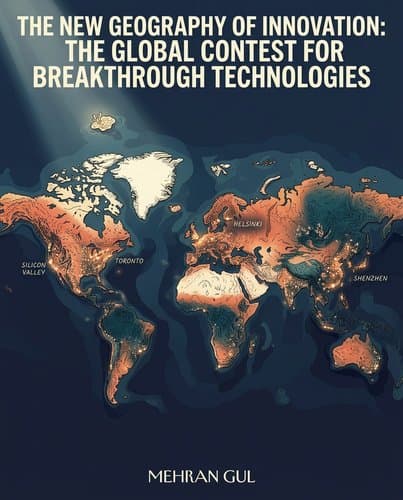
114875985_the-new-geography-of-innovation
by Mehran Gul
The next Silicon Valley won't be built by copying its surface features—it requires replicating the hidden biology underneath. Discover why non-compete laws…
In Brief
The New Geography of Innovation: The global contest for breakthrough technologies (2025) maps how innovation leadership is shifting globally and explains why copying Silicon Valley's policies rarely works without its underlying culture.
Key Ideas
Social infrastructure determines investment success
State investment in innovation can pay spectacular returns (Finland's €400k Supercell loan now returns multiples of all Finnish startup investment ever), but the same intervention creates dependency in other contexts — the difference is whether the underlying cultural and social infrastructure already exists
Extreme change reshapes adoption expectations
China's technology adoption advantage isn't a cultural quirk — it's a rational response to a Lived Change Index 100x more intense than the West's; populations that have experienced 322x GDP growth in a lifetime simply have different baseline expectations for what change looks like
Non-compete law drives ecosystem dominance
Silicon Valley's structural edge isn't talent or capital — it's two legal-cultural features almost impossible to transplant: California's refusal to enforce non-compete clauses, and a venture capital culture that treats power-law returns as normal, making nine failures acceptable if one succeeds
Exit equity distribution enables reinvestment
Europe's wealth-recycling problem has a precise mechanism: when a startup exit creates 11 millionaires instead of 160, the angel investment cycle that compounds Silicon Valley's dominance simply doesn't start — employee equity percentage is the lever, not entrepreneurial ambition
Patient institutional funding discovers breakthroughs
Canada's AI dominance was a deliberate policy choice to fund research through the 'AI winter' when neural nets were career suicide — the lesson is that foundational breakthroughs require institutional patience measured in decades, not quarters
Metrics conflate ambition with innovation
Switzerland's 14-year reign at the top of global innovation rankings while producing no consumer unicorns forces a real question: if a country can be the world's most innovative while building rail networks and privacy protocols instead of startups, the unicorn-count metric is measuring ambition, not innovation
Culture outweighs policy in ecosystems
Every country's innovation strategy converges on the same DARPA-plus-VC template, but outcomes diverge because culture is not policy — you cannot import a startup ecosystem without importing the social norms, risk tolerance, and wealth-recycling behaviors that make it self-sustaining
Who Should Read This
Business operators, founders, and managers interested in Innovation and Startups who want frameworks they can apply this week.
The New Geography of Innovation: The global contest for breakthrough technologies
By Mehran Gul
12 min read
Why does it matter? Because the country that builds tomorrow's technology isn't the one with the best policy — it's the one with the right culture underneath it.
Everyone assumes the innovation race has two contestants. America invents, China scales, and everyone else watches. Then you learn that a 400-person company in Helsinki — started with a government loan the size of a modest house — has earned more money than Avatar, Avengers, and every Harry Potter book ever printed. Combined. The CEO got the job because nobody else put their hand up. That uncomfortable fact doesn't fit the narrative, so most people quietly ignore it. This book refuses to. What Mehran Gul found, traveling from Shenzhen to Singapore, is that the more interesting question was never who wins the tech race — it's what each country's version of innovation accidentally confesses about itself. Every ecosystem looks, up close, like a reef: built from the calcified remains of ideas that almost worked, kept alive by creatures too small to see from the outside.
A 400-Person Company That Beat Hollywood — And What It Tells Us About Where Innovation Actually Lives
Ilkka Paananen became CEO of a Finnish gaming startup in 2000 for a simple reason: he was the only candidate. The founders couldn't afford to pay him, had no outside funding, and handed him the title mostly so he'd have something credible to put on a business card. He was 22, had never held a real job, and freely admits he had no idea what he was doing.
Two decades later, the company that handed him that card — Supercell — built a mobile strategy game called Clash of Clans in six months. That game has since pulled in over $10 billion in lifetime revenue. To put that number in human terms: it exceeds the combined box office of Avatar, Avengers: Endgame, and Avatar: Way of the Water — the three highest-grossing films in cinema history. It outearned every Harry Potter book ever printed. And it came from a team of fewer than 400 people, in Helsinki, seeded partly by a €400,000 loan from the Finnish government.
That loan has compounded in ways no one anticipated. Supercell is now the single largest corporate taxpayer in Finland — paying back, on its own, multiples of every euro the Finnish government has ever put into startups combined.
Here's what Paananen says when asked to explain it: without Finland's public schools, its healthcare system, its social safety net, Supercell wouldn't exist. Not in its current form. Not anywhere close. The company didn't emerge despite its environment — it grew out of it. As he puts it, if it takes a village to raise a child, it takes a city to raise a company.
This is the argument the book opens with, and it should recalibrate everything you think you know about where innovation comes from. Entrepreneurial genius matters. But the most valuable company per employee on earth wasn't born in a garage in Palo Alto. It was built in a country of 5.5 million people, by a student who got the job because no one else wanted it, in a welfare state that made the risk of failure survivable. The city made the company possible. The company paid the city back.
China Didn't Steal the Future — It Did the Homework the West Assigned
Here's the uncomfortable truth the standard story about Chinese tech gets wrong: China didn't just copy its way to relevance. It produced the most cited scientific paper of the twenty-first century — in any field, not just computer science. Four researchers at Microsoft's Beijing lab published ResNet in 2015, a breakthrough in neural network architecture that solved what engineers called the vanishing gradient: the problem that caused AI systems to go deaf in their deeper layers, losing the signal before it could reach the neurons that needed it. The paper has since accumulated nearly a quarter-million citations. Its authors — Kaiming He, Xiangyu Zhang, Shaoqing Ren, and Jian Sun — earned every degree they hold at Chinese universities, had never worked outside China before publishing it, and proceeded to win the ImageNet challenge by being the first team to beat human-level performance at image recognition. The last three editions of that competition have all gone to Chinese teams.
So that's the research picture. But the deeper surprise isn't the lab. It's the street.
Consider what it means to grow up in Shenzhen. In 1980, it was a fishing village of 30,000 people where an average resident earned less than $15 a month. Today it's a city of 17 million with the second-highest concentration of skyscrapers on earth and more billion-dollar tech startups than all of Germany. Someone born there in 1990 has watched their surroundings transform at a pace with no equivalent in recorded history — and the numbers bear this out. Zak Dychtwald, a researcher who tracks generational change in China, measures this through what he calls the Lived Change Index: per capita GDP growth as a proxy for how much transformation a person has actually lived through. Since 1990, Americans have seen that figure rise roughly 2.7 times. For the average Chinese citizen, it's 32 times. For Shenzhen specifically, 322 times.
That number reframes everything. When Chinese consumers adopt facial recognition at airports, or accept driverless buses as an unremarkable feature of a new city, or expect same-day free delivery as the baseline — this isn't a cultural quirk or state coercion. It's a rational response from people for whom radical change is simply the normal condition of life. The West looks at Chinese technology adoption and sees compliance. What it's actually seeing is demand, shaped by a lived experience of transformation so compressed and total that it makes the American postwar boom look like a slow Tuesday.
Silicon Valley Was Built on a Dead Boy and a Fruit Farm — And That's Why It's Still Winning
Think of a technology hub the way you'd think of a coral reef. The reef looks like a natural formation, inevitable, as though it could only have grown in that spot. But beneath the biology is always an accident — a shipwreck, a rock formation, a current that bent just slightly.
The reef that became Silicon Valley started with a 15-year-old boy dying of typhoid in a Florence hotel room in 1884. Leland Stanford Junior had caught the fever after a rough day at the helm of a steamboat on the Bosphorus. His parents dragged him south through Italy trying to outrun the illness. They failed. His father, one of the four men who built the Transcontinental Railroad — shortening the six-month journey between the US coasts to four days — woke from a fitful sleep beside his son's deathbed and said: the children of California shall be our children. Within a year, the family had donated 8,180 acres of Santa Clara farmland and the equivalent of a billion dollars in today's money to found a university in the boy's name. Leland Stanford's vision for that land was cherries and apricots. He wrote in 1887 that the valley's destiny was to export fruit. By the turn of the century he was right — the region supplied a third of the world's prune and apricot harvest. Stanford students still call the campus 'the Farm.'
None of that predicts what came next. What actually made the Valley is subtler and stranger: a line buried in California labor law. The state refused to enforce non-compete clauses. Everywhere else in America, leaving your employer to join a rival meant lawsuits, exile, reputational death. In Boston, people who switched companies were shunned. In the Valley, you could walk out of one semiconductor firm on Friday and start at the competitor on Monday. AnnaLee Saxenian, a Berkeley economist who once predicted the Valley would follow Detroit into decline and was proven wrong, concluded that this one legal quirk rewired the entire culture. Engineers didn't develop loyalty to companies — they developed loyalty to technologies. They thought of themselves as working for the Valley, not for any firm in it. Ideas crossed organizational membranes constantly, recombining in unexpected ways. Boston had a cluster; California had a network. That difference swallowed Boston's head start whole.
The non-competes explain the culture. Sebastian Mallaby's argument about venture capital explains the fuel. VCs abandoned the safe logic of bell-curve investing — spread your bets, average your returns — and embraced something closer to a lottery with extraordinary stakes: nine failures are fine if the tenth is Google. That shift made the cost of missing a winner higher than the cost of backing a loser, which meant money chased risk rather than fled it. A 22-year-old with a wild idea and no collateral could get funded. Failure stopped being career death. When the calculus changed for investors, it changed for everyone else — and the Valley went on to produce, in roughly two decades, the five most valuable companies in the history of capitalism.
Why Europe Keeps Selling Its Crown Jewels — And Why the Math Makes It Rational
Why does Europe keep selling its most valuable companies to American buyers? The instinctive answer — Europeans are more risk-averse, culturally allergic to the kind of swinging ambition that built Silicon Valley — feels right but it's the wrong answer. The real answer is structural, and a venture investor named Hussein Kanji identified its precise shape through one comparison that's hard to shake once you've heard it.
Take PayPal and Skype. Both exited at roughly the same moment in startup history, both roughly equivalent in size when you adjust for timing. Skype actually sold for more — around $3 billion against PayPal's $1.5 billion. By the standard scoreboard, Skype won. But PayPal's exit created somewhere between 100 and 160 millionaires. Skype's created eleven. That gap is the entire story.
An engineer who walks away from an acquisition with a few million dollars doesn't put it in index funds. They become an angel investor. They back the next generation of founders, often people they worked with, often in the same city. They show up at pitch meetings, introduce people, take calls at midnight from anxious first-time CEOs because they remember what that felt like. This flywheel is what makes Silicon Valley self-replicating — not the weather, not the culture, not some mystical frontier spirit, but the fact that successful exits spray wealth across hundreds of people who then pour it back in. When Skype's gains flowed to eleven people instead of 160, the flywheel never engaged. The money concentrated, stayed concentrated, and the next wave of European founders had to go looking for capital somewhere else — usually America.
DeepMind makes the same point from a different angle. Founded in a London townhouse in 2010, it was largely ignored by British investors and sold to Google in 2014 for $500 million. That figure, which once looked like a validation of UK tech, is now what a buyer pays when the seller has nowhere else to go. Without sufficient domestic capital to fund the compute costs that frontier AI demands, there was no credible path to independence. Britain didn't lose DeepMind because its founders lacked ambition. It lost DeepMind because the cascade of reinvestment that might have funded a rival bidder never ran.
The Country That Topped Every Innovation Index While Producing Nothing You've Heard Of
Switzerland has ranked first on the global innovation index every single year for fourteen years straight — and if you asked a software engineer in Tokyo or New York to name a single Swiss tech company, they'd probably stare at you. Not a product, not an app, not even a gadget. Watches, maybe. Chocolate, sure. But the world's leading innovation economy, by the most rigorous measurement anyone has produced, is invisible in the places where innovation is supposed to announce itself.
The paradox dissolves once you accept that the startup-and-unicorn frame is the problem. Switzerland's clearest claim to technological leadership isn't a company — it's a choice made in Geneva in the early 1990s by a British scientist named Tim Berners-Lee. While working at CERN, the particle physics institute buried under the French-Swiss border, Berners-Lee invented the World Wide Web and then faced a decision: patent it on CERN's behalf, or release it to everyone without charge. He released it. The institution surrendered its intellectual property rights entirely. The competing service at the time, Gopher, was technically superior and initially more popular — but it charged a licensing fee. Within years, Gopher was a historical footnote and the web was rewiring civilization. Berners-Lee later reflected that a universal space cannot also be privately controlled. The world's first website address ended in .ch — Confederatio Helvetica, Switzerland's Latin name — a fact that tells you everything about who built the infrastructure the rest of us live on.
The uncomfortable question Switzerland forces is whether the rest of the world's innovation strategies — American, Chinese, European — are actually distinct models or just local variations on the same unicorn-maximizing template. The CERN decision suggests a genuinely different answer: that the most consequential innovations may be the ones where the inventor deliberately kills their own leverage, betting that universal adoption creates more value than controlled extraction ever could. Switzerland didn't get rich from the web. It gave the web away and got rich anyway. Whether that makes it an outlier or a signal about what innovation looks like when it optimizes for something other than venture returns is a question the rankings were never designed to answer.
The Recycled Genius: How Canada Became an AI Superpower by Funding the Research Nobody Else Wanted
At a small AI conference held at a manor house outside Boston in the mid-1980s, Marvin Minsky — the MIT professor who had nearly single-handedly buried neural networks a decade earlier with a book dedicated to their flaws — sat down to listen to a presentation by Geoffrey Hinton. As Hinton spoke, Minsky removed the staple from his copy of the paper, spread the pages across the table one by one, and listened in complete silence. When the talk ended, he stood up and left the room without a word, abandoning the pages on the table. Hinton gathered them up afterward and mailed them back to Minsky at MIT with a note: 'You may have left these behind by accident.'
That moment captures the entire arc of what happened next. Hinton, a British-born descendant of George Boole — the mathematician whose algebra underpins every computer ever built — spent nearly thirty years as a fringe figure in AI, unable to land teaching jobs in the UK, bouncing between institutions on two continents, working through a spinal condition that made sitting impossible and forced him to meet students while lying flat on a desk. The mainstream told him neural networks were voodoo. He eventually found a home at the University of Toronto, where in 2012 his research group entered a Stanford computer vision competition and so thoroughly demolished every competing approach that it essentially ended the debate. Google responded by paying $44 million for a three-person startup built around his work — no products, no revenue, just ideas.
The instinct is to file this as a story about one stubborn genius. What the story actually runs on is Canadian public funding. The Canadian Institute for Advanced Research had backed neural network research for years when the approach was still considered professionally toxic. The Pan-Canadian AI Strategy then built on that bet by funding Mila in Montreal — giving it not just money but the mandate to keep the researchers it trained from decamping to California. The entire edifice rests on a deliberate wager made with public money on science that American and British funders had walked away from.
The immigration system is the other half of the story, and it runs on the same logic. Every major figure in Canadian AI — Hinton from the UK, Yoshua Bengio from France, Rich Sutton from the US — arrived as an immigrant. Canada's points-based system selects for qualifications and processes applications in weeks; the US H1B is a lottery that rejects eight in nine applicants regardless of talent. When US security concerns blocked Iranian researcher Sara Sabour from studying computer vision at a Washington university, she ended up in Hinton's lab at Toronto instead, collaborating on capsule network architecture — work that improved how machines perceive the three-dimensional structure of objects rather than just matching pixel patterns. Canada didn't get lucky. It built a filter the American system actively cannot replicate, and it catches exactly the people the lottery drops.
Everyone Copies the Same Playbook — Which Is Exactly Why the Playbook Isn't the Point
From Stockholm to Tokyo, every founder Gul met wore the same brightly colored t-shirts and used the same tribal slang — 'bruvsky,' 'brofessor,' 'Broseph Stalin' — signals of membership in a single global subculture that had somehow dissolved every national border he crossed. The structural recipe underneath was just as uniform: a government agency taking long-horizon research bets the private sector won't touch, paired with venture-backed startups that commercialize the output. Seoul, Stockholm, Singapore — identical playbook. China is politically different from the West, but its tech ecosystem is, as Gul puts it, Silicon Valley on steroids: more intensely capitalist than capitalism's birthplace, not a rival model but an amplified copy.
And yet outcomes remain stubbornly unequal. The same playbook produces wildly different results depending on who runs it. This is where Gul lands on something genuinely unsettling: copying the policy without copying the culture underneath it almost never works because culture isn't a policy layer sitting on top of a society — it is the society, operating as a living biological system. Ant colonies and microbiomes are superorganisms whose constituent parts have no awareness of the larger intelligence they collectively express. Human cultures work the same way. Every single person alive in England a century ago is dead, yet what we recognize as distinctly English persists. The body replaces every cell but stays itself.
Gul came to this frame reluctantly — it sounds like the kind of thing people say to excuse failure, to dress up inertia as destiny. But the data kept forcing him back to it. Some cultural organisms are what he calls technologically fertile: constantly generating new forms, fizzing with recombinant energy. Others lie dormant regardless of the inputs you apply. You cannot import fertility. It's just the thing the recipe leaves out.
The Imprint You Can't Copy
Here is the thing the playbook keeps leaving out. A Volvo isn't just built in Sweden — it's built by Sweden, stamped with decades of cultural insistence that the person inside the machine matters more than how fast the machine goes. You could move every factory, copy every specification, retrain every engineer, and still not get there. The safety philosophy isn't in the manual. It's in the water.
Which means the uncomfortable question isn't which country wins. It's what you're actually inside when you live inside a winner — whose priorities got baked into the defaults, whose anxieties shaped the guardrails, whose definition of progress you're now breathing like air. Culture doesn't sit on top of a society. It runs underneath everything you can legislate or fund or copy, doing its own logic quietly, all the time.
The real question was never which country wins. It was what winning, in each place, will actually feel like to live inside — and whether you've been paying close enough attention to notice the difference.
Frequently Asked Questions
- What is The New Geography of Innovation about?
- The New Geography of Innovation maps how innovation leadership is shifting globally and explains why copying Silicon Valley's policies rarely works without its underlying culture. Drawing on cases from Finland, China, and Canada, the book gives readers a framework for understanding why different countries produce different kinds of breakthroughs and what actually drives self-sustaining innovation ecosystems. Rather than treating innovation as a universal formula, it reveals how cultural norms, risk tolerance, and wealth-recycling behaviors determine innovation outcomes—demonstrating that policy cannot be separated from the deeper social infrastructure that sustains it.
- Why can't other countries successfully replicate Silicon Valley's innovation ecosystem?
- Silicon Valley's structural edge rests on two legal-cultural features almost impossible to transplant: California's refusal to enforce non-compete clauses and a venture capital culture that treats power-law returns as normal, making nine failures acceptable if one succeeds. These factors enable talent mobility and tolerance for failure. More broadly, every country's innovation strategy converges on the same DARPA-plus-VC template, but outcomes diverge because culture is not policy. You cannot import a startup ecosystem without importing the social norms, risk tolerance, and wealth-recycling behaviors that sustain it.
- How does China's technology adoption advantage compare to Western countries?
- China's technology adoption advantage isn't cultural—it's a rational response to a Lived Change Index 100x more intense than the West's. Populations experiencing 322x GDP growth in a single lifetime inevitably develop different baseline expectations for what technological change looks like. This creates fundamental differences in how populations perceive and adapt to transformation. Rather than reflecting innate cultural traits, China's rapid adoption emerges directly from lived experience of extraordinary economic change, making citizens naturally more receptive to innovation and technological disruption in their daily lives and economic structures.
- What are the key takeaways about state investment in innovation?
- State investment in innovation can pay spectacular returns—Finland's €400,000 Supercell loan now returns multiples of all Finnish startup investment ever—but the same intervention creates dependency in other contexts. The critical difference lies in whether underlying cultural and social infrastructure already exists. Without pre-existing conditions like risk tolerance, talent mobility, and wealth-recycling cultures, state intervention paradoxically reinforces dependency rather than enabling self-sustaining growth. True success requires embedding policy within supportive social structures and behavioral norms that make innovation self-perpetuating.
Related Book Summaries
Read the full summary of 114875985_the-new-geography-of-innovation on InShort