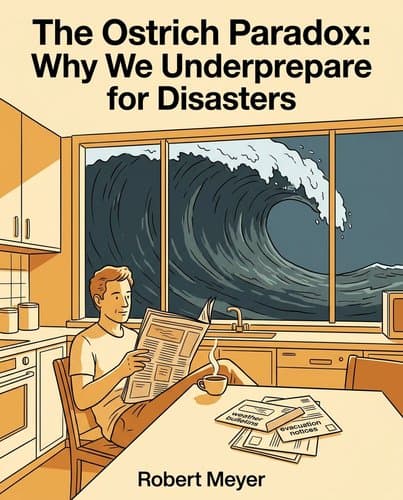
33533611_the-ostrich-paradox
by Robert Meyer
Our brains evolved for frequent, immediate threats—making rare, slow-moving disasters the exact type we're wired to ignore. Six named cognitive biases explain…
In Brief
Our brains evolved for frequent, immediate threats—making rare, slow-moving disasters the exact type we're wired to ignore. Six named cognitive biases explain every predictable catastrophe, and the fix isn't better warnings—it's smarter defaults, bundled actions, and structural design that works with human nature instead of against it.
Key Ideas
Reframe risk as lifetime, not annual probability
Reframe annual probabilities as lifetime probabilities when communicating risk: '1-in-100-year flood' leaves most people unmoved; 'greater than 1-in-5 chance of flooding over a 25-year mortgage' is the same math and far more motivating.
Defaults outperform persuasion for behavior change
Treat default options as policy, not neutral choice: the New Jersey vs. Pennsylvania auto insurance experiment shows that making a safer behavior the opt-out (rather than opt-in) changes outcomes more reliably than any awareness campaign.
Identify cognitive bias, then design solutions
Design preparedness programs starting with the decision-maker, not the hazard — identify which specific bias (myopia, amnesia, optimism, inertia, simplification, herding) will cause a specific population to reject a specific measure, then build around that bias.
Structural mechanisms outlast emotional learning effects
Don't expect experience with near-misses to produce durable preparedness. The emotional charge of a disaster fades faster than factual memory of it (hedonic fading), which is why structural mechanisms — building codes, mandatory bundling, long-term loans — do the work that trauma-based lessons were supposed to do.
Bundle multiple actions to prevent completion illusion
Single protective actions create the illusion of preparedness. The single-action bias means people feel done after step one; effective programs either bundle multiple steps together or make completion the visible, rewarded endpoint.
Warning rejection reflects predictable cognitive mechanisms
When someone ignores a disaster warning, resist the instinct to call it irrationality or indifference — it is most likely one of six identifiable, predictable cognitive mechanisms misfiring on a class of problem the human brain was not built to handle.
Who Should Read This
Curious readers interested in Behavioral Economics and Behavioral Psychology and the science of how the mind actually works.
The Ostrich Paradox: Why We Underprepare for Disasters
By Robert Meyer & Howard Kunreuther
10 min read
Why does it matter? Because when disaster science gets better and death tolls hold steady, we've been diagnosing the wrong problem.
The assumption most of us carry: better data, clearer warnings, more accurate forecasts — smarter preparation. Makes sense. Except five of the ten costliest natural disasters in recorded history happened after 2005, right when satellite imaging and real-time emergency alerts reached their peak. The warnings were there. So were the deaths.
The book's answer isn't that people are stupid. It's that our brains evolved to handle threats that are frequent, immediate, and visible. Disasters are precisely the opposite. Rare enough that your whole lifetime might pass without one. Their worst consequences land on future you. And the habits that work everywhere else — trusting your gut, going with the crowd, waiting to see what happens — turn lethal in the exact moments disasters arrive. This book names the specific cognitive mechanisms behind that pattern, and what it actually takes to design around them.
Better Warnings Made the Failure Harder to Explain, Not Easier to Prevent
On the night Hurricane Sandy hit Staten Island, Glenda Moore loaded her two- and four-year-old children into her SUV and drove for Brooklyn. The route she chose (Father Capodanno Boulevard, a coastal road) was probably the one she always took. Under the circumstances, it was nearly fatal. Within a mile of the bridge, the storm surge swallowed the road. She lifted both children out of the stalled car and waded toward houses in the distance. A wave took them from her arms. She survived. They didn't. That same night, twenty other people drowned on Staten Island alone.
Here's what makes this harder to sit with: Glenda Moore wasn't uninformed. The National Hurricane Center had been warning all week about storm surges up to eleven feet above normal tide levels. She had time. She had access to the same news everyone else had. By every measure of a functioning warning system, the information was there. The failure happened somewhere downstream of the warning.
That gap — between warning and action — is what the book is actually mapping.
Your brain runs on two operating systems that evolved for different conditions. The first is fast, reflexive, automatic: the one that applies your brakes before you've consciously registered the taillight ahead. It works beautifully for familiar situations. The second is deliberate and analytical, built for reasoning through novel problems when it has the right data. When these two systems encounter something rare, high-stakes, and unfamiliar (a storm surge, not just a storm), they tend to fail together in predictable ways. Glenda Moore's deliberate mind tried to reason, hit the limits of her knowledge about how surge flooding actually behaves, and her reflexive system filled the gap with the instinct that usually works: move, find safety, don't stop.
The same architecture fails in experts too. When a frozen sensor caused Air France 447's autopilot to disengage over the Atlantic in 2009, the copilot pulled the nose of the aircraft upward, exactly the wrong move at altitude, where it killed lift and stalled the plane. Pulling up was a trained reflex, drilled in for low-altitude terrain emergencies. For four minutes, with 228 people aboard, the crew couldn't diagnose what was happening. They never identified the simplest explanation: the stick had been pulled back the whole time. The training wasn't wrong. It misfired in a context it wasn't built for.
The common thread isn't ignorance. Our cognitive architecture is misconfigured for rare, delayed, high-consequence threats: the kind where no stored experience gives the reflexive system reliable guidance and the deliberate mind needs knowledge it typically doesn't have. Warnings can arrive perfectly and still fail to reshape behavior when it matters. More information and louder alerts help, but they're aimed at the wrong bottleneck — and one of the biggest isn't attention, it's memory.
We Remember the Disaster. We Forget Why We Were Afraid.
On the hillsides above Miyako, Japan, stone tablets carved by survivors of a 1933 tsunami still stand. One reads: "High dwellings are the peace and harmony of our descendants. Do not build any homes below this point." Nearly half the city had died in that disaster. The tablets were meant to make sure the lesson outlasted the people who'd lived it.
On March 11, 2011, a 129-foot wave funneled up Miyako's bay and destroyed over four thousand structures. Four hundred and twenty people died. The tablets were still there. The warning had survived intact for nearly eighty years. What hadn't survived was the thing the tablets were trying to transmit — the visceral, motivating terror of the water.
Hedonic fading explains the gap. Objective memory (the facts, the dates, the stone record) can last for generations. The emotional charge that makes those facts feel urgent can't. By the time Miyako rebuilt in the lowlands, the 1933 disaster hadn't been forgotten; it had been defused. The tablets were legible. Their motivation was gone.
The reward structure compounds it. In a study of residents along North Carolina's Outer Banks, only 55% of shutter owners said they planned to install them before an approaching hurricane — not because they doubted the risk (they actually estimated wind probability higher than official NHC forecasts), but because previous storms had taught them a lesson. Storms usually miss. Putting up shutters for one that passes means hauling them up and back down for nothing. Your neighbor who skipped all that had a relaxing beach day and felt like an expert forecaster.
That's the inversion: safety done correctly looks identical to safety never attempted. The protected house that survives a near-miss generates no signal — no reward, nothing to reinforce the behavior. So experience, the thing we assume teaches caution, quietly teaches the opposite. The emotional memory fades, the inverted rewards accumulate, and we rebuild in the lowlands.
The Risks We Ignore Are Exactly the Kind Most Likely to Kill Us
The problem with how we process rare risks isn't that we underestimate them. It's that we delete them entirely.
Before September 11, 2001, twenty-two insurance companies wrote $3.55 billion in coverage for the World Trade Center. Despite the buildings surviving a bombing in 1993, and despite a pre-purchase report that explicitly listed an airliner strike as a plausible catastrophe, the insurers lumped terrorism under a generic "all-other perils" clause — the same bucket as meteor strikes. They weren't calculating the risk and deciding it was small. They weren't calculating it at all. The probability was vague, unmoored from any data, and so it fell below the threshold where the brain bothers to engage.
Then the towers fell, and the opposite happened. The footage, the stories, the suddenly vivid knowledge that it could occur: all of it made the risk feel enormous. Air passenger miles dropped 12 to 20 percent, and millions of Americans switched to driving. Economist Garrick Blalock and colleagues estimated that shift killed approximately 2,300 people in 2002 alone. You are roughly 720 times more likely to die per mile in a car than on a commercial flight. Americans weren't wrong that planes could be targeted. They were badly wrong about the relative danger. The most salient risk after 9/11 was not the most deadly one.
Awareness isn't a neutral intervention. When a risk is vague — no number, no precedent, nothing to visualize — it falls out of the decision entirely. When that same risk becomes vivid, it tends to get overweighted. Kahneman and Tversky's research on probability weighting found that people pay far more to reduce a risk from .0001 to zero than from .0002 to .0001, even though the mathematical benefit is identical. The issue isn't how small the number is. It's whether the brain has something concrete to grab. Give it nothing and the risk disappears. Make it too vivid and it crowds out everything more dangerous. That leaves a different question: not how to calibrate perception, but what shapes the decision when perception fails.
What You 'Choose' in a Crisis Was Mostly Decided Before You Got There
Imagine you're signing up for a service and you hit a pre-checked box: "Add renewal protection." Checked means yes unless you move. Most people don't move. Now imagine the same box, unchecked. Most people don't move then either. The form is identical. The options are identical. The only thing that changed is which answer requires effort.
New Jersey and Pennsylvania ran the same experiment at scale — accidentally, with car insurance — and the results are hard to shake. Both states offered drivers the exact same choice: a cheaper policy that limited your right to sue after an accident, or a pricier one with no such restriction. They differed only in which option was the default. In New Jersey, the limited-sue plan was what you got if you did nothing. In Pennsylvania, your existing policy held unless you acted. Same financial stakes, same options, same general population. Yet in New Jersey, 79% of drivers kept the limited-sue plan. In Pennsylvania, only 30% chose it. The default didn't nudge the outcome. It nearly inverted it.
The uncomfortable implication is that people on both sides of that state line weren't reasoning to different conclusions. They were barely reasoning at all. Both groups just went with whichever answer required the least effort. The choice architecture, not the chooser, determined the result.
The NJ/PA data reframes what looks like apathy or indecision in a crisis. New Orleans had eight months of lead time after Hurricane Ivan's near-miss in 2004, with specific knowledge of every vulnerability in its levee system, evacuation infrastructure, and shelter capacity. Almost nothing was done. When Katrina struck in August 2005, over 1,500 people died and nearly a third of displaced residents never returned. Denial and optimism are the easy explanations. But the data points somewhere colder: any new protective investment has to fight the default of inaction. Loss aversion tips the scales further: a $25,000 levee retrofit registers as a concrete cost today; the equivalent savings in avoided flood damage are a vague maybe. The infrastructure project already in motion needs only a budget line to continue. Inaction doesn't require a vote. It just requires nobody to move.
The status quo isn't a neutral outcome of deliberation. It's a position engineered by whoever designed the choice, which means it can be redesigned.
Crowds Don't Correct Your Blind Spots — They Share Them
In May 1977, roughly a thousand people filled the Cabaret Room of the Beverly Hills Supper Club in Southgate, Kentucky (a room built for six hundred), waiting for a John Davidson show. When fire broke out in an adjacent room, an 18-year-old busboy took the stage and told everyone to leave. Some did. Most didn't. They looked around instead. No one nearby was moving with urgency, so they stayed, watching each other watch each other, waiting for a consensus that never came. By the time the lights went out and the rush for the exits began, smoke had filled the passages. 165 people died.
The warning was clear: a teenager on a nightclub stage, telling a thousand people to leave a burning building. What killed people was the gap between hearing it and acting — a brief, fatal interval in which each person surveyed the room, found the same evidence (everyone else sitting still), and concluded it was probably fine.
You don't look to crowds for wisdom; you look for similarity. If your instinct is to stay put, you find the people who are staying put. The ones already heading for the door don't register as signal. They register as anomalies. The crowd doesn't average out individual errors. It ratifies them.
Expertise doesn't break the pattern either. In a laboratory earthquake simulation, participants could invest in mitigation, and one player per group was secretly told whether those investments were actually cost-effective. When mitigation genuinely worked, the informed player invested accordingly, and was ignored. Then the experiment got strange: watching their choices go uncopied, the informed players eventually stopped investing too. The group didn't absorb the expertise. It wore the expert down.
Both cases turn on the same thing: when you scan a crowd for guidance, you're not asking who knows something you don't. You're asking who confirms what you were already going to do. That's a megaphone for whatever bias you walked in with.
Stop Trying to Change How People Think. Change What the Default Option Is.
Every cognitive bias in this book shares one property: you can route around it without fixing it.
Each of the biases we've traced has the same source: human brains misfire when confronted with rare, slow-moving disasters. The standard institutional response is to produce better input — clearer warnings, more vivid scenarios, longer checklists. Meyer and Kunreuther call their alternative a behavioral risk audit, a framework for redesigning preparedness around how people actually decide. If the biases are features of the architecture, not bugs in the software, better input won't help. You need a different output.
The audit works backwards from standard disaster planning. Traditional approaches start with the hazard: analyze the risk, assess the vulnerability, design protective measures. The behavioral risk audit starts with the person: which specific bias will cause which specific population to skip which specific measure, and what redesign routes around it? The question isn't "what does this population need to know?" It's "what design change makes the safer choice the path of least resistance?"
Connecticut's Shore Up CT program is what this looks like in practice. Myopia (the tendency to weight immediate costs far more heavily than distant benefits) makes flood-proofing nearly impossible to sell. A homeowner facing $25,000 in retrofit costs, with no flood in recent memory, won't find the math compelling no matter how carefully you explain it. Shore Up CT, launched in 2014, didn't try to fix that. It offered 15-year loans at 2¾% to finance exactly those retrofits. The numbers then reassemble into something myopia can work with: the loan runs $2,040 a year; the reduced insurance premium saves $3,480 a year; the homeowner nets $1,440 annually from day one. The short time horizon was never confronted. It was bypassed. The benefit is immediate and visible, which is exactly what myopia requires.
That's what the behavioral risk audit produces: not a message, but a mechanism. You're not persuading people to think differently. You're redesigning the choice until it fits the thinkers they already are.
For Threats Decades Away, Even the Best Framework Runs Out of Road
What happens when you apply every lesson in this book — better defaults, reframed costs, bias-aware design — and the math still doesn't work?
Sea level rise is the test case. The parameters are unusually well-defined: seas rising roughly three millimeters annually, with climate scientists converging on a three-foot increase by century's end. Miami Beach spent $400 million on pumps, but sized them for current nuisance flooding, not the much larger problem ahead. New York approved spending for sea level adaptation but targeted a two-foot rise, below what most scientists warn. Both cities knew the threat. Both chose preparation that looks serious but stops well short of the actual risk.
The familiar biases are running in both city halls: politicians won't fund benefits visible only after they've left office; uncertainty about precise timing breeds status-quo inertia; each city reads the other's inadequate response as validation. These are patterns the book has documented. Theoretically, they can be worked around.
But then Meyer and Kunreuther do something unusual for authors with a solution to sell. They point out that a resident who carefully calculates the economic return on costly flood adaptation — precisely the careful, deliberate reasoning the book has championed — will likely find the numbers don't justify it. The threat is too far off. The parameters are too uncertain. The math, done honestly, doesn't close.
At that distance, the authors conclude, persuasion can't run on self-interest. It has to run on moral obligation — the idea that you owe something to people who aren't alive yet, who can't show up at the city council meeting. That's a real argument. It's just not behavioral science. And the authors are honest enough to say so.
The Ostrich Was Never the Fool in This Story
Here's the thing about ostriches: they don't actually bury their heads. That's a myth. What they do is run — up to 45 miles per hour, the fastest two-legged animal on Earth. They can't fly, so they became something else. The book wants that to be you: stop pretending your cognitive limits don't exist, and build systems that route around them. Change the default. Reframe the timeline. Make the safe choice the lazy one. Within a certain range, that works.
But for threats 75 years out, the tools hit a wall. No nudge reaches people who haven't been born yet. No reframed probability makes the numbers pencil out. You'd need something else: a felt obligation to strangers who don't exist. That's not a behavioral science problem.
What the book gives you instead is a precise account of why. When climate action stalls, the failure isn't communication or framing or political will; it's a specific mismatch between the cognitive hardware we have and the timescale the threat requires. Knowing exactly where the system breaks is different from fixing it. But it means you stop misattributing the failure — you know what you're actually looking for. That's what a good map does, even when the territory has gaps.
Notable Quotes
“the best return on an insurance policy is no return at all.”
“disasters can't happen to me”
Frequently Asked Questions
- What is The Ostrich Paradox about?
- The Ostrich Paradox: Why We Underprepare for Disasters (2017) explains why intelligent people consistently fail to prepare for predictable catastrophes. Authors Robert Meyer and Howard Kunreuther map six cognitive biases—including myopia, optimism, and inertia—that cause this failure. The book offers evidence-based strategies for policymakers and individuals to design around these biases. Rather than relying on awareness campaigns, the authors recommend structural interventions like reframing risk communication, changing default options, and using mandatory bundling. The central argument is that disaster underpreparedness stems not from irrationality but from predictable cognitive mechanisms the human brain wasn't designed to handle effectively.
- What cognitive biases does The Ostrich Paradox identify?
- The Ostrich Paradox identifies six cognitive biases preventing disaster preparedness: myopia (short-term thinking), optimism bias (underestimating risk), inertia (resistance to action), amnesia (forgetting past disasters), simplification (oversimplifying decisions), and herding (following others' behavior). Meyer and Kunreuther argue: "When someone ignores a disaster warning, resist the instinct to call it irrationality or indifference — it is most likely one of six identifiable, predictable cognitive mechanisms misfiring on a class of problem the human brain was not built to handle." These biases are predictable patterns triggered by human cognition's evolution. Understanding them enables targeted interventions instead of generic awareness campaigns that typically fail to change behavior.
- What strategies does The Ostrich Paradox recommend for improving preparedness?
- The Ostrich Paradox argues reframing risk communication is crucial. Instead of stating '1-in-100-year flood' (which leaves most people unmoved), Meyer and Kunreuther recommend presenting the same risk as 'greater than 1-in-5 chance of flooding over a 25-year mortgage'—far more motivating. Default options function as powerful policy tools; the New Jersey vs. Pennsylvania auto insurance experiment shows that making safer behavior the opt-out choice (rather than opt-in) reliably changes outcomes better than awareness campaigns. Structural mechanisms—building codes, mandatory bundling, long-term loans—should replace reliance on individual behavioral change. Programs should bundle multiple protective actions or make completion a visible, rewarded endpoint.
- Why don't disaster warnings and experience lead to lasting preparedness?
- The Ostrich Paradox reveals disaster experience doesn't produce durable preparedness because of hedonic fading—emotional impact of disasters fades faster than factual memory. Single-action bias also prevents lasting change: people feel prepared after one protective step, creating false security that halts further action. Meyer and Kunreuther argue structural mechanisms—building codes, mandatory bundling, long-term loans—accomplish what trauma-based lessons cannot sustain. Effective preparedness programs either bundle multiple actions together or make completion visible and rewarded. Awareness campaigns fail because they rely on behavioral change rather than designing systems that reduce cognitive load, requiring willpower people consistently lack during predictable but distant risks.
Related Book Summaries
Read the full summary of 33533611_the-ostrich-paradox on InShort