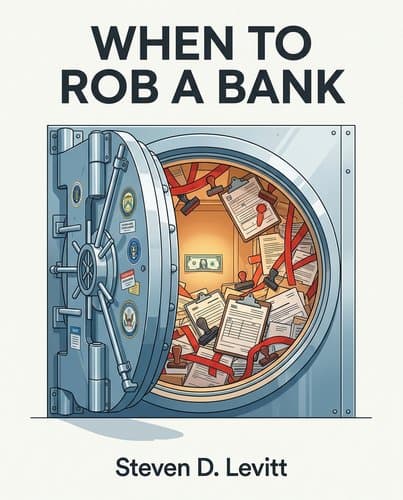
23019295_when-to-rob-a-bank
by Steven D. Levitt
Two rogue economists turn their contrarian lens on everything from TSA security theater to the hidden math of 'green' food choices, revealing that most…
In Brief
Two rogue economists turn their contrarian lens on everything from TSA security theater to the hidden math of 'green' food choices, revealing that most conventional wisdom survives not because it's correct, but because the incentives to question it are too high for everyone else.
Key Ideas
Incentives matter more than assumed incompetence
When an institution seems to be failing at its stated goal, don't assume incompetence first — ask what the actual incentives are for the people inside it. The TSA isn't irrational; it's rationally optimizing for defensible blame-avoidance, not threat reduction.
Unpriced externalities usually matter most
The externality you're not pricing is usually the most important one. For driving, crashes (each added driver raises others' insurance costs by ~$2,000) outweigh both congestion and climate change as a justification for a higher gas tax — yet crash externalities are almost never the center of the policy debate.
Let the math guide virtuous choices
Before making a 'virtuous' choice, check whether the math supports it. Skipping red meat and dairy for one day a week reduces food-related greenhouse emissions more than buying all locally sourced food — because production, not transportation, is 83% of the impact.
Design systems where honesty pays
Cheating is a price calculation, not a personality trait. Design the system so honesty is the rational choice, not just the moral one — because when the expected cost of cheating is low enough, most people will cheat, including people lying against their own financial interest out of embarrassment.
Risk priorities should follow the data
Systematic risk misattribution is costly. We mobilize enormous resources against spectacular, unfamiliar threats (strangers, terrorism, sharks) while underweighting mundane ones (people we know, horseback riding, drunk walking). The corrective isn't optimism — it's looking at the actual numbers before allocating attention or money.
Understanding doesn't guarantee control or outcomes
Sometimes the best available analysis still fails. The fertility test story and Linda Levitt's death sit next to each other in the book for a reason: economic thinking can expose institutional absurdity and statistical error, but it cannot make the outcomes different. Seeing clearly is not the same as being in control.
Who Should Read This
Readers interested in Behavioral Economics and Behavioral Psychology, looking for practical insights they can apply to their own lives.
When to Rob a Bank
By Steven D. Levitt & Stephen J. Dubner
10 min read
Why does it matter? Because the assumptions you have about risk, incentives, and 'doing the right thing' are probably backwards.
Every institution in this book is lying to you — not maliciously, just structurally. The TSA isn't optimizing for your safety; it's optimizing against blame. The IRS outsources tax collection at seven times the internal cost and calls it efficiency. The organic food lobby tells you to eat local when the data says eat less beef on Tuesdays. None of these are accidents. They're what happens when the people making decisions don't bear the consequences of those decisions — when incentives point one way and stated goals point another. Steven Levitt and Stephen Dubner spent a decade poking at this gap between performance and reality, and what they found isn't depressing so much as clarifying: the world makes a strange kind of sense once you stop asking what people say they're doing and start asking what they're actually rewarded for.
The TSA Is Protecting You From Toothpaste, Not Terrorists
Here's a thought experiment Levitt ran on the first day the Freakonomics blog went live at the New York Times: what would you do if you were a terrorist working with limited resources and wanted to maximize fear? His answer — twenty people with rifles and cars, shooting randomly at preset times across the country, then moving on — generated more hate mail than anything he'd written since the abortion-crime paper. The Times shut down comments after a few hundred responses. People called him a moron, a traitor, both.
The follow-up he wrote the next day is the part worth sitting with. He pointed out that the absence of major attacks on U.S. soil since 2001 has exactly two explanations: either counter-terrorism is genuinely working, or the threat isn't as large as advertised and terrorists are less competent than we imagine. Levitt thinks the second explanation is more likely — and that this is actually the optimistic reading.
What makes this more than contrarianism is where it leads. Consider how the TSA actually allocates its attention. A tube of explosive toothpaste, if it somehow brought down a plane, would be traceable: someone approved it, someone waved it through. A shoulder-launched missile fired at a plane from outside the airport perimeter? No one in the security line is responsible for that. So the TSA pours enormous resources into toothpaste and nail clippers, which produces visible, auditable, blame-deflecting activity — and relatively little into threats that are harder to assign fault for. The same logic runs through the CIA: an analyst isn't in trouble if an attack happens, only if there's no written report somewhere in the file suggesting it was possible. So analysts write reports. The institution optimizes for paper trails, not prevention.
The institutions we've built to manage risk aren't optimizing for risk reduction. They're optimizing for defensible behavior when something goes wrong. That sounds like a subtle distinction until you notice it means the biggest, most diffuse dangers get the least attention, while the narrow, traceable ones absorb most of the budget. The TSA can't protect you from everything. But it can prove, document, and demonstrate that it was protecting you from toothpaste.
The Cost You're Not Paying Is the One That's Killing You
Every price you pay is a lie — or at least a partial one. The real cost of almost anything includes consequences that fall on people who had no say in the transaction. Economists call these negative externalities. What this book calls them, implicitly, is the source of almost every miscalibrated incentive in modern life.
Levitt's case for dramatically higher gasoline taxes makes this concrete in a way that's genuinely disorienting. The standard argument is about climate change — burning fuel releases carbon, carbon warms the planet, tax the carbon. Reasonable. But when Levitt actually runs the numbers, global warming comes in dead last among the justifications. At roughly forty-three dollars per ton of carbon and 160 billion gallons burned annually, the climate externality works out to about twenty billion dollars a year — real money, but not the headline.
Congestion costs more: the Texas Transportation Institute estimated sixty-seven billion dollars in lost productivity annually from traffic delays in major metro areas. But even that gets beaten by something almost nobody talks about — crashes. A paper Levitt published in the Journal of Political Economy found that every additional driver on the road raises other drivers' insurance costs by roughly two thousand dollars, because a car that isn't there can't be hit. Stack that across all drivers and you get a tax justification north of two hundred billion dollars a year. The thing we argue about least — traffic deaths and the risk we impose on each other simply by showing up on the road — turns out to be the strongest economic case for making driving more expensive.
The gas tax in 2002 was forty-two cents a gallon. Levitt argued it should be at least a dollar higher. It hasn't moved since 1993.
The costs that are most diffuse, hardest to trace, and easiest to ignore are almost always the most underpriced. The TSA obsesses over toothpaste because toothpaste is auditable. Driving is underpriced because the people hurt by your commute aren't in the room when you decide whether to buy a car. Wherever the gap between private cost and social cost is widest, that's where you find the worst policy — and the most confidently wrong conventional wisdom.
Cheating Isn't a Character Flaw — It's a Price Calculation
Why do people cheat? The instinctive answer involves weak character, poor upbringing, the usual moral inventory. But consider what the data actually shows, and that answer starts to look like a comfortable story we tell instead of an honest one.
A research paper on Mexico's Oportunidades welfare program handed Levitt and Dubner one of the cleanest natural experiments in the literature on lying. Analysts matched what 100,000 applicants claimed to own against what inspectors actually found in their homes once benefits were approved. The predictable fraud was there: 83% of car owners hid their cars, 82% concealed trucks, 80% denied owning a video recorder. The benefit was worth roughly 25% of a typical household's annual spending, the penalty for getting caught was weak, and most people caught hiding assets weren't even removed from the program. The math was obvious. You'd almost have to be irrational not to lie.
But then the data turned strange. Thirty-nine percent of applicants who had no toilet told the welfare clerk they did. Thirty-two percent falsely claimed running water. Twenty-nine percent said they had a gas stove when they didn't. These people were lying in a direction that could get them disqualified from benefits they genuinely needed — lying against their own financial interest, at real cost, with no upside. The researchers chalked it up to embarrassment: facing a government clerk and admitting you have no toilet was apparently more painful than risking exclusion from a program that could materially change your life. Levitt called it one of the most remarkable lies of reputation he'd ever encountered.
What the Oportunidades data gives you, when you hold both findings together, is a complete picture of cheating as calculation rather than character. The car owners weren't more dishonest than the people who claimed fake toilets. They were all responding to the same basic question: what does this cost me, and what do I get? For the car owners, the math pointed toward concealment. For people without running water, the psychological cost of the admission outweighed the financial cost of the lie. Same incentive logic, opposite direction, entirely predictable once you know what people were weighing.
The interesting question was never whether someone is the kind of person who cheats. It's what the structure of costs and benefits made rational in that specific situation. Fix the structure, and behavior follows.
Your Eco-Friendly Choices Are Doing Less Than You Think — and Sometimes the Opposite
Imagine you spend a year driving past the farmers market, swapping grocery bags for canvas totes, and hunting down locally grown produce like someone who genuinely believes food miles are the whole story. Now imagine being told that eating one fewer serving of red meat per week would have done more for the climate than all of it combined.
That's exactly what Christopher Weber and H. Scott Matthews found when they traced the full greenhouse gas footprint of food consumed by American households. Transportation — the thing locavores obsess over — is 11% of food-related emissions. Production, meaning what the food actually is and how it was raised, is 83%. The final leg from producer to store? Four percent. Given those numbers, switching less than one day per week's worth of calories from red meat and dairy to chicken, fish, or vegetables cuts more emissions than sourcing every single thing you eat from a local farm. The food miles argument has the accounting almost perfectly backwards.
The reason is specialization. Industrial food systems are relentlessly efficient at bundling labor, transportation, and energy — so efficient that the environmental cost of what you're eating swamps everything else in the supply chain. A backyard gardener making ice cream or growing zucchini feels virtuous, but once you add the redundant trips, the idle equipment, the wasted output, and the opportunity costs, the math turns ugly. The system that looks industrial and wrong is doing most of the real work.
Skipping a burger on Tuesday looks like almost nothing. No farmers market, no canvas tote, no visible signal to anyone around you. But that's the one that moves the number. When the costs of any choice fall on people far removed from the transaction, and visible behavior earns social rewards regardless of actual impact, you get a market for green symbolism rather than green outcomes. Nobody fixes it because nobody in the system has a clear incentive to.
We Fear Strangers, but the Data Says We Should Fear People We Know
When police investigated the 2008 Christmas Eve massacre in Covina, California, they found that the shooter — Bruce Pardo — had been described by friends and neighbors as gentle, quiet, someone who seemed fine. That same season, a Muslim tax attorney named Atif Irfan was traveling with his family from Washington to Florida for a religious retreat. Strangers overheard him discussing airplane safety, panicked, and had the FBI pull the entire family off their AirTran flight. The FBI cleared them within hours. AirTran still wouldn't fly them home.
Everyone in that story had their threat assessment exactly backwards.
The actual numbers: murder victims know their killers roughly three times more often than they're killed by strangers. Nearly two-thirds of rape victims know their attacker. Of all missing children in a recent survey year, 203,900 were taken by family members, another 58,200 by acquaintances, and exactly 115 fit the nightmare scenario of a stranger abducting a child into the night. The version of danger your brain defaults to — lurking, unfamiliar, unpredictable — is statistically the least likely version to materialize. The version you've been trained to discount, because it's boring and involves people you've already decided to trust, is doing most of the damage. Bernie Madoff didn't find his victims by cold-calling strangers. He built a decades-long fraud almost entirely within his own social network.
The same mismatch runs through physical risk. Horseback riding produces serious injuries per riding hour at a higher rate than motorcycling — the CDC documented this as far back as 1990. When Ben Roethlisberger wrecked his motorcycle without a helmet, the national conversation ran for weeks. When Christopher Reeve was thrown from a horse and paralyzed, nobody proposed banning equestrian sports. The risk that fits our existing story about recklessness gets scrutinized. The risk embedded in something we find charming disappears into private property and missing police reports.
Even the People Supposedly Fixing Things Have No Reason To
The problem with dysfunctional institutions usually isn't that nobody knows what's wrong. It's that the people inside them have no personal stake in fixing it.
Take the IRS. The agency knows, down to a name and address, who owes back taxes — but it's so understaffed it can't collect the money itself. So Congress authorized outsourcing to private collection agencies, who keep 22 to 24 cents of every dollar they recover. A former commissioner told Congress directly: give us more agents and we'll collect nine billion dollars a year for about three cents on the dollar. Congress heard that math and passed. The reason isn't mysterious. No politician builds a career on championing a more aggressive IRS. The tax gap — money legally owed but never collected — runs roughly the size of the federal deficit, and closing it would require publicly embracing the one agency most voters want left starved. So every individual congressman's rational move is to leave the problem in place, let private agencies skim a quarter off the top, and avoid the headline.
The same structure appears in academic tenure. Levitt argues that tenure protects exactly the wrong people. It doesn't shield scholars doing controversial work — a university that fires someone for heterodox ideas just sends them somewhere else. What tenure actually does is make it nearly impossible to remove faculty who produce nothing. And the incentives that created the system have no internal critics: tenured professors benefit from it, administrators avoid the conflict of dismantling it, and the people most harmed — students, junior colleagues, universities paying salaries for zero output — have no formal mechanism to change it. Levitt's proposed fix is blunt: abolish it, pay everyone fifteen thousand dollars more, and watch the deadweight leave while the productive people stay. Clean, cheap, obviously correct. Also never going to happen without someone inside the institution deciding that fixing it matters more than the peace of not trying.
That's what connects these cases to everything else in this book. The solution is usually visible. The diagnosis is usually easy. What's missing is anyone whose incentives point toward implementation rather than away from it.
When the Clinical Lens Turns on Grief, It Doesn't Break — It Cuts Deeper
A gastroenterologist named Michael Levitt is standing at a hospital nursing station, waiting for an incontinence diaper for his fifty-year-old daughter who is dying of cancer. The nurse tells him she has other patients to care for. He knows she does. He is only interested in his daughter.
The final chapter is technically a miscellany — a pile of blog posts with no connecting tissue, the authors admit as much. KFC's staffing ratios. Anti-God books. Jim Collins's Good to Great, and how two of its eleven exemplary companies later lost eighty percent of their value. Levitt's instinct, as ever: look at the actual numbers rather than the story the numbers are supposedly telling. Strip the sentiment, find the incentive, follow the outcome.
That lens doesn't break when Michael Levitt turns it on his daughter's twenty-day death. It cuts more cleanly.
His account is written in the flat, bureaucratic language of a physician who has spent fifty years in hospitals. When his daughter returns to the referral center in a wheelchair — six days after leaving in apparent good health — her heart is beating irregularly at roughly 145 times per minute. The Rapid Response Team arrives and treats the atrial fibrillation as the primary problem. Her pulmonary function has deteriorated over eight hours; the tumor doubling inside her lung is the actual emergency. The young doctors are solving the auditable, assignable problem. The bigger thing keeps moving.
He catalogs the rest with the same precision: a prescription that takes ninety minutes to fill, a diaper that requires a nurse to finish her paperwork first, discharge delayed for hours because home oxygen is hard to arrange on a weekend. None of these people are villains. The physicians were generous with their time and did everything possible against an enormously aggressive cancer. But the system around them is optimizing for something other than his daughter — for process, for documentation, for the kind of defensible behavior that matters when something goes wrong. Which is exactly what the TSA does with toothpaste, what the IRS does with understaffing, what the tenure system does with deadweight faculty. The gap between what institutions are supposed to do and what they actually have incentives to do is the book's whole argument. Here it appears without any comedy at all.
Steve Levitt's eulogy follows, and you learn that Linda — his sister — coined the word Freakonomics, transformed his personality in middle school with the same confident contrarianism the book celebrates, and built profitable online businesses in 1995 that everyone around her insisted were doomed. Look at what's actually there, not the story people are telling about it. She lived it rather than theorized it. The book you've been reading exists because she named it.
The Method Doesn't Protect You — It Just Makes You Honest About What You See
The book doesn't ask you to become a cynic. It asks you to stop pretending that good intentions are the same as good outcomes — because once you make that trade, you can't unsee it anywhere. The same move that exposes TSA theater and green-label marketing also follows Michael Levitt down a hospital corridor while his daughter's tumor doubles and the paperwork catches up slowly. That's not a failure of the framework. That's the framework doing exactly what it's supposed to, revealing how even institutions staffed by decent people can end up optimizing for something other than what they're there to do. Levitt and Dubner's actual argument is that seeing that clearly — without flinching, without consoling yourself with the stated mission — is the only honest place to begin. Not the place where things get better automatically. Just the place where you're finally looking at what's actually there.
Notable Quotes
“Daddy, I am going to tell you something you are not going to want to hear. The MRI showed that I have two brain tumors.”
“—one of those relative terms employed in oncology. A Greek aphorism warns,”
“I have more patients to care for than just your daughter, Dr. Levitt.”
Frequently Asked Questions
- What is the main argument of When to Rob a Bank?
- When to Rob a Bank applies economic logic to everyday life by examining how institutions and individuals actually behave through data rather than assumptions. The book collects a decade of Freakonomics blog posts revealing how institutions optimize for wrong incentives, how conventional wisdom fails basic math, and how real data on risk, cheating, and taxes exposes the hidden rationality and absurdity in modern behavior. Rather than assuming failure means incompetence, the authors show that examining actual incentives explains seemingly irrational choices.
- Why do institutions seem to fail at their stated goals according to this work?
- When an institution seems to be failing at its stated goal, don't assume incompetence first — ask what the actual incentives are for the people inside it. The TSA exemplifies this: it's rationally optimizing for defensible blame-avoidance, not threat reduction. By understanding the actual incentive structure, what appears as institutional failure reveals itself as rational behavior given the incentives people face. This shift in perspective changes how we diagnose and address systemic problems.
- What does the book reveal about how people make decisions about cheating?
- Cheating is a price calculation, not a personality trait. Design the system so honesty is the rational choice, not just the moral one — because when the expected cost of cheating is low enough, most people will cheat, including people lying against their own financial interest out of embarrassment. This insight means ethical behavior depends primarily on whether the system makes dishonesty costly or risky, not on individual character.
- What are the limitations of economic analysis discussed in When to Rob a Bank?
- Sometimes the best available analysis still fails. Economic thinking can expose institutional absurdity and statistical error, but it cannot make the outcomes different. The book notes this limitation through stories placed side by side: one revealing how economic analysis uncovers absurdity, another showing tragedy beyond analysis's control. Seeing clearly through data and incentive analysis is not the same as being able to control or change outcomes.
Related Book Summaries
Read the full summary of 23019295_when-to-rob-a-bank on InShort