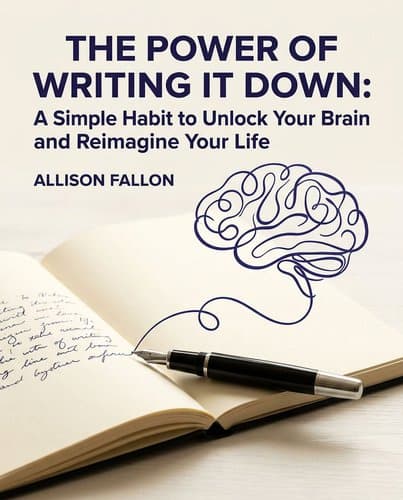
52609381_the-power-of-writing-it-down
by Allison Fallon
The place you freeze on the page is never a coincidence—it's a map of exactly where your life is stuck. Science-backed and surprisingly simple, 20 minutes of…
In Brief
The place you freeze on the page is never a coincidence—it's a map of exactly where your life is stuck. Science-backed and surprisingly simple, 20 minutes of daily unedited writing breaks the invisible loop between the stories you've inherited, the feelings you avoid, and the results you keep getting.
Key Ideas
Freewriting unlocks measurable biological healing effects
Schedule four 20-minute writing sessions this week. Don't edit, don't aim to produce anything readable. The goal is to translate what's happening — whatever is stuck — into language. The Pennebaker data is unambiguous: this alone has measurable biological effects.
Writing reveals stuck patterns in life
When you feel blocked on the page, ask: where is this same stuck pattern showing up in my life? The chapter and the life are always in sync. The page is diagnostic, not just expressive.
Infinity Prompt framework untangles stuck situations
Apply The Infinity Prompt to any situation where you feel stuck: (1) What are the objective facts — court-of-law details only? (2) What story am I making up about them? (3) How does that feel, and where do I feel it in my body? (4) What do I do because of or to avoid that feeling? (5) What result does that behavior produce — and does it loop back to reinforce the original fact?
Writing to one person removes performance
Write to one specific person — real, even if you'll never send it. Writing to an audience of one removes the performance pressure of being a parent, spouse, or employee and lets honest words come. The woman who thought she'd fallen out of love with her husband discovered the opposite the moment she directed words at him.
Third-person narration creates emotional distance
When a situation is consuming you, try narrating it in the third person: 'She didn't realize that what she was calling a career problem was actually a question about who she wanted to become.' Distance creates the narrator perspective that's impossible from inside the story.
Precise emotional words regulate mood better
Notice the words you default to when things go wrong. 'That sucks' and 'I'm devastated' are not equivalent — if your brain can't tell the difference between them, you're experiencing the Vanderbilt effect. Expanding your emotional vocabulary through writing will do more for your mood regulation than positive thinking alone.
Who Should Read This
People working on personal growth in Habit Formation and Self-Improvement, especially those tired of generic motivational advice.
The Power of Writing It Down: A Simple Habit to Unlock Your Brain and Reimagine Your Life
By Allison Fallon
10 min read
Why does it matter? Because where you're stuck on the page is where you're stuck in your life — and there's data to prove it.
There's a feeling you've probably been explaining away for years. Not depression. Not crisis. Just a persistent, low-frequency sense that something in you isn't quite getting out. You've tried the obvious things — sleep, exercise, therapy, a better morning routine. None of them touch it, exactly. Allison Fallon has a name for it: The Hang-Up. And she has a neurological explanation for why everything you've tried keeps sliding off it. More surprising is what she offers instead: twenty minutes, a pen, and research showing that four days of writing produces measurable immune improvements that last months after you stop. Not metaphorically — in your cells. The deeper claim is stranger still: the place where you stall on the page is the place where you're stalled in your life. Not a metaphor. A map.
You're Not Undisciplined — Your Brain Automated a Path You No Longer Want to Take
Habits don't fail because you lack willpower. They stick because, somewhere around the thousandth repetition, your brain stops deciding and just executes. Until you understand that, you'll keep blaming yourself for losing a fight that was rigged from the start.
That low-grade wrongness (what Fallon calls The Hang-Up) isn't a character flaw. It persists even when life, by any reasonable measure, is fine: decent job, people who care about you, no disaster to point to. And yet something nags, at the end of the day or the start of it. So you do what most of us do: outrun it. Wine, TV, a late-night scroll. You've built an impressive array of routines designed to drown out the signal before it reaches you. The Hang-Up, Fallon argues, is a message you've become skilled at not reading.
Here's the neuroscience. Every time you repeat a thought or a behavior, a signal travels from one neuron to another along a neural pathway. The first time, it's rough going. The hundredth time, it's a highway. After thousands of repetitions, the brain stops deciding. It just takes the old road automatically. That's why you can still navigate to a house you lived in a decade ago without consciously thinking about the turns. Efficient, even brilliant. And if you're trying to change something, this efficiency is exactly the problem.
Building a new habit means competing against infrastructure your brain spent years constructing. The signal already knows where it's going. Willpower keeps failing because you're trying to override a system built to resist override — not because there's something wrong with your character.
That mechanism runs in the other direction too — at least, that's Fallon's claim. Write something down repeatedly, and you might not just be recording words. You might be laying new road.
Writing for Four Days Changed Their Immune Systems for Months
Sixty-three people sat down to write about the worst thing that had recently happened to them. They were middle-aged tech workers (engineers, managers, specialists) who had just been laid off after an average of fifteen years with the same company. Researchers gave one group a simple instruction: write about the emotional reality of what had just happened. The anger at their employers. What their spouses were thinking. What they feared about the future. The other group wrote about how they'd managed their time at work.
Eight months later, 52 percent of the expressive writers had new jobs. Only 20 percent of the time-management writers did, despite sitting in the same number of interviews.
James Pennebaker, who designed the study, offered an explanation: unprocessed resentment finds outlets. Someone who has never put words to their fury at being fired will often leak it into an interview, not consciously, not intentionally, but in small moments of defensiveness or misplaced edge. Writing drained that animosity. It closed something that had been left open, and changed what these people did in rooms with strangers, months later, in ways they probably couldn't track themselves.
And then there's what it did to their bodies.
Pennebaker ran a separate study in which participants wrote for just twenty minutes a day, four consecutive days. People who did this visited the doctor 43 percent less often for illnesses like colds and flu — and the effect didn't fade when the writing stopped. Months after the experiment ended, their immune systems were measurably stronger than those who hadn't written at all.
The best explanation available is that leaving charged experience unprocessed is physiologically expensive — the body keeps a stress response running in the background, like an app that never quite closes. Writing seems to close it.
If Your Brain Can't Tell a Friend's Death from a Bad Pizza, Your Vocabulary Is the Problem
Imagine a doctor who only knows five diagnoses. No matter what walks through the door — appendicitis, a torn ligament, a kidney stone — she'll eventually force the case into one of those five boxes. It's not negligence. It's the limit of available categories. Your brain works the same way with emotions.
Vanderbilt researchers studying depression and suicide risk began cataloging the specific words their patients used. What they found: when someone uses "that sucks" to describe both a friend's death and a pizza with the wrong toppings, their brain registers both as roughly equivalent tragedies. Not because they're confused, but because without finer linguistic distinctions, the brain has no other option. A limited vocabulary means a limited emotional range. The categories available to you are the categories you experience.
Researchers call it affect labeling. What it describes is a precise mechanism: the right word for the right feeling turns down the alarm in your brain's fear center. The amygdala quiets; the prefrontal cortex kicks in. Naming isn't just reporting. It's regulating. Find the exact word for what you're feeling and something closes in the brain, a stress response that had been running in the background, waiting for clarity.
Writing is how you build vocabulary for your inner life, not the kind in a dictionary but the kind that lets your brain tell a friend's death from a bad pizza. Without those distinctions, the brain doesn't regulate. It just reacts.
The Infinity Prompt: How to See the Gap Between What Happened and the Story You're Telling About It
Amy walked into a writing workshop knowing exactly what her problem was. She'd been yo-yo dieting for years, she told the group, and she was ready to do something about it. When asked to name the facts of the situation — the objective, court-of-law details — she didn't hesitate: "I'm fat."
Allison Fallon paused. Then she turned to the rest of the room and asked everyone who agreed with Amy to raise their hand.
Not a single hand went up.
Amy was tall, blonde, the kind of person who turns heads. But that wasn't the point. The point was the distinction between a fact and the story you're telling about a fact. "I'm fat" isn't something you could enter into evidence. It's an interpretation, specific to Amy's own perception of herself. The actual fact, after a few more questions, was simpler and more precise: Amy had recently gained ten pounds. That was verifiable. Everything else was construction.
The Infinity Prompt begins with facts, and only facts. Not how you feel about them. Not what they mean. Just what happened: who was there, what was said, what you could describe to a stranger without editorializing.
The prompt has five parts. Facts come first. Then the story — the interpretation you've built around the facts, the meaning you've assigned without necessarily noticing. Then feelings — the tightness in the chest, the stomach dropping, the jaw that won't unclench. Then actions: what you do because of the feeling, or to escape it. And finally the result, which almost always loops back to confirm the original fact, locking the whole structure in place.
When Fallon pressed Amy past the facts and into the story, Amy had written something that revealed more than she realized: when she looks in the mirror, she cringes. Fallon asked what the actual thought was underneath that cringe. Amy looked at her paper. She said she'd written that she was disgusted with herself. Fallon pushed gently further: wasn't the thought, more precisely, "I am disgusting"?
Something moved across Amy's face. She'd had that thought, in those exact words, more times than she could count. She had never once stopped to put language to it. It had just been running, unnamed, the whole time.
This is what the prompt does. It doesn't ask you to express what you already know. It asks you to slow down at the gap — the gap between what literally happened (ten pounds gained) and the meaning that got welded to it ("I am disgusting"), so quickly and so quietly that you'd have sworn they were the same thing. Most behavioral loops live entirely inside that gap. You can't change what you can't see.
You're Not the Protagonist Trapped in the Story — You're the Narrator Who Can See Its Shape
Robert sat down to write a goodbye. Not a short note: an elaborate explanation, everything his family would need to understand why he'd made the decision he was about to make. He had loved writing as a teenager, filling notebooks with stories and poems, but adult life (the velocity of building a company, the demands of email and deadlines) had squeezed it out. Now he was in the worst stretch of his life. A repressed memory had surfaced, addiction and mental health had brought him to the edge, and he had decided to end it. So he wrote. He had to. There was simply no other way forward.
What happened next surprised him. As he organized his story into sentences, putting the facts in sequence, assigning words to things he had never named, something shifted. He wasn't inside the experience anymore. He was outside it, looking at it, the way you look at something on a screen. And from that distance, he felt something he hadn't expected: compassion. For himself. For the child who had survived what that child had survived. By the end, Robert chose to live.
Fallon calls this the shift from protagonist to narrator. The protagonist is inside the story, reactive, absorbing, unable to see what's coming or why things keep going the way they do. The narrator is the voice that steps back, sees the arc, names what's happening without being leveled by it. Both voices live in you. The protagonist runs your day. The narrator already knows what you want and understands the pattern — it just needs a way out.
Writing is that way out. Not because it solves anything directly, but because it forces you to construct a sequence, and sequences have shapes. When you string events into sentences (this happened, then this, then I felt this, then I did this), you can see the structure of something that felt like chaos. The narrator can't speak when you're too deep inside the experience to look at it. Give it a page, and it will show up.
Robert sat down to write a farewell. What emerged instead was a map of his own survival. He had been both people the whole time — the one drowning and the one who could see the shore. Writing let the second one finally speak. The stakes aren't always that high. But the narrator shows up in quieter moments too: the private writing no one will read, the future you're only beginning to imagine.
The Sentence Hidden Under the Grocery List
Fallon flew home from Indianapolis after a client told her about finding his murdered wife's journals — a relic, he said, the closest thing left.
On the plane, she texted her sister: if anything ever happened to her, destroy every journal she'd ever written. Half-joking. Mostly not.
When she got home, she opened her desk drawer and started reading. Most of it was what she expected. Then she found a page covered in a grocery list and doodles, with a single sentence scratched so faintly it was almost invisible. It was from her years in an abusive relationship, when she barely journaled because she feared what would happen if he found the words.
The sentence: I never knew love could feel so much like hate.
The woman who wrote those words is someone Fallon can barely recognize. Not because the pain wasn't real, but because she got out. The sentence is evidence — a timestamp on suffering that ended. Reading it, she could measure the distance between who she was then and who she is now. Without the words, that distance is invisible.
This is what writing leaves behind that nothing else does. Money gets divided. Possessions disappear. But a sentence under a grocery list can outlast everything — proof of what you survived, proof of how far you've come. And the voice that produced it is the one thing that can never be taken away.
The Chapter Card That's Still Empty
Amy's last chapter was still blank. Not because she'd missed something — because it hadn't happened yet. That gap is the whole point. Every loop you recognized yourself inside, every unnamed sentence you've been carrying, every pattern that keeps producing the same result — none of it writes the ending. You do. The narrator voice that can see the arc you're living, that surfaces what the protagonist is too close to name, has been inside you the whole time, waiting for twenty minutes and a page. Your words are how you find your way back to yourself. The ending hasn't been written. That's not a gap in the process. That's the invitation.
Notable Quotes
“This is how we take out the garbage,”
“This is what we think about your mother-in-law.”
“that sounded strikingly similar to what I was”
Frequently Asked Questions
- What is The Power of Writing It Down about?
- The Power of Writing It Down: A Simple Habit to Unlock Your Brain and Reimagine Your Life (2021) is a guide to expressive writing based on psychological research. Allison Fallon shows how writing privately, without editing, produces measurable benefits for mental and physical health. The book provides practical tools including the Infinity Prompt and targeted journaling techniques to help readers break stuck patterns, expand emotional awareness, and reconnect with their own voice and life story. Rather than focusing on polished content, the approach emphasizes translating internal experiences into language as a transformative practice.
- What are the main techniques taught in The Power of Writing It Down?
- The book offers several practical writing techniques. The Infinity Prompt is a five-step diagnostic tool examining facts, stories about them, bodily sensations, resulting behaviors, and feedback loops. Writing to one specific person removes performance pressure and enables honesty—a woman who believed she'd fallen out of love discovered the opposite when she directed words at her husband. Third-person narration creates distance from consuming situations. The book emphasizes expanding emotional vocabulary through writing, distinguishing between phrases like "that sucks" and "I'm devastated" rather than defaulting to weak descriptors. Each technique addresses cognitive and emotional blocks preventing authentic expression.
- What does research say about the health benefits of expressive writing according to this book?
- The book draws on Pennebaker's research showing measurable biological effects from expressive writing. Fallon recommends scheduling four 20-minute writing sessions weekly, writing without editing to translate whatever feels stuck into language. "The Pennebaker data is unambiguous: this alone has measurable biological effects." These sessions don't aim to produce readable material—the therapeutic benefit comes from translating internal experiences into words. The research demonstrates that consistent expressive writing produces quantifiable improvements in both mental and physical health, making it a scientifically-supported wellness practice anyone can implement.
- How does the page reflect patterns that are stuck in your life?
- Fallon teaches that "The page is diagnostic, not just expressive"—writing patterns directly mirror life patterns. When blocked on the page, the question becomes: where is this stuck pattern showing up in my life? This diagnostic approach means writing reveals not just emotional contents but behavioral cycles. By noticing what blocks your writing, what words you default to, and what stories you tell, you gain insight into patterns constraining your life. The Infinity Prompt helps trace how facts, stories, feelings, and behaviors create reinforcing loops that show up both on the page and in lived experience.
Related Book Summaries
Read the full summary of 52609381_the-power-of-writing-it-down on InShort