13585722_the-pumpkin-plan
by Mike Michalowicz
Most businesses fail not from lack of hustle but from serving too many wrong clients—stop spreading thin and discover how to identify your best customers, fire…
In Brief
The Pumpkin Plan: A Simple Strategy to Grow a Remarkable Business in Any Field (2012) argues that sustainable business growth comes from ruthless focus — eliminating weak clients, unprofitable services, and distractions to concentrate entirely on your best clients and strongest capabilities.
Key Ideas
Data-driven client evaluation removes emotional bias
Build an Assessment Chart immediately: list clients by revenue, cross out anyone who makes you cringe, then grade the rest on Pays Fast, Repeat Revenue, Communication, and Fix It. The chart makes the firing decision data-driven rather than emotional.
Focus on your unique competitive advantage zone
Find your Sweet Spot before you expand — it's the intersection of your top clients' needs, your single Area of Innovation (Quality, Price, or Convenience — pick one), and your ability to systematize delivery. Everything outside this intersection is a distraction.
Eliminate low-revenue time sinks strategically
Use the Shaw Solar test: identify which service consumes the most time for the least revenue, then eliminate it. The paradox is that subtraction often multiplies demand — clients who called for the cut service often ask 'what else can I buy?'
Interview clients before launching new services
Apply the Wish List interview — ask top clients what would let them finish work an hour earlier, what frustrates them about your industry, what they wish you understood — before investing a dollar in any new offering.
Validate ideas with refundable deposits first
Run the Insider Strategy's Predictor question before building anything new: 'I have this idea for X — is this something you'd want?' A non-response is a no. A yes with a non-refundable deposit is a guarantee.
Document processes for consistent non-expert execution
Design your business around the Airline Safety Card Method: document every process until a non-expert can execute it consistently. A business that requires the owner to perform deliverables is not scalable — it's a job with extra paperwork.
Obsess over top nine clients relentlessly
Pick your Top 9 and make the list visible. Post it. Attend to their calls first, modify products for them, surprise them with over-delivery. Everyone else gets good service; only these nine get obsessive service.
Who Should Read This
Business operators, founders, and managers interested in Startups and Business Strategy who want frameworks they can apply this week.
The Pumpkin Plan: A Simple Strategy to Grow a Remarkable Business in Any Field
By Mike Michalowicz
13 min read
Why does it matter? Because the harder you work on a broken model, the more permanently stuck you become.
Here's the hard truth about your exhausted, cash-starved business: the problem isn't that you're not working hard enough. You're probably working yourself to ruin. The problem is that you're watering every plant in a field of weeds when you should be killing most of them. Every entrepreneur hitting a wall believes the exit is one more client, one better hire, one bigger deal away. It never is. The people who actually broke through didn't add more — they cut savagely, narrowed obsessively, and served fewer people better than anyone else on earth could. This book is about that process: identifying which clients deserve your genius, firing the ones quietly destroying you, and building systems so your business runs without your hands on everything. The counterintuitive part isn't the strategy. It's accepting that doing less, deliberately, is what finally makes the business grow.
You're Not Failing Because You're Working Too Little — You're Failing Because You're Trying to Grow Everything
Mike Michalowicz is standing in a retirement home he can only afford because his computer services company — nearly a million dollars in annual revenue — is broke. He has stress blotches on his face. He has just been named New Jersey's Young Entrepreneur of the Year. He is a mess.
That contradiction is the whole point. More revenue didn't fix anything. Working longer didn't fix anything. The harder Mike pushed, the more his company needed him to keep pushing just to stay in the same place. His mentor Frank — a 70-year-old who'd grown an $8 million company into an $80 million one — put it plainly: keep operating this way and you'll end up a broken man in a rusty lawn chair, drooling, broke, haunted by what could have been. Not because you didn't work hard enough. Because the model itself was eating you alive.
Mike's model was simple and catastrophic: say yes to everyone. Drive six hours to install a mouse. Discount wildly for anyone who asked. He had no pride and infinite hustle — and what it produced was a company that consumed his entire life and returned almost nothing. More clients meant more chaos. More chaos meant more of Mike's time. There was no ceiling to how much he could give and no floor to how little he could keep.
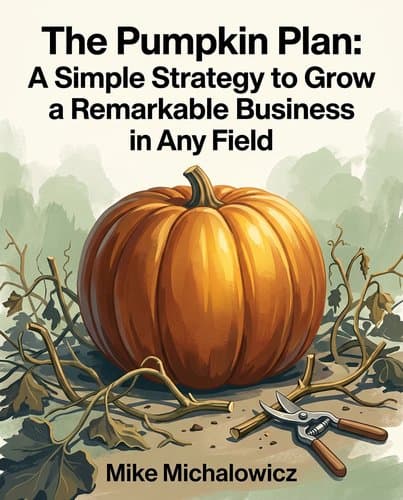
Then a newspaper story about a county-fair pumpkin farmer cracked the whole thing open. These obsessives who grow half-ton pumpkins don't get there by watering every plant equally. They identify the strongest candidates on each vine, cut everything else away without mercy, and focus every drop of care on the one specimen with the most potential. The farmer who tries to grow a hundred decent pumpkins will always lose to the one who grows a single freak of nature.
That logic inverts everything most entrepreneurs believe. You're not behind because you need more clients. You're behind because you're pouring energy into the wrong ones. Every rotten client you keep, every mediocre account you chase, is a vine you're watering instead of your best one. More hustle doesn't fix a broken model. It just breaks you faster.
The $1,800 Seed: You Cannot Grow a Prize-Winning Business by Planting Random Ideas
Imagine you want to grow the biggest pumpkin on your block. You buy a packet of basic seeds from the hardware store, plant a dozen of them, and water faithfully all summer. You'll get pumpkins — probably fine ones — but you will never, ever win a record. The genetics aren't there. No amount of fertilizer or care can manufacture what wasn't in the seed to begin with.
Chuck Radcliffe — a New Jersey hobbyist who got obsessed with growing giant pumpkins so he could photograph his son sitting inside one — accidentally explains this better than any business school professor could. Chuck makes an annual pilgrimage to the International Giant Vegetable Grower's Convention in Niagara Falls, partly for the community, but mostly hoping a top grower might hand him a single seed over a beer. One seed — not a packet, not a pound — that can cost $500. The best ones run $1,800 apiece. Do the math: a single pumpkin seed weighs roughly 1/200th of an ounce, which puts prize-winning Atlantic Giant seeds at about $300,000 per ounce. Gold runs around $1,750 an ounce. Chuck isn't being reckless. He understands something most entrepreneurs don't: you cannot grow a car-sized pumpkin from ordinary genetics. The seed is the prerequisite, not the polish.
Mike Michalowicz calls this the Sweet Spot. The idea is that every sustainable business sits at the intersection of three things: your best clients (the ones who pay well, communicate clearly, and energize rather than drain you), your unique offering (what you genuinely do better than anyone else — and in the one dimension that actually matters to those clients, whether that's quality, price, or convenience), and your ability to systematize that offering so it runs without you. Miss any one of the three and the whole structure collapses. Jorge Morales and Jose Pain of Specialized ECU Repair learned this by losing money first. They repaired the computer brains inside luxury cars, and early on accepted every brand that came through the door — including Jaguars they hadn't fully mastered. Refunds followed. Delays followed. When they finally narrowed to Porsche and BMW exclusively, their real expertise compounded: eventually five units an hour at $2,500. Same people, same shop, radically different result — because now the seed and the soil matched.
The sting is this: niche isn't something you earn the right to choose after you've grown big enough. It's what makes growth possible at all.
The Client You're Afraid to Fire Is the One Killing Your Business
The client you keep because you're afraid to lose the revenue is almost certainly the one preventing you from growing. That's not a motivational provocation — it's what the numbers show when you actually look at them.
John Shaw ran a solar installation company in a Colorado town of 18,000 people, competing against thirty other contractors. He left the house at 4:30 a.m. and got home after 7 p.m. His wife and daughter were becoming strangers. He was maxed out, broke on time if not on cash, and couldn't figure out how to grow without working more hours he didn't have. The culprit, once he looked clearly at it: solar hot-water systems. They consumed half his working hours and produced ten percent of his revenue. Solar electric panels took less time, required less supervision, and paid at least twice as much per hour. He knew this. He kept doing it anyway, because he'd marketed himself as a full-service contractor and couldn't imagine saying no.
When he finally killed off nearly all the solar hot-water work, something strange happened. Prospects would call asking for hot water, he'd say no, and at least half of them would ask, 'Well, what can I buy from you?' They wanted solar — any solar. By refusing the low-margin work, he became the specialist people trusted, and he tripled his solar electric jobs. That year, Shaw Solar took three months completely off and doubled revenue from $800,000 to $1.6 million. Saying no was the revenue move.
The tool that makes this possible without self-deception is the Assessment Chart. List your clients by revenue, then immediately cross out anyone whose name makes your stomach drop — cringe factor overrides revenue, period. Grade the rest on five factors: whether they pay promptly, whether they come back repeatedly, their potential future value, how clearly they communicate, and whether they tell you when you've made a mistake and then let it go. That last one matters more than it looks. A client who weaponizes your mistakes creates a fear environment where your team stops taking the risks that produce your best work — so the errors compound, and you end up proving them right.
What exposes denial faster than the scoring, though, is the Desert Island Question: if you could only take one client to a desert island — someone you'd need to actually survive with for months — who would you pick? The question cuts through the rationalizations you make when you're staring at a revenue number. You already know which clients you'd dread being stranded with. The chart stops you from pretending otherwise.
Tommy Muenich Cut Walmart and Made $30 Million. The Buyers Who Put Walmart Back Lost $35 Million.
A man who built a 200-client business to a $30 million exit did it by ignoring most of those clients almost entirely. His friend — call him Tommy Muenich, though that's not his name — started with the obvious move: pick the top ten and concentrate there. But when he and his team actually walked through the list, Walmart got cut. Not because Walmart was small. Walmart had bought millions from him. It got cut because Walmart never communicated clearly, never offered flexibility, and arrived every time with a bag full of demands and nothing to give back. So the top ten became nine, the nine went on the wall above every employee's desk, and the rule was simple: if one of those nine calls while you're already on the phone with someone else, you hang up, call them back within five minutes, and you do not let them go to voicemail. Not rudely. But before anyone else.
The other 191 clients still got solid work. They just weren't the priority. And the obsessive focus on nine actually improved service for everyone, because every fix Tommy made for his top clients got rolled out across the whole operation. Improvements compound when you're not trying to reinvent your process for every different kind of customer.
When Tommy sold the company, the buyers came in with a better idea. Tommy told the author they took down the list on day one and acted as if every client was equally number one. Tommy begged them not to. They lost $35 million in under two years.
The buyers thought egalitarian treatment was a virtue — a more mature, professional way to run a business. What they were actually doing was the equivalent of a pumpkin farmer deciding to water every plant in the patch equally because it felt fair. You don't get a world-record pumpkin that way. You get a lot of medium pumpkins and a lot of wasted fertilizer. The business that tries to be excellent for everyone ends up excellent for no one, because excellence requires concentration and concentration requires choice. Saying yes to all customers at the same level of intensity isn't generosity. It's how you guarantee you'll never be great for anyone. Which raises the question of what you do once you've picked your nine — specifically, how you keep surprising them once they start expecting to be surprised.
Your Clients Already Know What Would Make You Indispensable — You Just Haven't Asked the Right Questions
What if the most valuable product insight your business will ever generate is already sitting in someone else's head — a client who's never been asked the right question?
Scott Weintraub and his business partner Jeffrey Spanbauer left Pfizer with a specific frustration they'd watched executives bang their heads against for years: a blockbuster drug might capture twenty percent of the Boston market and two percent of St. Louis, with no one quite sure why the gap existed or how to close it. The standard fix was to run the same national campaign everywhere and hope. Scott and Jeff built a proprietary mathematical process that identified the precise local driver behind performance in every territory in the country — cardiologist influence in Boston, drug pricing in Los Angeles, physician face-time in Chicago. Same product. Completely different lever in each city.
Rather than pitch it, they asked for advice. Through a friend of a friend, Scott landed a meeting with someone named Seth. Once Scott stepped off the elevator into an executive suite with actual wood paneling, he realized something was off. Scott had no idea until Seth handed him his card: Chairman of Pharmaceuticals, Johnson and Johnson. He kept presenting anyway, framing everything as an evolving idea he was still refining. Five slides in, Seth called his VP of Marketing. Five more slides, and the VP said, 'This is exactly what we've been talking about.' Three days later, Scott and Jeff had signed half a million dollars in contracts. By their fourth year, they were doing $14.2 million annually.
The mechanism isn't charm or luck. When you position yourself as someone genuinely seeking input rather than closing a sale, the conversation opens differently. Prospects become collaborators. Seth's specific frustration — that nobody could explain why the same drug performed so differently across cities, let alone fix it — was exactly the problem Scott and Jeff had solved. When Seth's VP recognized it, the question 'how much does it cost?' followed naturally, without Scott ever having to ask for the sale.
Michalowicz calls the tool that makes this possible the Wish List: a structured client interview focused entirely on industry-wide frustrations, not feedback about your company. Questions like 'what would have to change for you to finish an hour earlier every day?' or 'what do you wish vendors in my field would just figure out?' These aren't satisfaction surveys. They're mining operations. You're looking for the frustration that three or four of your best clients share — because when the same complaint surfaces repeatedly, you're not hearing a personal gripe. You're hearing a market gap with your name on it.
The Business That Depends on You Doing the Work Is Not a Business — It's a Job You Can't Quit
Here's the uncomfortable truth most entrepreneurs carry around like a secret: the belief that your business depends on you doing the work isn't a sign of dedication. It's the ceiling. Stop treating it like a badge of honor and you'll never build anything that can grow beyond what your personal hours allow.
Michalowicz learned this the brutal way after landing seventy-five clients in under two years. By every external measure, things were going great. Internally, he was driving all over town to personally service accounts because he didn't trust his technicians to do it right. When he tried hiring experienced veterans — guys with twenty-year resumes — they caused more problems than they solved, overriding his protocols because they were convinced they knew better. He'd built a company that couldn't run without him, and the more clients he added, the worse the trap got. His mentor Frank named it plainly: real entrepreneurs don't do the work themselves. They identify what needs to happen and then build processes so that other people — or other systems — can execute it consistently, every time, without asking.
The tool Michalowicz developed for this he calls the Airline Safety Card Method. An aircraft emergency card has to be executable by absolutely anyone — a small child, a first-time flier, someone who can't read English. If the instructions are too complex for the least-capable person in the cabin, the system has failed. Same standard applies to every process in a business: break it down, then break it down again, until a brand-new hire or the guy delivering your lunch could follow it without confusion. If they can't, the system isn't finished.
This is genuinely tedious work. What feels effortless to you after years of practice is nearly impossible to articulate until you force yourself to disassemble it step by step. But the math is hard to argue with. A ten-minute task you personally handle twenty times a week costs you over three hours. Building a system to replace that takes ten hours once — and then you never have to do it again.
For situations too unpredictable to script, Michalowicz adds three questions every employee runs through before acting: Does this better serve our top clients? Does it protect or advance what makes us different? Does it maintain profitability? Three yeses and they act without texting you. Anything less and they stop. Say a top client calls asking for a same-day change. Under the old model, that call routes to the owner. Under this one, the employee runs the questions, gets three yeses, and handles it. That's not a shortcut — that's your judgment, cloned, running without you in the room.
You Don't Beat the Competition by Being Better. You Win by Making the Competition Irrelevant.
Imagine two auto mechanics on the same block. The first spends every year trying to be slightly faster, slightly cheaper, slightly friendlier than the shop next door. The second decides to work exclusively on one make of car — vintage Porsche — and becomes the only specialist within a hundred miles. The first mechanic competes forever. The second stops competing entirely.
That's the endpoint the Pumpkin Plan has been building toward: not a business that beats its rivals, but one that makes rivalry beside the point.
Michalowicz stumbled into this after selling his IT company. His next venture was a computer forensics firm — evidence gathering for legal cases. The market was crowded with former law enforcement types, but he noticed something strange: every single one of them refused to work criminal defense. Attorneys were desperate. Nobody would take their calls. So Michalowicz pivoted the entire company to serve exactly the clients everyone else had walked away from.
What happened next is worth sitting with. Within two years, a three-person team landed the Enron Nigerian Barge trial — Kenneth Lay's legal team needed forensics help, and Michalowicz's firm was the only credible option in the country. His people dug through the financials and found what federal investigators had missed: a paper trail connecting Enron and Merrill Lynch in a scheme to inflate profits. When the evidence surfaced, Enron's attorneys had the team on a private jet in thirteen minutes, trying to get them out of reach before the other side could depose them. Celebrity clients followed. None of it required a marketing budget or a sales team. It required occupying a space nobody else wanted.
Demand doesn't exist independently of what's available.
The standard assumption is that consumer demand is a fixed thing — a curve you compete to occupy. But when nobody serves criminal defense attorneys, demand for that service is invisible, not absent. The moment you show up alone in that space, you don't just win market share. You become the market.
Somewhere in your field there's a niche everyone is quietly avoiding. The uncomfortable clients, the underserved segment, the service no one wants to standardize. That's not a warning sign. That's your seed.
The Cut You Keep Avoiding Is the Beginning of Everything
Every entrepreneur in this book was already holding the answer before they found it. Shaw had his electric panels. Tommy had his nine. Michalowicz had a courtroom full of desperate defense attorneys nobody else would touch. The asset wasn't missing — it was just buried under everything they were too scared to stop doing. That's the real work the Pumpkin Plan asks of you: not a new strategy, not a rebrand, not a pivot toward some untapped market. Just the honesty to look at your client list and admit what you already know. The ceiling on your business isn't the economy, the competition, or the timing. It's the bad vine you're still watering because cutting it feels like losing. It isn't. That client-scoring exercise from Section 3 takes an afternoon. What comes after it — no more stress blotches in the bathroom mirror, no more dreading Monday from a rusty lawn chair — that's finally the business you meant to build.
Notable Quotes
“Besides me, which vendors are critical to your business and that you really like?”
“Why do you want to talk to them?”
“Thanks. Which one do you depend on the most?”
Frequently Asked Questions
- What is The Pumpkin Plan about?
- The Pumpkin Plan argues that sustainable business growth comes from ruthless focus—eliminating weak clients, unprofitable services, and distractions to concentrate entirely on your best clients and strongest capabilities. Drawing on the metaphor of champion pumpkin farming, it delivers a practical framework for identifying your niche, systematizing delivery, and building a business that scales without consuming your life. Michalowicz contends that many business owners spread themselves thin across too many clients and services, but true growth happens when you eliminate everything that doesn't serve your core mission and ideal customers.
- What does The Pumpkin Plan mean by finding your Sweet Spot?
- Your Sweet Spot is the intersection of three elements: your top clients' needs, your single Area of Innovation (Quality, Price, or Convenience—pick only one), and your ability to systematize delivery. According to Michalowicz, everything outside this intersection is a distraction. This framework forces you to choose a specific way you'll win in your market rather than trying to be all things to all people. By identifying this intersection, you can build systematic processes that deliver exceptional value in your chosen dimension, making your business more scalable and profitable.
- How do I create an Assessment Chart according to The Pumpkin Plan?
- Build an Assessment Chart immediately by listing all your clients by revenue. Next, cross out anyone who makes you cringe—clients you dread working with. Then grade the remaining clients on four criteria: Pays Fast, Repeat Revenue, Communication, and Fix It. This chart transforms the difficult firing decision from emotional to data-driven. Once complete, you'll clearly see which clients truly fuel your business and which ones drain resources while delivering little value, enabling you to focus on relationships that matter most.
- What is the Wish List interview in The Pumpkin Plan?
- The Wish List interview is a customer research method for asking top clients powerful questions before investing in any new offering. Ask what would let them finish work an hour earlier, what frustrates them about your industry, and what they wish you understood. These questions reveal genuine pain points rather than your assumptions. Michalowicz recommends pairing this with the Predictor question: "I have this idea for X—is this something you'd want?" A non-response is a no; a yes with a non-refundable deposit is a guarantee.
Related Book Summaries
Read the full summary of 13585722_the-pumpkin-plan on InShort