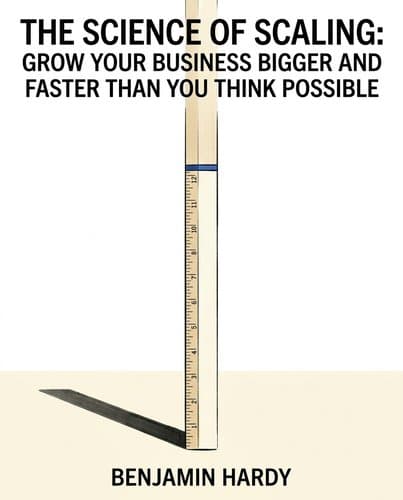
212659366_the-science-of-scaling
by Benjamin Hardy
Most businesses plateau not from lack of effort, but because founders unconsciously set floors that cap their own growth. Learn how to use impossible goals as…
In Brief
Most businesses plateau not from lack of effort, but because founders unconsciously set floors that cap their own growth. Learn how to use impossible goals as perceptual filters that force radical simplification, attract extraordinary people, and collapse your timeline to 10x results.
Key Ideas
Set Impossible Goals to Force Innovation
Set a goal that makes your current approach obviously impossible — not one that stretches it. If you can reach the goal by doing more of what you're already doing, the goal is too small to force the innovation you actually need.
Timeline Compression Reveals True Priorities
Use timeline compression as a diagnostic tool, not a pressure tactic. Ask: 'If I had to hit my 10-year goal in one year, what would immediately fall below the floor?' Whatever you'd cut is probably already noise — you're just not admitting it yet.
Cut Below-Standard Work Before Scaling
Raise your floor before you try to scale. Identify the clients, offers, staff, or habits you're tolerating below your actual standard, and cut them. Smarsh went from near-breakeven to $100M in profit in 18 months — the cuts came first.
Collapse Complexity to Unlock Scale
Simplicity is the prerequisite for speed. If your business has multiple competing offers, tiered product lines, or revenue streams that 'hedge,' it is probably too complex to scale. The move to 10x almost always requires collapsing complexity, not adding to it.
Hire One Exceptional Person Over Many
Look for the one 'Super Who' — a partner, hire, or collaborator — who changes the math entirely. Pay top of market for one extraordinary person rather than assembling a team of adequate ones. The impossible goal is the filter that attracts the right person.
Honesty About Limits Builds Trust
The honesty the impossible goal demands is itself a business asset. Mark Young's admission of 'we gave you bad advice' didn't lose him the client — it landed a $10M deal within two weeks. Clarity about your floor signals confidence about your value.
Who Should Read This
Business operators, founders, and managers interested in Scaling and Business Strategy who want frameworks they can apply this week.
The Science of Scaling: Grow Your Business Bigger and Faster Than You Think Possible
By Benjamin Hardy
13 min read
Why does it matter? Because your most responsible goals are quietly killing your growth.
Here's what no one tells ambitious people: the more disciplined you are, the more dangerous your goals become. Not because discipline fails you — but because hitting a target you can actually see trains you to stop looking further. Realistic goals don't protect you from failure. They just make the ceiling invisible until you've already hit it. Benjamin Hardy's argument runs the opposite direction from everything most high-performers have been rewarded for believing — that the goal shapes not just your destination but your perception, your standards, and ultimately your identity. Set a small enough target and you'll filter out the partnerships, the pivots, and the hard truths that would have changed everything. That sting you're feeling is the point.
The Goal You Set Determines What You Can Even See
Alicia Ault had been working her credit coaching business for years, but nothing was moving. When she finally launched her software product, LevelUp Score, she set herself a goal: sign 100 clients in 90 days. She got to work, calling companies one by one, filling her calendar, staying busy. The problem was she had no idea she was already stuck — the goal had decided that for her before she ever made a single call.
Here is what most planning advice gets backwards: goals are not targets you aim at. They are filters that determine what you can perceive in the first place. The size of your goal shapes what questions occur to you, which opportunities look relevant, and which partners seem worth calling. A modest goal doesn't just produce modest results — it produces a modest version of reality. You literally cannot see what falls outside its frame.
When Alicia pushed her target from 100 clients to 1,000, the math became immediately, obviously impossible. Her current approach — individually pitching credit repair businesses — could not get her there. And that impossibility was the useful part. It forced a question she had never thought to ask: why wasn't she calling software companies already serving her market? One conversation led to an introduction to the owner of Credit Repair Junkies, a platform used by over 8,000 credit repair companies. A single partnership deal put more potential clients within reach than years of individual outreach ever could have. The pathway wasn't hidden. It was invisible from where she had been standing, because a 100-client goal had nothing to teach her about leverage at that scale.
This is what psychologists call a stretch goal: a target that is impossible given your current skills, knowledge, and assumptions. Kennedy's moon commitment worked the same way — it didn't just focus NASA, it made the other six strategies on his list obviously insufficient. The mechanism isn't motivational. It's perceptual. When the gap between where you are and where you need to be is wide enough, your brain abandons its existing map and looks for new territory. Incremental goals let you optimize what you already have. Impossible goals reveal what you've been unable to see.
The uncomfortable implication is that responsible, realistic planning — the kind praised in every business school — may be the most reliable mechanism for staying exactly where you are.
Honest Goals Force Honest Conversations You've Been Avoiding
The obstacle to scaling almost never turns out to be strategic. It's honesty. Most leaders already know which clients are draining them, which services exist because they were afraid to say no, and which parts of the business they'd be embarrassed to explain out loud. The impossible goal doesn't create this knowledge. It just makes the knowledge unbearable to ignore.
Mark Young had been running Jekyll & Hyde Advertising for over thirty years. The firm was genuinely world-class at one thing: getting physical consumer products into mass retail chains like Walmart and scaling them through traditional TV campaigns. They had turned a $1 million earwax kit into the category leader across 50,000 stores. Nobody did what they did better. Then, gradually, they stopped doing only that. Clients asked for Amazon ad management and social media campaigns. Jekyll & Hyde said yes. Revenue from these smaller services added up. The real reason, as Mark eventually admitted, was fear — they'd been told the future was digital and didn't want to be left behind.
When Mark set a goal of reaching $100 million in revenue within three years — up from $20 million — the complexity of what his agency had become was suddenly impossible to rationalize. A $100 million target built on scattered, low-margin digital work for clients who couldn't afford real retail launches wasn't a path to anything. The goal made that obvious in a way that a decade of modest growth had let him avoid.
What followed was painful in the specific way that honesty is painful. Mark identified ten clients below the floor his new goal required and began cutting them. One — a women's makeup brand paying $4,000 a month for Amazon ad management — he called directly. His message was not diplomatic. He told them their entire business model was wrong, that Amazon was a retailer, not a business, and that without a $300,000 commitment to a mass retail and TV launch, they'd likely fail within two years. Then he said the harder thing: we should never have taken you on under the old terms. We told you what you wanted to hear instead of what you needed. That was our mistake.
The client wired the $300,000. Within two weeks of Mark raising his floor, Jekyll & Hyde had shed its conflicting service offerings, cut the clients who couldn't operate at the level the firm actually served, and landed a deal worth nearly $10 million from a single conversation about a health supplement already doing $10 million in revenue that could, with the right retail push, reach $500 million.
None of this required new strategy. It required the willingness to stop lying — to clients, to the team, and most uncomfortably, to himself. The impossible goal was just the mechanism that made the lying finally cost too much to continue.
Compress the Timeline Until the Noise Disappears
Once the honesty is unavoidable, the next question becomes: how long are you willing to let that knowledge sit before acting on it?
What would you do differently if your ten-year plan had to happen in one year? Not as a thought experiment — as a real commitment, with everything that follows from it?
In April 2024, Hardy posed exactly this question to a room of eighty CEO coaches gathered in Whistler. One of them, Richard Bryan, was fifty-four years old and had spent fifteen years flying between Colorado and the UK to manage a real estate portfolio in Bristol. His eleven-year plan was clear: sell off the portfolio gradually, free up time for his wife Melissa, finish a book, and grow a coaching practice. Reasonable. Sequenced. Totally honest about the fact that the hard part — actually letting go of the real estate business — could wait.
Hardy walked the group through a simple compression exercise. Write down your eleven-year goal. Now ask how you'd reach it in three years. Then in one. Not as a mandate, just as a question: what would have to be true?
When Richard reached the one-year version, something shifted. If he had twelve months, there was no longer any logic to maintaining the Bristol portfolio. Every month he spent managing it was a month he wasn't coaching. The flights, the time zones, the tenant calls — none of it served the life he said he wanted. From an eleven-year view, the real estate business felt like a foundation. From a one-year view, it was obviously a delay. The room heard him say it out loud: 'I'd sell the portfolio and go all-in on coaching.' Someone audibly gasped.
Parkinson's Law is working against you here. Work expands to fill the time available for it, and so do the rationalizations that protect your current decisions. Long timelines don't give you more room to succeed. They give you more room to avoid the one choice that actually matters. Richard had known for years that the real estate portfolio was pulling him away from what he wanted most. The eleven-year plan hadn't hidden that fact; it had made acting on it feel irresponsible.
Compress the timeline and the noise falls away immediately, leaving the single actual bottleneck — what strategists call the crux. For Richard, it was obvious the moment it stopped feeling responsible to postpone it. Within a year, he sold half the portfolio, redirected his energy into coaching, and built that practice to a genuinely global scale. The life he'd planned for sixty-five arrived a decade early, because one question forced him to stop treating the future as something that would eventually arrive and start treating it as something he was building right now.
You Cannot Scale a Complex System — You Can Only Simplify One
Most founders hit a wall somewhere between seven and eight figures and assume they need more — more products, more channels, more staff. The wall isn't usually a shortage problem. It's a weight problem. Think of your business as a shopping cart you're pushing uphill. Add enough products, clients, service lines, and side channels, and the cart doesn't become more valuable — it becomes heavier. At some point you stop climbing and start just holding on. Scaling almost always begins with taking things out of the cart.
When Steve Jobs returned to Apple in 1997, the company was losing over a billion dollars a year. Most executives in that situation reach for growth tactics — new markets, new partnerships, new revenue streams. Jobs did the opposite. He surveyed roughly 350 products Apple was making and cut them to about ten. Not the weakest ten — ten total. Everything else was gone. Within a year, Apple posted a $309 million profit. The iMac G3 only existed because the company had finally stopped fragmenting its attention across things that would never be excellent. Jobs said it plainly: focus doesn't mean saying yes to the important thing — it means saying no to a hundred genuinely good ideas so the one thing can actually breathe.
The programmer Rich Hickey has a name for what Jobs dismantled. He calls it the elephant — the accumulated weight of everything a system has already built. Think of it as the organizational equivalent of technical debt. As you keep building, the work you've already done starts to dominate every decision about where to go next. The elephant isn't a mistake. It's what all systems naturally become. And once it's big enough, the greatest obstacle to scaling isn't the market or the competition — it's the system itself.
Most owners don't recognize their elephant because the pieces look sensible individually. Of course you kept that legacy client. Of course you added the adjacent service. Of course you maintained the side channel while the core grew. Each yes had a reason. Taken together, they produce a system too entangled to move quickly.
The move from one million to ten million almost never runs through addition. It runs through the hard, emotionally uncomfortable work of deciding what you're actually optimizing for and then removing everything that answers a different question. The goal you committed to in the previous section is what makes this possible — a target ambitious enough that the mismatch between your current complexity and your required simplicity becomes too obvious to rationalize away. Once you can see the elephant clearly, you realize it isn't a foundation. It's the delay.
Your Floor Is Your Ceiling: The Standard You Tolerate Is the Limit You Set
Zion Williamson walks into NBA training camp at 330 pounds. Not once — repeatedly. The New Orleans Pelicans are paying him $197 million across five years, and they have inserted weight clauses and game-participation requirements into a professional athlete's contract because Zion's own standards have proven insufficient. This is a player who blew through a Nike sneaker on live television during his one college season. The talent was never the question. The floor was.
Most leaders look outward when growth stalls — at competitors, at market timing, at the economy. The Zion problem suggests a more uncomfortable diagnosis. Talent, opportunity, and enormous external investment cannot compensate for a low internal standard. What you consistently tolerate defines the ceiling above which nothing in your organization can rise. Your team reads your floor, not your ambition. They calibrate to what you actually accept, not what you say you want.
When Kim Crawford Goodman became CEO of Smarsh, a digital compliance company sitting at $40 million in revenue, she walked into a culture built on longevity rather than performance. People expected raises tied to tenure. Nobody outside the executive suite saw the financials. The whole place had the quiet, slightly stale energy of an organization that had stopped asking whether it was any good. Within her first two months, she cut nearly twenty percent of the workforce. A few months later, she did it again. She closed satellite offices producing nothing distinguishable, renegotiated contracts with major clients who had grown accustomed to extracting services for free, and told those clients plainly that the arrangement had been making Smarsh worse at serving them. Eighteen months after she arrived, the company was generating over $100 million in annual profit on $400 million in revenue. The market hadn't changed. The floor had.
Raising the floor is the precondition for growth tactics to work — not a growth tactic itself. Every team member below your standard, every client relationship you maintain out of discomfort rather than fit, every process you tolerate because fixing it feels like the wrong week: these are not neutral. They set the gravitational ceiling for what your culture can become. The leader who flinches at accountability teaches everyone around them that the floor is lower than the org chart says it is. And once that lesson is learned, it compounds.
The hard question isn't what your ceiling could be. It's what you're actually willing to enforce today.
You Are Probably One 'Super Who' Away From the Breakthrough
Raise your floor, simplify the model, force the timeline — and you'll still sometimes plateau, because the next leap requires someone the current room doesn't have.
The most precise illustration of this in the book comes not from a case study but from its own origin. Benjamin Hardy had spent a year writing the manuscript that became this book. In August 2024, a 25-year-old entrepreneur named Blake Erickson flew to Florida and asked to be listed as co-author on work Hardy had already built — on the grounds that shared authorship would establish Erickson's credibility fast enough to make their planned training company, Scaling.com, actually work. Hardy's first reaction was that Erickson hadn't earned it. His second reaction, which he was honest enough to record, was that he didn't know whether he was willing to operate at the level of generosity and shared ownership that real scaling requires. He'd watched successful people claim to teach scaling while protecting their own throne — and here was his chance to do the same thing he'd criticized.
He resolved the tension the only way the model permits: he set a floor. If Erickson wanted his name on the book, the entry price was a million dollars upfront — proof of commitment, not just conviction. Ten minutes after leaving Hardy's house, Erickson texted that he and his wife were in.
That text is the whole argument. The impossible goal — transforming millions of businesses globally — was what made Hardy visible to Erickson in the first place, and what made Erickson's boldness legible rather than presumptuous. Without the scale of the vision, neither of them would have recognized in the other someone worth betting on. The high floor filtered out everyone who wasn't serious. And the resulting partnership compressed by at least a year what either of them could have built alone.
This is the sequence the book has been building toward. The goal determines what you can see. The honest deadline strips away the rationalizations. Simplicity creates the margin. And then, when the model is clean enough and the target is clear enough, the right person appears — or finally recognizes you as someone worth appearing for. You are probably not far from the breakthrough. You are most likely one simplified model, one impossible commitment, or one 'Super Who' relationship away. The question is whether your goal is big enough for them to find you.
The Standard You Set Right Now Is the Business You'll Have in Three Years
Think about Hardy getting that text — the one that told him what he already knew, just in a form he could no longer ignore. That's what this framework actually does. It doesn't hand you new information so much as it removes the permission structure you've been using to ignore what you already see. The client you keep isn't a strategy problem. Neither is the service line you said yes to because no felt riskier, or the ten-year plan that's really just a very long way of postponing one decision you've already made in private. Those are tolerance problems. And tolerance is the only ceiling that actually matters, because it's the one you built yourself. So here's the direct version: what are you still carrying that you already know doesn't belong?
Notable Quotes
“As soon as I changed that goal to a thousand, I knew there was absolutely no way I’d be able to reach it with my current situation. There was no way. It was very impossible for me,”
“It was so impossible that my current thinking and approach wouldn’t get me there.”
“Why aren’t you calling software companies that are already marketing to your market?”
Frequently Asked Questions
- What is the main argument of The Science of Scaling?
- The book argues that scaling is fundamentally an identity problem where goals act as perceptual filters that determine what you see, cut, and pursue. Benjamin Hardy provides a framework for setting targets that make your current approach impossible, forcing the simplification, strategic cuts, and key hires needed to reach 10x growth. The central thesis is that true scaling requires transforming your identity and business fundamentals, not simply doing more of what already works. This shift forces the innovation you actually need.
- How should you set goals according to The Science of Scaling?
- Set a goal that makes your current approach obviously impossible — not one that stretches it. If you can reach the goal by doing more of what you're already doing, the goal is too small to force the innovation you actually need. This principle requires identifying targets so ambitious they demand fundamental restructuring of how you operate, eliminate unnecessary elements, and attract different talent. The impossible goal becomes a diagnostic tool and a filter for attracting the right collaborators and team members.
- What is timeline compression and how should it be used?
- Use timeline compression as a diagnostic tool, not a pressure tactic. Ask: "If I had to hit my 10-year goal in one year, what would immediately fall below the floor?" Whatever you'd cut is probably already noise — you're just not admitting it yet. This exercise reveals which activities, clients, or revenue streams are genuinely essential versus those you're tolerating out of habit or fear of change. Timeline compression helps identify and eliminate complexity proactively, making your path to scaling clearer and faster.
- What role does simplicity play in scaling according to Hardy?
- Simplicity is the prerequisite for speed. If your business has multiple competing offers, tiered product lines, or revenue streams that "hedge," it is probably too complex to scale. The move to 10x almost always requires collapsing complexity, not adding to it. Smarsh went from near-breakeven to $100M in profit in 18 months by making strategic cuts first. Hardy argues that eliminating competing initiatives allows focus, speed, and the clarity needed to achieve exponential growth rather than incremental improvements.
Related Book Summaries
Read the full summary of 212659366_the-science-of-scaling on InShort