36452903_the-science-of-self-discipline
by Peter Hollins
Discipline isn't about gritting your teeth harder—it's about designing systems where the right choice becomes the easy choice. From restructuring your…
In Brief
The Science of Self-Discipline: The Willpower, Mental Toughness, and Self-Control to Resist Temptation and Achieve Your Goals (2017) reframes discipline as a design problem rather than a character trait.
Key Ideas
Shop groceries after eating, not hungry
Shop for groceries after eating, not before — willpower depletes as blood glucose drops, and hungry shopping is a guaranteed discipline failure. The store is the one place where ten minutes of restraint replaces indefinite restraint at home.
Make desirable behavior your default option
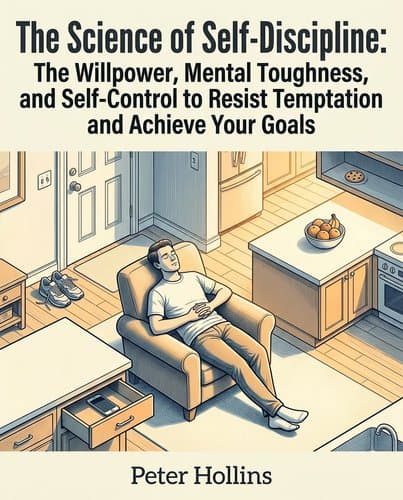
Redesign your environment so the default action is the one you want: fruit on the counter instead of chips, phone face-down across the room, floss in four locations around your home. The organ donor data shows that defaults alone can swing behavior by 68 percentage points.
Push through perceived limits consistently
When you feel tapped out, treat that signal as the 40% mark, not the finish line. Do one more — one more rep, one more minute, one more paragraph — and you'll discover the limit was the announcement of the limit.
Observe urges until they naturally subside
When an urge strikes, don't fight it or distract yourself from either — both strategies make urges stronger. Instead, observe it: locate where it lives in your body, breathe through it, and watch it peak and pass. Most urges subside within 20-30 minutes if you stop feeding them with resistance.
Evaluate long-term consequences of temptation
Use the 10-10-10 Rule before giving in to a temptation: ask how you'll feel in ten minutes, ten hours, and ten days. The ten-day window typically reveals that the short-term pleasure has entirely evaporated and only the consequence remains.
Choose accountability over public goal announcement
Don't announce your goals to get praise — telling people triggers a false 'done' signal in the brain that reduces motivation. Instead, find one accountability partner who withholds congratulations until you've actually earned it, and who will notice when you go missing.
Build habits over sixty-six days minimum
Commit to at least 66 days when building a new habit — not 21. The awkwardness you feel in early weeks is neurologically normal: you've moved behavior from the basal ganglia (automatic) to the prefrontal cortex (effortful). Push through it and the discomfort dissolves as the habit wires in.
Who Should Read This
People working on personal growth in Self-Improvement and Habit Formation, especially those tired of generic motivational advice.
The Science of Self-Discipline: The Willpower, Mental Toughness, and Self-Control to Resist Temptation and Achieve Your Goals
By Peter Hollins
10 min read
Why does it matter? Because you've been blaming yourself for a design problem.
The assumption is that some people just have it — that iron-willed quality that gets them to the gym at 5am and past the cookie aisle without hesitation. You've probably decided you're not one of them. Here's what behavioral science actually found: self-discipline isn't a character trait at all. It's a system that gets hijacked by the alarm you set and ignore, your social circle, and the defaults you never consciously chose. Every major finding in this field points to the same uncomfortable truth — most discipline failures aren't failures of character. They're failures of architecture. The people who seem disciplined haven't summoned more willpower than you. They've built environments, habits, and social structures that mean they rarely need it. That's the game, and this summary shows you how to play it.
You've Been Trying to Fill a Leaking Bucket
In a room at Case Western Reserve University in 1996, 67 people sat surrounded by the smell of fresh-baked cookies. Some got to eat them. The others were handed radishes. Then everyone moved to a different room and was given a puzzle to test persistence. The cookie-eaters kept at it more than twice as long. They made more attempts. They quit later. Not because they were smarter or more motivated — but because they hadn't spent the last twenty minutes fighting themselves.
Psychologist Roy Baumeister called this "willpower depletion." Resisting the cookies didn't just feel hard; it measurably drained something. Brain activity decreased. Blood glucose dropped. When the next challenge arrived, there was less left.
Most discipline advice gets this backwards. The assumption is that failures of self-control reveal a character flaw: you didn't want it badly enough, you're weak, you need to try harder. But the radish study points somewhere else. It doesn't matter how resolute you were at 10am if by 3pm your brain has been fighting temptations for five hours. The person who ate the cookies isn't more disciplined than you. They're just less depleted.
The whole game changes. You're not trying to build a will strong enough to absorb every challenge thrown at it. You're trying to arrange your life so you never have to sit in that room with the radishes in the first place.
Here's what that looks like. If your phone charges on your nightstand, every hour of lying awake scrolling is a withdrawal from your willpower account, one you may not notice until 2am. But setting a charger in the kitchen takes ten seconds, once. Same outcome, radically different cost. You get to be the cookie-eater — not by indulging, but by never putting yourself in the room.
The real skill isn't toughness. It's choosing where to spend.
Your Environment Is Already Making Most of Your Decisions
Most of your daily choices aren't choices at all. They're automatic responses to whatever your environment put in front of you, and you never noticed because it felt like deciding.
The cleanest evidence comes from organ donation rates across eleven European countries. Some countries automatically enrolled citizens as donors, requiring action to opt out. Others required people to actively sign up. Auto-enrolled countries hit 95% participation or above; the best opt-in country peaked at 27%. Same populations, same values about donation. A 68-point swing produced entirely by which option came pre-selected. Nobody's mind was being changed. The environment was deciding.
Researchers call this the default effect, and it runs through daily life almost invisibly. A Cornell study tracked how many Hershey's Kisses office workers ate depending on where a candy jar sat and whether it was clear or opaque. Clear jar on the desk: 7.7 a day. Move it six feet away: 5.6. Opaque jar across the room: 3.1. The chips sitting on your kitchen counter work the same way — they're a pre-checked box. Every time you walk through the kitchen even slightly hungry, the decision has already been made for you. A bowl of fruit on the counter does the same thing in the opposite direction. The difference in what you eat over a year isn't mainly about resolve. It's about which option your environment makes effortless to reach.
The organ donor data matters here because it strips away every other variable. No personality differences, no financial incentives, no awareness campaigns: just which box was already checked. You can use that same mechanism deliberately. Gym clothes laid out on the floor the night before are an opt-in to tomorrow's workout — you see them first thing and the decision is mostly made. Stuffed in a drawer, working out becomes something you have to choose from scratch at 5am, when you're least equipped to choose anything. Put a phone face-up on your desk, buzzing with every notification, and you've pre-enrolled yourself in distraction. Face-down across the room, checking it becomes an active decision.
The reframe this produces is total. Discipline isn't about summoning enough force of will to override your impulses. It's a design problem: what does your environment make effortless, and what does it make cost effort? Rearrange your surroundings, not your resolve, and you change what you actually do, without spending any willpower. The goal was never to become someone who can stare down temptation indefinitely. It was to stop building situations that require it.
You Have 60% More Capacity Than Your Mind Is Reporting
What actually happens when your body tells you to stop?
Most people treat that signal as a verdict. Muscles burning, lungs tight, concentration fraying: these feel like announcements that you've reached the edge. The Navy SEALs, who have unusually strong incentives to test this assumption, developed a different reading: that signal marks roughly 40% of your actual capacity. The sensation of hitting a wall is the wall your brain built, not the wall your body found.
Consider what happens during a set of push-ups. You struggle at ten reps. A voice surfaces — too tired, too sore, no point. If you pause and do one more anyway, you've just disproved the voice. One more after that. Then another. Suddenly you're at twenty, without breaking, and the limit that felt like solid ground turns out to have been a suggestion. What changed wasn't your muscles. It was your willingness to treat the signal as information rather than as instruction.
A biochemical dimension moves this out of motivational territory. Researchers once handed people sugar pills labeled as caffeine before a weightlifting session — and found they lifted significantly harder. More telling: two pills outperformed one, and larger pills outperformed smaller ones, following the exact dose-response curve of real medication. The brain wasn't being tricked into feeling something false. It was producing the chemical changes it anticipated. Belief in capacity is a lever that moves actual biochemistry, not just attitude.
The practical upshot: the first wave of fatigue or resistance marks where you expected to stop, not where you have to. Every time you push past it (one more rep, ten more minutes, one more paragraph), you finish the task and revise your estimate of what's possible. That revision compounds each time you test it.
Fighting Temptation Is the Fastest Way to Lose to It
Resisting an urge is about as effective as holding back a waterfall with your hands — the pressure builds, and when it breaks through, it hits harder than if you'd stepped aside. That's what most discipline advice recommends when an urge hits: resist it, distract yourself, think about something else. It produces exactly the same result.
Marlatt, working with patients in residential treatment, noticed something counterintuitive: people completely cut off from substances reported far fewer cravings than expected. The substance hadn't changed. The internal struggle had stopped — and the craving had nothing to run on.
That flips the logic entirely. You're not fighting an external force. You're the one keeping it alive.
Daniel Wegner's white bear experiments showed the same thing: tell people not to think about a white bear and they can't stop. The instruction to suppress a thought is itself a thought about it. What you push hardest against grows most persistent.
The way out isn't stronger resistance. Marlatt developed urge surfing as the alternative: instead of fighting the craving, you watch it. Notice where it lives in your body: chest, throat, hands. Track it rising, peaking (typically within twenty minutes), then subsiding on its own. The urge passes. It always does. You're not waiting it out through gritted teeth. You're watching it like weather.
A small language shift helps: not "I want a cigarette" but "I have an urge to have a cigarette." That reframe moves the urge from being you to being something near you, a sensation to observe rather than a demand you must answer. You don't need to defeat it. You just need to let it complete.
Your Future Self Is a Stranger to Your Brain — That's Why You Keep Betraying Them
Your brain has already decided it doesn't care about your future self — and it made that decision before you were aware there was one to make.
Stanford neuroscientist Hal Ersner-Hershfield put people in fMRI scanners and asked them to think about themselves right now, themselves ten years out, and a stranger. When he analyzed the neural patterns, the future self matched the stranger, not the current self. At the level of brain activity, the person you'll be in a decade registers as someone else. Not a metaphor for emotional distance — the literal reason you can know, clearly, that skipping the gym today will cost you years later and still skip the gym. You won't sacrifice for someone you don't identify with, and your brain has quietly filed that future person under "other people."
Ersner-Hershfield's follow-up shows just how thin that gap is. He digitally aged participants' photos (gray hair, jowls, the accumulated years) and had them navigate a virtual environment as those older avatars before stepping up to a virtual mirror. Afterward, everyone divided a hypothetical $1,000 across four options: a gift, a fun event, a checking account, or a retirement fund. People who had seen their aged faces put nearly double into retirement compared to those who'd seen their current selves. Seeing an aged avatar of some other person changed nothing. Only your own future face made any difference.
The problem isn't willpower. Your future self registers as a stranger, so you won't prioritize their interests over your own immediate comfort. When participants saw their older face in the mirror, the future self stopped feeling like someone else. What they did with money changed because who they were protecting changed.
The 10-10-10 Rule does the same thing without a virtual mirror. Before giving in to a temptation, ask how you'll feel in ten minutes (good, faint guilt), ten hours (mostly regret, the pleasure already gone), ten days (pure regret, the pleasure long gone and the failure barely memorable). Running through those intervals forces you to inhabit your future self, not imagine a stranger. The ten-day version of you becomes real enough to matter.
Telling People Your Goals Makes You Less Likely to Achieve Them
Telling someone your goal is the fastest way to make yourself less likely to achieve it.
NYU professor Peter Gollwitzer ran four studies with 63 subjects testing exactly this. People who kept their goals private consistently outperformed those who announced them. The reason: when you tell someone you plan to lose weight or run a marathon and they say "good for you," the praise activates what Gollwitzer called "identity symbols" — the same neural markers that form when you actually accomplish something. Your brain gets a partial done-signal and reduces its motivation to pursue the real thing. Talking about the goal feels similar enough to achieving it that one substitutes for the other.
That's why New Year's resolutions announced at dinner parties tend to disappear. The applause already felt like arriving.
The fix isn't silence. It's earned praise instead of free praise. A University of Pittsburgh weight-loss study split pairs of participants into two groups: one gave each other structured encouragement only when actual effort was made; the other had no such framework. Ten months later, 66% of the structured-praise group had maintained their weight loss versus 24% of the other group. The difference wasn't support. Both groups had partners. It was when the support arrived. Praise for effort produces more effort; praise for having a plan produces the feeling of effort without the actual work.
The practical rule: don't tell people your goals. Tell them your dissatisfaction, and make clear you expect to be held to account. If your running partner is waiting for you on a cold morning, you don't need to have announced a goal to anyone — you need to show up, or let someone down. That social pressure, attached to what you actually do rather than what you said you'd do, is the mechanism that works.
Motivation Gets You to the Starting Line. Systems Keep You Running.
How many times have you started something with real motivation and still failed? Not fake motivation — the genuine kind, the kind that has you reorganizing your schedule at 11pm. You had it. You also had nothing two weeks later.
Motivation is an emotional state, and like all emotional states, it decays. Phillippa Lally tracked 96 people over 12 weeks as they tried to build new habits and found the average time to automaticity was 66 days (not the commonly cited 21) with some taking as long as 254. That gap has to be crossed on something other than motivation. What makes the crossing harder: during those early weeks, the new behavior runs through the prefrontal cortex (the brain's deliberate-decision center) rather than the basal ganglia, which handles automatic behavior. That's why it feels effortful and wrong. That sensation isn't failure. It's the mechanism.
Most people treat discipline as a binary: you either have willpower or you don't. That framing leaves five levers untouched. Organizational behavior researcher Joseph Grenny identified six in total: personal motivation, personal ability, social motivation, social ability, structural motivation, and structural ability. Treat discipline as a willpower problem and you've addressed one. Look at what social motivation does on its own: if a running partner is waiting for you on a cold morning, the cost of quitting is now social, not just personal. That one lever does more work than any amount of resolve. Engineer all six — put the healthy food at eye level, lock in the accountability partner, build in the environmental cue — and every lever pushes in the same direction. The system does the carrying.
The prior sections build toward exactly this: remove friction before decisions happen, design the environment, arrange your relationships. Get past the 66 days. Then let the habit run itself.
The Architecture Question You Haven't Asked Yet
The research keeps arriving at the same verdict: the person who maintains discipline across years isn't fighting harder than you. They've just stopped fighting in places where fighting was never going to work. Every study we've covered — the radish room, the organ donor defaults, the aging avatars, the goal-announcement backfire — describes the same underlying structure: behavior is downstream of environment, social contracts, and the paths your life has made frictionless. Change those, and behavior follows without requiring daily acts of heroism. So the honest question after all of this isn't "why can't I be stronger?" It's "what, specifically, in my current setup is making the wrong choice easier?" That's a solvable problem. And unlike strength of character, most of the solutions fit in a grocery cart.
Notable Quotes
“Whatever you do, do not think about a hippopotamus.”
“credit from past behavior. If you notice that you're using past behavior to justify counterproductive actions in the present (”
“), stop immediately and don't undercut your own progress. Each event should be taken in a vacuum, and you don't get an accumulation of points you can buy bad behavior with. If you find yourself ever making statements such as”
Frequently Asked Questions
- When is the best time to grocery shop if you want better self-discipline?
- The Science of Self-Discipline recommends shopping for groceries after eating, not before. Willpower depletes as blood glucose drops, and hungry shopping is a guaranteed discipline failure. Since the store is the one place where ten minutes of restraint replaces indefinite restraint at home, timing your shopping to coincide with fullness dramatically reduces impulse purchases. This simple environmental adjustment prevents decisions that would otherwise require constant willpower to undo through the week. By ensuring you're well-fed before entering the store, you shift the difficulty from sustained home restraint to a manageable brief period of focus.
- What is the most effective way to design your environment for self-discipline?
- According to Hollins, redesign your environment so the default action is the one you want: fruit on the counter instead of chips, phone face-down across the room, floss in four locations around your home. The organ donor data shows that defaults alone can swing behavior by 68 percentage points. This approach eliminates constant decision-making by making desired behaviors the easiest path. Rather than relying on willpower to resist temptation, you structure choices so that automatic, unconscious behavior aligns with your goals.
- How long does it really take to build a new habit according to neuroscience?
- Commit to at least 66 days when building a new habit — not 21. The awkwardness you feel in early weeks is neurologically normal: you've moved behavior from the basal ganglia (automatic) to the prefrontal cortex (effortful). Push through it and the discomfort dissolves as the habit wires in. The common 21-day myth underestimates the time your brain needs to rewire neural pathways. Understanding this neurological reality helps you persist past the initial discomfort when building lasting change.
- What should you do when you experience a strong urge or craving?
- When an urge strikes, don't fight it or distract yourself from either — both strategies make urges stronger. Instead, observe it: locate where it lives in your body, breathe through it, and watch it peak and pass. Most urges subside within 20-30 minutes if you stop feeding them with resistance. This acceptance-based approach prevents the mental struggle that amplifies cravings. By treating urges as temporary physical sensations rather than commands to obey or resist, you allow them to naturally diminish.
Related Book Summaries
Read the full summary of 36452903_the-science-of-self-discipline on InShort