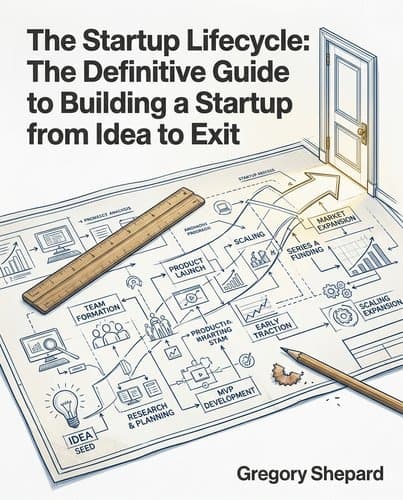
205309547_the-startup-lifecycle
by Gregory Shepard
Most startups don't fail from bad ideas—they fail because founders build without knowing who will acquire them or why. This definitive lifecycle guide…
In Brief
The Startup Lifecycle: The Definitive Guide to Building a Startup from Idea to Exit (2024) presents a seven-phase framework for building a startup backward from the exit, treating the venture as a system that can be deliberately engineered.
Key Ideas
Design customer base for acquisition value
Plan your exit before you build your product: identify your Ideal Acquirer Profile during the vision phase, then build your customer base to match their ICP — misaligned customers directly lower your acquisition price
Build for your survival, not theirs
The 90% startup failure rate is structural, not random — VCs expect 29 of 30 bets to fail; build a system designed for your survival, not their portfolio hedge
Validate customer adoption before scaling tech
Validate the customer before scaling the technology: the question isn't whether the product works, it's whether real humans will use it the way you've built it (see: restaurant managers who won't touch a grease trap regardless of cost savings)
Standardize operations before acquisition diligence
Standardize before you grow — undocumented processes don't just slow you down, they create due-diligence liabilities that acquirers will price into the purchase offer or use to walk away entirely
Bridge round reveals genuine acquirer intent
When an acquirer shows interest, ask them to lead a small $1–1.5M bridge round with right-of-first-refusal language — their willingness to invest reveals genuine intent, creates FOMO among competitors, and forces early diligence on your terms
Treat funding as outcome, not plan
Treat 'funding' as an outcome, not a plan — founders who say 'I need funding' are focusing on the only thing their flashlight hits; the seven-phase lifecycle is the map that turns the lights on
Deep domain expertise outweighs credentials
The subject-matter-expert founder — the person who has lived the problem — has the strongest competitive vantage point; lack of Silicon Valley credentials is not a disqualifier, it's often the insight advantage
Who Should Read This
Business operators, founders, and managers interested in Startups and Business Strategy who want frameworks they can apply this week.
The Startup Lifecycle: The Definitive Guide to Building a Startup from Idea to Exit
By Gregory Shepard
13 min read
Why does it matter? Because building a startup without a planned exit is like skateboarding at 30 mph without knowing where the pavement ends.
Here's the hard truth about that 90% startup failure rate: it isn't bad luck. It's arithmetic. Venture capitalists spray money across thirty bets expecting twenty-nine to burn, because the one that doesn't will make them whole. Your failure is already priced into their model. The question nobody asks founders before they mortgage everything and hire their first team is whether they're following a system designed for their own survival — or quietly serving someone else's math. Gregory Shepard has made twelve exits, grew up below the poverty line, and spent half a million dollars interviewing founders about why things fell apart. What he found is that the startup is a machine that can be engineered backward from the exit, phase by phase, before you write a single line of code. That map exists. Most people just never got handed it.
The Game Is Rigged — But Not in the Way You Think
The 90 percent failure rate for venture-backed startups isn't a tragedy. It's a business model — and it belongs to the investors, not to you.
Gregory Shepard spent $500,000 and conducted more than 1,200 in-person interviews — founders, investors, accelerators — to confirm what the trade journals bury in optimistic language: the spray-and-pray portfolio model is deliberate. As laid out earlier, VC firms budget for your failure before you've written a line of code. One unicorn covers every loss. That math works fine for them.
What it means for you is something the model never makes explicit. When you take VC money and position yourself as a potential unicorn, you're running at hyper-growth targets designed to service an investor's hedge. Hit a market dip, lose a key hire, or ship six months late — and you go down hard. The investors don't rush over. They're already scanning the sidewalk for the next founder.
So if failure isn't mostly bad luck, and it isn't mostly wrong ideas, what is it? It's founders running a race whose rules were written for someone else. The fix isn't better luck. It's a system built around your exit — one where the math works in your direction from day one, not the last.
The Kid Who Sold Rattlesnakes Already Knew the Secret
A teenager in rural California in the 1980s had figured out a clean business: catch live rattlesnakes, sell them to a local buyer for antivenin milking and fang collection, pocket two hundred dollars a snake. He worked with a forked green stick and a feed sack, stalking the sun-warmed rocks until he could pin a rattler behind its head without getting struck. The acquisition side was solid. The warehousing side was a cage in the basement. One afternoon his mother came home, walked across the floor above his inventory, and the snakes rattled in unison like a drum line. Animal control arrived. The business died that afternoon.
What happened next is the thing worth understanding. He didn't grieve the snakes. He asked his buyer a single question: what do reptile collectors actually need to keep these animals alive? Rats, mostly. He bought a breeding pair the next day and started supplying the same network he'd been part of as a catcher. He'd gone from miner to equipment seller in forty-eight hours — the same move his mother had already given him the frame for. She'd pointed at a historical plaque in their California mountain town noting that Levi Strauss had made his first fortune there before moving to San Francisco, and told him something Gregory Shepard never forgot: the gold miners weren't the winners. The people selling them the jeans were. He'd made that pivot by instinct. She'd just given him the name for it.
This is what growing up broke and outside every conventional track actually produces, if you let it. Shepard was autistic, severely dyslexic, and synesthetic — his brain registered patterns as shapes and colors while everyone else saw disconnected data points. Teachers wrote him off. He built his education in irrigation ditches and construction sites, thinking while his hands worked. The poverty wasn't a detour around the real starting line. It was where he learned to read ecosystems, find the overlooked supply problem inside someone else's gold rush, and move before the opportunity closed.
The reader who grew up without the MBA, the network, or the family safety net has been living inside the problem long enough to see it whole. That's the vantage point that finds the next supply gap — the rats — once the obvious opportunity is gone.
Five Ways Founders Kill Their Own Startups (Before Investors Get the Chance)
Gregory Shepard was on an off-road electric skateboard doing 25 mph when a rock took the wheel off and launched him into the air. In the half-second before he hit the ground, he had one coherent thought: this is going to hurt. It did. He spent a long stretch in the hospital. Somewhere in that recovery time, the analogy assembled itself: most founders are on that same board, going faster than they can control the situation, and the wheel that comes off isn't bad luck or a down market. It's something they built in from the start.
Here is the pattern Shepard extracted from 1,200 one-on-one interviews with founders, investors, and operators — conversations designed to get past the polished postmortems that founders give to trade journals, where the stated cause of death rarely matches the actual one. Five failure modes showed up again and again, and every one of them is internal.
The wrong team. Not just bad hires, but founding teams misaligned on motivation — what Shepard calls 'coin-operated' groups, assembled around the prospect of wealth rather than the problem they're solving. In practice, a coin-operated team optimizes for the fundraising deck instead of the product: they tune the pitch, not the thing. Money creates appetite. The work requires something harder to manufacture.
The wrong customers. Founders build for someone, then discover that someone doesn't match whoever would eventually acquire the company. If Salesforce is your exit target, your customer base needs to look like Salesforce's — and if it doesn't, no amount of revenue fixes the mismatch.
No exit strategy. This is the one that stops most people cold, because 95 percent of founders start building without one. Shepard reviews roughly a hundred deals a month and almost none include a plan for who buys the company, at what price, or under what terms. Building a startup without knowing your acquirer is the same as building a product without knowing your customer.
Overvaluation. A company like Nortel can inflate to a $283 billion market cap performing success rather than achieving it, then crater within two years. Shepard calls this 'success theater': founders inflate their valuation to attract capital, hire to justify it, burn through runway to maintain the appearance, and eventually lose the ability to step back down.
Bad advice. Specifically, advice from investors who have spent their careers as passengers, not drivers. An investor can afford your failure — it's a line item in their portfolio model. For you, it's everything. Their risk tolerance is mathematically different from yours.
What these five have in common: none of them require a bad market or bad timing to kill you. They're decisions, made early, that compound quietly until the wheel comes off at speed.
Design Your Exit Before You Pour the Foundation
Imagine you're building a house. You pour the foundation, frame the walls, run the electrical, tile the bathrooms — and only after the roof goes on do you bother to ask who might want to buy it. You find out they wanted a ranch-style, not a two-story. They need three car bays, not two. Their buyers are retiring couples, and you built for young families. The structure is sound, but it's the wrong structure. That is how nearly every founder approaches an exit — as a conversation you have at the end, once the thing is built.
Shepard's framework flips this completely. The acquirer profile comes before the product, because who will buy your company determines what you should build. This isn't a philosophical preference — it's arithmetic. Only 20 percent of startups that go up for sale actually change hands. The ones that don't sell aren't necessarily bad businesses. They're businesses built for customers nobody who writes acquisition checks wants access to.
The specific mechanism Shepard calls the attachment rate is this: the percentage of your customers who are already customers of your potential acquirer. That overlap matters because of how acquirers do the math. A buyer will only credit revenue that folds cleanly into their own base. If your users and their users are different people, your revenue doesn't add to their revenue; it just adds complexity. Shepard learned this at Affiliate Traction, when a deal he'd spent months building collapsed at the table. The buyer was a large affiliate network looking to expand its merchant relationships — but Shepard's customers were a different segment entirely, and the overlap was nearly zero. He estimates the mismatch cost him $25 million.
So the design sequence runs backward from the exit, not forward from the idea. You start by asking who the likely acquirer is, what kind of customers they prize, and what metrics — growth rate, retention, gross margin — they use to set a purchase price. Those metrics become the KPIs you hand to your functional teams. Those KPIs shape your go-to-market strategy. That strategy determines which customers you go after first. Which means your ideal customer profile is, at its root, a function of your acquirer's ideal customer profile. Build the customer base your acquirer wants to inherit, and the exit negotiation becomes a conversation about price rather than fit.
You don't raise money to figure out where you're going. You raise money because you've already mapped the route and need fuel for the drive.
Your First Customer Is More Dangerous Than Your First Investor
Shepard showed up to a Goldman Sachs pitch with a biotech startup he believed in and left ten minutes later with six of eight investors gone — no explanation, just empty chairs. The two who stayed did it as a favor to the friend who'd arranged the meeting.
That image points to something deeper: the gap between having a working idea and having proof that real humans will use it.
When Shepard was building an environmental biotech startup, he watched a friend struggle with a grease trap — expensive, recurring, and never quite solved. He developed a freeze-dried bacteria product that literally cleared the water. He showed up with a five-gallon bucket, poured it in, came back the next day. Clean. The technology did exactly what it was supposed to do. Validated, he thought.
Except the product required restaurant managers to handle the application themselves. And regardless of how much money they'd save, they refused. Not because the product was flawed. Because the customer he'd built for — someone willing to trade a little labor for cost savings — wasn't the actual human making the decision. The real customer wanted the problem gone without ever touching it. The whole business model had to pivot from product to product-enabled service, with a technician doing the application from a truck in the parking lot.
Technology validation and customer validation are different problems. One asks whether the thing works. The other asks whether the specific human you're selling to will actually use it the way you built it — given their emotional relationship to the task, their job pressures, their reluctance to look foolish, their refusal to get their hands dirty. You can answer the first question in a lab. The second one only resolves in the field, in front of real people, before you've spent your seed money on a go-to-market strategy built around the wrong behavior.
The Fire You're Not Supposed to Put Out
A California fire chief, sitting in an office so tidy it looked like a furniture catalog, told Shepard something that landed harder than most business advice ever does. Shepard asked how his crews went about putting out wildfires. The chief laughed. 'We don't,' he said. The goal is containment — you build fire roads around the perimeter and let the blaze eat through its own fuel until it dies. If you chase every fire instead, new ones start behind you while you're bent over the old one.
That's the operating condition of a startup without documentation. The fire roads are your written processes: recurring problems that would have eaten a new afternoon get solved once, written down, and closed. Without them, every problem is a first-time problem. Not occasionally. Permanently. Shepard ran the numbers at Affiliate Traction: teams with standardized practices generated five times more revenue per employee than teams without them. The gap wasn't talent. One group spent their days solving yesterday's problem from scratch. The other group already had the answer written down.
Shepard's fix is unglamorous by design. He calls it a 'humble best practice' — Shepard's term for a plain-language description of how a task gets done, written so a new hire could follow it on day one. Three successful repetitions of anything: that's the trigger to write it down. The document lives in shared software, not someone's laptop.
The reason this matters at the exit is concrete. Shepard watched a deal stall for six months — not because the business wasn't profitable, but because the founder hadn't kept records of how the company actually ran. The acquirer needed to understand what they were buying, and the answer was buried in the founder's head. By the time documentation got sorted, the acquirer had moved on to another deal and come back with a lower number, a penalty assessed for the cost of figuring it all out. The deal barely closed. A cleaner set of records would have meant a faster close and a higher price. The instruction manual isn't busywork — it's what lets an acquirer believe the business can outlive whoever built it.
Growth That Destroys Value — and the Exit That Proves the Difference
Revenue that points at the wrong buyer doesn't build value — it destroys it. Shepard learned this directly when a potential acquirer dug into Affiliate Traction and found that half the customer base had come through lead generation rather than retail. The buyer's words were close to: we only want people buying products, and you'll need to get rid of the rest before we can talk seriously. Years of real growth, real customers, real money — and roughly half of it had to be jettisoned before the conversation could even start. The deal Shepard thought was worth millions collapsed into something much smaller. The lesson it left was permanent: growth only counts when it compounds toward the person who will eventually write the check.
An ideal customer profile isn't really about who finds your product useful. It's about whose customer base your acquirer wants to inherit. An acquirer buying your company to expand their reach will only value the customers who look like their own. Everyone else reads on their spreadsheet as complexity, not upside.
The fix isn't to grow more carefully. It's to identify the acquirer first and let that choice shape everything else — which customers to pursue, which KPIs to track, which parts of the business to pour resources into. Shepard calls this scaling toward an exit rather than growing for its own sake. The transit startup he invested in showed what that looks like in practice: each new dollar of ticketing volume cost less to deliver than the last. Adding headcount without that efficiency improvement is just adding weight to the chassis. At some point the structure buckles under its own bulk.
Once the acquirer is identified, the relationship itself becomes the instrument. That transit startup didn't wait for an acquisition conversation — they built a co-selling partnership with their target buyer first, running joint deals on touchless ticketing technology. When the partnership had traction, Shepard told them to do something counterintuitive: ask the acquirer to lead a small bridge round of one to one-and-a-half million dollars, with contract language giving them a right of first refusal and a pre-negotiated purchase price. The acquirer's willingness to write that check told Shepard everything about their seriousness. It also seeded FOMO among competitors, who assumed a deal was imminent and moved faster to avoid being shut out. The company sold for over forty million dollars. The exit wasn't a milestone they stumbled into. It was an outcome they had been engineering for years.
What You Do the Morning After the Wire Clears
Shepard was sitting in the dark, laptop open, the blue light of the screen the only thing in the room, staring at a bank balance that didn't feel real. His first big exit had closed. The wire had cleared. And his first coherent thought was that someone at the bank had made a terrible mistake and would be calling soon to fix it. He went back to bed. He checked again in the morning. The number was still there. The imposter syndrome lasted weeks before he trusted it enough to act on it.
When he finally did act, the choices tell you what the whole system was built for. He bought his wife a car. He bought his brother a tractor-trailer for a construction startup the brother was trying to get off the ground. He helped his mother fix up the land where the family had lived in tents when he was a child. Then he and his wife launched a philanthropic fund. This is the sequence of a person who grew up poor and never forgot what it felt like — not spending to celebrate, but spending to repair.
H. L. Hunt, the Texas oil baron, once said that making a lot of money is just a way of keeping score. Shepard disagrees. The Startup Science Lifecycle exists to move founders from paycheck-to-paycheck into enough freedom that they can rewrite the rules for themselves and then extend that freedom to other people. He calls it altruistic capitalism: in practice, that means structuring exits so that the wealth they generate flows outward — to family, to community, to the next founder who didn't grow up with connections or capital. That's why he codified a repeatable system instead of keeping the pattern-recognition locked inside his own head. A system can be handed to someone else. A gut feeling can't.
The exit isn't the finish line. It's the morning you wake up with the freedom to decide what actually matters — and the means to pursue it.
The Map That Was Never Supposed to Reach You
The system Shepard mapped wasn't invented when he wrote it down. It existed. It was just held by people who already had a seat at the table — passed through networks, accelerators, rooms you couldn't get into without knowing someone who knew someone. The founder who grew up under the poverty line, who processed the world differently, who was handed every signal that this path wasn't meant for them — that person often carries the sharpest possible read on a real problem. They've lived inside it. They know what the solution actually needs to feel like. What they rarely had was the framework to convert that knowledge into a company someone would pay to own. That gap isn't a talent gap. It's an access gap. The map doesn't walk the road for you. But every founder who went in without it and got lost wasn't failing. They were navigating in the dark. What you're holding now is the map — the exit-first framework, the sequencing, the exact logic Shepard used to build something someone would pay to own. Use it.
Notable Quotes
“Sorry, we have a deal on the table.”
“You’ve got them on the hook,”
“You’ve made it! Get ready to have your lives changed, because we’re about to get the exit you’ve been waiting for.”
Frequently Asked Questions
- What is the main framework presented in The Startup Lifecycle?
- The Startup Lifecycle presents a seven-phase framework for building a startup backward from the exit, treating the venture as a system that can be deliberately engineered. Gregory Shepard teaches founders how to identify acquirers before writing code, validate customers before scaling technology, and standardize operations to survive due diligence. The framework helps convert domain expertise into a sellable, fundable business by working backward from the desired exit rather than building forward blindly. This systematic approach replaces chaotic startup journeys with a deliberate, engineered process designed to maximize acquisition potential and minimize structural failure risk.
- What are the key takeaways about exit planning in The Startup Lifecycle?
- Plan your exit before you build your product: identify your Ideal Acquirer Profile during the vision phase, then build your customer base to match their ICP — misaligned customers directly lower your acquisition price. Rather than chasing any customer, strategic founders align customer acquisition with potential acquirers' needs from the start. This backward-planning approach ensures every customer added strengthens the business's attractiveness to specific acquirers. The book demonstrates how deliberate customer alignment transforms the acquisition process from a lottery into a predictable outcome, fundamentally changing startup success rates.
- Why is customer validation important before scaling technology?
- Validate the customer before scaling the technology: the question isn't whether the product works, it's whether real humans will use it the way you've built it. Shepard illustrates this with restaurant managers who won't touch a grease trap regardless of cost savings, showing that superior products fail when customers resist adoption. Building technically flawless products that customers won't actually use wastes resources and delays necessary pivots. This principle saves startups from over-engineering solutions that customers reject, forcing validation before major technology investments.
- How does The Startup Lifecycle address operational standardization?
- Standardize before you grow — undocumented processes don't just slow you down, they create due-diligence liabilities that acquirers will price into the purchase offer or use to walk away entirely. When acquirers conduct due diligence, they discover whether your business runs reliably without founder heroics. Undocumented, improvised operations signal risk and instability, directly reducing valuation or killing deals. By systematizing operations early, founders ensure their business remains attractive to acquirers and survives acquisition scrutiny. This transforms operational standards from nice-to-have to essential deal protection.
Related Book Summaries
Read the full summary of 205309547_the-startup-lifecycle on InShort