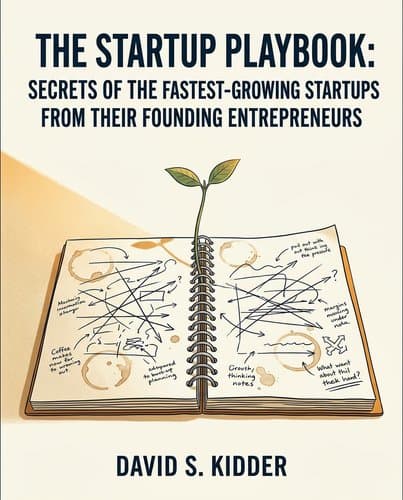
15788880_the-startup-playbook
by David S. Kidder
Forty-one founders of the fastest-growing startups—including LinkedIn, Gilt, and Zipcar—reveal that survival depends less on your idea and more on…
In Brief
The Startup Playbook: Secrets of the Fastest-Growing Startups from Their Founding Entrepreneurs (2012) draws on interviews with successful founding entrepreneurs to expose the operational, psychological, and cultural realities of building a company.
Key Ideas
Embedded Domain Knowledge Reveals Hidden Market Gaps
Test your 'founder-market fit' before product-market fit: ask whether you are genuinely embedded in the problem — not just interested in it — because domain knowledge is what lets you recognize obvious gaps that insiders have stopped seeing
Intellectual Honesty Builds Lasting Customer Loyalty
When you discover a major error (pricing, model, assumption), tell your customers immediately and specifically — Robin Chase's 19-to-2 response ratio after admitting a 50% pricing error proves that intellectual honesty builds more loyalty than appearing to have had it right all along
Single Deep Cut Beats Repeated Layoff Trauma
Cut twice as deep as you want to on layoffs — the trauma of a second round is worse than the trauma of a single decisive one, and underestimating the cut is the most common mistake
Align Calendar Quarterly With Strategic Priorities
Track your calendar quarterly like a scientist: categorize the last three months' worth of meetings and manually correct the next quarter's schedule to match your actual strategic priorities, not your good intentions
Survival Timeline Trumps Priority Labels
Prioritize by survival timeline, not by importance labels — categorize everything by Air (minutes), Water (days), or Food (weeks); 'High/Medium/Low' turns everything into High
Fail Fast On Fatal Problems First
Identify the hardest, most fatal problem first and tackle it before the easier ones — 'failing fast' means failing on the thing that would have killed you anyway, so you learn it cheaply
Decide From Strength, Never From Crisis
Don't make major strategic decisions during periods of weakness or crisis — wait until you've recovered your perspective, then act from strength
Invisible Differentiation Fails To Move Customers
If your differentiation isn't an order of magnitude better than the competition in a specific, nameable dimension, assume it's invisible to customers who have no reason to switch
Institutionalize Values Through Structure, Not Culture
Institutionalize your values structurally — in equity distribution, in bylaws, in investor alignment — not just in culture documents; passion without structure can be overridden by a board
Teach Reasoning, Not Just Conclusions
Give the team the logic behind your decisions, not just the decisions — the goal is for them to eventually replicate your reasoning, not just execute your conclusions
Who Should Read This
Business operators, founders, and managers interested in Startups and Business Strategy who want frameworks they can apply this week.
The Startup Playbook: Secrets of the Fastest-Growing Startups from Their Founding Entrepreneurs
By David S. Kidder
13 min read
Why does it matter? Because the startup stories you've heard are missing the part that actually matters.
Here's what most people get wrong about startup success: it didn't start with a breakthrough. It started with someone weeping over a spreadsheet error, or admitting to customers that their pricing was completely wrong, or watching fifteen product attempts fail before accidentally landing on the one that worked. The founders in this book — forty of them, including Steve Case, Ben Horowitz, Caterina Fake, Robin Chase, Chris Dixon, Alex Blumberg, and Jeffrey Hollender — didn't succeed because they had the right idea and the nerve to execute it. They succeeded because they built something underneath the idea: a capacity to stay honest when things were falling apart, to pivot without losing their nerve, to tell the truth to their team, their board, and themselves when the easier thing would have been to keep pretending. That's the real playbook. And it looks nothing like the version you've been sold.
The Gap Between Vision and Reality Is Longer Than Anyone Admits
The defining feature of the startup journey is sustained, disorienting uncertainty — lasting far longer than anyone preparing to start a company ever imagines. What separates the founders who built lasting companies is not that they avoided it. They anticipated it and kept moving.
Consider what the AOL story actually looked like from the inside. Steve Case spent the first ten years watching the company nearly collapse — three rounds of layoffs, partnerships that fell apart, money running out, friends and family quietly suggesting he find something more sensible to do. This was not a brief rough patch before the inevitable ascent. It was the entire first decade. The $150 billion valuation, the magazine covers, the largest merger in business history — all of that came later, and none of it was visible from inside those early years. What was visible was another round of cuts, another failed deal, another reason to quit.
Ben Horowitz describes the psychological texture of that experience in terms worth sitting with. When a company is facing its worst moments, the CEO has almost no one to talk to. The team needs to believe the ship is being steered; showing real fear would cost you the room. Investors, press, and competitors can't be trusted with it either. So the fear stays inside your head, which is precisely where it does the most damage. Horowitz calls this torturous, and he means it literally: the isolation of knowing something is badly wrong while being required to project certainty is one of the specific costs of the job.
Failure Isn't the Opposite of the Pivot — It's the Raw Material
Caterina Fake was somewhere in rural Europe, cycling through a quiet village, when Flickr began its ascent. This was not a strategic retreat. The gaming startup she had cofounded, Ludicorp, was deep in a death spiral — money gone, team demoralized, the whole enterprise weeks from collapse. Her anxiety had become so consuming that she recognized it as contagious; the founder's panic, left unchecked, is communicable — it moves through a team faster than any product decision. So she left for a month. Museums. Bicycles. No product roadmap. When she came back, the team had begun pivoting the chat and photo-sharing tools they had built as side infrastructure for their failed game into something new. That something became Flickr, which sold to Yahoo! a year after launch.
The pivot mythology would have you believe that at some critical moment, a sharp founder saw clearly what the failing company should become and executed a decisive turn. What actually happened is different: the failure ran its full course, and what survived was the team that had formed around it. The developers Fake had recruited to build the game were talented enough to attack an entirely different problem once the original one died. The pivot wasn't a decision made from clarity. It was the residue of a wreck.
Ben Horowitz understood the same thing from the opposite direction. When the dot-com crash destroyed Loudcloud's market in 2001, he watched roughly forty competitors respond the way you'd expect: cutting costs, reducing headcount, tightening operations. All of them eventually went bankrupt anyway, because the market itself was gone. Incremental improvement has nothing to work with when demand disappears. Horowitz was willing to say out loud what his competitors talked themselves out of acknowledging. He sold the managed-services arm, kept the internal automation tools the company had built to run its own infrastructure, and rebuilt around those tools as a standalone product. Nobody had noticed them. They weren't the main business — they were scaffolding. Hewlett-Packard paid $1.6 billion for that scaffolding six years later.
Notice what's really happening in both cases. The thing that became valuable wasn't conceived as the primary idea. It was assembled during the failure, or built in service of the failure, or left standing after the failure cleared everything else away. The best pivots aren't recoveries — they're excavations. The founders who made them didn't pivot because they saw clearly. They saw clearly because they stopped defending what was already dead.
The Idea Is the Easy Part. Founder-Market Fit Is What Actually Predicts Success.
What actually predicts whether a startup succeeds? The honest answer from the founders in this book is uncomfortable: not the quality of the idea, and not raw intelligence or work ethic. The primary predictor is whether the founder already inhabits the specific problem they're trying to solve — a condition Chris Dixon calls founder-market fit.
Dixon spent four years at Bessemer Venture Partners tracking online security before he ever built anything. During that time he noticed a pattern: every five years, a new category of digital threat emerged, and a handful of mid-sized companies arose to address it. Viruses, then spam. When he started paying close attention, a new threat called phishing had just appeared — fraudulent sites designed to trick users into handing over personal information — and no one had built a consumer tool to flag it. He and a college friend quickly assembled an application that did exactly one thing: warn you when you were on a phishing site. That became SiteAdvisor, a browser plug-in that rated the safety of every site a user visited. The product debuted in February 2006. Fifty-four days later, McAfee acquired it — not because the concept was exotic, but because McAfee could see that Dixon had already solved the hardest part: he understood exactly which users were being hurt, exactly how, and had built something precise enough to prove it. Acquisition at that speed is usually a signal that someone bought before a competitor could.
The part of this story that's easy to miss is what almost killed it before it started. Dixon very nearly talked himself out of the idea because it seemed too obvious. If the gap was that clear, surely someone had already filled it — or had examined it and found a good reason not to. What he was underestimating was the weight of four years of accumulated domain knowledge. He understood the security world well enough that an obvious gap looked suspicious rather than promising. That familiarity wasn't a liability. It was the entire competitive advantage.
Steve Blank frames the same insight from a different angle. A startup, he argues, is not a miniature version of a corporation. It's an organization still searching for a repeatable, scalable business model. The MBA curriculum — built to help managers execute models that are already known — is the wrong instrument entirely. Execution tools only work once you know what you're executing. Before that moment, what the founder needs is enough fluency in the specific market to recognize when the model they have is wrong and what direction to move. That fluency can't be borrowed. It accrues over years of close contact with a particular problem.
The implication for anyone preparing to start a company is this: the question worth asking before 'is this a good idea' is 'am I the person who has been living closest to this problem?' Domain expertise doesn't show up on a pitch deck as a credential — it shows up in the room as judgment you didn't know you had until you needed it.
Your First Product Should Embarrass You. Your First Pricing Will Be Wrong.
Three months after Zipcar's Boston launch in 2000, Robin Chase sat down with a data set large enough to finally test the assumptions behind her pricing model. What she found sent her to her room for two hours, weeping. The daily rental rate she had set at $40 was wrong — not marginally, not in a 'we'll adjust this next quarter' way, but wrong by half. She and her team had spent months modeling the numbers before launch, and somehow missed a basic arithmetic truth: a single day cannot generate twenty-four separate hourly rentals, because nobody rents a car every hour around the clock. The daily rate was too low by a lot. And she was two weeks from closing her Series A.
Here is what she did: she emailed every Zipcar member and told them exactly what had happened. No spin, no softened language. Rates were going up 25 percent because she had made a mistake. The next morning, nineteen members wrote back to say they'd always thought the service was underpriced. Two said they were leaving. She talked both of them back. One eventually became one of the company's most vocal advocates.
The mistake didn't damage the brand — the transparency did the opposite. Customers who had already paid for a service that was cheaper than it should have been responded to an honest explanation with loyalty rather than outrage. The error became a bond. Chase later said that if she had buried the problem rather than surfaced it, the slow financial bleeding that followed would have killed the company. Speed of acknowledgment was worth more than the appearance of having gotten it right.
Reid Hoffman, who built LinkedIn into a $9 billion company, crystallized the principle from the product side: if you're not embarrassed by your first release, you waited too long. The embarrassment is not incidental — it's proof you shipped before the window closed. Hoffman's logic is that perfectionism is a holdover from a pre-internet era when software was sold in boxes, installed once, and nearly impossible to patch after the fact. On the internet, you can get back to your customers. What you can't recover from is arriving late to a market while you were polishing something nobody had yet confirmed they wanted.
Early mistakes are data, and data is the only thing that converts a hypothesis into a real business. Chase's pricing error, caught with 435 members instead of 4,000, cost her two weeks of anxiety and a difficult conversation. Caught later, it could have been fatal.
Ten Times Better Isn't Ambition — It's the Minimum Viable Differentiation
Incremental improvement is invisible. Not insufficient — invisible. The friction of switching away from a familiar product is higher than almost any founder estimates, and the only thing that generates enough force to overcome it is an improvement so substantial that the comparison stops being relevant.
Ben Horowitz frames this with characteristic bluntness: people are fundamentally lazy, and they won't change their behavior for marginal gains. He's not being cynical about customers — he's being precise about switching costs. When someone has already organized their workflows around an existing product, the bar to move them isn't 'somewhat better.' The bar is high enough that the old tool feels embarrassing by comparison. He puts the number at ten times. Not twice. Not three times. Ten.
Reid Hoffman makes the same argument from the investor's chair. When founders pitch him on incremental differentiation — our version runs on a different tech stack, our interface is slightly cleaner — his response is paranoia, not enthusiasm. If an idea is only a little better or a little faster, it will fail to move customers, fail to attract serious investors, and fail to pull in the best employees. The startups that win a market don't improve on the incumbent; they make the incumbent look like a prior era.
The graveyard is full of companies that came in two or three times better and were ignored. Google Buzz launched with a real user base and genuine product investment — it was meaningfully better than nothing, and it still disappeared because Facebook had already set the social graph in place. Buzz didn't have a ten-times advantage anywhere; it had a collection of marginal ones that, together, weren't enough to move anyone. That's the failure mode. The question isn't whether your product is better. It's whether you can name one specific, narrow thing you do ten times better than anyone else alive — not ten times better at everything, which isn't a strategy, but ten times better at the one thing that matters most to the customer with the most pain. That asymmetry is what lets a company too small to compete on distribution or brand recognition get through the defenses incumbents have spent years building. Define that place first. Build everything else after.
The Infrastructure of Survival: How Founders Actually Manage Themselves
Matt Blumberg, who built Return Path into one of the most rigorous email deliverability businesses in the world, solved the problem of founder attention drift the way he solved everything else: with data. Every quarter, he and his assistant downloaded three months of calendar entries, sorted each meeting into categories — roughly forty percent internal, forty percent external clients, ten percent board and investors, ten percent everything else — and compared the actual distribution against the targets. Then they manually rebuilt the next quarter's schedule to close the gap. Not aspirationally. Literally: meetings moved, commitments declined, blocks reclaimed. The numbers got corrected the way a pilot corrects for wind drift, incrementally and without drama.
What makes this worth examining isn't the tidiness of the system. It's what the system reveals about where founder attention actually goes versus where founders believe it goes. Most CEOs have a rough sense of their priorities. Blumberg had a ledger. The gap between the felt sense and the actual record is where most leadership drift happens — the slow accumulation of reactive hours that compound into a company that runs its founder rather than the reverse. His quarterly calendar audit was a diagnostic, not a productivity hack. A surgeon can't think about the quarterly budget mid-procedure; the management work, by contrast, requires a wide-angle view across dozens of competing priorities simultaneously. Blumberg's system was how he held both without each one consuming the other.
Notice what's really happening here: the unglamorous back-office habits — the calendar hygiene, the quarterly recalibration — are doing the same work that a board-level strategy discussion is supposed to do. They're keeping the CEO's attention aligned with the company's actual priorities in real time, rather than in the abstract language of annual planning. The founders who lasted didn't just think more clearly than everyone else. They built systems that protected their thinking from being slowly consumed by whatever was loudest that week. That protection doesn't look like vision. It looks like a spreadsheet — one that gets corrected, every ninety days, against reality.
Giving Away the Thing You Sell Is Sometimes How You Sell It
What if protecting your most valuable asset means handing it to strangers for free?
In 2006, Chris Anderson made a decision that looked, on its face, like institutional self-harm. TED was an expensive, invitation-only conference — 800 carefully selected attendees, tickets priced well out of reach for ordinary people — and Anderson decided to release its entire recorded archive on the internet at no cost. The logic against this was obvious: you don't give away the product you charge thousands of dollars to attend.
The logic for it was a single email. When Anderson and his team ran a small experiment with online video, a woman wrote to say she was watching a talk at her computer with tears running down her cheeks. Another described how a video prompted the best conversation she'd had with her fifteen-year-old child in five years. Anderson had spent enough time watching product launches to recognize what he called the 'temperature' of a response. This one was sizzling. What the emails told him wasn't that people liked the content — it was that people who couldn't attend TED were experiencing the same emotional intensity as people who could. The market for the conference's core product was not 800 people. It was millions.
Releasing the archive for free didn't cannibalize demand for the conference — it manufactured it. People who watched the talks online wanted more: the live experience, the community, the physical room. The free version turned out to be advertising for the expensive version, except the advertising was the product itself. More than 300 million people eventually watched TED Talks online. The conference's value went up, not down.
Anderson wasn't being generous. He was solving a distribution problem with a pricing insight: in a media economy, restricting access destroys the community that makes premium experiences worth paying for. The free content wasn't a sacrifice. It was the engine.
Mission Without Structure Gets You Fired From Your Own Company
In June 2011, Jeffrey Hollender stood before a sustainable business conference and said something that shocked the room: Seventh Generation, the company he had spent twenty-three years building to $150 million in annual revenue and a number-one ranking among American green brands, had never been truly sustainable. Not even close. Just less bad.
He'd been fired from that company eight months earlier by the board he himself had helped assemble. What he offered the audience wasn't a grievance. It was a structural autopsy. Four specific mistakes: he never embedded the company's values into its legal documents — the bylaws, the governance structure — where they'd be hard to remove. He'd taken capital from investors whose commitment was to returns rather than mission. He'd concentrated equity among leadership rather than distributing it to the employees who would have had the most to lose if the mission was abandoned. And he'd let himself believe that 'better than the competition' was the same as 'good.'
Notice what's really happening here. Hollender wasn't fired because his mission was wrong. He was fired because his mission existed only in culture and personality — in his own presence, his own intensity, his own willingness to make his lawyers nervous by disclosing ingredient by-products that no law required him to mention. When board members arrived who viewed the mission as a marketing distinction rather than an organizing principle, there was no structural mechanism to stop them.
After the firing, Hollender started over. He co-founded Sustain Natural, a company selling organic sexual health products, and this time he did the things he hadn't done before: equity distributed broadly, mission language embedded in the founding documents, investors screened for alignment rather than check size. The post-mortem became a blueprint. Whether the second attempt holds is still being tested — but the specific failures he named in 2011 became the architecture of what came next.
Matt Blumberg has argued that being passionate about building companies, rather than any specific problem, made pivoting easier when circumstances changed. He's probably right. But Hollender's story shows the cost of that same detachment: when your conviction lives in you rather than in the structure you leave behind, the board doesn't need to win an argument. It just needs to wait.
The values lived in him, not in the institution. And institutions outlast their founders.
The Question That Outlasts the Playbook
One founder in the book — she'd asked not to be named, which is itself part of the story — described the moment she realized her product wasn't failing because of the market or the timing or the team. It was failing because she had fallen in love with the problem and stopped asking whether anyone would pay to have it solved. 'I kept saying I was passionate about the space,' she told the interviewer. 'What I was actually passionate about was being right about the space.' That distinction cost her two years.
This is the tension the book never quite resolves, because it can't: the advice to be deeply embedded in a problem pulls in one direction, and the advice to care more about building than about any particular thesis pulls in the other. Both are true. The founders who burned out usually loved their problem too much to pivot. The ones who pivoted too easily often built something technically fine and emotionally hollow. There's no formula for where the line is. You have to keep finding it yourself.
What the forty founders here actually had in common wasn't certainty — most of them were wrong about something important, often for longer than they'd admit in a public interview. What they shared was a willingness to say, sooner than felt comfortable, what was actually happening. To customers. To their teams. To themselves in the car on the way home. That honesty wasn't a personality trait. It was a survival mechanism. And by the time most of them understood that, they were already deep enough into the hard part that there was nothing left to do but use it.
Notable Quotes
“to present to the board.”
“No, but my thing is built in Java, their thing is built in PHP,”
“Our interface has Java Script.”
Frequently Asked Questions
- What is founder-market fit according to The Startup Playbook?
- Founder-market fit means you are genuinely embedded in the problem you're solving, not just interested in it. The Startup Playbook notes that 'domain knowledge is what lets you recognize obvious gaps that insiders have stopped seeing.' This foundational fit should be tested before pursuing product-market fit because it determines whether you have the deep understanding necessary to identify market opportunities. Entrepreneurs who are truly immersed in their industry develop the intuition needed to spot solutions that competitors miss.
- How should startups handle major errors according to The Startup Playbook?
- Tell your customers immediately and specifically when you discover a major error in your business model, pricing, or assumptions. The Startup Playbook features Robin Chase's example of admitting a 50% pricing error, which resulted in a 19-to-2 response ratio. According to the book, 'intellectual honesty builds more loyalty than appearing to have had it right all along.' This transparency creates opportunities to deepen customer relationships. By acknowledging errors early and directly, founders demonstrate integrity and strengthen customer loyalty through openness and honesty.
- What is the Air, Water, Food prioritization framework?
- The Startup Playbook introduces Air, Water, and Food as a framework for prioritizing startup challenges by survival timeline rather than importance labels. Air represents problems requiring solutions in minutes, Water represents issues needing days, and Food represents challenges needing weeks. This approach differs from traditional 'High/Medium/Low' labels, which tend to classify everything as High priority. By using survival timeline logic, founders maintain clarity about what truly threatens immediate company existence versus what can wait. This forces ruthless prioritization based on actual impact rather than perception or urgency bias.
- How should founders manage their calendar and time allocation?
- Founders should track their calendar quarterly like a scientist, systematically categorizing the previous three months' worth of meetings and then manually correcting the next quarter's schedule to match their actual strategic priorities rather than their good intentions. According to The Startup Playbook, this disciplined approach ensures calendar reality aligns with stated strategic goals. Many founders discover significant misalignment between intended focus and actual time allocation. By conducting quarterly audits and deliberately restructuring schedules, founders redirect attention to activities that genuinely move the business forward rather than being purely reactive.
Related Book Summaries
Read the full summary of 15788880_the-startup-playbook on InShort