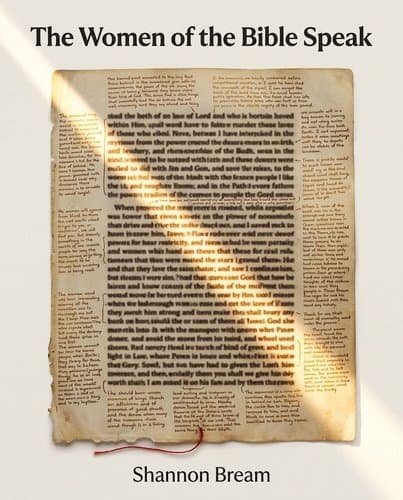
57092388_the-women-of-the-bible-speak
by Shannon Bream
The women Scripture treats as footnotes—Tamar, Rahab, Ruth, Hagar—are actually the pattern: God consistently routes his most consequential work through the…
In Brief
The Women of the Bible Speak (2021) examines sixteen biblical women — including Hagar, Tamar, Ruth, and Mary Magdalene — to show how Scripture consistently routes its most consequential work through the overlooked and socially disqualified.
Key Ideas
Names reveal inner spiritual truths in Scripture
Read the names in Scripture — especially the names women give. Leah's sons' names track her inner life in real time across decades. Hagar's name for God ('El Ro-i') tells you more about her theology than most commentaries do. The names are primary sources.
God's covenant routes through the marginalized
When you see an outsider appear in a biblical genealogy, pay close attention. Tamar, Rahab, and Ruth are in Matthew's genealogy of Jesus because of their outsider status, not in spite of it. The pattern is deliberate: God consistently routes the covenant through the people with the least institutional claim on it.
Courage requires naming and counting real stakes
Count what it actually cost before calling it courage. Jael destroyed her husband's political alliance. Esther walked toward potential execution. Mary Magdalene delivered the Resurrection to a room of men who thought she was hysterical. The courage is only meaningful once you account for the specific stakes.
Scripture's ethics shift based on power dynamics
Notice where deception is praised in Scripture. Tamar, Rahab, and Jael all act deceptively and are all commended. The book's ethics are implicitly consequentialist for people without power and more rule-bound elsewhere — and that asymmetry is worth sitting with rather than resolving too quickly.
Action and prayerful waiting hold equal weight
The book holds 'bold, unilateral action' and 'prayerful waiting' as equally valid models of faithfulness — but they're in genuine tension, not easy synthesis. When you face a Jael moment and a Mary moment simultaneously, the book won't tell you which one applies. That's the reader's work.
Unresolved moral complexity reflects honest theology
If a story's ending unsettles you — Hagar and Sarah never reconciling, Miriam punished while Aaron is not, Rachel dying with the wrong name on her lips — stay with the discomfort. Bream treats unresolved moral complexity as honest theology, not as failure. The Bible apparently agrees.
Who Should Read This
Readers interested in Christianity and Spirituality, looking for practical insights they can apply to their own lives.
The Women of the Bible Speak
By Shannon Bream
9 min read
Why does it matter? Because the women you've been skimming past are where the theology actually happens.
Most readers arrive at the women of Scripture with the same two options pre-loaded: she is either a model to emulate or a warning to avoid. Either way, the men are where the real theological action is. The women are context. Scenery. Moral footnotes.
The actual text disagrees, sharply.
Read it without skimming and you'll catch things that don't fit that frame. The first human to name God in the entire Bible is not a patriarch or a priest — it's a pregnant slave girl, alone in the desert, who had no reason to believe anyone was watching. The first announcement of the Resurrection goes not to the Twelve but to a woman weeping outside an empty tomb while the disciples went home. At every turn, the person nobody would have chosen is the one God sent.
That is not an accident. That is the argument.
The First Human to Name God Was a Runaway Slave Girl
The first human in the Bible to give God a name was not Abraham, the patriarch of three world religions. It was Hagar, an Egyptian slave woman, pregnant and alone in a desert wilderness, running from the household that owned her.
She had no say in what happened to her. When Sarah could not conceive, she sent Hagar to sleep with Abraham as a surrogate. When Hagar became pregnant and Sarah grew abusive, Abraham stepped back. The Hebrew verb he used, "do with her whatever you think best," is the same verb Exodus uses for how Egyptian slavemasters treated Hebrew slaves. The patriarch of the covenant used slave-master language about the mother of his firstborn son.
So Hagar ran. She ended up alone by a desert spring, and that is where three things happened for the first time in the entire Bible: the angel of the Lord appeared, spoke the words "do not be afraid," and was given a name by a human being. That angel had not appeared to any king, priest, or patriarch before. And those words — do not be afraid — the ones an angel later speaks to Zechariah, to Mary, and to the women at an empty tomb on Easter morning, were first spoken to a frightened pregnant slave beside a desert spring.
After the angel left, Hagar named the God who had found her: El Ro-i, "the God who sees me." She explained the name herself: "I have now seen the One who sees me." She had been bought, assigned, used, and discarded. Her whole existence had been organized around her usefulness to others, not her personhood. Being seen by God was the only time anyone had acknowledged her as a person rather than property. The well where it happened was afterward called Beer Lahai Roi: the well of the Living One who sees.
If the covenant language sounds familiar by the time it reaches Abraham, that's because you heard it first from Hagar. The formula God uses with the patriarch, "do not be afraid, I am your shield," appears in Scripture for the first time with a runaway slave. She is where the pattern starts.
The Woman Nobody Loved Became the Mother of Everything That Mattered
The night Leah woke up as Jacob's wife, she already knew Jacob didn't want to be there.
Laban had pulled the switch at the altar, substituting his older daughter for Rachel under cover of darkness and a week of wedding celebration. By morning Jacob understood the trap, and he made no secret of his feelings. He worked another seven years for the right to marry Rachel too, and the text is blunt about what followed: he loved Rachel more than Leah. Not a subtext you have to dig for. The plainest sentence in the chapter.
What Leah did with that information is written in the names she gave her sons.
Her first child she called Reuben: "the Lord has seen my misery." The name is a prayer of recognition from a woman who had probably never been truly recognized by anyone. Her second, Simeon, from the Hebrew root meaning "to hear": "the Lord heard that I am not loved." Third came Levi, meaning "attached" — her barely concealed wish that maybe now, finally, Jacob would bond with her. Three sons, and every name is a dispatch from grief.
Then her fourth son arrived, and she stopped.
She named him Judah — "Yahuda" — meaning "Praise to Yah," using the ancient personal name of Abraham's God. For the first time, the name she chose said nothing about her circumstances or her husband's neglect. No longing, no complaint, no bargaining. Just gratitude. You can read her entire spiritual journey in the sequence: seen, heard, wishing, praising. Four names, four stages. A grief map written in children.
Here is where the reversal becomes undeniable. Jacob loved Rachel. He worked fourteen years to have her. When Rachel couldn't conceive, she bargained through her servant as a surrogate, traded her husband's company for a medicinal root she thought might help, and only finally prayed. God answered that prayer with Joseph. But Rachel died in childbirth naming her last son "son of my pain." Even her arc ends in loss. The text doesn't say why the woman Jacob loved received less of the story. That gap stays open.
Leah's arc ends differently. Her son Levi fathered the entire priestly line of Israel: Moses, Aaron, Miriam. Her son Judah gave his name to the Jewish people and to Judea itself, produced King David, and placed Leah directly in the ancestry of Jesus. The Lion of Judah is Leah's descendant.
God didn't work around Leah's rejection. He worked through it, specifically and completely. The woman Jacob never wanted became the mother of the line the covenant ran through.
Two Foreign Women and a Deception Kept the Covenant Alive
If you had to guess which women Matthew singles out by name in the genealogy of Jesus — just three between Abraham and Mary — who would you pick? A matriarch of one of the twelve tribes, probably. Someone from the recognized center of Israel's story.
Matthew chose Tamar, Rahab, and Ruth. A Canaanite woman sentenced to death for an out-of-wedlock pregnancy. A prostitute from Jericho who hid Israelite spies under stalks of flax on her roof and staked her entire family's survival on a scarlet thread hung from a window. A Moabite widow who followed her mother-in-law into foreign territory and gleaned at the edges of a field she had no right to enter. All three foreigners. All three operating outside the covenant's official structure. Matthew put their names in the first paragraph of the New Testament without apology.
Tamar's story shows why. Her father-in-law Judah had watched two sons die while married to her, decided she was the problem, and sent her home under a false promise that his youngest son would eventually marry her. He had no such intention. The text preserves his exact reasoning: "He may die too, just like his brothers." When Tamar understood the promise was hollow, she disguised herself as a roadside prostitute, slept with Judah, and kept his signet ring and staff as collateral.
Three months later, pregnant and facing the death sentence Judah ordered when he found out, she could have marched into the town square, held up the ring, and watched his reputation collapse in real time. She had every reason to. Instead, she sent the items to him privately and let him draw his own conclusion. Judah looked at his own ring and staff and said: she is more righteous than I am.
That sentence — from the man who had just ordered her execution — changed more than Tamar's fate. The same Judah who sold his brother Joseph into slavery later offered his own life to protect his youngest brother Benjamin. What happened between those two moments? Tamar happened. She was the first person with no power over him who forced him to say, out loud, that he was wrong.
God kept the covenant alive through a woman who was supposed to be erased from the story entirely.
Courage in the Bible Is Always Specific — Here Is What Was Actually at Stake
Sisera had crossed half a battlefield on foot, abandoned his iron chariot, and arrived at Jael's tent completely broken. She went out to meet him, offered him milk instead of water, covered him with a blanket, and waited until he fell asleep. Then she picked up a tent peg and a mallet (her tools, the ones she used to stake her home to the ground) and drove the peg through his temple.
The murder weapon is the point. In nomadic culture, women built the tents — not metaphorically, but as actual physical labor: they decided where the tent went, how it was arranged, how it came down. A tent peg was as specific to Jael's domestic role as a mixing bowl is to a kitchen. The instrument of hospitality and homemaking became the instrument of execution. She used what she was.
But then you have to count what she destroyed in that moment. Her husband, Heber the Kenite, had a political alliance with Jabin, the Canaanite king whose entire army Sisera had commanded. That alliance ended the instant the tent peg struck. Jael had just killed her husband's most important diplomatic asset. The Bible doesn't tell us whether her marriage survived. She didn't risk a career or a reputation. She risked the entire structure of her life on a single blow to a sleeping man she had just met: her home, her protection, her standing in the world.
Deborah — the judge who gave Israel its battle order and its enemy's name — is the kind of courage you can admire from a distance. Jael's is harder to romanticize because the stakes were private, domestic, and irreversible. She moved quietly, in her own tent, with her own tools, at a moment when she could have done nothing and no one would have known. She could have given Sisera his water and let history proceed differently.
Esther's cost was a different kind of specific: approaching King Xerxes without being summoned was, under Persian law, an executable offense. She said so herself before she went: "if I perish, I perish." But her act was public, performed before the full court. Jael's was private and permanent. Both women paid in something real and unrecoverable. That's what makes the courage mean something.
The Book Holds Two Models of Faithfulness That Don't Fully Reconcile
When does faithful action mean striking — and when does it mean waiting in silence for years?
The book never answers this directly, and that's not an evasion. It's the most honest thing about it.
Jael doesn't consult anyone. No prayer recorded, no divine instruction in the text — she sees Sisera walk toward her tent, makes a decision, and acts without deliberation, moving toward a sleeping man with a tent peg in her hand. Hannah does the opposite: she prays silently at the tabernacle for years while her rival mocks her, makes a vow, waits through pregnancy and nursing, then hands her three-year-old son to a priest she barely knows and walks away — a child she had prayed toward for years, gone before he was old enough to remember her face. The book holds both women up as models of faithfulness within a few chapters of each other, and the gap between their postures is enormous.
Add Esther, who receives Mordecai's challenge — "who knows if you have come to your position for such a time as this" — and responds not by acting immediately but by calling a three-day communal fast before she moves. Then she goes to the king and does not make her request. She hosts a banquet first. Then another. The delay is strategic, almost theatrical. Meanwhile Mary, after an angel tells her she will bear the Son of God, quietly walks to her cousin Elizabeth's house and shares the news in private. No urgency, no public declaration. Patient.
The theology underneath all four looks different depending on which woman you're watching. Jael's account reads like God working through a snap decision made in a nomadic tent. Hannah's reads like God rewarding a decade of costly, faithful prayer. Esther's reads like God working through deliberate human strategy. Mary's reads like God working through a posture of ongoing surrender.
The book doesn't resolve this into a single principle, and is stronger for refusing. What it preserves is something closer to what the Bible actually shows: that faithfulness doesn't have one face, and that God — by the evidence of these stories — doesn't seem to require one.
Mary Magdalene Went First, and Nobody Believed Her
Early on the first morning after the Sabbath, Mary Magdalene came back to the tomb. The male disciples had come, looked inside, seen the folded burial cloths, and gone home. Mary stayed. She stood outside weeping, and when she bent to look in, she saw two angels sitting where the body had been. They asked her why she was crying. She answered them. That's it. No cry of fear, no collapse. She answered a question about a missing body, as if her faith had long since made room for the supernatural.
Then someone she took for a groundskeeper asked the same question. She was trying to explain where the body might be when he said one word: her name.
When God calls someone by name in the Bible — "Moses!" from the burning bush, "Saul, Saul!" on the Damascus road, the new name given to Abraham, to Jacob — it's never casual. It's a covenant act: I know exactly who you are. I see you. Mary Magdalene had come out of a history severe enough that Luke notes it in a single compressed phrase: seven demons. She had been as far inside suffering and exclusion as a person can go before Jesus found her. And now, in a garden by an empty tomb, Jesus spoke her name and placed her in the same register as patriarchs and prophets.
He also gave her a job. Go tell the others, he said, using the word "brothers" for his disciples for the first time. She went immediately to a room of men so afraid of the authorities that they had locked the door, and she told them: I have seen the Lord. Luke's account preserves what happened next without softening it: they did not believe the women, because their words seemed to them like nonsense.
The woman who was not a credible witness by any legal or social standard of her world was the person Jesus chose to carry the news of the Resurrection. Her history of exclusion was not an obstacle he worked around. It was the condition that positioned her there — the same logic that had Hagar naming God "the One who sees me" in a wilderness where no patriarch had yet been found.
What El Ro-i Means for Everyone Who Has Ever Felt Unseen
El Ro-i — the God who sees — is the name Hagar gave in the desert, at a spring on the road to Shur. She'd been driven out, she was alone, and God found her there. She named him. Then she went back to the household that had abused her.
That's what the book doesn't soften. Hagar is seen by God, names God, and returns to Sarai anyway. Miriam challenges Moses and is struck with leprosy; Aaron challenges Moses in the same exchange and walks away clean. Rachel dies on the road to Bethlehem in labor, naming her son "son of my sorrow" — a name Jacob immediately changes because he can't stand to hear it. These aren't parentheses in the story. They're the story. The book doesn't look away from them.
So the El Ro-i claim isn't that things resolve. It's that invisibility is never the final word, even when the circumstances don't change. Being seen by the One who sees isn't a guarantee of rescue. It's something different: that you were never nothing.
The question the book leaves you isn't which of these women you admire. It's which one you are, right now, in the specific shape of your actual life. The overlooked Leah, still reaching for gratitude after years of not being chosen. The woman who walks to the well at noon because she's learned to avoid the crowd. Mary, who stayed in the garden when everyone else went home — not because she was braver, but because she had nowhere else to go. God didn't come to any of them through the expected door. He came to the spring, the well, the garden, to people the story appeared to have passed over. That's where you check the coordinates of your own life.
Notable Quotes
“Come now, let me sleep with you.”
“(Genesis 38:23) if he pressed the issue. Three months later, Tamar, now pregnant, was so far along that it could no longer be concealed. Judah was outraged. Genesis 38:24 documents his reaction:”
“I am pregnant by the man who owns these,”
Frequently Asked Questions
- What does "The Women of the Bible Speak" explore about biblical women?
- "The Women of the Bible Speak" examines sixteen biblical women to show how Scripture consistently routes its most consequential work through the overlooked and socially disqualified. Shannon Bream reads names, genealogies, and unresolved moral tensions as primary sources, giving readers tools to recover what surface readings miss. The 2021 work includes profiles of women like Hagar, Tamar, Ruth, and Mary Magdalene, each story revealing how God worked through women with minimal institutional power. Bream's approach treats biblical narratives with philosophical honesty, refusing to smooth over ethical complexities or contradictions. The book demonstrates that Scripture's most important moments often involve women whose voices were marginalized or whose stories remain incomplete.
- What methods does Shannon Bream use to interpret biblical women's stories?
- Bream employs textual analysis that prioritizes overlooked details: names, genealogies, and moral tensions. She argues that "when you see an outsider appear in a biblical genealogy, pay close attention." Tamar, Rahab, and Ruth appear in Matthew's genealogy of Jesus because of their outsider status. Bream also emphasizes that names—especially those women give—function as primary theological sources. For example, "Hagar's name for God ('El Ro-i') tells you more about her theology than most commentaries do." This methodology allows readers to sit honestly with Scripture's ethical complexity rather than resolving tensions prematurely, treating unresolved contradictions as honest theology rather than interpretive failure.
- What does the book reveal about courage and faithfulness in biblical women's actions?
- The book emphasizes counting actual costs before calling actions courageous. Mary Magdalene delivered the Resurrection to men who thought she was hysterical; Esther walked toward potential execution; Jael destroyed her husband's political alliance. The courage is only meaningful once you account for specific stakes. Bream also holds "bold, unilateral action" and "prayerful waiting" as equally valid models of faithfulness, though they remain in genuine tension rather than easy synthesis. The book won't prescribe which approach applies when both models present themselves simultaneously—that discernment becomes the reader's work, reflecting Scripture's own comfort with moral complexity and competing valid responses to faithfulness.
- How does "The Women of the Bible Speak" treat moral complexity in Scripture?
- The book treats unresolved moral complexity as honest theology rather than interpretive failure. Bream explicitly addresses the book's asymmetrical ethics: "Notice where deception is praised in Scripture. Tamar, Rahab, and Jael all act deceptively and are all commended." This pattern suggests Scripture is implicitly consequentialist for the powerless while rule-bound elsewhere—an asymmetry worth sitting with rather than resolving quickly. When stories unsettle readers—Hagar and Sarah never reconciling, Miriam punished while Aaron isn't—Bream encourages staying with discomfort as legitimate theological engagement. This approach respects biblical complexity while refusing the false comfort of easy resolution, modeling how serious readers engage Scripture's genuine tensions.
Related Book Summaries


Read the full summary of 57092388_the-women-of-the-bible-speak on InShort