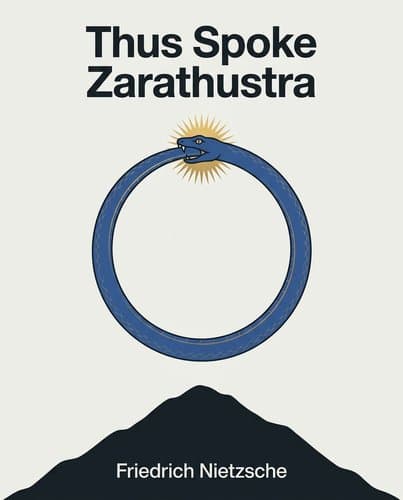
51893_thus-spoke-zarathustra
by Friedrich Nietzsche
After God is dead, the real work begins: forging your own values from nothing and willing your exact life—every humiliation, every grief, every moment of…
In Brief
After God is dead, the real work begins: forging your own values from nothing and willing your exact life—every humiliation, every grief, every moment of grace—to recur forever. Nietzsche's ultimate test isn't a cosmological claim but a dare: become someone who can say yes.
Key Ideas
Does your virtue create or sedate?
Test your values against Nietzsche's question: are they in service of creation, or in service of rest, ease, and not being harmed? The virtues that produce good sleep (comfort, approval, modest reputation) are precisely what Zarathustra mocks as sedation disguised as morality.
Genuine virtue precedes language and crowds
Check whether your virtues are genuinely yours or renamed herd properties. The moment you give a virtue its common name — 'justice,' 'kindness,' 'modesty' — you've handed it to the crowd. Genuine virtue is pre-linguistic, idiosyncratic, almost inarticulate: 'this is my good, this I love, just thus do I like it.'
Unmask revenge in moral punishment
The spirit of revenge operates in your moral reasoning whenever you feel the impulse to punish. Nietzsche traces all punishment systems to the will's inability to undo the past — 'It was' is the stone it cannot roll — and its revenge against anyone who doesn't share its wrath. Catching this impulse is not optional: it is the precondition for willing anything higher.
Retroactively author your lived experience
The creative will can redeem the past not by changing it but by retroactively claiming it. 'I willed it thus' transforms the passive experience of having-been-happened-to into the active authorship of a life. This is not self-deception; it requires becoming the kind of person who could have willed exactly that.
Could you affirm eternal recurrence?
Use the eternal recurrence as a personal test rather than a cosmological claim: if this exact life — every humiliation, every boredom, every grief, every moment of grace — recurred forever without alteration, could you say yes? If not, Nietzsche's question is: what would you have to become to be someone who could?
Who Should Read This
Thoughtful readers interested in Existentialism and Ethics willing to slow down and wrestle with ideas.
Thus Spoke Zarathustra
By Friedrich Nietzsche & Walter Kaufmann & Silvia Cecchini & Domenico Ciampoli
11 min read
Why does it matter? Because "God is dead" was Nietzsche's question, not his answer.
Everyone quotes "God is dead" as if Nietzsche crossed the finish line. He hadn't even laced his shoes. That line is the starting pistol — the catastrophe that creates the problem the entire book is trying to solve. Strip away heaven, moral order, the idea that suffering means something, the comfort of pity, the fantasy of progress, the reassurance that everyone is equal. What's left? Nietzsche's answer, delivered through a mountain hermit-prophet named Zarathustra, is stranger than nihilism and harder than faith: a philosophy of absolute Yes, so total it must include willing every moment of your life to repeat forever. Not because existence is good. Because the alternative — resenting it — hollows you out. The snake is already in your throat. The only question is whether you'll bite.
The Real Crisis Wasn't God's Death — It Was Figuring Out What to Build on the Ruins
On Christmas Day 1882, Friedrich Nietzsche wrote a letter from what amounted to the bottom of a well. Lou Salomé, a young philosopher he'd hoped to marry, had turned him down, taking with her his last hope of ending four years of enforced solitude. The letter went to his friend Franz Overbeck and wasn't really about heartbreak. It was about running out of philosophical road. "If I cannot find the magic formula to turn all this — muck to gold," he wrote, "I am lost."
Nietzsche didn't merely think philosophical problems — they moved through him like weather. Since 1876, he had spent five years systematically stripping down every concept mankind uses to feel dignified. Morality turned out to be sublimated aggression. Beauty was a human projection onto a cosmos of pure chaos. Truth reduced to the errors the species could not escape. And God: dead, killed by human knowledge. By late 1881, this particular storm had nowhere left to go.
Here's what most readers miss: "God is dead" is not the conclusion. It's the problem. The famous scene in The Gay Science — the madman sprinting through the marketplace, lantern in hand, screaming "We have killed him!" — is not triumphant. The man is terrified. How do we console ourselves? What festivals of atonement must we now invent? The questions are posed and left hanging. Nietzsche had demolished the structure and was sleeping in the rubble.
Then in January 1883, after ten unexpectedly clear days, Part One of Zarathustra poured out in a rush. Nietzsche later described the experience as something received rather than constructed, thoughts arriving whole, unbidden, with the force of revelation. The Superman, will to power, eternal recurrence, amor fati: the whole positive philosophy appeared almost fully formed.
Which is what makes an observation by Hollingdale, the book's own translator, so genuinely unsettling. Line the new concepts up against Lutheran theology and they map almost perfectly. Amor fati mirrors the Lutheran doctrine that events are divinely willed and to resist them is impiety. Eternal recurrence echoes "world without end." The Superman carries the same emotional charge as the soul lifted by divine grace — the awe, the submission, the sense of something utterly beyond the merely human. Hollingdale's point is structural: Nietzsche transferred the entire emotional architecture of Christian worship to his new figures, term by term.
Nietzsche hadn't escaped the Lutheran parsonage he'd grown up in. He'd rebuilt it in disguise, because he had nowhere else to go.
To Create New Values, You Must First Be Destroyed by the Old Ones
Think about how we usually imagine becoming wiser. We picture it like a tower under construction: each experience adds a floor, and the person at the top can see further because of everything stacked below. Nietzsche's three metamorphoses describe something closer to the opposite.
The spirit begins as a camel — not a symbol of weakness but of strength. The camel actively seeks the heaviest loads: humiliating yourself to wound your pride, suffering through difficult truths, loving those who despise you. It takes real force to want these burdens. Once laden, the camel runs into the desert. Alone there, it becomes a lion.
The lion's work is confrontation. Its enemy is a golden, scale-covered dragon called Thou Shalt: a thousand years of inherited moral commands crystallized into a single commanding force. The dragon's position: all values have already been created; there is no room left for "I will." The lion's answer is exactly that: I will. But here Nietzsche makes a move most readers miss. The lion cannot create new values. Its entire power is negative: it can refuse, break, and seize freedom from the reverence it used to honor. The sacred No it produces is essential. But it's still defined by what it destroys. You cannot build a new world out of negations.
So why must even the lion be dismantled? Because the child is something genuinely different, not a more powerful lion, but a prior kind of creature altogether. Nietzsche describes it as pure innocence and forgetfulness, a creature of beginnings rather than battles. The child does not arrive at Yes by working through No. It says Yes because it has forgotten there was ever a battle. Think of the difference between someone who finally makes peace with a difficult past and someone who simply never had one — from outside they look similar, both open, both undefended. But the first person's openness was built against something; it still carries the imprint of what it overcame. The child's Yes isn't like that. Nothing had to be worked through to get there. Where the camel's strength was carrying burdens and the lion's strength was breaking them, the child's power is that neither burdens nor struggle exist for it anymore. It no longer wills against something inherited, or even toward something imagined — it creates from the spontaneous fullness of its own nature.
What makes the sequence genuinely strange is this: the camel's reverence doesn't survive into the lion; the lion's defiance doesn't survive into the child. Each stage is destroyed to produce the next, and the final destination is not wisdom compounded from the prior two: it's radical innocence that was only possible after everything was dismantled.
Your 'I' Is a Toy the Body Is Playing With
The conscious mind — what you call "I," the voice narrating your experience — is not in charge. This is Nietzsche's central claim in these chapters, and it hits harder the longer you sit with it.
He draws a sharp line between two things we usually conflate: the Ego, the conscious self-narrating "I," and the Self, a deeper intelligence residing in the body that the Ego cannot directly access. The Ego feels like the commander. It reasons, deliberates, evaluates. But Zarathustra says it's the instrument, not the player. The Self uses sense and spirit as tools, channels through which the body gathers information and exerts its will. Behind every thought, Nietzsche says, stands something older and more authoritative than the reasoning mind: a silent sovereign the Ego can't see directly.
The clearest illustration: the Self issues an order — feel pain — and the Ego immediately gets to work. It thinks hard, turns the problem over, maybe arrives at something that feels like genuine philosophical insight about suffering. It believes it has done philosophy. But Nietzsche's point is that it was assigned exactly that task. The thinking was commanded. The Ego is a puppet giving speeches about free will.
This inverts everything. Pride in your intelligence is the Self congratulating itself on a useful tool. Your "will to truth" (what philosophers call their highest drive) is, Zarathustra says, a disguised will to power: the desire to bend reality into forms the mind can dominate. The philosopher and the priest are, at this level, doing the same thing.
And if the body is always the real speaker, using mind as its instrument, then the loudest deniers of the body aren't outside this structure. They're caught deepest in it.
The sharpest edge: the people most loudly contemptuous of the body, the ascetics and monks and preachers of heaven, are running from a body that has failed them. Heaven was not discovered; it was invented by exhausted, suffering people who needed somewhere else to be. But the razor cuts further: these same people, whatever they claim about immortal souls, are more convinced of the body's reality than anything spiritual. Their entire metaphysical project is organized around escaping something that has already proved, through sheer agony, that it is the most present thing in their existence. Heaven is what you invent when you hate your body so intensely you cannot stop thinking about it.
The healthy body, Zarathustra says, is the honest speaker: not comfortable, but incapable of lying about what it is. The sick body projects its agony outward into theology. The healthy one creates meaning without needing to flee.
The Prophet Who Knew the Teaching He Wasn't Yet Strong Enough to Speak
What does it mean that the book's most important philosophical moment is left unspoken?
Most readers treat Zarathustra as a philosophy delivered; this scene suggests Nietzsche knew it was a philosophy mid-formation.
Zarathustra is on a bridge, explaining to his disciples that the deepest human problem is the will's inability to move backward through time. The past is an immovable stone. This powerlessness breeds what he calls the spirit of revenge: unable to undo what was, the will turns its frustration outward as punishment, moral condemnation, the whole machinery of guilt. He's been building toward a solution: the will must learn to claim its past as chosen, to say not "it happened to me" but "I willed it thus." He pushes further — the will to power must will something higher than reconciliation with time — and then asks the question that would name eternal recurrence: who could possibly teach the will to move in reverse?
And he stops. He looks at his disciples with what the text describes as the terror of a man seized by something, his gaze going through them as if searching behind their faces. Then, after a beat, he laughs and waves it off: keeping silent is difficult, especially for a babbler. Subject changed.
A physically deformed man Zarathustra met earlier in the scene gets the last word: why does Zarathustra speak to his pupils differently than to himself?
The question lands because it's exactly right. Zarathustra possesses the doctrine. He knows what the teaching requires. But willing eternal recurrence (saying yes to existence, without exception, forever) is not something you argue your way into. It requires a transformation the argument alone cannot produce. "The Stillest Hour" makes this explicit in a separate scene: an internal voice confronts him with the same accusation and delivers its verdict plainly: the teaching has ripened, but the teacher has not. He must return to solitude not because he lacks the idea but because he has not yet become the kind of being who can speak it without flinching.
That's what the dramatic form of the book is actually doing. Zarathustra is not a mouthpiece delivering Nietzsche's conclusions. He is Nietzsche mid-process, knowing what the philosophy requires, breaking off in terror at the exact moment it demands full commitment. The incompleteness is not a failure of craft. It's the most honest thing about the work.
The Shepherd Doesn't Accept the Snake — He Bites Its Head Off
A young shepherd is lying on the ground, convulsing, a thick black snake hanging from his mouth. It crawled in while he slept and bit fast into his throat. Zarathustra finds him and does the obvious thing: grabs the snake and pulls. It won't move. And in that moment of uselessness, something cries from Zarathustra that isn't quite him: Bite. Bite its head off. The shepherd bites. He spits the severed head away and springs to his feet — but the man who stands up is not the man who went down. He's surrounded by light. He's laughing. And Zarathustra, who has seen everything, admits he has never heard laughter like this on earth.
Most readers approach Nietzsche's life-affirmation as philosophical serenity: making peace with suffering, accepting the hard parts alongside the good, cultivating equanimity. The shepherd vision is a deliberate correction. The snake in the throat is not something you learn to tolerate. Swallowing it (living with it, adjusting to it, finding a way to breathe around it) is not the act Nietzsche is after. The act is the bite. Violent, decisive, total. And what follows isn't peace. It's laughter that doesn't sound human anymore.
The machinery behind this is what Zarathustra couldn't finish naming on the bridge: the will's rage at the past, its helplessness crystallized into blame.
The creative will does something wilder: it claims authorship of the past. Not "I've made peace with it," but I willed it thus: a retrospective act of ownership, the past recast as chosen rather than endured. This is why Zarathustra breaks off in terror when he gets close to naming it: actually performing this act, on everything, including the unbearable moments, isn't an argument you can conclude. It's a transformation.
Eternal recurrence is what makes that transformation genuinely violent. The doctrine isn't "life goes on." Every specific moment recurs, forever, exactly as it was. The snake crawls back into the throat every time. The question isn't whether you can tolerate that. It's whether you can bite its head off every time and still spring up laughing. The shepherd who manages this is no longer fully human in the ordinary sense: he's become something that can say yes to existence without exception. What Zarathustra burns with at the end of the vision is not admiration. It's longing — the particular kind that comes from being able to see exactly what you are not yet.
The Question That Weighs Nothing and Changes Everything
Here's the thing about eternal recurrence that Nietzsche never quite says plainly: it isn't a claim about physics. It's a question he's pressing against whatever you're doing right now. Not whether you could survive your life repeated — endurance is cheap — but whether you could will it. The whole thing. Unchanged. Including the parts you've been quietly trying to escape, reframe, or at least not think about before bed. Most people fail this test the moment they take it seriously, which is exactly the point. The shepherd doesn't bite the snake because he's become invulnerable. He bites it because he becomes something that can say I willed it thus — not as consolation, but as authorship, a retroactive claim that turns what-was-done-to-you into what-you-chose. That transformation isn't a conclusion you reach. It's a thing you have to become. And apparently, on the other side of it, you laugh in a way nobody's heard before.
Notable Quotes
“?' Thus madness preached. 'Can there be redemption when there is eternal justice? Alas, the stone”
“cannot be rolled away: all punishments, too, must be eternal!' Thus madness preached. 'No deed can be annihilated: how could a deed be undone through punishment? That existence too must be an eternally-recurring deed and guilt, this, this is what is eternal in the punishment”
“, you all most like to bellow: but I have unlearned belief in”
Frequently Asked Questions
- What is Thus Spoke Zarathustra about?
- Thus Spoke Zarathustra presents Nietzsche's philosophical response to the collapse of traditional morality, offering not nihilism but the active creation of new values from the ground up. Through the prophet Zarathustra, the work equips readers to identify herd instincts disguised as virtue, break free from the spirit of revenge, and use eternal recurrence as a test for living with full, unconditional affirmation. Rather than accepting conventional morality as given, Nietzsche challenges readers to create their own values that serve creation rather than comfort, and to transform passive experience into active authorship of life.
- What is the eternal recurrence test in Zarathustra?
- The eternal recurrence is a personal test, not a cosmological claim: if this exact life — every humiliation, every boredom, every grief, every moment of grace — recurred forever without alteration, could you say yes? If not, Nietzsche's question becomes: what would you have to become to be someone who could? This test reveals whether you're truly living with affirmation or merely enduring existence. It challenges you to retroactively claim your past by saying 'I willed it thus,' transforming passive experience into active authorship. The eternal recurrence thus serves as a measure of whether your values and choices genuinely serve creation.
- What does Nietzsche mean by the spirit of revenge in Thus Spoke Zarathustra?
- The spirit of revenge operates in your moral reasoning whenever you feel the impulse to punish. Nietzsche traces all punishment systems to the will's inability to undo the past — 'It was' is the stone it cannot roll — and its revenge against anyone who doesn't share its wrath. This revenge impulse masquerades as justice and morality, but it fundamentally stems from resentment toward what cannot be changed. Catching this impulse in yourself is not optional; Nietzsche considers it the precondition for willing anything higher. To transcend revenge means abandoning punishment-based ethics and learning to retroactively claim your past through willing it.
- How does Nietzsche distinguish between genuine virtue and herd morality in Zarathustra?
- Genuine virtue is pre-linguistic, idiosyncratic, and almost inarticulate — 'this is my good, this I love, just thus do I like it.' The moment you give a virtue its common name — 'justice,' 'kindness,' 'modesty' — you've handed it to the crowd. Nietzsche distinguishes between virtues that serve creation and those that produce good sleep through comfort, approval, and modest reputation. Values that seduce you toward ease and harm-avoidance are precisely what Zarathustra mocks as sedation disguised as morality. Test your values: are they genuinely yours and in service of creation, or are they herd properties renamed to sound virtuous?
Related Book Summaries
Read the full summary of 51893_thus-spoke-zarathustra on InShort