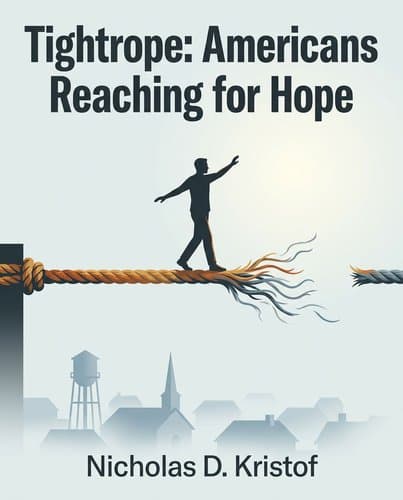
45553638_tightrope
by Nicholas D. Kristof
American workers earn less in real terms than they did in 1973 — not from laziness or bad choices, but from deliberate policy decisions.
In Brief
American workers earn less in real terms than they did in 1973 — not from laziness or bad choices, but from deliberate policy decisions. Kristof and WuDunn follow the human casualties of a system that was redesigned to reward capital while stranding the people who built it.
Key Ideas
Economic Growth Without Median Wage Growth
Real wages for non-supervisory American workers were lower in 2018 ($22.65/hr) than in 1973 ($23.68/hr) in inflation-adjusted terms — economic growth that doesn't reach the median worker is not broadly shared prosperity, regardless of what GDP or stock indices show.
Policy Differences Explain Social Outcome Gaps
When you encounter a story of individual failure — addiction, incarceration, homelessness — the first question should be whether the same forces produced the same outcomes in peer nations. If Canada, Germany, and France didn't see deaths of despair despite identical economic pressures, the explanation is policy, not character.
War on Drugs Deliberately Targeted Minorities
Nixon's domestic policy chief John Ehrlichman admitted in 1994 that the war on drugs was designed to criminalize Black people and antiwar protesters — treating it as a good-faith public health effort is a category error that has sent millions to prison while protecting the executives who engineered mass addiction.
IRS Audits Poor More Than Wealthy
The IRS audits more than one-third of returns from working poor earning under $20,000 while auditing fewer than 6% of returns from millionaires — and the top 5% of earners account for more than half of all underreported income. The enforcement asymmetry is a policy choice, not a resource constraint.
Economic Collapse Drives Family Fragmentation
MIT economist David Autor's research shows that trade-driven collapses in male employment directly caused marriage rates to fall and out-of-wedlock births to rise — family fragmentation followed economic collapse, not the other way around. Policies targeting family structure without addressing wages treat the symptom.
Proven Programs Exist But Stay Underfunded
Programs with documented results — Women in Recovery's 4.5% three-year recidivism rate, Canada's 24-hour layoff action centers, IUDs that return $7 per dollar invested — already exist. The barrier to scaling them is not evidence; it is the political choice to keep spending on incarceration instead.
Who Should Read This
History readers interested in Social Issues and Policy who want a deeper understanding of how we got here.
Tightrope: Americans Reaching for Hope
By Nicholas D. Kristof & Sheryl WuDunn
8 min read
Why does it matter? Because the people you assume failed themselves were standing on a floor that was pulled out from under them.
The easy story: some people have discipline and some don't. Some communities hold together and others fall apart. You already know which kind Yamhill, Oregon is.
What breaks that story open: the same economic forces that hollowed out working-class wages in America also hit Germany, France, and Canada — and none of them produced an epidemic of deaths from overdose, alcohol, and suicide. America did, almost uniquely. That gap isn't a character difference. It's a policy difference: specific decisions made over fifty years that dismantled the structures turning working-class effort into working-class stability, then blamed the casualties for falling. Tightrope follows that wreckage through real families (people the authors grew up beside) and refuses to let any political tribe off the hook. The question it forces isn't "what went wrong with these people?" It's why America produced this epidemic when no comparable country did — and once you see it, the standard story about discipline and character becomes impossible to reassemble.
The Promise Was Real Before It Was Broken
In 1973, Dee Knapp was hiding in tall grass on her family's property in Cove Orchard, Oregon (population fifty), while her husband Gary fired rifle shots into the darkness where she lay. She had fled the house when he came home drunk and hit her. Her eldest son had thrown a sleeping bag from a second-story window; she caught it midair and ran. Now she was flat in the field, bullets smacking the ground seventy feet from the house, waiting for Gary to tire himself out.
What she felt lying there, bruise forming on her cheek, wasn't despair. It was hope — the specific hope that tomorrow morning, no matter what Gary did, the Number 6 school bus would come down that road and carry her five children to Yamhill Carlton High School, where they would learn algebra and biology and the use of prepositions. Things no one in her family, across ten generations of subsistence farming and migrant labor, had ever been taught.
She and Gary had started married life as fruit-pickers following the California and Oregon harvests, earning by the bushel, sleeping in shacks. As of 1960, only one in five hundred migrant-worker children finished elementary school. Dee had dropped out in fifth grade; Gary could barely write his name. But here: they owned their two-and-a-half acres, bought for $2,500 in 1963 (the first home either had with electricity). Gary held a union pipe-laying job; Dee drove tractors on a hazelnut farm. All five children were already outpacing their parents in school, and Dee let herself imagine Farlan, smart and good with his hands, designing pipelines someday rather than digging them.
That arc was real. Not exceptional. The common experience of working-class families across America in the 1970s.
Four of her five children are now dead. Farlan from liver failure. Zealan burned to death drunk in a house fire. Nathan killed when the meth he was making exploded. Rogena from hepatitis linked to drug use. The fifth, Keylan — identified as a math prodigy by his elementary school — survived partly because thirteen years in state prison kept him away from drugs long enough to outlast his siblings.
The promise wasn't an illusion Dee invented to cope with Gary's rifle. It was briefly, genuinely real. What came for her children wasn't poverty revealing its permanent face. It was something that broke.
Bad Choices Don't Explain a 45-Year Collapse in Real Wages
Kevin Green's downfall looked like character failure. The economics told a different story.
Kevin grew up in Yamhill, too — same road, same school bus as the Kristofs, different house. His father Tom, a union mason and Korean War veteran, built a solid life from hard work. Kevin inherited the ethic into an economy that had stopped rewarding it. He found jobs after the local factories started closing — first at a storage-rack company, then welding trailers. Neither lasted. Without steady income he couldn't afford to marry the woman he'd lived with for a decade, who'd had his twin boys. When the trailer plant shut, she left. Kevin drank, gained weight to 350 pounds, developed diabetes, injured his back. Social Security paid him $520 a month. The state assessed $350 a month in child support, which he often couldn't cover — and when he fell behind, Oregon confiscated his driver's license.
That detail is the hinge. In rural Yamhill County, no license means no commute means no job — a policy that converts the poverty of being unable to pay into the criminality of being unable to work, trapping at least 7 million Americans nationwide. The debts compounded, the desperation deepened, and Kevin eventually pulled a shotgun on his ex during a custody confrontation. That felony made him effectively unhireable. He died in early 2015, organs failing. The hospital had sent him home on Christmas Day 2014. His entire estate was a set of tools, left to his sons.
The instinct is to say Kevin made bad choices. He did. But the choices came after the floor gave way — and the floor gave way for everyone. Average hourly wages for nonsupervisory workers in 2018 were $22.65 in inflation-adjusted dollars. In 1973, when Kevin was in middle school, they were $23.68. The economist Raj Chetty found that 92 percent of Americans born in Tom's generation out-earned their parents by thirty. Among Kevin's generation, barely half did. That's not a story about individuals making worse decisions than their parents. It's a story about what the economy stopped doing.
Kevin once passed a homeless man in Sheridan, badly sunburned, shirtless. He pulled off his own shirt and handed it over. The man who died on that farm with nothing but tools was also that man.
America's Class System Isn't an Accident — It Was Built
At what point does a system that consistently protects wealth and punishes poverty stop being an unfortunate byproduct and start being a design?
In 2017, Joel Sanders was convicted of felonies — fraud he committed as CFO of a law firm he helped destroy. The sentence: no prison time. A $1 million fine, payable over three years. He kept his Long Island home, his oceanfront Miami condominium, two leased luxury cars, and about a million dollars in liquid assets. His attorney then petitioned to cancel even the fine, arguing it would impose "undue hardship" on the family. The court received this as a reasonable argument.
More than one-third of all IRS audits target people earning under $20,000 a year. The top five percent of earners account for more than half of all underreported income, yet are audited at a fraction of that rate. People with nothing can't afford to fight back. Enforcement concentrates where resistance is lowest.
The education system works the same way. School funding tied to local property taxes means a wealthy suburb in the same state can outspend a neighboring poor district two to one. One Supreme Court vote in 1973 preserved that arrangement. Demetrio Rodriguez, a San Antonio sheet-metal worker, sued over his children's underfunded school and lost, 5-4.
Each of these outcomes traces to a specific, reversible decision made by people it benefited. No conspiracy required — only enough decision-makers, over enough decades, choosing in the same direction. Kevin Green pulled a shotgun during one desperate moment after years of cascading failures, died with a felony record and nothing to his name. Joel Sanders orchestrated fraud at scale, kept the beach condo, and found a new job at $375,000 a year. That gap isn't a discrepancy in the system. It's the system.
Pharmaceutical Executives Addicted Millions and Never Spent a Day in Jail
Daniel McDowell sat across from a new doctor, trying to sort out the knee pain he'd carried home from Afghanistan, the lasting damage from an antitank mine strike that had ended his combat deployments. The doctor looked at his chart and paused. "You're on more medication," he said, "than someone with terminal cancer would be on." By then the damage was done. Daniel was already dependent on the oxycodone prescribed by the pain clinic the VA had sent him to, and cutting the dosage sent him scrambling. He started injecting crushed pills, then switched to street heroin when black-market prescriptions became too expensive, then to dealing to cover a $150-a-day habit. He was arrested, spent eight months in jail, relapsed the first night out, and attempted suicide twice. He blames himself. "At any point," he says, "I could have said I don't want to do this."
That's the remarkable thing: Daniel's willingness to own something that wasn't really his to own. Purdue Pharma had spent the 1990s persuading doctors that opioids were safe for chronic pain. They helped finance the American Pain Society's push to classify pain as a fifth vital sign, which hospitals adopted and tied to patient satisfaction scores used to set reimbursement rates. Prescriptions soared. McKinsey advised Purdue how to push sales further and counter the arguments from families of teenagers who had overdosed. Eighty percent of Americans who became addicted to opioids started with a prescription, not a street drug. Purdue was eventually convicted of a felony. Its fine was $600 million — against estimated OxyContin revenues of $35 billion. No executive went to prison. The Sackler family is now worth $13 billion.
Then consider Geneva Cooley. A 71-year-old Black woman caught carrying pills was sentenced to life without parole. The prison system didn't record it as "life." It wrote a number — something close to a thousand years.
The prescription data was not ambiguous. Purdue had it. Daniel blamed himself for an addiction pharmaceutical executives manufactured for profit, survived two suicide attempts, and served eight months in jail. The executives who designed the machine paid fines too small to register against their earnings. Their customers got life.
Germany Faced the Same Economic Forces — and Nobody There Is Dying of Despair
The pharmaceutical companies weren't the only ones who looked away. If factory closures hollow out communities, why did the same forces leave so many more Americans dead?
Victor Tan Chen, a sociologist at Virginia Commonwealth University, spent weeks after the 2008 recession talking to autoworkers laid off by GM and Ford: some in Detroit, some in Windsor, Ontario, just across the river. The plants on both sides faced identical global pressures. The workers' outcomes were not. Within twenty-four hours of a major Windsor layoff, Canada had an action center running — job coaches, retraining referrals, benefit navigation. When laid-off Ford workers said they wanted nursing credentials, the center didn't hand them a pamphlet; it persuaded a local college to open a new program immediately. Detroit workers got nothing comparable. They were left to treat job loss as personal failure, absorbing it alone, cycling downward into apathy.
The difference wasn't the factory closure. It was what happened in the twenty-four hours after.
Angus Deaton, Nobel Prize-winning economist, put it plainly: "Globalization is global. None of this stuff is happening in Germany or France or Spain. The deaths of despair are just not happening in Europe. A lot of policy has been directed against the working class." The US spends barely one-fifth of what comparable industrialized nations spend on job training, and has been cutting that share for decades, even as prison budgets have grown.
Kevin Green, the Knapp children, the overdoses and suicides rolling through Yamhill and a thousand towns like it: the American death toll wasn't the inevitable cost of economic disruption. It was the cost of choosing not to respond to it.
We Already Know What Works. The Country Just Chooses Not to Pay for It.
In 2018, a courtroom in Tulsa hosted a graduation ceremony. Seventeen women stood to receive their certificates. Between them, they had accumulated 260 years of addiction — an average of fifteen years each — plus felony records, lost children, fractured families. The judges, sheriffs, and district attorney who had prosecuted these same women sat in the audience applauding. Ken Levit of the George Kaiser Family Foundation told the graduates plainly: they had saved Oklahoma $70 million in prison costs.
The standard argument against programs like this is that they don't work at scale — addiction is too entrenched, the population too damaged, the investment too steep. Women in Recovery is a direct answer to that argument. The program runs eighteen months, six times longer than most addiction treatment. It pairs intensive counseling with coaching on budgeting, résumé writing, and anger management, then connects graduates to employers willing to take them on. Cost: $28,000 per person, less than a single year behind bars. Three-year recidivism rate: 4.5 percent, against a national post-prison average near fifty.
The National Academies ran the same calculation at national scale. Child poverty costs the United States roughly $1 trillion a year in crime, lost productivity, and downstream welfare spending. A coordinated package — monthly child allowances, universal early childhood programs, expanded health coverage, free contraception — could cut that rate by more than half. Estimated cost: $100 billion annually. A ten-to-one return, documented by researchers commissioned by Congress. None of it unproven. Canada runs child allowances. Germany funds job retraining within days of a layoff.
The evidence isn't contested. The knowledge isn't missing. What's missing is the political decision to act on it.
Kevin Green died at fifty-seven, congestive heart failure, with four Knapp children and three Green children already gone before him from that road in Yamhill. His death certificate names a medical cause. The book names a policy cause — the accumulated bill for choices made year by year about who deserves investment and who doesn't. The tools to change his story existed. The country chose not to use them.
That is itself a choice. Which means it can be made differently.
The Choice America Keeps Remaking
Kevin Green's death certificate says congestive heart failure. That's accurate the way listing "impact" as the cause of a car accident is accurate — true, but missing almost everything. What it leaves out is the factory closure, the confiscated license, the felony that followed him to every job application he ever filed. Those aren't circumstances that happened to Kevin. They are decisions made in budget cycles and sentencing hearings.
That's the discomfort worth sitting with — not grief, though there's plenty. The specific discomfort of knowing Canada deployed job-training centers within twenty-four hours of major layoffs, that Women in Recovery gets 4.5 percent recidivism for $28,000 per person, that these tools work and are already running. We keep choosing, each budget cycle, to spend the money elsewhere. The authors' conclusion is uncomfortable: poverty is a policy choice. Which means the people we've lost were one too. Evidence-based intervention — job training, treatment, reentry support — runs around a hundred billion dollars a year. The status quo, in prisons and emergency rooms and lost wages, costs closer to a trillion. Kevin Green's death certificate says congestive heart failure. The ledger says something else.
Notable Quotes
“He grabbed his loaded .22 rifle and pointed it at her menacingly. She bolted past Gary and out the front door into the night. Gary's shouting had awoken the children upstairs.”
“series. These were hardworking, smart, outperforming kids, mostly of color, and nearly one-quarter had aimed to be doctors. Yet not one has become a doctor, and one-quarter failed to earn a BA within six years. Four became homeless, one spent time in prison and one died. The Globe described”
“Sometimes, I just want to run away from home,”
Frequently Asked Questions
- What is Tightrope: Americans Reaching for Hope about?
- Tightrope: Americans Reaching for Hope (2020) argues that the collapse of working-class America stems from deliberate policy failures—not personal failings. Using decades of data and reporting, Kristof and WuDunn trace how wage stagnation, mass incarceration, and the opioid crisis resulted from specific political choices rather than individual shortcomings. The book distinguishes structural causes from individual symptoms and identifies evidence-based interventions that have already demonstrated results in other nations, equipping readers to understand why working-class decline is a policy problem requiring policy solutions.
- What does Tightrope argue about personal responsibility for working-class decline?
- The book demonstrates that individual stories of failure should be evaluated through a policy lens rather than blamed on personal character. "When you encounter a story of individual failure — addiction, incarceration, homelessness — the first question should be whether the same forces produced the same outcomes in peer nations. If Canada, Germany, and France didn't see deaths of despair despite identical economic pressures, the explanation is policy, not character." By comparing outcomes across developed nations facing similar economic pressures, the authors show that different policy choices—not cultural or moral differences—explain working-class decline in America.
- What does Tightrope reveal about America's wage decline since the 1970s?
- The book presents striking wage data showing that real wages for non-supervisory American workers were lower in 2018 ($22.65/hr) than in 1973 ($23.68/hr) in inflation-adjusted terms. This finding directly challenges the narrative of shared prosperity: economic growth that doesn't reach the median worker cannot be called broadly shared prosperity, regardless of positive GDP or stock market performance. Kristof and WuDunn use this data to argue that decades of policy choices prioritizing capital over labor have hollowed out middle-class stability, making wage stagnation—not individual effort—the primary barrier to working-class advancement.
- What solutions does Tightrope propose for working-class economic decline?
- Rather than proposing new theories, Tightrope emphasizes that evidence-based solutions already exist and work: Women in Recovery's program achieves a 4.5% three-year recidivism rate, Canada's 24-hour layoff action centers help displaced workers, and IUD programs return $7 per dollar invested. The barrier to scaling these interventions is not evidence or feasibility; it is the political choice to maintain current spending priorities, particularly on mass incarceration rather than effective prevention and support. Kristof and WuDunn argue that policymakers have the data needed to redirect resources toward proven programs if they prioritize working-class welfare.
Related Book Summaries



Read the full summary of 45553638_tightrope on InShort