12075_tractatus-logico-philosophicus
by Ludwig Wittgenstein, David Pears, Brian McGuinness, Bertrand Russell
Language can describe facts but cannot touch what matters most—ethics, beauty, meaning—and that silence is not a failure but a revelation.
In Brief
Language can describe facts but cannot touch what matters most—ethics, beauty, meaning—and that silence is not a failure but a revelation. Wittgenstein's razor-sharp logic demolishes centuries of unanswerable philosophy by exposing the questions themselves as malformed, leaving only the profound truth that the most important things cannot be argued away.
Key Ideas
Unanswerable Questions Dissolve Under Analysis
When a philosophical question feels unanswerable after centuries of debate, ask whether it is actually a malformed question — one that dissolves under careful analysis of what it's really asking (proposition 4.003).
Language Shares Structure With Depicted Facts
Language doesn't connect to the world through arbitrary convention alone — for a sentence to depict a fact, even falsely, it must share a structural form with that fact. This is why metaphors work and why gibberish doesn't.
Meaning Transcends the Bounds of Logic
The things you care about most — love, ethics, beauty, the meaning of your life — are not lesser because they resist logical articulation. For Wittgenstein, they are precisely what cannot be argued away, because argument requires the domain of facts they transcend.
New Vocabulary Expands Your Experiential World
'The limits of my language mean the limits of my world' is not just a philosophical thesis — it's a prompt to expand your vocabulary, since every new concept you acquire is literally a new region of reality you can now inhabit.
Performative Contradiction Points at Reality
When you encounter an idea that uses itself to argue against itself (as the Tractatus does), resist the urge to dismiss it as incoherent. Sometimes a performative contradiction is the only honest way to point at something real.
Who Should Read This
Thoughtful readers interested in Ethics and Existentialism willing to slow down and wrestle with ideas.
Tractatus Logico-Philosophicus
By Ludwig Wittgenstein & David Pears & Brian McGuinness & Bertrand Russell
12 min read
Why does it matter? Because the questions you've spent your life asking may not be questions at all.
Most philosophy promises to answer the hard questions — what is real, what is good, what happens when we die. Wittgenstein's opening move is to set that expectation on fire. The Tractatus is not an answer book. It's a precision instrument for locating exactly where language stops working, and why. His argument is that most philosophical questions aren't unanswered; they're malformed — assembled from language reaching beyond its own boundaries, producing the illusion of a question where there is only noise. Here's where it gets genuinely weird: everything that matters most — ethics, beauty, the sheer fact that anything exists at all — lives in that exact zone of silence. Not because it's unknowable, but because it can only be shown, never said. By the end, Wittgenstein will admit his own sentences are technically nonsense. That's not a failure. That's the point.
The World Is Not a Collection of Things — It's a Collection of Facts
Wittgenstein's first move is so quiet it almost slips past you, and then you realize it has rearranged the furniture of your mind. The world, he writes in proposition 1.1, is the totality of facts, not of things. Four words — not of things — and the entire Western philosophical tradition has to scramble to catch up.
Here is why it matters. You probably assume, reasonably, that reality is an inventory: atoms, chairs, people, mountains. The philosopher's job, on this view, is to figure out what's on the list. Wittgenstein says this is the wrong picture entirely. A list of every object in the universe would tell you nothing about the world, because it wouldn't tell you how any of those objects stand in relation to each other. 'Socrates' plus 'wise' is just two items. The fact that Socrates is wise — that's something real happening, a connection, a state of affairs. The world isn't storage; it's arrangement.
That insight leads somewhere stranger. Arrangements don't exist in ordinary physical space — they exist in what Wittgenstein calls logical space, a kind of coordinate system for all possible configurations of things. Every actual fact occupies a position in this space, and every merely possible fact occupies a position too. Reality is the subset of logical space that happens to be switched on.
Objects — the irreducible simples that Wittgenstein posits as the bedrock beneath every state of affairs — are fixed and unalterable. They can't be destroyed, only rearranged. But those rearrangements, the facts, are everything. The world has texture, not just inventory.
If this feels like Wittgenstein has traded one list for another, notice what's changed: he's shifted philosophy's job from cataloguing substances to mapping relationships. That shift is the fixed point in logical space around which everything else orbits. Language, logic, the limits of what can be said — all of it is plotted from here.
A Gramophone Record Explains Why Language Can't Be Arbitrary
Put a vinyl record on a turntable. The groove cut into that disc is nothing like the sound that comes out of the speaker — one is a physical trench in plastic, the other is a pattern of compressed air. And yet the record encodes the music. How? Not by resemblance in any obvious sense, but by structural correspondence: the variations in the groove mirror, point for point, the variations in the sound wave. Different medium, same architecture.
Wittgenstein uses exactly this image to explain why language connects to reality at all. A gramophone record, a musical score, a sound wave, and the thought of a melody — these seem like utterly different things. But they all carry the same piece of music because they all share the same underlying logical structure, each one a different projection of the same form. Language and the world work the same way.
When you say 'the cup is on the table,' the sentence doesn't look anything like the arrangement of objects it describes. But for the sentence to assert that fact — even to get it wrong — it must have something structurally in common with the fact. Specifically, it must represent the same number of things standing in the same kind of relation. 'Cup' and 'table' stand in a relation inside the sentence, and that structure mirrors the structure of cup-on-table in the world. If you wanted to describe a three-object arrangement, two names wouldn't be enough. The sentence has to have the same logical shape as what it's about.
Wittgenstein calls this shared architecture the logical form. Proposition 2.18 states the principle flatly: a picture must have logical form in common with what it depicts, or it cannot represent that thing at all — correctly or incorrectly. A picture that shared no structure with reality couldn't even be wrong about it. It would just be disconnected. Notice what that means: the logical form isn't something you choose or stipulate. It's the precondition. It has to already be there for meaning to have anything to grip — and crucially, it can't itself be stated. Any sentence you used to describe logical form would already be relying on it.
This is the elegance of the idea: meaning isn't a convention we layer on top of sounds and marks. You didn't choose for your sentences to have logical form the way you chose what words mean. Without it, you don't have language that says false things — you have noise.
And here's where it gets genuinely strange: that shared logical form can only be shown. It's visible in how language works, never capturable as a fact about language. Any attempt to state it steps onto a ladder that was already holding you up.
Philosophy's Job Isn't to Answer Questions — It's to Dissolve Them
Wittgenstein's proposition 4.003 delivers the verdict bluntly: most of the questions and propositions scattered through philosophical literature are not false but nonsensical. He isn't saying philosophers have been getting things wrong. He's saying they've been producing elaborate grammatical illusions — sentences that look like questions but point at nothing. Take a sentence like this: 'Is the Good more identical than the Beautiful?' It looks like a question while meaning nothing at all.
Here's the diagnosis. Language has rules of grammar, but grammar as we normally understand it permits all kinds of sentences that are logically empty. You can construct a sentence with a subject and a verb and a predicate and still produce complete nonsense — not factual nonsense, but structural nonsense, a sentence with no possible situation in the world that it could be about. The traditional puzzles of philosophy — What is consciousness? What is the Good? What is time? — often belong to this category. They seem hard to answer because the question has no determinate content, the way a lock that fits no key isn't a very difficult lock.
Proposition 4.112 reframes everything: philosophy is not a theory but an activity. Its output isn't propositions — conclusions, systems, doctrines — but clarity. The philosopher's job is to take a sentence that seems to demand an answer and show, patiently, that it is grammatically out of order. Russell, introducing the book, frames this tartly: the right method of teaching philosophy would be to show the student, whenever they produced a philosophical assertion, that it was meaningless.
Throw away the expectation of answers, and you're left with something stranger and more interesting — a practice of dissolving confusion rather than accumulating truths. Whether that feels like liberation or disappointment tells you something about what you wanted from philosophy in the first place.
The Things That Matter Most Cannot Be Said — Only Shown
The most important things cannot be said. Wittgenstein means this literally, and he means it as a structural claim, not a lament about vocabulary.
Here is why. Language works because a sentence shares logical form with the fact it depicts — that is the whole mechanism, as the previous sections established. But this means logical form itself stands outside what language can capture. Any sentence you constructed to describe the shared structure between language and world would already be relying on that structure to do its work. You'd need a sentence that somehow pictured its own precondition, which is like trying to see your own eye without a mirror. Proposition 2.172 puts it plainly: a picture cannot depict its own pictorial form — it can only display it. The foundation of representation is invisible to representation.
This is not a gap that better words could close. It's the condition that makes words possible in the first place.
Once you follow that logic, the ground starts to shift. Ethics, aesthetics, the question of what makes life worth living — Wittgenstein places all of these in the same category. Not because they're trivial, but for the opposite reason. Ethical propositions don't describe facts; they don't report states of affairs that could be true or false in logical space. Whatever ethics is about is not a fact, and sentences are for facts. The same goes for beauty, for the soul, for the question of why there is something rather than nothing. These aren't gaps in our vocabulary. They're the same structural limit, reached from a different direction — and that requires its own space to work through.
The book ends with a proposition that is really an instruction: what cannot be spoken about must be passed over in silence. Not reluctantly. Necessarily.
Ethics, the Soul, and the Meaning of Life Are Unsayable — Which Is Why They're Indestructible
Imagine a man condemned to death who spends his final night not in terror but in a kind of calm. Whatever argument you'd construct to show him that death is bad — that he'll miss sunsets, conversation, the warmth of another person — he could simply observe: none of those losses will be experienced by him. Death isn't a moment he'll live through and regret. It's the edge of experience itself. Wittgenstein's proposition 6.4311 arrives at this same place through logic: death is not an event in life. We don't live to experience it. Not consolation — geometry.
Here's what that reveals. Any fact about the world is something that could, in principle, be stated, contested, refuted. You can argue someone out of a factual belief by showing them evidence. But the fear of death, or the conviction that cruelty is wrong, or the sense that a particular piece of music is beautiful — these don't point at facts in the world. They don't occupy positions in logical space that evidence could challenge. Proposition 6.421 says ethics and aesthetics are transcendental: they lie entirely outside the domain of factual propositions. Not below it. Outside it.
That move runs exactly backward from how it first appears. You might hear 'ethics cannot be put into words' as a demotion — philosophy abandons moral reasoning to silence. What Wittgenstein is actually saying is closer to the opposite. Anything that can be stated can be refuted. Anything expressible as a proposition about the world is subject to counterevidence, to better arguments, to the next discovery that rewrites the picture. Ethics, placed outside language, is placed outside that entire machinery of logical demolition. You cannot construct a valid argument that cruelty doesn't matter in the way you can argue that a scientific hypothesis is wrong. 'Cruelty doesn't matter' isn't the negation of a factual claim. It's a category error — and once you sit with that for a moment, the analogy arrives with full force: like trying to weigh a color.
The same logic applies to the self. Proposition 5.632 states that the subject — the soul, the experiencing 'I' — is not part of the world but its boundary. The eye doesn't appear in the visual field; it's what makes the visual field possible. You can map every fact about a person's brain, behavior, and history, and still the one doing the mapping won't show up in the map. The self is the limit of the world, not something inside it — which means it's also beyond any argument that operates within the world.
Here's where it gets genuinely strange. The things most likely to feel fragile — meaning, value, the experiencing subject — turn out to be the ones no logical argument can touch. Not because they're protected by authority or tradition, but because they were never factual claims to begin with. Wittgenstein's distinction between what can be said and what can only be shown applies here in full: they show themselves in how a life is lived. They cannot be said, and that's exactly what makes them indestructible.
'The Limits of My Language Mean the Limits of My World'
Your language isn't a tool you pick up and put down. It's the walls of the room you live in. Proposition 5.6 makes this personal in a way the rest of the Tractatus doesn't quite prepare you for: the limits of my language mean the limits of my world. Not the limits of what I can describe — the limits of what I can think, encounter, or even bump up against as a possibility.
Here's the argument. Thinking, for Wittgenstein, isn't some private inner cinema that language then translates into words. Thought is already a logical picture — it has to be, because picturing is the only mechanism by which anything can represent anything else. Which means that anything genuinely thinkable must already have the structure of a possible proposition. And anything that can't be shaped into that structure isn't lurking in some wordless region of your mind, waiting for better vocabulary. It simply isn't available to you as a thought at all. The corollary arrives with the force of a door closing: we cannot think what we cannot think, so what we cannot think we cannot say either.
The argument starts to feel like solipsism — the view that only your own mind and its contents exist, that the world is real only insofar as you experience it — and Wittgenstein doesn't flinch from that. He says solipsism is, in a way, correct. What it points at is real. But it cannot be stated, only shown: the fact that this is my language, the only language I understand, means this is my world, the only world I have access to. There is no view from outside it. You can't step back and compare your world-as-bounded-by-language against the world-as-it-really-is, because that act of comparison would require a language you don't have.
You might hope a higher vantage point would let you see the limits from outside — climb above your language into some meta-language that describes its structure. But any vantage point is still a language, with its own limits it can only show, never say. There is no altitude from which the limits become visible as limits. They are the shape of your world, which means you're already inside them, and there is no outside.
That's a lot to sit with. It's also, somehow, freeing — the walls turn out to be exactly as large as everything you can think.
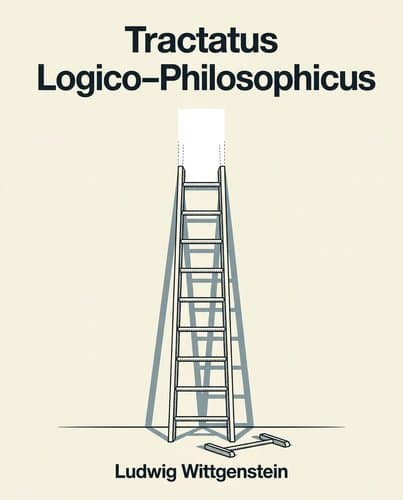
The Ladder You Must Throw Away
Imagine a guide who leads you through a forest, explaining every landmark and turn, then says at the edge of the clearing: by the way, none of what I just said made any sense. You'd feel cheated — unless that was the only forest where nonsense was the path in, and the clearing couldn't have been reached any other way.
That is precisely what Wittgenstein does in proposition 6.54. He states plainly that his own propositions are nonsensical. Not the conclusions of other philosophers — his. The reader who has followed the argument about logical form, about what can and cannot be said, about the limits of language being the limits of the world, arrives here to find the author dismantling the ladder they just climbed. The propositions of the Tractatus were necessary steps. Now they must be thrown away. Only then, he says, will you see the world aright.
This is not a confession of failure. The argument is completing itself. If the book's central claim is that the logical structure underlying all meaningful language cannot be stated — only shown — then any sentence that tries to state it, including every sentence in the Tractatus, is technically nonsense. Wittgenstein knew this from the beginning. The book is designed to perform its own conclusion, the way a proof by contradiction works (assume the opposite, follow it until it collapses): follow the reasoning until you see why the reasoning had to be abandoned.
What you're left with isn't a doctrine. It's a changed perception — a way of seeing language, world, and the silence around both that no proposition could have handed you directly. The ladder had to exist. You had to climb it. But a ladder you keep holding isn't a ladder anymore; it's a wall.
Russell, who introduced the Tractatus and co-authored the Principia Mathematica, the landmark treatise on logic that Wittgenstein was partly arguing against, introduced the book with a candor rare among philosophers: he admitted that Wittgenstein's conclusions left him with genuine intellectual discomfort, and then endorsed the work anyway. That's the honest response. Not resolution — sitting with unresolved tension, recognizing that something true can leave you unsettled. The Tractatus ends where it must: what cannot be spoken about must be passed over in silence. Not as surrender. As the one thing the book was always pointing toward.
What Silence Actually Sounds Like
Notice what Wittgenstein does with his final sentence. He says that what cannot be spoken about must be passed over in silence — and that sentence is itself one of the things it describes. He couldn't escape the trap. He knew he couldn't. He wrote it anyway.
That's not a flaw in the argument. That's the argument finishing itself. You've climbed a structure built entirely out of propositions that were, by their own logic, nonsense — and somewhere in the climbing, something shifted. Not a conclusion you can hand to someone else. A change in how the questions look. The ones that seemed most urgent — about consciousness, value, the self — turn out to have been pressing against a wall that was never a door. Wittgenstein doesn't leave you with answers. He leaves you with the strange, quiet relief of having finally seen where the questions were pointing all along.
Notable Quotes
“must mean something which stands above or below, but not beside the natural sciences.) The object of philosophy is the logical clarification of thoughts. Philosophy is not a theory but an activity. A philosophical work consists essentially of elucidations. The result of philosophy is not a number of”
Frequently Asked Questions
- What is the main argument of the Tractatus Logico-Philosophicus?
- The Tractatus argues that language can only meaningfully depict facts about the world, and that most traditional philosophical problems arise from misusing language beyond its logical limits. Published in 1921, Wittgenstein's work shows that meaningful discourse is constrained by the structural relationship between language and reality—a sentence depicts a fact only when it shares the logical form of that fact. This framework helps dissolve pseudo-problems that have plagued philosophy for centuries, revealing them as malformed questions that disappear under careful linguistic analysis rather than genuine problems requiring solutions.
- What does Wittgenstein mean by 'the limits of my language mean the limits of my world'?
- 'The limits of my language mean the limits of my world' is not just a philosophical thesis—it's a prompt to expand your vocabulary, since every new concept you acquire is literally a new region of reality you can now inhabit. This proposition suggests that what we can think and understand depends directly on the linguistic tools available to us. Language structures our reality, so mastering new words and concepts genuinely expands the domains of reality accessible to our understanding and experience, making knowledge expansion a matter of linguistic innovation.
- What can and cannot be expressed according to the Tractatus?
- The Tractatus distinguishes sharply between what can be said and what can only be shown. Facts about the world—empirical matters—can be articulated through language structured to match their logical form. However, the deepest things you care about most—love, ethics, beauty, the meaning of your life—cannot be stated. They resist logical articulation precisely because argument operates within the domain of facts, while ethics and meaning transcend this domain entirely. These truths aren't lesser for being inexpressible; their silence indicates their metaphysical importance.
- Why does the Tractatus argue against itself using contradictory reasoning?
- The Tractatus famously undermines its own logical propositions, using language to argue about the limits of language itself. When you encounter an idea that uses itself to argue against itself, resist dismissing it as incoherent—sometimes a performative contradiction is the only honest way to point at something real. Wittgenstein's self-negating structure is intentional: having used logical analysis to reach its conclusions about language's limits, the work itself becomes a ladder that must be climbed and then discarded, demonstrating rather than explaining the truths it conveys.
Related Book Summaries
Read the full summary of 12075_tractatus-logico-philosophicus on InShort