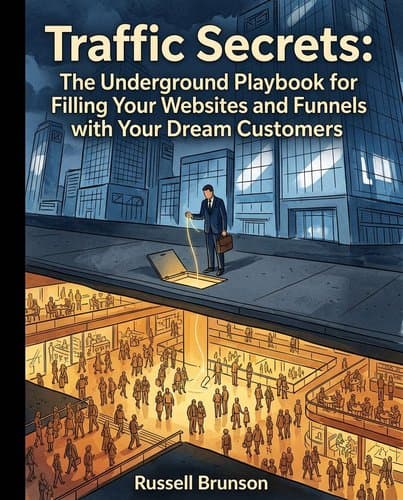
48736213_traffic-secrets
by Russell Brunson
Every platform will eventually evict you — so stop renting attention and start owning it. Master the Dream 100 framework, break-even funnel engineering, and…
In Brief
Traffic Secrets: The Underground Playbook for Filling Your Websites and Funnels with Your Dream Customers (2020) teaches online business owners how to drive consistent, scalable traffic without depending on any single platform.
Key Ideas
Map where ideal customers congregate
Before spending a dollar on ads, build your Dream 100 list: identify the 100+ influencers, podcasts, Facebook groups, newsletters, and YouTube channels where your dream customers already congregate. Every traffic decision flows from this list — who to court, whose audiences to target with paid ads, and where to guest-appear first.
Break-even front-end enables infinite scaling
Engineer your front-end funnel to break even on ad spend through order bumps and one-time offers. A funnel that recoups its ad cost on the front end has no advertising budget — you can scale from $100/day to $25,000/day indefinitely, because every new customer is either profitable or free.
Diagnose which element is broken
Every marketing failure traces back to one of three elements: hook (didn't stop the scroll), story (didn't build desire or relationship), or offer (wasn't worth acting on). Diagnose which one is broken before changing anything else — running more traffic at a broken offer is just losing money faster.
Email ownership beats platform renting
Treat every earned or paid traffic source as a conversion machine for your email list, not a direct sales channel. Social media followers, YouTube subscribers, and podcast listeners are rented audiences — only the email list survives platform shutdowns. The goal of every ad, post, and interview is to move people onto a list you own.
Master platform through daily publishing
Pick one platform — the one where you personally spend the most time as a consumer — and publish daily for at least 12 months before expanding to a second. Your first 45–50 pieces of content will be weak; start before your audience is big enough to notice. Expanding to a second platform too early splits attention before mastery on the first.
Integration deals create compounding traffic
Set up integration marketing deals with complementary businesses: get your email or offer inserted into partners' automated onboarding sequences (day 3 of their email welcome series, a thank-you page insert, an exit pop-up). Unlike one-time ad buys, integrations compound as the partner's audience grows — set up once, receive traffic indefinitely.
Premium commissions win affiliate support
Pay affiliates more than your competitors do, not less. Affiliates with large audiences have unlimited options; the company offering the highest commission wins their promotion. On break-even front-end funnels, paying affiliates 100% of front-end revenue is rational when lifetime customer value is known — you're buying customers free.
Who Should Read This
Business operators, founders, and managers interested in Marketing and Sales who want frameworks they can apply this week.
Traffic Secrets: The Underground Playbook for Filling Your Websites and Funnels with Your Dream Customers
By Russell Brunson & Dean Graziosi
9 min read
Why does it matter? Because the platform you're betting your business on was designed to eventually replace you with bigger advertisers.
Brunson was buying clicks for twenty-five cents and selling them for three dollars. Then Google changed the rules overnight and it was gone. Every few years, a platform promises easy traffic — and entrepreneurs build their entire business on that promise, right before the platform changes the rules. Google did it. Facebook did it. They'll do it again. But the entrepreneurs who keep getting wiped out aren't unlucky; they're playing the wrong game. Brunson spent fifteen years studying the ones who survived every algorithm update, every overnight rule change, and discovered they weren't better at gaming platforms. They were building something platforms can't touch: an audience they actually owned. Every ad they ever ran wasn't just buying a sale. It was buying a relationship. This book is about the difference between renting attention and owning it — and why, once you understand that gap, every ad dollar you've ever spent starts looking like either a transaction or an investment.
Every Platform That Loves You Today Will Evict You Tomorrow
In 2003, Russell Brunson was selling a DVD about how to build potato guns. He'd set up Google ads targeting anyone who typed "spud guns" into a search bar, paying $0.25 per click and clearing $2–3 on every sale. Not rich yet, but watching the math and thinking it was only a matter of time.
Then overnight, Google raised the price to $3 per click. Same ad. Same audience. Same potato guns. Just twelve times the cost. Half the entrepreneurs Brunson knew never recovered.
The pattern was straightforward once he stepped back far enough to see it. Every major advertising platform runs the same three-act cycle. First comes adoption: prices are kept artificially low to flood the platform with advertisers and build momentum. Then a price hike: costs rise steadily until anyone who can't squeeze more revenue out of each visitor gets squeezed out. Finally the slap: the platform eliminates the small advertisers entirely (the ones spending a few thousand dollars a month rather than a million) because they generate a fraction of the revenue while demanding most of the support.
Small advertisers are always the first to go. They are structurally inconvenient to the platforms, and the platforms know it.
When Facebook opened its ad platform in 2007, Brunson recognized the pattern immediately — cheap entry costs, explosive adoption, and a flood of entrepreneurs building their entire businesses on borrowed ground. He called it Zanos: Zuckerberg as Thanos, capable of snapping half of all online entrepreneurs out of existence with a single policy change.
The landlord set the terms, changed the terms, and raised the rent until you couldn't afford to stay. The question Brunson forces you to sit with is whether your business could survive tomorrow morning if your main traffic source simply stopped working — because for thousands of people he watched, it already has.
Your Dream Customers Are Already Gathered — You Just Need to Find the 100 Nodes That Control Access to Them
When Russell Brunson finished writing DotCom Secrets, he could have done what most people do: blast his email list, post on social media, and hope momentum built. Instead he sat down and mapped every community where startup entrepreneurs (his dream readers) were already spending time. Fifteen Facebook groups. Thirty podcasts. Forty email newsletters. Twenty YouTube channels. When he added up all the audiences, he landed on thirty million people living inside 185 identifiable communities.
The shift that followed is the core of what he calls the Dream 100. Brunson realized he didn't need to reach thirty million individuals. He needed to reach 185 people, the owners and hosts of those communities, who already had those thirty million people's trust and attention. So he mailed each of them a physical copy of his book.
One package landed with John Lee Dumas, a podcaster Brunson had followed for years but never met. Dumas loved the book, invited Brunson on, and within a week of that episode airing, five hundred copies had sold. Thirty of the 185 became promotional partners. Final tally: over a hundred thousand copies, driven almost entirely by concentrated outreach to fewer than two hundred people.
Traffic isn't manufactured. It already exists, pre-gathered in communities built around shared problems, interests, and desires. The internet didn't just make it easier to reach people — it created permanent, named, findable pools of them. Wrestlers have forums. Keto dieters have Facebook groups. Personal finance obsessives subscribe to the same newsletters. Your job isn't to draw isolated individuals toward you one by one. It's to find the nodes controlling access to those pools and reach the people running them.
Before spending anything on ads, answer one question: which podcasts, newsletters, YouTube channels, and communities does my dream customer already consume? If you're your own dream customer, you already know. Those communities are your map.
Every Marketing Failure Traces Back to One of Only Three Problems
It's 9:27 PM and a woman named Jessica has just gotten her last kid to sleep. She falls onto the couch, pulls out her phone, opens Facebook. She's almost ready to close the app when a photo stops her mid-scroll: a woman in workout clothes with a dark wet stain on her gray shorts. The headline is a blunt, first-person confession about something mortifying that happened to her during a workout.
Jessica laughs, then goes quiet. She knows exactly what that feels like. She'd done it herself on a trampoline that year, invented a reason to get off, and carried the guilt ever since.
She clicks through. A video loads. The woman in the photo, fitness blogger Natalie Hodson (mother of two ten-pound babies), tells the full story: the filmed workout, the embarrassment, and the doctor who helped her fix it. Natalie and that doctor built an e-book together: pelvic floor exercises, diet tips, training programs, all available from home for $47.
Jessica runs across the room to find her credit card.
Brunson uses this sequence — fictional Jessica, real Natalie — to illustrate the only framework you need: Hook, Story, Offer. The wet-spot photo was the hook: a specific image that created a question worth answering. The video was the story: it built trust with Natalie as a person and raised the perceived value of what was coming. The $47 e-book was the offer: concrete, priced, irresistible.
Over three years, 120,000 women bought it.
Same framework, different direction. Ad not working? Hook, story, or offer. Landing page not converting? Same three. Webinar attendance down, close rate dropping, emails going unopened: you only have three places to look. Identify which one is failing and you know exactly what to fix.
A Funnel That Breaks Even on Ads Has No Budget — It Can Scale Forever
A venture capitalist sits across from Brunson at lunch, ready to hand over ten million dollars. The standard question comes first: how much does it cost to acquire a customer? Brunson says they'd been paying around $250 per ClickFunnels trial, then turned the ads off. The VC brightens: great CPA, he says. Want funding to scale that?
Brunson has to explain why that's the wrong question.
The unit economics looked like this. His front-end funnel sold a free book; readers paid $7.95 for shipping. Each customer cost $23 in ads, leaving him $15 in the hole immediately. An order bump for the audiobook converted at roughly one in five buyers, adding $7.70 in average revenue. A one-click upsell for a $97 course converted at just under 10%, adding $9.62. A second upsell, a $297 traffic course, converted at around 4%, adding $12.44 more. Final average cart value: $37.71. Net profit per customer: $14.71, before ClickFunnels was ever mentioned.
When a funnel turns a profit before the customer ever hears your core offer, you don't have a meaningful advertising budget anymore. Spend $100 a day or $25,000 a day — as long as the math holds, every dollar in returns at least a dollar out. ClickFunnels scaled from $100 to $25,000 in daily ad spend with zero outside funding, the funnel subsidizing its own growth.
The follow-up sequence is where the real multiplier lives. Over one month, four front-end funnels generated 14,205 leads and netted $14,417. Brunson was effectively paid over a dollar per lead to acquire them. Then the follow-up emails began: free videos, a webinar invite, a $2,997 offer at the close. Those same 14,205 people spent $234,240 over the next thirty days at zero additional ad cost. Sixteen dollars returned for every dollar made in the original funnels. Owned traffic compounds. The ad spend buys the lead once; the follow-up collects on it indefinitely.
Email Is the Only Traffic Asset No Algorithm Can Take Away
Collette Brunson was working two jobs at $9.50 an hour when her husband woke her up one morning to ask for a thousand dollars they didn't have. He'd been failing at online businesses for eighteen months — twenty-three attempts, every one of them a loss. She opened her eyes, listened to the pitch, and asked one question: "Do you think this will be the one that works?"
He did. The money was for a retirement-sale course from Mark Joyner, one of the early pioneers of internet marketing, who claimed the secret to his success was building email lists with millions of members. Brunson bought it, read it, and found that Joyner had confirmed what he'd already half-suspected after buying a CD-ROM stuffed with a million email addresses that turned out to be worthless: the list was the business.
What took longer to understand was why. Every other audience you accumulate (social media followers, YouTube subscribers, podcast listeners) lives on someone else's platform. The platform decides who sees your content, how often, and under what terms. It can downrank your posts, sell your followers ads for your competitors, change its algorithm overnight, or simply cease to exist. You don't own those people; you're renting access to them through a landlord who can raise the rent or lock you out whenever it's convenient.
An email list gives you a direct line to each subscriber, independent of any platform's incentives. Nobody can demote your email the way Facebook can demote a post. Nobody takes a cut when you send it. Brunson's benchmark, a ratio he'd tracked across his own businesses, was roughly one dollar per subscriber per month: 10,000 subscribers supports a $100,000 business; 100,000 supports a million-dollar one. That makes the list an asset with a calculable yield, not just an audience.
Everything else in the traffic system exists to feed the list. Paid ads, podcast appearances, guest posts, Dream 100 partnerships — you spend money or attention to get someone to click; the click only becomes permanently valuable when it puts them on your list. From there, you can follow up indefinitely, at no additional cost, regardless of what any platform decides to do next.
Brunson says twice in his career, a few emails to his list generated enough revenue in days to prevent bankruptcy. That's not a marketing channel. That's the only asset the platforms can't reach.
When You Have Your Own Show, Nobody Ignores Your Calls
Think of cold-pitching your way into a farmers market versus owning the square where it's held — the moment you control the platform, the vendors come to you. Building your own show works the same way. Once you have real reach, your relationship to the Dream 100 inverts: you stop chasing and start fielding.
Brunson landed on this insight watching Celebrity Apprentice, episode seven. Arsenio Hall — who hosted his own late-night show from 1989 to 1994 — spent hours on-camera calling famous friends trying to raise charity money. Voicemail after voicemail. The one commitment he landed, from Jay Leno, arrived past the deadline and didn't count. The man who once had Bill Clinton fly in during a presidential campaign to play saxophone on his stage couldn't get a single donation to register. When you control a platform with millions of viewers, even future presidents take your meeting. When the network cancels the show, your phone stops ringing — because you were never the draw. The audience was.
The Arsenio Hall story reframes what you're actually building. A show is the thing your Dream 100 genuinely want access to. Your audience is worth more than any gift, referral, or perfectly constructed cold pitch. So the rational move is to build the platform now, before the audience exists, because there's no other way to get there.
Start before you're ready. Brunson launched his podcast on March 26, 2013, while nearly bankrupt, owing $250,000 to the IRS, having just let go of roughly a hundred employees. His first forty-five episodes were bad. A colleague told him so. But when you're at your worst, you're also least watched. No one hears the stumbles, and finding your voice requires making them. Three years later, the podcast had tens of thousands of listeners per episode, and most of his highest-paying coaching clients had discovered him there, binge-listening from episode one before ever reaching out to work with him.
The $12 Million Decision Made Almost as an Afterthought
The most powerful distribution decisions look like minor defaults.
When ClickFunnels launched, someone on Brunson's team added a small "This Page Made with ClickFunnels" badge to the bottom of every member's page — on by default, coded with that member's personal affiliate link. Every visitor who clicked through and signed up triggered a commission for the page's owner. Members could remove the badge, but most didn't. As ClickFunnels grew to hundreds of thousands of users creating millions of pages, the badge propagated everywhere those pages did. Five years later, one design decision made almost as an afterthought was generating over 10,000 new members and a million dollars a month in recurring revenue: twelve million dollars a year, scaling automatically with adoption.
The same compounding logic governs who joins your affiliate network and how hard they work for you. When competitors were paying affiliates 20–30% commission, ClickFunnels launched at 40%. The best affiliates, the ones with the largest lists and the most audience trust, stopped promoting competitors and switched. Top affiliates have unlimited things they can promote; outpaying everyone else is the rational move when a single yes from the right person can deliver thousands of customers.
None of this requires managing. You set the commission, they go to work, and every customer they bring in is permanently yours — paying back through the follow-up sequence at zero additional cost. You built the system once. Now it just runs.
The Library That Closes in Five Minutes
In 2004, Russell Brunson was on a family vacation when he slipped into a small-town library minutes before closing and read an email from John Reese announcing a million dollars in sales in eighteen hours — from something called Traffic Secrets. He sat there reading that one sentence over and over until the librarian asked him to leave. He drove back to the lake with two words looping. Fifteen years later, hours after swearing he'd never write a third book, Reese emailed Brunson offering to sell him the TrafficSecrets.com domain. Some loops close exactly the way they opened. The badges, the affiliate commissions — those aren't the point. They're what scales the system once the foundation holds. The point is what Brunson felt in that library: the conviction that reaching the right people with the right message could change everything. The tools in this book work. The only question left is what you're going to say when enough people are finally listening.
Notable Quotes
“I don't know if Alexis will like this,”
“He set down his new scented hand sanitizer that he had brought in to pitch at the meeting. He picked up his new UV nail polish and handed it to the group.”
“he asked. They looked at it, opened it up, and smelled it.”
Frequently Asked Questions
- What is the Dream 100 strategy in Traffic Secrets?
- Before spending a dollar on ads, you should build your Dream 100 list by identifying the 100+ influencers, podcasts, Facebook groups, newsletters, and YouTube channels where your dream customers already congregate. Every traffic decision flows from this list—who to court, whose audiences to target with paid ads, and where to guest-appear first. This foundational strategy ensures your entire marketing effort targets the right audience from the start, rather than spray-and-pray approaches that waste resources on the wrong platforms and people.
- How can you build a break-even funnel in Traffic Secrets?
- Engineer your front-end funnel to break even on ad spend through order bumps and one-time offers. A funnel that recoups its ad cost on the front end has no advertising budget—you can scale from $100/day to $25,000/day indefinitely, because every new customer is either profitable or free. This approach removes the constraint of having a fixed marketing spend, allowing rapid scaling once the break-even point is achieved and the core funnel mechanics are tested.
- What are the three reasons marketing campaigns fail in Traffic Secrets?
- Every marketing failure traces back to one of three elements: hook (didn't stop the scroll), story (didn't build desire or relationship), or offer (wasn't worth acting on). Diagnose which one is broken before changing anything else—running more traffic at a broken offer is just losing money faster. This diagnostic framework helps marketers identify the precise problem in their funnel. Rather than blindly scaling broken campaigns, you should pinpoint whether your audience ignored your message, didn't connect with your pitch, or simply didn't find your offer compelling enough.
- Why does Traffic Secrets emphasize building an email list over social media followers?
- Treat every earned or paid traffic source as a conversion machine for your email list, not a direct sales channel. Social media followers, YouTube subscribers, and podcast listeners are rented audiences—only the email list survives platform shutdowns. The goal of every ad, post, and interview is to move people onto a list you own. Email lists are permanent assets that remain under your control even when algorithms change or platforms collapse, making them the most valuable audience to cultivate.
Related Book Summaries
Read the full summary of 48736213_traffic-secrets on InShort