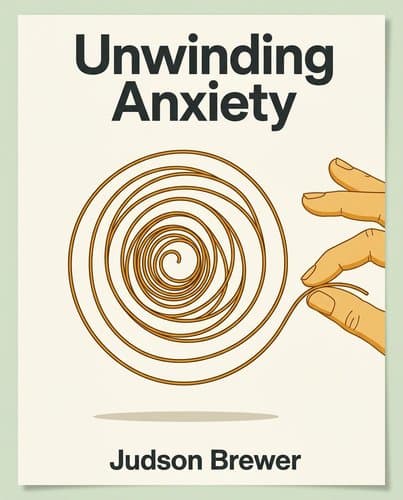
55628986_unwinding-anxiety
by Judson Brewer
Anxiety isn't a character flaw—it's a habit loop your brain learned for survival. Judson Brewer reveals how to rewire it by making curiosity more rewarding…
In Brief
Anxiety isn't a character flaw—it's a habit loop your brain learned for survival. Judson Brewer reveals how to rewire it by making curiosity more rewarding than worry, using your brain's own update mechanism to dissolve the cycles that keep you stuck.
Key Ideas
Name patterns to dissolve anxiety loops
Map any recurring anxiety or habit as trigger → behavior → result, in writing. Naming the structure — not the origin — is often sufficient to begin dissolving the loop.
Stop seeking why, observe body sensations
Stop hunting for why you're anxious. The 'why habit loop' (trigger: anxiety; behavior: search for cause; result: more anxiety) reinforces itself every time you run it. Ask what is happening right now in your body instead.
Observe actual results of behaviors
The next time a craving or anxious urge hits, pay deliberate attention to what the behavior actually delivers — not what you expected. Your orbitofrontal cortex updates from felt experience, not from reasoning about the experience.
Shrink time horizons to manage uncertainty
When tomorrow feels impossible, shrink the time horizon. Anxiety is driven by uncertainty; smaller windows contain less of it. Ask whether you can stay out of the loop for the next five minutes, not the next year.
'Hmm' activates embodied awareness
Try 'hmm' as a body-based curiosity tool: when anxiety spikes, sound out a genuine 'hmm' and locate where in your body you feel it most. This bypasses analytical processing and drops you directly into embodied awareness.
Stress disables prefrontal cortex control
Willpower requires your prefrontal cortex, which shuts down under stress — exactly when habits fire. Assigning moral weight to strategy failures misidentifies the problem. The strategies were built on faulty architecture.
Seek internal rewards over substitutions
Substitution habits (candy for cigarettes, scrolling for stress) habituate over time and demand more stimulus to produce the same effect. Seek internally generated rewards — curiosity, kindness — that do not require an external source and do not deplete.
Who Should Read This
People working on personal growth in Mental Health and Habit Formation, especially those tired of generic motivational advice.
Unwinding Anxiety
By Judson Brewer
10 min read
Why does it matter? Because the anxiety you're managing is a habit your brain is actively running.
Anxiety isn't a condition that rolls over you. Your brain constructs it, actively and efficiently, using the same reward circuitry that kept your early ancestors alive. Most people never figure that out — so they keep treating anxiety like weather: something that arrives without invitation, makes everything harder, and eventually passes if you wait it out. You've probably tried to manage it: breathe through it, reason with it, hunt down the triggers, substitute something healthier, simply try harder. None of it held. That single shift in understanding breaks the logic of every strategy that ever failed you. Judson Brewer spent two decades scanning brains, running trials, and building programs that actually worked to nail down exactly why. What he found points, finally, to a framework that actually works.
Anxiety Is Not a Broken Brain — It Is a Survival Feature Running in the Wrong Era
Imagine a navigation system that, when GPS signal drops, does not pull over and wait for a connection. Instead it generates directions from whatever fragments are available (old maps, half-remembered routes, worst-case detours) and issues them faster and faster as confidence drops. The result is just noise, getting louder.
That is what your prefrontal cortex does under uncertainty.
The PFC evolved roughly a million years ago on top of a far older survival brain, and its job is prediction: pull from experience, project forward, model what happens next. When it has accurate information, it works beautifully. When information runs out, it does not idle — it accelerates, generating worst-case scenarios from whatever raw material is at hand. Brewer reduces it to two ingredients: unresolved fear, and a brain that cannot stop filling in what happens next. Fear itself is useful, a three-part learning mechanism so ancient that even a sea slug uses it. Cue, behavior, result. A car bears down, you jump back, you learn to look both ways. But when the PFC layers onto that older system and cannot find solid information, the learning loop does not complete. It spins.
What Brewer finds most troubling, and most useful to know, is what happens over time. Each anxious rehearsal deposits a little residue. The brain stores it like a live culture in a jar — and the next time uncertainty arrives, it reaches for that jar first, works the residue into the new mix, and the batch comes out a little more sour than the last. A reasonable response to one stressful week becomes, over months, a background hum that latches onto anything open-ended: a gap in the calendar, a text left unanswered, a weekend with no fixed plan.
Anxiety is a habit the brain learned and kept practicing. You may have been feeding it without knowing there was anything to feed.
Every Strategy You've Tried Failed for the Same Neurological Reason — Not a Personal One
Every anti-anxiety strategy that felt like it should work — gritting your teeth, distracting yourself, avoiding the triggers — failed for the same reason. None of them touched the mechanism that actually drives behavior.
Start with willpower, because it produces the most guilt. Willpower lives in the prefrontal cortex, the newest and most fragile part of the brain. Under calm conditions it works: the rational voice that says breathe, you're fine. The problem is that stress hands control to the old survival brain, which powers it down until the threat passes. The moment anxiety spikes and you most need to reason yourself calm, willpower has already left the building.
Brewer describes a patient he calls Emily who could, mid-panic attack, actually talk herself down: this is your brain playing games, you decide what happens next. She was a high-powered lawyer. He calls her one in a million. Commanding yourself to calm down during anxiety is asking the part of the brain that just went offline to fix the very problem that knocked it offline. For everyone who isn't Emily, that command achieves nothing except a fresh layer of shame. Not because of any failure of character. Because the prefrontal cortex was already gone.
Substitution fares no better. Eat almonds instead of scrolling, take a walk instead of worrying: these swap the terminal behavior but leave the habit loop intact. Trigger-avoidance is the same game with a different costume — take a different route to skip the coffee shop, block the contact who spikes your anxiety, rearrange your life so the cue never fires. The trigger finds you anyway. The craving rises. And the old brain, which runs on rewards and has never once changed its behavior because you explained things to it, has no reason to update. Eventually the old behavior snaps back, which is why most people have failed at the same habit more than once and concluded the problem is with them.
It isn't. Willpower, substitution, and trigger-avoidance share one flawed assumption: anxiety is a content problem, solved by different thoughts or different places. Anxiety is a learning problem. Until the old brain encounters something more compelling than the habit, the loop runs on, unimpressed by effort.
Naming the Loop Is Already an Intervention — But Asking 'Why' Makes It Worse
John walked into a psychiatrist's office in his mid-sixties, referred for alcoholism. Six to eight drinks a night, nearly every day. Brewer pulled out a blank sheet of paper and drew three boxes: trigger, behavior, reward. Afternoon anxiety triggered the drinking. The drinking delivered numbness. The entire structure of John's problem, visible in thirty seconds.
John hadn't seen it. Not because he was unintelligent — you can't see the loop from inside it. Brewer describes the moment of mapping as switching on a light in a dark room. John walked in hopeless and left animated. Within a few weeks he quit cold turkey. No medication, no extended therapy.
Brewer calls this First Gear: recognition without repair. The map is just a map. For some loops, that is the complete intervention. Once the structure is visible, the behavior loses its grip. The loop kept running because it was invisible. Light kills that particular parasite. That is the whole first move. What comes next is different in kind, not just degree.
Most people hit a predictable trap here. They map their loops, feel the satisfaction of clarity, and immediately try to fix what they've found, using the same approaches that already failed. Brewer diagrams this as its own loop: clarity triggers premature action, action fails, frustration compounds. The map just became the trigger. Resist it. The map is the work.
It gets worse. A patient he calls Amy came in with anxiety that spiraled from the smallest triggers. Her husband and friends kept asking why she wasn't fixed yet. Amy asked herself the same question: why am I anxious? Within the first ten minutes of her appointment, she had cycled through that search three times — each attempt producing not an answer but a fresh spike of anxiety. Brewer drew a new map on the spot: trigger (anxiety) → behavior (try to figure out why) → result (more anxiety). The why-hunting was its own habit loop, feeding what it was supposed to cure.
His fix was almost absurdly plain. He told her the why doesn't matter. What matters is what is happening right now: what thoughts, what sensations. Three deep breaths, a phrase to say on the exhale, practiced together before she left. That was the session.
The argument underneath both cases is the same. Anxiety is not a mystery to be solved. It is a loop to be seen.
Your Brain Learns Only From What You Actually Feel — Not From What You Know
One of Brewer's early study participants had been smoking since she was a teenager — the whole identity of it baked in before she could vote. Cool, rebellious, social. The reward value her brain stored for cigarettes included all of it: the ritual, the peer approval, the tiny hit of defiance. Decades later, she knew the health statistics as well as anyone. She probably recited them to herself. She lit up anyway.
Brewer didn't add to her knowledge of cancer statistics. He gave her one instruction: pay attention while you smoke. Notice what you actually smell. Notice what it actually tastes like, right now.
Her report came back a few sessions later. Smoking, she said, smells like stinky cheese and tastes like chemicals. Yuck.
That's the whole mechanism. She didn't reason herself out of the habit. She noticed her way out of it.
Here's why it works. Your orbitofrontal cortex, a crossroads in the brain where emotion, sensation, and memory converge, assigns a composite reward value to every behavior you repeat. It bundles together all the context from when you first learned the habit: the social scene, the mood, the payoff. Then it stores that value and ranks behaviors automatically, like a playlist sorted by your teenage taste in music. The playlist keeps playing even when your taste has changed, because the OFC doesn't update from information you read or thoughts you think. It updates only from experience, specifically from a gap between what it expected and what actually arrived.
When the woman paid attention while smoking, her OFC got current data: the smell is foul, the taste is chemical. The gap between that and the stored "cool and rebellious" value was enormous. Her brain registered a prediction error and the reward value dropped. She didn't need willpower. The behavior got genuinely less appealing to the part of the brain that runs behavior.
Think of a child who yanks on Santa's fake beard and sees the stranger underneath. They cannot un-know what they saw. The OFC works the same way: once it has registered the actual current experience of a habit (the bloated stomach after the chips, the spike in deadline pressure after the procrastination), that information cannot be unfiled. The reward value drops, and the loop weakens, not because you overcame it but because your brain updated its records.
Brewer's lab measured this mathematically. Using a mindfulness tool embedded in smoking and overeating apps, and applying a formal learning model to participants' ratings, his team found that after ten to fifteen mindful encounters with a craving, the reward value dropped to near zero. Not a resolution reached through insight. Not decades of therapy. Ten to fifteen honest looks at what the behavior actually felt like.
Knowledge never touches that number. Attention does.
The Clinical Numbers Behind an Approach That Surprised Even Its Inventor
Does this actually work, or does it work the way most wellness frameworks work — beautifully in the book, unevenly in the world?
In 2013, a congressional staffer named Michael got what he'd later call "voluntold" by Congressman Tim Ryan to test a smoking cessation app Brewer had just finished building. Michael wasn't planning to quit. He smoked ten cigarettes a day and, by his own account, was afraid to leave the house without a pack. Three weeks after starting the program, he quit entirely. When Brewer read the email, he cried. He told his wife, stammering: "This may actually work."
That admission matters. Brewer had spent nearly two decades studying the neuroscience of habit change. He had built the clinical framework, run the trials, written the papers. And when it worked on a stranger who hadn't volunteered for it, his honest reaction was surprise.
Six years later, Michael was still smoke-free.
The clinical numbers are blunter. When Brewer's lab ran a randomized controlled trial on people diagnosed with Generalized Anxiety Disorder (half added app-based mindfulness training to their existing care, half continued as before), anxiety scores dropped 63 percent in the app group, moving from moderate-to-severe down to normal range. These are early results — but early results with a Number Needed to Treat of 1.6. The gold-standard antidepressant benchmark is 5.15 — treat five people to benefit one. Here, fewer than two. Mathematical modeling confirmed the mechanism: mindfulness reduced worry, which drove anxiety down. The chain held.
Curiosity Is Not a Mood — It Is a Learnable Behavior With Higher Reward Value Than Anxiety
In 2019, Brewer led a silent meditation retreat for the U.S. women's Olympic water polo team — back-to-back gold medalists, fresh off winning the world championship and the Pan American Games. Three days in, he hiked them to a mountain overlook in Colorado and, without warning, broke the silence with a loud "hmm." Not a mantra. The spontaneous sound you make when something genuinely catches your attention. Everyone repeated it. The sound echoed across the valley.
The team got it immediately. When frustration arose during meditation sessions, "hmm" moved their attention into the body, into the physical texture of the frustration itself, rather than into attempts to escape it. When self-judgment looped, "hmm" interrupted by treating the sensation as interesting rather than threatening. Curiosity changed the relationship with what the loop was feeding on, and the loop dissolved.
Compare that to what substitution does. Eat blackberries instead of cake, watch puppy videos instead of anxious news — each works briefly, then habituates. Brewer borrows an image from Buddhist cosmology to explain why: the hungry ghost, a creature with a vast stomach and a throat so narrow that food digests before it arrives. The hunger never resolves because the architecture prevents it. Whatever you reach for to soothe an anxious craving works the same way: relief lands, the OFC logs it, and next time it demands a little more. Tolerance builds exactly as it does with alcohol.
What the "hmm" does is structurally different. There are two kinds of curiosity, and they feel nothing alike. The restless need-to-know kind is familiar: think of Amy from Section 2, excavating her anxiety for causes, asking why am I anxious, where did it come from, what does it mean? It burns through possibilities and demands an answer that will finally close the loop. When the answer doesn't arrive, or doesn't satisfy, the loop tightens. Interest-type curiosity doesn't work that way. It's open, wondering, with no particular destination. It requires no external supply, builds no tolerance, and never runs out because each moment of genuine attention is, by definition, new. The "hmm" on the mountain overlook wasn't asking the frustration to justify itself. It was just looking at it.
Brewer's lab measured this directly. Open, curious states register higher reward value in the orbitofrontal cortex than anxious ones; the brain doesn't just believe curiosity feels better, it measures it on the same scale it uses for everything else. The OFC updates its hierarchy accordingly, the way it did for the woman who finally paid attention while smoking.
The anxiety loop runs on fuel you keep handing it. Curiosity shows you that you have been holding the match.
The Only Experiment That Matters Is the One You Run Yourself
The framework lands or it doesn't in a single moment — not in a therapy session, but the next time a craving shows up uninvited. Michael didn't earn his six years of freedom through discipline or insight. He just pointed his attention at something he'd kept just out of direct view, enough times for his brain to quietly update its records. That's the whole machine. The loops running in you right now don't need to be dismantled. They need to be watched — with the kind of open, almost childlike hmm that treats your own anxiety as genuinely interesting rather than threatening. You already know which loop to start with. You've been carrying it long enough to recognize the weight.
Notable Quotes
“I should make sure my kids know that this is a dangerous intersection”
“Go get me some information!”
“when stress and anxiety reared their heads so that we could fight them off, not to let them get in our way of helping others who were really suffering. Our life of martyrdom was summed up by one of my surgery professors, who quipped,”
Frequently Asked Questions
- What is Unwinding Anxiety about?
- Unwinding Anxiety reveals that anxiety is a learned habit loop driven by the brain's reward system — not a character flaw or chemical imbalance. Judson Brewer explains how the same mechanics behind addiction sustain chronic worry, and gives readers practical tools — including curiosity-based awareness techniques — to identify their loops, update the brain's reward signals, and break free from anxiety at its root. The book challenges conventional understanding of anxiety and offers actionable strategies based on neuroscience research rather than willpower or positive thinking.
- How can I start breaking my anxiety habit loop according to Unwinding Anxiety?
- To begin breaking an anxiety habit loop, map your recurring anxiety as trigger → behavior → result in writing. "Naming the structure — not the origin — is often sufficient to begin dissolving the loop." This approach focuses on identifying the pattern rather than understanding why you became anxious. Once you recognize the loop's mechanics, you can observe what your anxiety-driven behavior actually delivers versus what you expected. This gap between expectation and reality helps update your brain's reward signals at a neural level.
- Why doesn't willpower work for breaking anxiety habits?
- Willpower fails during anxiety because "the prefrontal cortex, which shuts down under stress — exactly when habits fire." When you're most stressed, the brain region needed for willpower is offline, making discipline impossible. Brewer further emphasizes that "assigning moral weight to strategy failures misidentifies the problem. The strategies were built on faulty architecture." Rather than fighting anxiety with willpower, Unwinding Anxiety teaches you to work with your brain's reward system by building curiosity-based awareness, which activates different neural pathways that don't rely on prefrontal control.
- What is the 'hmm' technique in Unwinding Anxiety?
- The 'hmm' technique is a body-based curiosity tool that bypasses analytical thinking during anxiety spikes. When anxiety strikes, "sound out a genuine 'hmm' and locate where in your body you feel it most. This bypasses analytical processing and drops you directly into embodied awareness." Rather than trying to reason through anxiety or search for its causes, this simple sound triggers a shift from your thinking brain to direct sensory experience. This creates space for your reward system to reset without relying on external substitutions.
Related Book Summaries
Read the full summary of 55628986_unwinding-anxiety on InShort