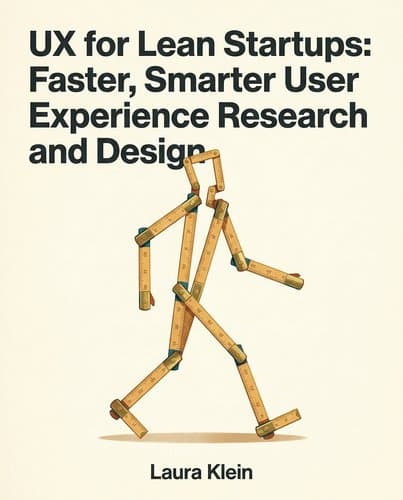
16128986_ux-for-lean-startups
by Laura Klein
Stop building products nobody wants—Laura Klein shows lean startup teams how to run fast, rigorous UX research that validates ideas before wasting a line of…
In Brief
UX for Lean Startups: Faster, Smarter User Experience Research and Design (2013) provides a practical framework for applying user experience research without the time and budget of a large organization. It teaches startup founders and product teams how to test assumptions, design for real users, and make faster, better-informed product decisions — reducing the risk of building something nobody wants.
Key Ideas
Narrow Niches Drive Deeper Market Traction
Define your niche narrowly enough to market deeply: targeting 'women aged 25–35 with $500+ monthly disposable income' outperforms targeting 'women' every time — specificity creates traction, breadth creates noise.
Rule of Five Validates True Market Demand
Use the Rule of Five before building anything: find five non-family strangers willing to commit to your hypothetical product. If you can't, your market is too small, too hard to reach, or you haven't tried hard enough.
Five Questions Screen Unqualified Prospects Early
Qualify leads before pitching: use the five-question discovery checklist (burning issue, solution recognition, decision authority, competitive awareness, approved budget) — a 'no' on any question means the lead isn't a prospect yet.
Mid-Term Goals Build Sustainable Systems
Set mid-term goals (3–5 years) rather than annual ones: annual targets create pressure that prevents building sustainable systems; mid-term goals allow prioritization without constant urgency.
OGSM Alignment Connects All Work to Mission
Apply the OGSM cascade: every employee should be able to trace their daily output back to the company's core objective — if a packing operative can't explain how their work connects to the brand's mission, the alignment is broken.
Dollar Price Increases Unlock Hidden Margins
Test the $1 price increase: if your product costs $10 with a 10% margin, a $1 price increase doubles your margin to 20% — before chasing new customers, examine what financial levers inside the current business are being left untouched.
Systems Replace Person-Dependent Business Bottlenecks
Build systems, not dependencies: if you are the biggest sales producer in your company, the business is unscalable and unsellable — start replacing person-reliant processes with documented, automated systems now, not when you're ready to exit.
Curiosity Culture Builds Resilient Teams
Respond to failure with curiosity, not punishment: Dweck's research shows that praising effort over innate talent is what builds resilience — leaders who penalize mistakes train their teams to hide problems rather than solve them.
Who Should Read This
Business operators, founders, and managers interested in Startups and Product Design who want frameworks they can apply this week.
UX for Lean Startups: Faster, Smarter User Experience Research and Design
By Laura Klein
12 min read
Why does it matter? Because the lone visionary entrepreneur is your biggest liability.
Most startups don't die from lack of passion. They die from lack of process. The graveyard of failed ventures is packed with founders who had conviction and vision and genuine belief their product would change something — and who never stopped to ask whether anyone wanted it badly enough to pay for it. That's the gap between enthusiasm and execution. Laura Klein's UX for Lean Startups sits in that gap, and this summary uses it as a home base for a broader set of tools — sales funnels, planning frameworks, financial levers, exit thinking — that share the same underlying discipline: replacing founder assumptions with user evidence before those assumptions become expensive mistakes. If you've ever built something only to discover the market didn't need it the way you imagined, this is the framework you should have had first.
The Reason 80% of Businesses Fail Has Nothing to Do With Bad Luck
Most businesses fail structurally, not circumstantially — and the failure is already underway before the first customer walks through the door. The statistics are damning: somewhere between 65% and 80% of new ventures collapse within their first eighteen months. Most people blame timing, capital, or a rough economy. The harder explanation is that most of these businesses never should have launched in the form they did.
The structural flaw shows up most clearly in how founders think about markets. Consider the targeting mistake the book dissects: an entrepreneur decides to market to 'women.' That's 3.9 billion potential customers — surely a larger pool means larger opportunity? The logic collapses under scrutiny. A campaign built for 3.9 billion people is, in practice, a campaign built for no one. Interests, income levels, life stages, and needs diverge so dramatically across that group that any message broad enough to include all of them will be specific enough to move none of them. The counterintuitive move — the one that actually works — is radical narrowing. 'Women aged 25 to 35 with more than $500 in monthly disposable income' is a tiny fraction of that original number, but it's a group you can reach, speak to precisely, and convert. Smaller targeting creates larger impact because it allows your message to actually land.
Failure isn't an event that happens to a business. It's a design flaw baked in at the formulation stage.
'Making a Profit' Is Not a Purpose — And the Market Can Tell
Think of a ship's captain who knows the vessel is seaworthy, has a competent crew, and has provisioned for a long voyage — but has never decided where they're going or why. Every navigational choice becomes arbitrary. The crew can't prioritize, can't anticipate, can't commit, because commitment requires a destination worth reaching. That's not a leadership problem or a logistics problem. It's a purpose problem, and it compounds every other problem on board.
Most founders are in this situation without realizing it. You've had the good idea, done the research, lined up the resources — and still the venture stalled. That's a genuinely frustrating place to be, because the conventional advice ('work harder,' 'network more') never touches the actual fault line. Purpose isn't a motivational poster you hang after the real strategy is built. It's a structural element that the strategy rests on.
Here's what makes that concrete: when a company's stated values don't match its visible behavior, customers notice — and increasingly, they leave. Actively. The market is pricing purpose directly into outcomes.
But a purpose that exists only in the founder's head is inert. It has to cascade — from strategy to management to the frontline worker dealing with a customer complaint at 5pm on a Friday. A vision that doesn't reach that level isn't a shared vision; it's a private one. And a private vision can't align a team, can't build trust with customers, and can't attract investors who are explicitly evaluating whether the whole organization is pulling in the same direction.
Your Vision Is Worthless Until Five Strangers Believe In It
How do you know whether people actually want what you're building, or whether they're just being polite? That distinction is the whole game — and most founders never find out until it's too late.
Validation has nothing to do with enthusiasm. Friends will tell you the idea is great. Colleagues will nod along at your pitch. None of that counts. What counts is whether a stranger — someone with no social obligation to spare your feelings — will commit to paying for something that doesn't exist yet. Laura Klein's Rule of Five is built on exactly this logic: find at least five people who fit your target market, who have no personal connection to you, and who say they would actually use or pay for your hypothetical product. If you can't find five, the diagnosis is blunt — your market is too small, too hard to reach, or you haven't pushed hard enough. The rule isn't a finish line; it's a minimum viable filter. Pass it, and you have enough signal to keep going. Fail it, and you've saved yourself from funding a fantasy.
Finding those five people is itself diagnostic. You don't recruit from friends or family. You go where the problem lives — discussion forums, LinkedIn groups, review threads where people openly complain about the exact friction your product is meant to remove. When you reach them, the methodology matters: open-ended questions only. The moment you ask 'wouldn't it be useful if...' you've contaminated the result. Ask them instead to describe how they currently handle the problem, what workarounds they've rigged up, where those workarounds break down. What you're hunting for is a recurring pain — not a theoretical one — and proof that people are already spending time or money improvising solutions. That improvisation is the demand signal. It means a market exists and is actively waiting.
Once you've confirmed the problem is real, the next instrument is the Minimum Viable Product — but the term is widely misunderstood. An MVP is a representation of your solution, not an incomplete version of it. A wireframe sketch of an app interface qualifies. A paper mock-up qualifies. What you're testing is one specific hypothesis about how the product should work — whether users can navigate to checkout without instruction, for example — using just enough fidelity to generate genuine feedback. Build further than that before the hypothesis is confirmed, and you've spent real resources answering a question nobody asked yet. Klein's logic runs all the way through: you're not asking whether people tolerate your product. You're searching for the moment they're demanding it faster than you can deliver it.
The Sales Funnel Doesn't End at the Close — It Just Starts There
Most salespeople treat the funnel as a performance problem — how compelling is the pitch, how polished the deck, how wide the distribution. The actual discipline is a filtering problem: figuring out who deserves the pitch at all, before you spend a minute delivering it.
The five-question checklist that separates a lead from a prospect makes this concrete. Before a lead advances — before you prepare a presentation, schedule a demo, or invest another conversation — you need five answers. Does this person have a burning problem that requires immediate resolution? Do they recognize that your solution addresses it? Are they the one with authority to make the purchase decision? Do they understand who else is competing for their budget? And is that budget already approved? A single 'no' anywhere in that chain disqualifies the lead. Not permanently, but for now — they're not a prospect, they're a contact to nurture later. This is ruthless by design. The point is to concentrate your energy where deals can actually close, rather than spreading it across everyone who answered a cold email.
Once a lead clears those five gates and becomes a prospect, the presentation discipline shifts the same way. Customers are indifferent to your product's design, reputation, or technical sophistication. They want to know one thing: what does this solve for me, and what does that solution return in money or time? Leading with features is a trap. Leading with their specific pain — and a concrete ROI attached to removing it — is the only thing that moves a conversation forward.
The funnel doesn't close at the contract signature either. A Quarterly Business Review keeps a customer's trust active, surfaces how much value they're actually extracting, and opens the door to adjacent products they haven't considered yet. Retention, done right, is its own lead generation.
If Everything Is a Priority, You Have No Strategy — Just Noise
When does growth become a liability? Almost immediately, if you haven't built a system for saying no. The instinct running most expanding businesses is additive — more products, more partnerships, more initiatives. But every new priority added to the list quietly dilutes the ones already there. Stephen Covey's observation cuts to the bone: 'When you have too many top priorities, you effectively have no top priorities.' At that point, you don't have a strategy. You have noise.
MIT Sloan research found that executives who struggled most with execution were operating on planning horizons too short to build anything durable — annual targets like 'increase revenue 10%' that managed pressure rather than direction. Three-to-five year mid-term goals gave organizations room to construct, not just react. The difference is the difference between a company building something and a company running in place.
The practical tool for filtering before that overwhelm sets in is a five-part opportunity rubric. Does the opportunity match available skills and experience — or are you stretching into territory that will cost more to learn than it returns? What reward does it actually deliver, monetary or otherwise? Does it create genuine growth, or just more of the same work at the same level? Does it serve the intended audience, or a generic one? And critically: will it generate further business, or end the moment the contract closes? That last question alone eliminates a surprising number of attractive-looking opportunities. A one-off relationship with low referral value ranks low regardless of how exciting it looks on the surface.
Running an opportunity through that filter before committing resources is what keeps growth from becoming its own form of chaos. Choosing fewer things, and choosing them with clear criteria, is what separates a scaling company from one that's simply busy.
The OGSM Model: How Boardroom Strategy Becomes a Packing Operative's Daily Target
Imagine a packing operative at a small cosmetics company loading boxes at the end of her shift, uncertain whether the urgent order she just rushed through actually mattered. She knows her job. She doesn't know why.
That gap — between what people do and why it matters — is the real alignment problem. And the instinct to solve it with better communication misses the point entirely. More all-hands meetings, clearer memos, a better communicator: none of it closes the gap, because the gap isn't informational. It's structural. What's missing is a cascading framework that translates a boardroom ambition into something a packing operative can trace back to her daily output.
The OGSM model — Objective, Goals, Strategies, Measures — is that framework. It's been around since the fifties, and Coca-Cola still uses it. It works by making every layer of the organization answerable to the one above it. The objective is the emotional core: not 'we want to be the best,' but something specific enough to be argued about — 'become the world leader in natural cosmetics.' From that single statement, three or four SMART goals descend: increase production by 50% within ten months, build the international website within twelve. Each goal generates a set of strategies — recruit organic farmers, bring on an HR team, contract a web developer. Each strategy then produces a measurable question asked every month: are we on track?
The cascade matters because it removes interpretation at every level. The packing operative rushing that order isn't doing it because a manager told her to. She's doing it because the production target she's part of connects, without gaps, to the company's stated objective. Her effort isn't invisible — it's load-bearing.
The cascade also solves a subtler problem. Without it, KPIs become the last line of defense against the underperformer who genuinely believes they're doing well. No metrics means no mirror. High achievers feel unseen; mediocre performers feel fine. Both are a slow drain on everything you're trying to build.
Praising People for Being Smart Is How You Kill Innovation
A group of primary school children walks into a room and solves an easy puzzle. Half are told they're smart. The other half are told they worked hard. Then the researcher, Carol Dweck, gives them something much harder. The 'smart' children abandon it quickly — a wrong answer now threatens their identity, and the safest move is to stop trying. The 'effort' children push through and score dramatically higher. The difference isn't ability. It's what the praise taught each group to fear.
That experiment maps directly onto what happens inside a company when leadership punishes failure. The moment employees learn that a failed initiative means consequences, the calculation changes. Nobody volunteers the risky idea. Nobody flags the experiment that didn't work. The organization looks stable, even competent — and quietly stops generating anything new. Fixed mindset doesn't stay with the individual who developed it in childhood. It becomes organizationally contagious, spreading through every room where a manager has ever made someone feel stupid for being wrong.
The alternative isn't cheerful tolerance of incompetence. It's a structural commitment to rewarding effort and treating failure as information. When Satya Nadella took over Microsoft in 2014, he made growth mindset the explicit operating principle of the company — not as an HR initiative, but as a direct response to a culture where employees had learned to protect their standing rather than build things. Stack ranking, which pitted employees against each other and punished public failure, was scrapped. Teams were measured on collaboration and learning. The bet was that potential is widely distributed across an organization, not concentrated in a hired few who arrived already exceptional. That's the shift: from innovation as a talent acquisition problem to innovation as a cultural infrastructure problem. You can hire brilliant people into a culture that punishes mistakes and watch them learn, within months, to protect themselves instead of build things. The culture wins. It always does.
Raising Your Price by $1 Can Double Your Margin — The Financial Levers Most Founders Ignore
Think of your business as a machine with a dozen dials, most of them untouched. You're pouring energy into the one dial everyone reaches for — volume, more customers, more transactions — while the dials already inside the machine sit at their factory defaults.
Here's the one that stops most founders cold: if you're selling a product at $10 with a 10% margin, you're clearing $1 per unit. Raise the price by a single dollar and your margin doubles — from $1 to $2, from 10% to 20%. One dollar of change, 100% improvement in margin, no new customers required. This isn't a pricing trick; it's a demonstration that the most powerful levers in your business are often the ones you haven't decided to pull yet. The same logic applies to payment timing: cut the window between invoice and payment from thirty days to fifteen and you accelerate cash flow without changing anything you sell. Renegotiate supplier terms and you free up working capital that was already yours. None of these moves require a new product, a new market, or a new hire.
Cash management solves the operational half of the problem. The other half is leadership capacity — and a specific fallacy quietly undermines companies at scale. Promoting top performers into management feels logical, but performance and leadership are different skills. The best salesperson on your team may have no ability to develop the people around them. Stretch assignments and deliberate mentorship are the actual tools for building managers who can sustain growth you're no longer running personally.
Only 20% of Listed Businesses Actually Sell — Start Planning the Exit Before You Need One
Exit planning feels like a problem for later — something you address when you're tired, ready to retire, or fielding an offer. That instinct is exactly backwards, and one number makes the case: according to BizBuySell, only 20% of businesses listed for sale actually get purchased. The other 80% don't fail because of bad timing or a soft market. They fail because the business was never built to be owned by anyone other than its founder.
The diagnostic question that exposes this is blunt: are you still the biggest sales producer in your own company? If yes, you don't have a business — you have a job that happens to employ other people. A prospective buyer sees revenue that walks out the door the moment you do. The same logic applies to every system that runs on a specific person rather than a documented process. When a single employee's departure puts the company at risk, that risk shows up in the acquisition price — or kills the deal entirely.
Building a sellable business means replacing people-dependence with systems: automated lead generation, transferable client contracts with recurring revenue, financial records organized under standard accounting practices (the format any serious buyer will demand), and a management layer that can run operations without the founder's daily input. These aren't cosmetic preparations for a sale. They're the features that make a business resilient right now — predictable to run, legible to investors, capable of surviving a bad quarter without a founder working weekends to hold it together.
The paradox is worth sitting with. Every discipline covered in building a company — tight targeting, purpose-driven strategy, systems over heroics, financial levers, leadership depth — points toward the same destination. Success means constructing something that doesn't need you. The best businesses are ones their founders could hand off tomorrow without the revenue collapsing. Most founders never get there, which is the same frustration hiding behind every founder who can't take a vacation without their phone blowing up. The ones who do get there started building toward it on day one.
The Discipline That Sets You Free
Here is the quiet truth underneath everything this book has asked you to build: the discipline, the systems, the aligned teams, the documented processes — none of it is really about efficiency. It's about freedom. Every framework you install is one less thing that needs you to make it work. You are slowly removing yourself from the machine. That feels, at first, like loss. It isn't. The founders who end up with genuine choices — to sell, to step back, to start something new — are the ones who treated their own indispensability as a problem to be solved, not a point of pride. Build something that works without you. Then decide what you want to do next. That's not the end of the story. It's the first moment you actually get to choose one.
Notable Quotes
“either you’ve picked too small a market, your market is too hard to reach, or you’re just not trying hard enough.”
“Approach each customer with the idea of helping him or her solve a problem or achieve a goal, not of selling product or service.”
“we want to be the best!”
Frequently Asked Questions
- What is UX for Lean Startups about?
- UX for Lean Startups teaches startup founders how to apply user experience research and design without large budgets. The book aims to help teams 'reduce the risk of building something nobody wants' by providing practical frameworks for testing assumptions and designing for real users. Rather than complex research methodologies designed for enterprise organizations, Klein offers streamlined, low-cost approaches that help founders make faster, better-informed product decisions. The book emphasizes understanding your specific market deeply before scaling and maintaining user focus throughout development.
- What is the Rule of Five in UX for Lean Startups?
- The Rule of Five is Klein's simple pre-launch validation technique for testing market demand before building. She recommends: 'find five non-family strangers willing to commit to your hypothetical product' before investing resources. If you can't find five committed potential users, 'your market is too small, too hard to reach, or you haven't tried hard enough.' This principle forces founders to validate genuine interest through direct conversation. It's a cost-effective way to test whether real demand exists for your product concept.
- How should you qualify leads before pitching according to UX for Lean Startups?
- Klein's qualification method uses the five-question discovery checklist. As she states: 'a 'no' on any question means the lead isn't a prospect yet.' The five questions assess burning issue, solution recognition, decision authority, competitive awareness, and approved budget. This framework prevents teams from wasting effort on unqualified prospects, instead directing sales energy toward those with genuine buying intent and budget capacity. It's a simple but powerful qualification technique that ensures sales efforts focus on leads most likely to convert into customers.
- Is UX for Lean Startups worth reading for product teams?
- UX for Lean Startups is valuable for startup founders and product managers building with limited resources. Klein's practical framework eliminates expensive research agencies, replacing them with low-cost validation techniques like the Rule of Five and lead qualification methods. The book prioritizes speed and relevance over academic rigor, helping teams make smarter decisions quickly. If you're launching a product, scaling a team, or want to reduce the risk of building unused features, this book provides immediately actionable, low-cost strategies that deliver measurable results.
Related Book Summaries
Read the full summary of 16128986_ux-for-lean-startups on InShort