14727_water-blessing-labels-sacred-feminine-collection-1
by Masaru Emoto
Water crystals photographed under different emotional intentions reveal a universe where gratitude isn't just a feeling but a physical force—Emoto's radical…
In Brief
Water crystals photographed under different emotional intentions reveal a universe where gratitude isn't just a feeling but a physical force—Emoto's radical framework suggests your inner emotional state literally reshapes matter, making love and thankfulness the most powerful tools for healing yourself and the planet.
Key Ideas
Water crystals offered as empirical proof
Emoto's central claim is that water responds to human intention — beautiful words and music produce symmetrical hexagonal crystals, negative words produce distorted ones — and he treats tens of thousands of crystal photographs as empirical proof of this.
H2O spiritually recast as Love and Gratitude
The H2O formula is reinterpreted as a spiritual equation: Oxygen equals Love (giving energy), Hydrogen equals Gratitude (receiving energy), and the ratio must be 1:2 for positive energy to circulate and multiply rather than stop.
Evidentiary standards shift between science and metaphysics
The system's evidentiary standard shifts freely between scientific and metaphysical registers — the 1996 prayer experiment is presented as controlled empirical proof, while a plagiarism dispute is resolved by suggesting the claimant 'photographed the crystal in a different dimension.'
Unfalsifiable framework immunizes theory from scientific testing
The framework is structurally unfalsifiable: chemical contamination (chlorine) is treated as insurmountable damage to water, while vibrational intention (love and gratitude) is credited with neutralizing Chernobyl radiation in survivors who refused to evacuate.
Mass appeal reveals hunger for emotional cosmology
The book's extraordinary commercial reach — three million copies, 45 languages, self-published after rejection by mainstream publishers — reflects a genuine hunger for a worldview in which inner emotional states have physical and cosmic consequences. That hunger is worth understanding separately from evaluating the claims.
Who Should Read This
Readers interested in Spirituality and Gratitude, looking for practical insights they can apply to their own lives.
Water Blessing Labels Sacred Feminine Collection 16 pc
By Masaru Emoto
11 min read
Why does it matter? Because three million people bought a book arguing that saying 'thank you' to water changes its molecular structure — and understanding why that's compelling tells you something important about what people actually need.
Picture a perfect hexagonal ice crystal, symmetrical as a snowflake, glowing faintly like something alive — conjured, according to Masaru Emoto, simply by placing the words "love and gratitude" near a vial of water for twenty-four hours. It's a genuinely beautiful image. Hold it for a moment before asking the harder question: what kind of claim is actually being made here? Because Emoto isn't offering you a curiosity. He's offering a complete system — one where human souls are literally weighing down the planet when they fail to evolve, gratitude has a precise chemical ratio, and water is the universe's recording medium. This summary walks you through the architecture of that system: where the emotional logic is surprisingly coherent, where the metaphysics quietly swallow the evidence, and why the book sold three million copies in translation across more than forty languages.
The Most Beautiful Photograph No Human Could Have Made
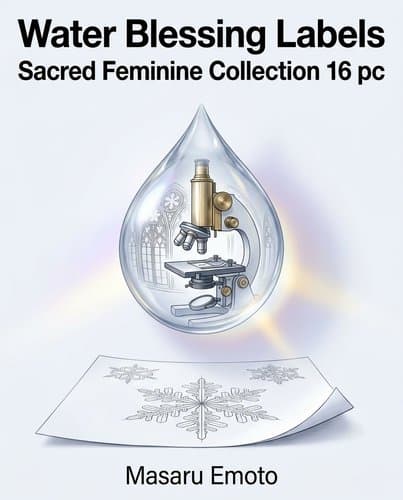
Picture a small team of researchers in a room held at minus five degrees Celsius, hunching over petri dishes, day after day, for two months — producing nothing usable. Then a single frozen droplet yields something under the microscope that stops everyone cold in a different way: a perfect hexagonal crystal, symmetrical and radiant, like a snowflake drawn by someone who knew exactly what they were doing.
That image, captured in Masaru Emoto's Japanese laboratory sometime in the 1990s, launched fifteen years of obsessive photography. His team eventually accumulated tens of thousands of crystal images. And yet, of all of them, one stood apart. It came from a sample of water left for twenty-four hours in the presence of the written phrase 'love and gratitude.' When frozen and photographed, it formed what Emoto describes as something resembling an open flower — not a clinical geometric pattern, but something that seemed to radiate light from within. He says, plainly, that no human hand could have made it.
Here's the move Emoto is making, and it's worth pausing on: he's not presenting the photograph as interesting data. He's presenting it as proof of something theological — a moral truth. The universe, he's arguing, has aesthetic preferences, and they happen to align with kindness.
To get there, he builds a visual contrast first. Water drawn from natural springs or the upper reaches of rivers reliably produces clean, symmetrical hexagons. Water from taps or lower, more polluted river stretches produces broken, asymmetrical shapes — not just different, but visually disturbing, the way a face looks wrong when something is off. The contrast is doing argumentative work before a single claim is stated. You see it, and you feel the difference, and that feeling is the argument.
The 'love and gratitude' crystal sits at the top of this hierarchy. For Emoto, it isn't a curiosity or a data point — it's the answer to questions he returns to throughout the book: where we come from, what we're for, where we go. The photograph is doing theological work disguised as photography.
Water Is Not a Substance — It's a Language
Emoto traces this back to the opening of the Gospel of John: 'In the beginning was the Word.' His reading is that 'Word' doesn't mean language in the literary sense — it means vibration. God didn't speak creation into existence through sentences. He hummed it into being through frequencies. Every object that exists — a rose, a desk, a human cell — has its own vibrational signature, what Emoto calls 'hado.' Water, uniquely sensitive to these frequencies, acts as the recording medium. It doesn't just carry God's message; it is the medium through which the message becomes physical reality.
Emoto introduces the H2O formula not as chemistry but as a hidden equation about how love should move through the world. Oxygen represents Love — the active, giving, positive force. Hydrogen represents Gratitude — the receptive, receiving, negative force. The formula has two hydrogens for every oxygen. That ratio, 1:2, is not coincidental. It's the design specification for how energy must circulate to sustain itself.
He works this out through a seminar scenario. Imagine a speaker sharing an idea with a room full of people. The speaker gives one unit of love. Each person in the room, if genuinely moved, generates gratitude in return — but for the cycle to continue rather than terminate, they need to generate two units of gratitude, not one. The first unit returns to the speaker, recharging them. The second transforms: the person who felt grateful becomes compelled to share the experience with someone else, and in doing so stops being a receiver and becomes a giver. Gratitude flips polarity and becomes love again. The chain reaction continues indefinitely — a kind of emotional perpetual motion — but only if the ratio holds at 1:2. At 1:1, the energy dissipates. The math, Emoto insists, is not metaphorical.
Then he points to your face as corroboration. One mouth, two ears. You have exactly one instrument for giving and two for receiving. Notice what he's doing: the same ratio appears in chemistry, in human anatomy, and in what he calls God's intentional design. Each domain is a different angle on the same truth. The system isn't loosely metaphorical — it's a locked set of correspondences, each one confirming the others.
Whether or not you find the logic convincing, the architecture is worth appreciating. Emoto has built something where every element refers back to every other element. Water encodes divine vibration. Vibration follows the 1:2 principle, which is written into the molecular structure of water itself. Your body is seventy percent water, shaped in the exact proportions the principle requires.
Prayer Travels Across Land and Sea — If You Photograph the Right Vial
The system is internally elegant. Then it has to make contact with actual events.
Here is the core claim Emoto makes about prayer: it works at a distance, it can be verified through crystal photography, and the evidence is right there in the before-and-after photographs.
On February 22, 1996, at two in the afternoon, five hundred people scattered across Japan simultaneously directed a single prayer toward a vial of tap water sitting on Emoto's desk in Tokyo. The prayer was almost bureaucratically specific — it named his office, his city, his name — and asked that the water become clean. Three minutes later, the water was frozen and photographed. The resulting crystal was symmetrical, radiant, everything the polluted tap water had previously failed to produce. Emoto presents the photographs side by side as proof. Not suggestive data. Proof.
Pause here, because the evidentiary standard is about to shift. The 1996 experiment at least gestures toward empirical structure: a before state, an intervention, an after state. Follow the trail one step further — to Fujiwara Dam in 1997 — and you can watch the framework quietly change its own rules.
At the dam, a Shinto priest led a prayer ceremony, and Emoto's team photographed the water before and after. The resulting crystal was heptagonal — seven-sided, where frozen water normally produces six. Emoto's interpretation: seven sides means the crystal came from a '3.5-dimensional' zone, halfway between the physical world and the spirit realm. About a week later, the body of a murdered woman was found in the dam. Emoto went back and looked at the pre-ceremony photographs more carefully and reports seeing the image of a woman in distress trapped inside the crystal. His conclusion: the prayer had freed her soul to ascend.
Then a Swiss woman claimed she had taken the Fujiwara Dam crystal photograph herself, at a Helsinki laboratory in 1967. Emoto flew to Zurich with a lawyer. After two hours of unresolved dispute, he offered her a resolution: perhaps she had taken the photograph — in a different dimension. She eventually retracted her claim, and Emoto treats this as further confirmation that such dimensions exist and that the crystal image had somehow already been there, waiting to be captured.
Notice what's happened. The crystal photograph began the book as physical evidence. Here it becomes an artifact that can exist across multiple dimensions simultaneously, and a copyright dispute about who took it becomes additional proof of dimensional reality. The evidentiary standard hasn't collapsed — it's expanded. Any outcome can be absorbed. A beautiful crystal confirms the prayer worked. A disputed photograph confirms the existence of higher dimensions. A murder victim found nearby confirms that the crystal had already recorded her suffering before the prayer released her.
Emoto is building a system where nothing can falsify anything, because every anomaly becomes a window into a layer of reality the current data simply wasn't deep enough to reach. The narrator's own view: proof is supposed to be capable of failing. A standard that can absorb any outcome isn't evidence of truth — it's a description of faith. That distinction matters, because one of them can be wrong.
The Reason Science Won't Discuss Any of This Is the Illuminati
Why does Emoto spend three chapters building a case that looks like science, and then pivot to the Illuminati?
The pivot reveals something structural about the entire project. Emoto invokes Jacques Benveniste — a French immunologist who published research in Nature, one of the most prestigious scientific journals in the world, claiming that water could retain a biological 'memory' even after a substance was diluted to nothing — as evidence that orthodox inquiry has already begun validating what he's been saying about water's capacity to store information. Benveniste is the credential, the white coat in the room. But then Emoto tells you that Benveniste himself once warned him: 'Never talk about God.' Rather than taking that as a signal to keep the theological claims separate from the scientific ones, Emoto takes it as evidence of suppression. Why would a researcher say that, unless powerful forces were actively discouraging the connection?
From there the framework shifts fast. Water research is being repressed, Emoto argues, because truly understanding water would force people to recognize themselves as 'children of God' — and that recognition would dissolve the authority of whoever currently runs things. He names that group in the language of conspiracy: a 'powerful minority,' and links them explicitly to the Illuminati through his collaboration with David Icke (the British conspiracy theorist). In the same chapter, he rewrites Einstein's E=MC² so that C stands for Consciousness rather than the speed of light — a revision he presents not as metaphor but as a corrected description of physical reality, one in which human awareness is literally woven into the structure of the universe.
Here's the move worth naming precisely: Emoto uses scientific legitimacy when it points toward his conclusions and explains away scientific rejection as proof of elite interference. Benveniste validates him; the broader scientific community's silence validates him differently — as a sign that he's over the target. Agreement confirms the theory. Disagreement also confirms the theory. That's not an empirical framework with theological implications. It's a belief system that has borrowed the appearance of empirical structure — the experiments, the photographs, the citations — to create the feeling of evidence without the vulnerability that real evidence requires.
Love and Gratitude Can Neutralize Radiation (The Formula Doesn't Apply Here)
Here is the claim the entire framework rests on, and the place where it quietly breaks: love and gratitude can neutralize radiation.
Emoto describes a village called Budische — his spelling — in Belarus, roughly a hundred miles from Chernobyl. After the 1986 meltdown, authorities ordered an evacuation. Almost everyone left. But fifty-five elderly residents stayed, cared for by a young man named Alexei. They drank from a local spring that had been flowing for a century. Years passed. They showed no radiation effects. Emoto's explanation: Alexei and the villagers loved their spring. Their gratitude for it kept the water clean, and the clean water kept them safe.
Notice where the precision of the 1:2 formula goes. Earlier in the book, Emoto builds a careful architecture — oxygen as love, hydrogen as gratitude, the ratio locked into molecular structure, written into your face, governing how energy must circulate to sustain itself. The math, he insists, is not metaphorical. But when that framework encounters Chernobyl, no ratio is calculated, no mechanism proposed, no control group considered. The surviving villagers simply loved their water, and that was enough. Chlorine in tap water, by contrast, is called an insurmountable poison — a violation of God's will that Emoto links to a rise in skin conditions four decades after its introduction. Chemical contamination is permanent damage; nuclear contamination dissolves in the presence of the right feeling. The framework doesn't apply consistently. It applies selectively, to whichever conclusion needs supporting.
Emoto is not doing science with spiritual implications. He's doing something closer to theology with scientific furniture arranged around it — the photographs, the formulas, the case studies — to generate the feeling of evidence. The feeling is real. The architecture is internally elegant. The story of those fifty-five people in Belarus is genuinely moving, and the idea that love might offer some protection in an indifferent world is one of the oldest human hopes there is.
What the framework can't do is be wrong. And a system that can't be wrong isn't explaining the world. It's describing a way of experiencing it — which is a different thing, and not necessarily less valuable, but worth seeing clearly for what it is.
Three Million People Weren't Wrong to Want This
So why did three million people buy this book?
Not by accident. 'The Message from Water' was rejected by every mainstream publisher Emoto approached. He and his wife self-published it through her small company, packed the orders themselves, and shipped copies by hand. By any conventional measure, it should have stayed a curiosity. Instead it spread across 45 languages — and Emoto's thinking kept expanding with it. He eventually argued that the weight of unevolved human souls was measurably contributing to rising sea levels: the same system that explained crystal photography extended, without friction, to explain climate change. That gap between institutional rejection and mass embrace is worth taking seriously, because it tells you something about what the book was actually offering that conventional publishers couldn't see.
The hunger it feeds is specific: the desire to live in a world where inner life has physical consequence. Not metaphorical consequence — actual, photographable, molecular consequence. If your gratitude can shape a crystal, then gratitude is not just a social grace or a mental health practice. It has mass. It operates on matter. The universe is built in a way that notices whether you are kind.
That's not a new longing. It runs through every tradition that has ever asked whether prayer works, whether love survives death, whether a good life leaves any mark on the fabric of things. What Emoto did — and this is the achievement worth crediting — is give that longing a visual language at exactly the moment when photographs could circulate globally. You don't have to read Japanese, or understand hado, or follow the 1:2 ratio argument. You look at two crystals side by side and you feel the difference. The image does the work that doctrine used to do.
The framework is unfalsifiable, the experiments uncontrolled, the causal claims unsupported. All of that is true, and worth knowing. But dismissing the book on those grounds misses what it's doing for the people who keep it on their shelves. It's giving them a cosmology in which their inner life is not epiphenomenal — not a side effect of chemistry, not a story they tell themselves to get through the day, but something the universe is genuinely, structurally responsive to. That is a thing people need, and the need doesn't go away when the evidence falls short. It just goes looking for the next framework willing to take it seriously.
What the Crystal Is Actually Proving
Emoto ends his book in Prague, 66 years old, somewhere in the middle of a 35-day world tour, convinced he has been carrying this message across 700 lifetimes. But sit for a moment with what he actually built: a system in which your capacity for love and gratitude is not a private experience that evaporates when you stop feeling it, but something the physical world registers, responds to, remembers. The crystal didn't prove that. The experiments wouldn't survive peer review. The framework bends to fit every outcome. All of that is true. And three million people bought it anyway — in 45 languages, on six continents — because the alternative, that your inner life leaves no mark on anything, is its own kind of claim, and not obviously the easier one to live with.
Notable Quotes
“Where did I come from?”
“Where am I going after I die?”
“I’ll leave Earth to you. Please take good care of it.”
Frequently Asked Questions
- What is the main claim of Masaru Emoto's Water Blessing Labels?
- Masaru Emoto's central claim is that water responds to human intention — beautiful words and music produce symmetrical hexagonal crystals, negative words produce distorted ones. This 2005 work presents tens of thousands of crystal photographs as empirical proof that human intention, emotion, and language directly shape the physical structure of water crystals. Drawing on crystal photography and spiritual reinterpretation of the H2O formula, it offers a framework in which cultivating gratitude and love can positively influence both personal wellbeing and the natural world. The work achieved remarkable commercial success, reaching three million copies across 45 languages.
- How does Masaru Emoto reinterpret the H2O formula in this work?
- Emoto reinterprets the H2O formula as a spiritual equation rather than a purely chemical one. Oxygen equals Love (giving energy), Hydrogen equals Gratitude (receiving energy), and the ratio must be 1:2 for positive energy to circulate and multiply rather than stop. This spiritual interpretation links water's chemical composition directly to emotional and intentional states in humans. By framing gratitude and love as fundamental forces embedded in water's molecular structure, the framework suggests that cultivating these emotions can create measurable physical changes in water and, by extension, in human health and wellbeing.
- What is the evidentiary standard used in the Water Blessing Labels work?
- The book's evidentiary standard shifts freely between scientific and metaphysical registers. The 1996 prayer experiment is presented as controlled empirical proof, while a plagiarism dispute is resolved by suggesting the claimant 'photographed the crystal in a different dimension.' This mixed approach creates a structurally unfalsifiable framework: chemical contamination like chlorine is treated as insurmountable damage to water, while vibrational intention (love and gratitude) is credited with neutralizing Chernobyl radiation in survivors who refused to evacuate. Opposing evidence can be reinterpreted rather than disproving core claims.
- Why did Water Blessing Labels become commercially successful despite mainstream publisher rejection?
- The book achieved extraordinary commercial reach of three million copies across 45 languages, despite being self-published after rejection by mainstream publishers. This remarkable success reflects a genuine hunger for a worldview in which inner emotional states have physical and cosmic consequences. Rather than focusing solely on scientific validation, the work resonates with audiences seeking meaningful connection between their inner emotional life and outer reality. Understanding this hunger separately from evaluating the scientific validity of the water crystal claims reveals why the book found such global appeal despite mainstream scientific rejection.
Related Book Summaries


Read the full summary of 14727_water-blessing-labels-sacred-feminine-collection-1 on InShort