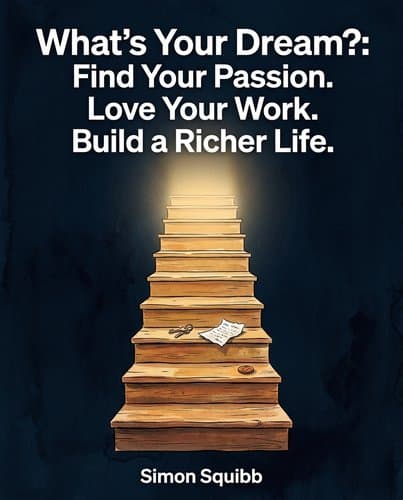
218375973_what-s-your-dream
by Simon Squibb
Most people never pursue their dreams because they never say them out loud—Squibb's street interviews and rags-to-riches story reveal that naming your dream…
In Brief
Most people never pursue their dreams because they never say them out loud—Squibb's street interviews and rags-to-riches story reveal that naming your dream publicly, finding one paying customer, and running a simple 'would I still do this with $5M?' test are all it takes to transform vague longing into real momentum.
Key Ideas
Voice Your Dream Into Reality
Name your dream out loud — Squibb's evidence across hundreds of street interviews is that the physical act of saying it to another person changes how you carry yourself, and how others respond to you. Silence is not modesty; it's the most effective way to kill an idea.
Money Test Reveals True Purpose
Run the '$5 million acid test': imagine you already have five million dollars, then ask whether the idea still keeps you awake. If yes, it's a dream worth pursuing. If it evaporates, it was a financial goal dressed up as a purpose.
Customers First, Business Plans Second
Find one paying customer before you write a business plan. The plan is a distraction; the customer is proof. Squibb's Rule of Three — first customer makes it real, second proves it's not a fluke, third creates usable data — replaces months of projection with days of reality.
Name Your Fears to Shrink Them
Use the 'best-case/worst-case' exercise before any major risk: visualize the worst outcome in concrete detail and ask whether you could survive it. When Natasha's husband said 'it's only money,' the risk became navigable. Most fears shrink when you name them specifically.
Constraints Drive Creativity and Discipline
Start poor on purpose. Before spending anything, ask whether removing this cost would force a more creative solution. Constraints aren't a handicap — they're what kept Squibb disciplined across fifteen years of Fluid while a better-funded joint venture collapsed in under two.
Own Your Value or Exit
Equity or exit: if you're building value for someone else's business without owning a piece of it, the trajectory is toward resentment. Ask for equity, or treat the role as an apprenticeship with a defined end date — not a permanent arrangement.
Relationships Build Competing Motivated Buyers
Sell your business by not trying to sell it. The moment you signal you're a motivated seller, buyers know they have leverage. Build relationships with potential acquirers for years before any transaction; the goal is to create motivated buyers competing for something they think they might not get.
Who Should Read This
Business operators, founders, and managers interested in Startups and Motivation who want frameworks they can apply this week.
What's Your Dream?: Find Your Passion. Love Your Work. Build a Richer Life.
By Simon Squibb
10 min read
Why does it matter? Because the ladders everyone tells you to climb are specifically designed to make your dream feel irresponsible.
Most people treat the conventional path — salary raises, mortgage payments, careful saving — as the responsible choice. The grown-up choice. The one that proves you've got your head screwed on. Simon Squibb spent the first fifteen years of his life with nothing, slept in a stairwell to survive a winter, and built himself up to the kind of wealth where conventional wisdom said he'd finally made it. Then he sold his company, collected the money, and discovered he hated everything about it. Not because success is hollow — but because he'd spent twenty-five years working toward a financial target instead of an actual dream. What's Your Dream? is the product of that hard, expensive education: a case against the ladders most people spend their lives climbing, and an argument that the so-called reckless path — naming what you actually want and building toward it — is often the only rational one.
The Life You're Building Might Be a Trap
Simon Squibb had wanted a Porsche since the years he spent homeless with nothing in his pockets. So when he finally sold his company for millions, he went to a Mayfair showroom and drove one out. The first week was euphoric — he took any excuse to get behind the wheel, mentioned the car constantly, felt like proof he'd made it. Then someone put a small scratch in the paintwork. He spent three days shuttling the car back and forth to the garage. Standing there arranging repairs for a problem most people wouldn't even notice, he realized something had gone wrong. He thought he'd bought the car. Instead, it had purchased him — his attention, his anxiety, his time. He sold it as quickly as he could and felt almost as good doing so as he had driving it off the lot.
That experience crystallized something Squibb had spent most of his working life getting backwards. He'd left home at fifteen, built a creative agency with his wife Helen called Fluid, and eventually sold it for the financial security he'd always told himself he wanted. Then he had it — and hated it. The making had meant something. The having was just maintenance. Everything he'd chased — the money, the status, the car — had delivered something closer to a cage than a life.
His most provocative reframe: home ownership, the ambition millions of people organize their entire financial lives around, isn't really a choice between renting and buying. It's a choice between monthly payments and options. The mortgage ties you to a job, a city, a fixed trajectory. Squibb moved to Hong Kong and slept on a friend's sofa for months — and that period changed his career entirely. He couldn't have done it carrying a mortgage. The question isn't which costs less per month. The question is what you're trading away.
'Dream' Is Not a Soft Word — It's a Survival Tool
The word 'dream' sounds soft until you watch what it actually does to a person. Then it looks less like a motivational poster and more like a switch being thrown.
Squibb was working through a McDonald's queue when he asked the cashier his standard question: what's your dream? The young man — Delon — shook his head. No dream. No plan. Just living, seeing where things went. Squibb didn't buy it, so he made an offer: sit down and eat, and if Delon could come up with something before he left, Squibb would help make it happen. Ten minutes later, Delon appeared at his table — coat on, off the clock, bag of chips in hand. Something had changed. He wasn't sheepish or halting. He sat down and said it straight: he wanted to be a Twitch streamer, a popular one, wanted to make people smile. His manager had overheard and offered to help. When Squibb posted the video, millions of people watched it.
What shifted in those ten minutes wasn't Delon's circumstances or his odds. Before that conversation, he'd had attempts — quiet ones, probably abandoned quietly — and a dream he'd been carrying around in secret, too afraid to say out loud because he thought people would laugh. Naming it didn't change the dream. It changed him: the posture, the eye contact, the certainty. That's the instrument Squibb is describing. Not aspiration as a mood, but articulated purpose as a psychological state that other people can feel and respond to.
This is why Squibb insists on the specific word. Goals have a binary logic — you hit them or you don't. That makes them brittle. A missed target is a small failure; enough small failures and you quit. A dream operates differently because it's bigger than any single outcome. It can absorb setbacks without dying. You can change direction, lose a job, blow a launch, and still be working toward the same thing. Nobody schedules an annual dream review and tells you your performance has been insufficient.
The taboo around the word is evidence of how powerful it is. Delon had been living with his for years and told nobody — not friends, not family. Society trains people out of saying it: keep your head down, pass your exams, wait your turn. That training works. It produces people who suppress the clearest signal they have about what would actually motivate them, and replace it with targets that drain rather than charge them. The proof is a kid in a fast-food uniform who, given ten minutes and a reason to say it out loud, walked back transformed.
Everyone Already Knows Their Dream — They're Just Afraid to Say It Out Loud
So far we've been talking about what a dream is. The harder question is what's blocking you from saying it out loud.
Squibb has asked this — what's stopping you? — to thousands of strangers, in streets and airports and fast-food queues. What he's found is that the blockers are remarkably consistent. Nearly everyone gets stuck on one of seven excuses, and whichever one is yours, it feels unique and insurmountable right up until the moment you name it.
He maps these excuses as seven rungs. At the bottom: people in pure survival mode, so consumed by getting through the week that a dream feels like an insult to their circumstances. One step up: people who've built lives around possessions that now own them, whose mortgaged houses and financed cars have swallowed the flexibility they'd need to try anything new. Above that come the people who claim not to know their dream — which Squibb calls a surface lie. Ask them what they'd do if money were no object and the answer usually arrives before they've finished the sentence. The fifth rung is the most crowded: people who know exactly what they want but have talked themselves into believing it requires credentials or genius they don't have. Sam, the woman Squibb stopped on a Hong Kong street, had already named her catering business — Chez Sam — but had convinced herself she didn't know how to begin. Three days after their chance meeting, she was catering her first professional event, to a room full of investors. The skill was never the issue. The top rungs belong to people sabotaged by someone else's fear, and people who've failed before and locked that experience somewhere they refuse to revisit.
The framework matters because most people are stuck on one or two rungs, not all seven. Locate yours and the problem shrinks from 'I can't do this' to something specific and solvable.
And if you're still not sure whether what you have is a real dream or just a passing idea, Squibb has a test. Imagine five million dollars in your account, all financial pressure gone. Does the idea still keep you up at night? If it does, it was never about the resources. It was always about the courage to say it out loud.
The Most Transformative Sentence You Can Hear Is 'Really?'
She was stacking shelves at Tesco when Squibb walked up and asked her the question he'd been carrying all morning: what's your dream? She looked over his shoulder first — checking for cameras, for some kind of setup. There wasn't one. Just a stranger in a grocery store, $195 in his coat from a tip someone had sent him on TikTok that he hadn't asked for and didn't need, no plan for what came next.
Once she realized he meant it, something shifted. She straightened up, made eye contact, and told him. A care home. She knew exactly what kind of place it would be, what she'd name it, where it would sit. The whole thing had been living in her head for years, rooted in the fact that her mother had died alone at home — and she'd decided that shouldn't happen to anyone else if she could help it. Squibb told her it sounded extraordinary and handed her the cash on the spot, calling it a deposit for her services whenever she was ready to open.
'Really?' That was all she said.
That single syllable is the whole point. She already had the dream, already knew the details, already understood her own reasons. None of that was the bottleneck. The bottleneck was whether any of it was real — whether someone else could take it seriously enough to pay for it. The moment they did, the idea stopped being private and became a transaction. A transaction is the beginning of a business.
Squibb's argument is that finding your first customer matters more than writing a business plan, building a pitch deck, or waiting until you feel ready. Plans give you the feeling of progress while the dream stays theoretical. A customer makes it actual. It doesn't matter if they're your neighbor, a former colleague, or a stranger in a grocery store — someone handing over real money for what you're offering collapses the gap between 'I want to do this' and 'I am doing this' faster than any amount of preparation.
Starting With Nothing Is Not a Disadvantage — It's the Strategy
The transition out of that Tesco moment is abrupt — so here's the bridge: what carries you forward isn't confidence, it's necessity. And the fastest way to kill necessity is money you haven't earned.
Think of capital as a painkiller. A little, at the right moment, helps you function. Too much, too early, and you stop feeling the signals telling you something is wrong.
Squibb learned this the expensive way through a joint venture with a Hong Kong private equity tycoon whose deals ran into the hundreds of millions. The partner wanted equity stakes in a comic book franchise, a restaurant chain, a sports management agency. Squibb, who'd spent years bootstrapping Fluid to profitability, suddenly had unlimited access to someone else's checkbook. What happened next is almost predictable: they leased an office with a gym and cinema room sized for twenty-five people, occupied by three. They hired a feng shui master to optimise the layout. They spent in anticipation of revenues that hadn't arrived, then kept spending when those revenues didn't show. The comic book flopped. The partner went quiet. The legal dispute followed. When it was over, Squibb had eaten a seven-figure loss and a clean education in why constraints are protective. With no one watching every pound, he'd stopped asking whether each cost moved the business forward. The absence of that question was the actual catastrophe.
His rule since: bootstrap. Earn before you spend. Let the business pay for itself one step at a time. That sounds like caution. It's the opposite — it's how you stay sharp. When money is tight, you only do things that work. You don't rent space that makes you feel arrived; you find customers that make you feel useful.
The third customer matters specifically. The first proves the idea exists outside your head. The second proves the first wasn't polite charity. Three creates something new: actual data. Three customers start telling you what they want versus what you assumed they'd want, and those two things are almost never identical. At Fluid, the early clients weren't brands in general — they were a specific kind of client with a specific kind of problem. That narrow focus was what built the knowledge to expand later. Niche first. The mass market, if it comes, comes after you actually know something.
Luck Is Just Boring Mathematics
Stay visible long enough and the odds eventually tip in your favor — not because fortune smiles on the persistent, but because persistence is a mechanical advantage that compounds while everyone else is quitting.
When Squibb launched Fluid, he sat down and made a list of fifty Hong Kong companies he wanted as clients — household names, dream accounts, the kind of brands a new agency with no track record had no business calling. He contacted every single one in the first month. Nobody replied. He could have revised the list downward, aimed at easier targets, been more realistic. Instead, he kept contacting them every month, year after year. Not with the same pitch on repeat, but with something useful each time: a relevant article, a seasonal note, thoughts on a competitor's campaign or a pricing shift in their sector. The goal was to stay front-of-mind without asking for anything. By the end of year one, several names had become clients. By year nine, every single company on the list had worked with Fluid. All fifty. The math is simple: if you remain present and relevant long enough, you will be the one standing when a client finally develops a need. Your competitor who gave up in year three won't be.
This reframes what most people call luck. The entrepreneur who 'gets lucky' is usually the one who never gave someone a clean opportunity to forget them. The ones who walked away — exhausted, underfunded, convinced the timing was wrong — handed over their position on that list. Persistence isn't a personality trait you either have or don't. It's a practice: show up, add value, don't disappear. Do it long enough and the probability of a yes stops shrinking and starts compounding. That's not inspiration. That's arithmetic.
The Endpoint of Building Something Isn't Wealth — It's the Freedom to Give It Away
HelpBnk is a platform Squibb built on a single idea: you show up, say what you need, someone helps you, and nothing changes hands. The staircase is its physical home — a gray, grubby building in Twickenham with no address, no post box, and no connecting block, bought at auction for $34,000 because logic said it was worthless. A woman drove six hours from Scotland to stand outside it, paper in hand with her dream written on it, rehearsed her words one more time, and pressed the doorbell.
That doorbell is what thirty-five years of building pointed toward. Not the agency, not the sale to PwC, not the financial security — those were intermediate steps. The endpoint was the freedom to install a camera in the ugliest building in Twickenham and tell people: come here, say it out loud, and I'll try to help you. No fee. No equity. No strings.
The career arc is legible in retrospect. Both models — the agency, then the investment fund — were honest, but transactional: help exchanged for something. HelpBnk breaks that pattern entirely. The whole system runs on the logic that a man who once told a young, homeless Squibb 'if you don't pay, you don't pay attention' was simply wrong. It took him three and a half decades to build the thing that proves it.
The staircase matters because of what it used to be. When Squibb was fifteen, sleeping rough in winter, he pushed open a fire-exit door on a quiet street and slept on the stairs inside because it was the closest thing to shelter he could find. Buying one for $34,000 — a building that logic said was worthless — was never really about property. It was about what a staircase can mean to someone who has nothing: the first step toward something bigger.
Your dream isn't the destination. It's the mechanism that gets you to the place where you can genuinely help someone else find theirs — and do it for free, without keeping score.
The Staircase Was Always the Point
The staircase cost $34,000 and made no financial sense. No address, no tenants, bicycle frames rusting in the well. Every conventional measure said walk away. Squibb bought it because he'd once slept in a building exactly like it, cold, fifteen years old, with nothing but a name for what he needed next. That wasn't a weakness he survived. It was the education. Naming what you need — saying it to another person, out loud, without apology — is the first move. Everything else follows from that or it doesn't follow at all. And the strangest thing he learned across thirty-five years of building, selling, losing, and starting over: the point was never the money. The money was just what made it possible to stand at the bottom of an ugly staircase in Twickenham and tell someone, free of charge, that their dream was worth taking seriously. That's the whole business model. It turns out to be enough.
Notable Quotes
“A dream? Not really, no.”
“I think I’ve come up with my dream. My dream is to be a Twitch streamer. A popular one, make people smile.”
“Let’s put this away and never look at it again.”
Frequently Asked Questions
- How does naming your dream change your life?
- Naming your dream out loud is the foundational act of building a meaningful life, according to Simon Squibb. "The physical act of saying it to another person changes how you carry yourself, and how others respond to you. Silence is not modesty; it's the most effective way to kill an idea." This conclusion draws from hundreds of street interviews. Verbalizing your ambition creates psychological and social momentum that silence cannot match, fundamentally shifting how others perceive and respond to you.
- What's the $5 million acid test?
- The $5 million acid test is a mental exercise to distinguish between a true dream and a financial goal, according to Squibb's framework. Imagine you already have five million dollars, then ask whether the idea still keeps you awake. "If yes, it's a dream worth pursuing. If it evaporates, it was a financial goal dressed up as a purpose." This test filters out ambitions motivated purely by money, ensuring you pursue something with genuine personal meaning. By removing financial pressure from the equation, you clarify your actual motivation and passion.
- What's the Rule of Three for starting a business?
- The Rule of Three replaces months of business projections with days of real-world validation. Find one paying customer before you write a business plan, because the customer is proof while the plan is a distraction. "First customer makes it real, second proves it's not a fluke, third creates usable data." This approach prioritizes evidence over planning: actual customer feedback proves the concept, demonstrates repeatability, and provides actionable patterns. Squibb argues this method is far more efficient than elaborate projections, shifting focus to practical market testing.
- When should you ask for equity in a business?
- You should ask for equity whenever you're building value for someone else's business without owning a piece of it. This principle is straightforward: "If you're building value for someone else's business without owning a piece of it, the trajectory is toward resentment." Squibb suggests two options—either ask for equity in the business, or treat the role explicitly as an apprenticeship with a defined end date, not a permanent arrangement. Without ownership or a clear exit, ongoing work creates frustration as you build someone else's wealth.
Related Book Summaries
Read the full summary of 218375973_what-s-your-dream on InShort