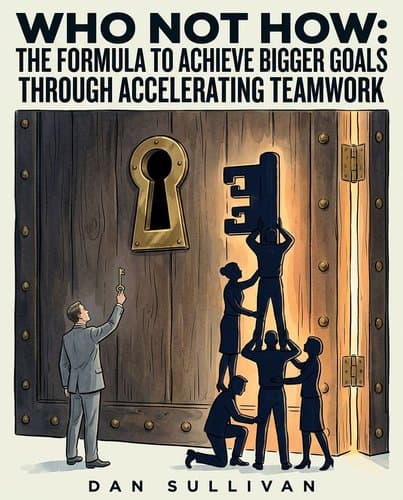
54018473_who-not-how
by Dan Sullivan
Stop asking how to do more and start asking who can do it better—the fastest path to bigger goals is building the right relationships, not developing more…
In Brief
Who Not How: The Formula to Achieve Bigger Goals Through Accelerating Teamwork (2020) argues that ambitious people limit themselves by asking how to do things rather than who can do them.
Key Ideas
Procrastination signals time to find help
When you feel procrastination, do not push harder — treat it as a signal. Ask 'Who can do this?' instead of 'How do I figure this out?' The block is your intelligence telling you the goal has outgrown your solo capability.
Impact filter defines done before delegating
Before searching for a Who, complete an Impact Filter: write down the project, purpose, ideal outcome, and — most critically — the specific criteria for what 'done' looks like. Handing someone a clear vision is your only indispensable job; everything else is their How.
Delegation ROI equals reclaimed time value
Treat every dollar spent on a Who as an investment in your highest-leverage work, not a cost. The measure is not what you pay them — it is what the time you reclaim allows you to do. Scheduling is worth 1/10th of performing; overhead tasks are worth 1/100th of creating.
Clear vision eliminates need for micromanagement
Once you hire a Who, give them complete permission to own the How — including diverging from your original approach. Micromanaging process is a symptom of unclear vision. If you feel compelled to control how it gets done, sharpen your definition of what done looks like instead.
Mutual benefit foundation for Who relationships
When you find a strong potential Who, ask 'What's in it for them?' before anything else. Every durable Who relationship is mutual — both parties expand through it. A Who who gains nothing from the collaboration will not stay a Who for long.
Time gatekeeping protects high-leverage work
Audit who has access to your time as rigorously as you cultivate new relationships. Building intake filters, approval processes, or a gatekeeper assistant is not elitism — it is the operational mechanism that lets you exercise the buyer's posture consistently.
Public goals self-select the right collaborators
State your goals publicly and specifically. Lars Ulrich ran a classified ad; the right Who found him. Clarity of vision acts as a filter: the people who resonate with your specific outcome will self-select in, and the wrong fits will self-select out.
Who Should Read This
Business operators, founders, and managers interested in Team Building and Leadership who want frameworks they can apply this week.
Who Not How: The Formula to Achieve Bigger Goals Through Accelerating Teamwork
By Dan Sullivan & Benjamin P. Hardy
10 min read
Why does it matter? Because asking "How?" is not self-sufficiency — it is a ceiling disguised as virtue.
You probably believe that figuring things out yourself is the responsible path. Diligent. Self-reliant. The kind of thing that actually builds character. That assumption is so deeply wired it barely feels like a belief — it just feels like how things work.
Dan Sullivan, the man who invented the Who Not How framework, did not write a single word of it.
What follows is not a productivity system. It is a reframe so fundamental that once it lands, you will look back at every goal you capped at your own ceiling and feel the waste of it.
Asking 'How?' Feels Like Responsibility — It Is Actually a Cap on Your Ambition
In the summer of 2019, Tucker Max sat across from Reid Tracy, president of Hay House, at a private business mastermind called GeniusX and pitched a book idea. By the end of that dinner, Tracy was interested. Within weeks, Tucker had negotiated not just the book deal but a tentative multi-book arrangement for Dan Sullivan — something Benjamin Hardy, the book's actual writer, had spent a full year failing to produce on his own.
Hardy had been trying. He'd pitched the idea to his existing publisher in 2018. They said no — focus on the other project. He kept asking. The answer kept being no. Every version of "How do I make this happen?" ran into the same wall.
What changed wasn't Hardy's effort or credentials. What changed was the question. Tucker Max didn't need to figure out how to break through to a publisher. He had the relationships, the credibility, and the track record to walk straight to the right person and make the case. Hardy couldn't have gotten that dinner. Tucker walked in through the front door.
The book calls this "Who Not How." Asking "How do I accomplish this?" feels like responsibility — industrious, virtuous, self-sufficient. But it's a ceiling. It ties your ambition to what you can currently see, know, and do. The question "Who?" removes it — and produces something no one originally imagined.
Procrastination Is Not a Character Flaw — It Is Your Intelligence Waiting for a Who
Procrastination is your intelligence sending a specific signal: the goal is real, the ambition is sound, but you are not yet the right person to pursue it alone.
Lars Ulrich was the only kid in his California high school who cared about British heavy metal. Five hundred classmates wore pink Lacoste shirts; he wore Saxon T-shirts. He had no one who cared about any of it. No school club, no local scene, no door to knock on. He was stuck because the goal had outgrown what he could pull off alone. Then he placed a classified ad in a local paper called The Recycler: "Drummer looking for other musicians to jam with." James Hetfield, too shy to hold eye contact, answered it. They co-founded Metallica. The band sold more than 100 million albums.
Ulrich didn't solve a How problem. He stated a Who problem publicly, and the right Who appeared. That's the move.
The book makes a claim that takes a second to settle: procrastination is a form of wisdom. When you stall on a goal, your inner intelligence already knows the goal has outgrown your current capability. The paralysis is the signal. Asking "How do I do this?" deepens the paralysis, because the honest answer is you don't yet know, and you may never know on your own. The better question is "Who can help me with this?" — or more directly, "Who can achieve this goal for me?"
Procrastination left unaddressed sets off a chain: blocked progress erodes confidence, and shrinking confidence narrows imagination. Narrowed imagination produces smaller goals. Smaller goals shrink your sense of what you're capable of becoming. The most common deathbed regret, according to research the book cites, is never having taken steps toward what you actually wanted. Unanswered procrastination is the mechanism behind that regret.
The shift from How to Who is about matching the size of the goal to the size of the team pursuing it. Ulrich's goal — to play serious music with serious musicians — was real and worth pursuing. He just wasn't going to find his people by trying to be more social. He said what he wanted, clearly, and trusted that the right person was already out there waiting to hear it.
One Who Can Return Twelve Weeks of Your Year — and Some of Those Weeks Are Irreplaceable
Sharon Duncan had built her practice from the ground up and was proud of it. She was also exhausted. Working what she described as a zillion hours a week, she was spinning too many plates, her stress was through the roof, and she barely had time for her 82-year-old mother — a devoted baseball fan who wanted nothing more than to go to games with her daughter.
When Sharon started working with Dan Sullivan, she encountered a single idea that reoriented everything: if you build a team that can operate without you, you can take three months off per year. Entirely off. Not checking email from the beach, but genuinely away.
She did the arithmetic and arrived somewhere unexpected. What if she freed herself up so completely that she could spend those three months traveling the country, watching major league baseball with her mother? Not someday. Now. Her mother was 82. There was no "later" version of this plan.
One hire made it real. Sharon brought on a Practice Manager whose job was to absorb the administrative and logistical load that had been consuming her days. That single role returned 500 hours to her year — equivalent to 12.5 forty-hour workweeks, or roughly three months of full-time work. The stress didn't gradually fade; it dropped immediately.
Sharon and her mother went to every game of the 2018 World Series.
The detail the book holds onto is the mother's age. Every hour Sharon spent on tasks someone else could have owned was an hour taken from someone whose seasons with her were numbered. Sharon had been telling herself she was too busy. What she was actually doing was prioritizing logistics over the person she most wanted to spend time with, for years, because she hadn't seen another option.
Sharon realized she could have done this years earlier. The means were always there. What was missing was permission: the belief that her time was worth protecting, and the trust that someone else could handle what she'd been carrying herself.
Most people are one hire away from this. They just haven't let themselves make it.
The 'Cost Mindset' Is Not Frugality — It Is the Most Expensive Way to Live
Wes Sierk is a millionaire. He drives expensive cars, built a company from scratch, and recently sold it for a large sum. In August 2019, he climbed onto his roof in California heat to rig a box fan through his evaporator coil. He was trying to avoid a $7,900 repair quote.
He fell backward. His skull cracked on the concrete.
Eleven days in the hospital. Two in a coma. Two months bedridden, using a walker to reach the bathroom, relearning how to talk and move. His neurosurgeon told him more than half of people who fall from their own height and land on their head die. For those two months, a single thought ran on a loop. The line he'd heard a hundred times and never actually believed had finally landed: if money can solve it, it isn't a real problem.
What makes this more than a ladder-safety story is the timing. Two weeks before climbing onto that roof, Wes had closed the sale of his company — a deal that should have taught him exactly this. When a buyer first approached, Wes handled the negotiation himself. Six months of drowning in details he didn't understand. His team's productivity collapsed. Hundreds of thousands in attorney fees. The deal fell apart. He eventually hired an investment banker. The fee was around $500,000. Where Wes had tried to negotiate 8x company earnings on his own, the banker secured 10x and produced five competing offers in under six months, returning millions more than Wes would have reached alone.
Two weeks later, he was on a roof to save a few hundred dollars.
The problem wasn't recklessness. It was a belief most of us carry below conscious thought: spending money is a cost to minimize and quietly resent. Raised with small-town frugality, the habit had served Wes in some ways. But it placed a ceiling on what he allowed himself to spend, and therefore on what he allowed himself to have.
Whos are not expenses. They are multipliers. The investment banker didn't cost Wes $500,000 — not hiring him earlier had cost far more. The AC repair wasn't a $7,900 loss. It was a $7,900 exchange for a life where his skull stayed intact.
Wes's first milestone of recovery, in December 2019, was hiring someone to put up his Christmas lights. The first time since 2003. He describes it as a big decision. That's how far the cost mindset reaches: paying for Christmas lights felt like a moral failure.
The Right Who Does Not Execute Your Vision — They Expand What You Think Is Possible
On December 6, 1929, an Oxford don named J.R.R. Tolkien handed four years of private work to a colleague he barely trusted. The manuscript was a poem of more than 4,200 verses — dense, mythological, unlike anything being written at the time. Tolkien had kept it hidden because it was so unusual he had no idea whether it was even good. The colleague was C.S. Lewis, and Tolkien was terrified.
Lewis responded the next day with genuine excitement, then followed up with something more useful: a detailed, line-by-line critique that ran from overarching structure down to individual word choices, including sections he had simply rewritten himself. Tolkien revised the poem extensively based on that feedback.
What happened next is the part we tend to skip. Lewis didn't just encourage Tolkien to finish the work — he became the only reason Tolkien believed the work was worth finishing. Thirty-six years later, after The Lord of the Rings had sold tens of millions of copies worldwide, Tolkien wrote to a reader named Dick Plotz about Lewis: he had been Tolkien's only audience, and without Lewis's eagerness for more, the trilogy would never have been completed.
We default to explaining that kind of success through character. Credit the person, forget the environment. Tolkien was a genius; the story was always in him; publication was inevitable. None of that is true. Tolkien had the material but not the conviction. Lewis didn't execute Tolkien's vision — he was the reason Tolkien decided the vision was worth having.
And the dependency ran both ways. While Lewis was encouraging Tolkien to build his mythology, Lewis himself was in the middle of a crisis of faith. In 1931, Tolkien walked Lewis back to Christianity during a long evening conversation. That return to faith became the foundation of Lewis's creative and theological work: the Chronicles of Narnia, his apologetics, his legacy. Neither man's output was inevitable. Each required the other.
There's a move most people miss when they think about finding Whos. The assumption is that a Who helps you execute what you already want to do. They handle the logistics, the tasks, the Hows you don't have time for. That's true as far as it goes. But the right Who changes what you think you're capable of. They see potential in the work that you can't see from inside it. They take something you've been treating as a private hobby and make you believe it's worth finishing. The goal itself gets bigger.
Tolkien needed a Who. Lewis needed a Who. Without each other, the work that changed both their lives would have stayed in a drawer.
Your Only Real Job Is Radical Clarity on What 'Done' Looks Like
Picture two construction foremen. One follows workers around the site, correcting their grip on tools, explaining when to drive each nail. The other hands them a detailed set of blueprints and gets out of the way. Both end up with a building. Only one ends up with a team that can build without him.
Freedom without a destination is just expensive motion. The research confirms what the stories already suggest: high autonomy without clear goals produces worse outcomes than low autonomy — not marginally worse. The book's plainest line: a Who without clarity will wander in circles freely but go nowhere meaningful.
The Impact Filter is Sullivan's one-page answer. It forces six questions: what's the project, what's the purpose, what does done actually look like — Sullivan's version for the Hardy book might have read something like "a first-time entrepreneur who's never heard of Dan Sullivan finishes it knowing one specific thing they can do differently that week" — what's at stake if you act or don't, and what must be true at the end. The point isn't documentation. It's enough precision to hand the goal off completely.
The morning after Hardy pitched the book, Sullivan handed him a completed Impact Filter. What success looked like. What the outcome required. Then: "I'm here if you need me. Go." Sullivan wrote nothing, supervised nothing, reviewed no drafts. He defined the destination. Hardy delivered the book.
Micromanaging process is what happens when the outcome isn't defined clearly enough to hand off. Get the What and Why sharp enough, and a capable Who will find the How themselves.
The Person You Become When You Ask "Who?"
The clearest thing this book leaves you with is not a productivity insight. It is a different model of what you are. Your potential isn't a fixed attribute — it's always a function of who is around you. Tolkien without Lewis probably finishes the poem as a private hobby and never shows it to anyone. Even Jordan needed Pippen and Phil Jackson. The right Who doesn't just get the task done.
So the question shifts. Not "Can I do this?" but "What does done look like — and who do I hand it to?" Your only real job is knowing the answer to the first part clearly enough to make the second part easy. The What and the Why. Everything else is their How.
Notable Quotes
“a zillion hours per week.”
“She barely had time to spend with her aging mother. Sharon is ambitious and loves growing. She invests in herself, and as a result, she sought coaching from Dan. One of the first things Sharon learned was a concept Dan calls”
“What if I freed myself up with Whos to such a degree that I could take three months off per year and spend that time traveling the country going to major league baseball games with mom?”
Frequently Asked Questions
- What is the main premise of Who Not How?
- The book argues that ambitious people limit themselves by asking 'How' instead of 'Who.' Rather than treating effort as your primary resource, you should build relationships that multiply your capacity, allowing you to pursue bigger goals without burning out. The core principle is: when you face procrastination or feel stuck, your goal has outgrown your solo capability. The solution is not to push harder on 'How do I figure this out?' but to ask 'Who can do this?' instead. By focusing on finding the right person rather than solving problems yourself, you expand your team and accelerate progress.
- How do you prepare before delegating and find the right person to delegate to?
- Before searching for a Who, complete an Impact Filter: write down the project, purpose, ideal outcome, and—most critically—the specific criteria for what 'done' looks like. Handing someone a clear vision is your only indispensable job; everything else is their How. When evaluating a potential Who, ask 'What's in it for them?' first—every durable Who relationship is mutual and both parties expand through it. State your goals publicly and specifically; clarity of vision acts as a filter, allowing the right people to self-select in and the wrong fits to self-select out.
- Why should you treat hiring a Who as an investment rather than a cost?
- Treat every dollar spent on a Who as an investment in your highest-leverage work, not a cost. The measure is not what you pay them—it is what the time you reclaim allows you to do. Scheduling is worth 1/10th of performing; overhead tasks are worth 1/100th of creating. When you invest in a Who to handle lower-value activities, you reclaim hours for your highest-leverage work. The ROI is measured not by salary but by the exponential impact your reclaimed time enables—letting you focus on what only you can do.
- What does procrastination signal according to Who Not How?
- When you feel procrastination, treat it as a signal—not a reason to push harder. Procrastination is your intelligence telling you the goal has outgrown your solo capability. Instead of asking 'How do I figure this out?', ask 'Who can do this?' This reframe transforms procrastination from a failure of willpower into diagnostic feedback about your capacity limits. It signals you've reached the natural boundary of solo execution and need to expand your team to pursue bigger goals effectively. The solution is delegation, not determination.
Related Book Summaries


Read the full summary of 54018473_who-not-how on InShort