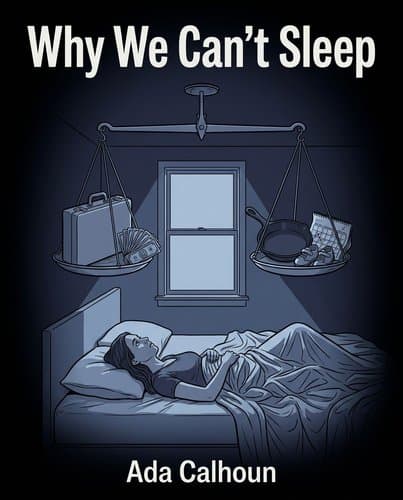
51285456_why-we-can-t-sleep
by Ada Calhoun
The 4am anxiety spiral isn't weakness—it's a rational response to being handed "having it all" as a mandate with none of the structural support to pull it off.
In Brief
The 4am anxiety spiral isn't weakness—it's a rational response to being handed "having it all" as a mandate with none of the structural support to pull it off. Gen X women aren't failing at midlife; they were set up to.
Key Ideas
Daughters less likely to outearn fathers
When you wake at 4am cycling through financial regrets, you're not catastrophizing — daughters born in 1980 have roughly a one-in-four chance of outearning their fathers, down from nearly one in two for daughters born in 1940. The anxiety is a rational read on real math.
Individual solutions deepen victim blaming
The 'Lean In' prescription backfires: a Harvard Business Review meta-analysis found that framing gender inequality as an individual fix causes people to blame women more for failing to close the gap. Unless you're the boss, you cannot hire yourself, give yourself a raise, or make your workplace less toxic.
Ask doctors directly about HRT
If you're perimenopausal and your doctor hasn't discussed HRT, ask directly. The 2002 study that caused mass prescription-flushing was about women aged 50–79 and was misapplied to women in their 40s. Modern North American Menopause Society guidelines support HRT for women under 60 within 10 years of menopause onset.
Consistency over optimization builds wellbeing
Real standing community does more for midlife wellbeing than optimization. The formula is almost insultingly simple: pick a bar, set a recurring time, show up monthly. Fifty women showed up the first night Calhoun's writing group met — some drove in from out of town.
Setback narratives build stronger resilience
The 'oscillating family narrative' — stories that include the setbacks alongside the climbs — builds more resilience than success-only stories. Apply it to your own life: name the economic dip as part of the plot, not evidence of failure.
Reconsider Gen X survival strategies
The Gen X reflexes of minimizing, dark humor, and 'I have no right to complain' were rational adaptations to childhood difficulty that went unprocessed. Recognizing them as coping strategies, rather than character traits, is the first step to deciding which ones still serve you.
Who Should Read This
People working on personal growth in Mental Health and Resilience, especially those tired of generic motivational advice.
Why We Can't Sleep
By Ada Calhoun
10 min read
Why does it matter? Because what feels like personal failure is actually a structural forecast.
You know the number. The one that appears behind your eyelids at 4am, before you're even fully awake: debt, or the age your mother was when she seemed to have it figured out, or the number of years until your youngest leaves home. You run the math. You make the apologetic internal announcement: I'm lucky, really. I have no right to feel this way.
Here's the thing: you do. Not because your life is worse than you think — because your read of it is accurate. The exhaustion, the money fear, the bone-deep sense that you're falling short of something you can't quite name — those aren't symptoms of a woman who can't cope. They're the accurate responses of a woman who was handed an impossible deal and told it was a gift.
That realization, it turns out, is where the relief starts.
"You Can Do Anything" Was Never a Gift — It Was a Mandatory Assignment With No Support Structure
Imagine being handed a precise instruction manual for adult womanhood: not as a suggestion, but as a mandate. The manual covers everything: career, children, a fulfilling marriage, an immaculate household. It doesn't mention that the infrastructure needed to run all of it — affordable childcare, parental leave, a partner who shares domestic work equally — hasn't actually been built. That's the bind Gen X women were placed in, and the reason so many arrive at midlife feeling like they personally failed.
The Enjoli commercial from 1980 was, for a generation of girls, a blueprint. A woman in a business suit became an apron-clad cook, then a cocktail-dress-wearing seductress. All in thirty seconds. All while her perfume held. "I can bring home the bacon, fry it up in a pan, and never let you forget you're a man." Take a girl like Kelly, growing up in the New Jersey suburbs, the first in her blue-collar family expected to surpass them. She didn't read that ad as advertising. She saw a schedule. She filed it alongside the Mary Tyler Moore reruns, the Geraldine Ferraro campaign footage, the shoulder-padded women marching into corporate offices in movie montages. The message accumulated into something indistinguishable from a social contract: this is what women do now, all of them, not as a radical choice but as the baseline.
Philadelphia psychotherapist Deborah Luepnitz, who treats Gen X patients, names what broke inside that contract: "Possibilities create pressure." The Boomers who raised Gen X had proposed "having it all" as a radical, hard-won new horizon. Millennials came of age after the illusion had already publicly frayed, with enough disillusionment in the air to temper expectations. Gen X got the promise at full intensity, before the asterisk appeared, at precisely the moment structural support still hadn't materialized. They absorbed it not as one option among many but as an obligation. When life arrived with debt, derailed careers, and domestic labor still defaulting to them, the most available explanation was personal failure.
You've probably felt this as something private, idiosyncratic, yours. The question is where that certainty comes from. The answer starts in a sixth-grade classroom in 1986.
Your 'I'm Fine' Reflex Isn't Weakness — It's What You Learned When No One Helped You Process the Explosion
On January 28, 1986, Ada Calhoun was ten years old when her fifth-grade science teacher, Mrs. Morledge, wheeled a boxy television into the classroom so the students could watch the Challenger launch live. They counted down from ten, cheered at liftoff, then went quiet as the shuttle's smoke trail split in two directions and the boosters separated from where the rocket should have been. The announcer went silent. For twenty-five seconds, a classroom full of children stared at the screen, slowly working out whether the cheerful teacher with two young kids at home — the one they'd been carefully taught to love — had just died on national television. Then: "Obviously, a major malfunction." Then Mrs. Morledge told them it was time for lunch.
No counselor appeared. No assembly was called. Within a few weeks, kids on the playground were telling Challenger jokes — a match flicked skyward, "What's that? The Challenger." Not funny, but it was something. You work with what you have.
That's the origin of the reflex. The "I'm fine" that Gen X women deploy automatically, the dark humor that dissolves any situation before it can demand real feeling, the instinct to make something into a joke before anyone catches you caring — these weren't character traits that arrived fully formed. They were learned in real time, in classrooms and lunchrooms across the country, by children who encountered something enormous and were handed nothing to process it with. Detachment was the only available tool. They got good at using it.
Challenger just happened to be the one with a countdown and cameras. Divorce was dismantling households at scale: average family income dropped 42 percent when couples split, with children almost always going to their mothers. Crime ran high through the 1970s and into the '90s. A hundred million people watched The Day After, a 1983 ABC broadcast depicting nuclear annihilation, and children wrote letters to President Reagan begging him not to start the war. None of it came with guidance. Adults were either unavailable or simply not operating in an era that considered emotional processing their job.
What you end up with, decades later, is a generation of women who can absorb enormous difficulty without visibly registering it, and who read their own stoicism as evidence they should be doing even better. The coping style worked. The problem is it became invisible, and invisible things can't be examined.
The Numbers Are Not in Your Favor, and Your Body Knows It
The pay gap doesn't hold steady across a career. It widens. Women and men with MBAs earn nearly the same right out of school; a decade later, women earn 57 cents on the male dollar, right when Gen X women are supposedly in their professional prime. The Harvard Equality of Opportunity Project found something bleaker: daughters born in 1940 had roughly a 40 to 45 percent chance of outearning their fathers. Daughters born in 1980 have about one in four. The trend held even as more women entered white-collar work and got better educated. The floor dropped while they were running.
The domestic labor case gets made in a hotel bar in Nashville, where Calhoun is sitting with two Gen X women in their mid-forties. Annie describes giving her husband a ski trip to Utah for his fortieth birthday (she paid for it) and assigning him one household task while she was working: the electric bill. He was on the slopes with friends when the power company cut the service. Nineteen degrees outside. The nanny called. Annie left work to fix it in person, because that's the only way to restore service once it's been shut off. When they went to couples therapy afterward, the therapist explained that his brain was wired for the hunt while Annie's was wired for the hut — all the relationships, all the logistics, while the hunter provided. She tried to engage with it. "In this analogy," she said to the therapist, "the electric bill is the deer? He is a bad hunter."
The line gets a laugh. But the structure underneath isn't funny. Annie was the primary earner and the primary household manager, and when she tried to address that through therapy, she got a theory for why the arrangement was natural. The therapist wasn't helping fix the imbalance; he was annotating it.
Lori, a contracts analyst in Charlotte who made every reasonable decision available to her (stable career, affordable city, delayed children until she was financially ready), describes herself at 41 with no job, paying preschool tuition for a child she's keeping home, borrowing from retirement savings. "We did a lot of things right, you know? My husband and I. We did a lot of things right." She's correct. The decisions weren't wrong. The math was.
The Most Effective Treatment Was Abandoned Because a Reporter Broke an Embargo
The fear that Gen X women carry about hormone replacement therapy wasn't built on settled science. It was built on a broken news embargo.
In July 2002, the National Institutes of Health ended a major study on hormone treatment early, citing an apparent rise in the risk of heart disease, stroke, and breast cancer. The news spread instantly, not because of careful medical communication, but because a researcher had shared the results early with the Detroit Free Press, which broke the embargo before the study appeared in any journal. Good Morning America ran the story on a Tuesday morning. By the end of the week, women across the country had pulled hormone prescriptions from their medicine cabinets and flushed them.
What they hadn't been told: the study was tracking women aged 50 to 79, not the 40-somethings managing perimenopausal symptoms. Its aim was to see whether hormones could protect older postmenopausal women from heart disease. A different question entirely. The estrogen-only arm of the same study, which continued for two more years, eventually found a decreased breast cancer risk, not an increased one. But once you say "cancer" on a morning news broadcast, no correction catches up. Mary Jane Minkin, a Yale gynecologist and one of the country's top menopause specialists, called July 9, 2002 the day the music died for menopausal women. That's exactly what it was.
The medical establishment's response locked the damage in. OB/GYN residencies largely stopped teaching hormone therapy. A 2013 Johns Hopkins survey found that only one in five OB/GYN residents had received any formal menopause training. Which means if you sat down with a doctor confused, exhausted, sweating through your clothes at night, you were likely to hear "just wait it out" — or get an offer of an antidepressant that might dull the hot flashes while also suppressing libido and adding weight.
Into that vacuum came everything else: jade eggs (Goop's $66 flagship product), non-FDA-approved hormone pellets promoted by celebrities, vaginal laser procedures costing thousands. Meanwhile, perimenopause, which most women have never heard of until they're in it, can last anywhere from a few months to thirteen years, four on average. That's four years of hormonal disruption as erratic as a crashing stock market, managed with tools that either don't work or were never evaluated.
Gen X women are paying the price in their own bodies, for a fear manufactured by accident, spread by one morning's news, and locked in by doctors who were never trained to know better.
The Fix Isn't Better Aspiration — It's a Different Story
What if the cure is just a more refined version of the disease?
By the time Calhoun finishes cataloging what Gen X women are up against (the structural pay gap, the hormonal chaos, the phone delivering bad news at 2 a.m.), a reader might reasonably expect a corrective list. The wellness industry has spent decades volunteering for that job. SoulCycle. Açaí. Kombucha. "All the milks from substances that can't technically be milked," as journalist Taffy Brodesser-Akner put it after months immersed in Gwyneth Paltrow's wellness empire. Level up once and you discover how infinite the remaining requirements are. The problem isn't that wellness advice is bad — some of it is fine. It's that wellness is the same impossible standard dressed in athleisure.
What Calhoun found actually helped was embarrassingly modest: a therapist, an accountant, a doctor who understood perimenopause, and regular time with women she liked. Not as self-improvement.
The reasoning lives in a story. A woman having the worst kind of Tuesday climbs into what she thinks is her Uber. The car is messy. She starts cleaning up the back seat and handing the driver his trash. He stares at her. She grows angrier: she's been doing things for other people all day and no one says thank you. Then she looks out the window, sees a woman on the sidewalk, and realizes she has hopped into a complete stranger's car and is handing him his own garbage. His wife is standing right there. The situation could tip any direction: mortification, a scene. Instead, the driver laughs. His wife laughs. The woman laughs. The three of them stand on the sidewalk, unable to stop.
Calhoun's therapist friend Asia names what made the difference: the driver chose glee over judgment. The woman could accept her mistake because nobody weaponized it. That reframing, seeing yourself as a heroine worth rooting for rather than a case study in failure, is what makes ordinary life survivable. Not easier. Survivable, and sometimes genuinely funny. The woman in the Uber ends up doing exactly what Dan McAdams, a Northwestern psychologist who spent decades studying how people build life stories, found most resilient adults do: narrating setbacks as meaningful rather than as evidence that nothing will ever go right. Gen X has plenty of material for that version.
Reframing doesn't dissolve the structural problems. The pay gap stays. The perimenopause fog stays. The phone still lights up at 2 a.m. But it changes who's doing the carrying.
A friend of Calhoun's who'd been through a divorce and a career change put it plainly. She was sitting in a Florida restaurant at closing time, staff stacking chairs around them, and she said: "It's kind of like a weird little adventure. What could possibly happen next? It's been kind of weirdly… terribly… fun."
Terrible fun. That's not a cure. It's better than a cure — it's a way of living inside the actual life you have.
What "Terrible Fun" Actually Means
The game was rigged before you sat down. Knowing that doesn't improve the hand you're holding, but it does end the exhausting project of blaming yourself for the outcome. You weren't failing to optimize hard enough. The math was never on your side.
What you do with that clarity is the whole question. Not a meal plan. Not a vision board. Just a recurring evening with people who actually know you, a story about your life that treats the hard years as part of the story rather than evidence you failed, and maybe — if you're lucky — a restaurant at closing time where someone looks at everything that went sideways and asks: what could possibly happen next?
The game is still rigged. That's not optimism. It's curiosity. And it turns out curiosity is enough.
Notable Quotes
“Looks like a couple of the solid rocket boosters, uh, blew away from the side of the shuttle, in an explosion.”
“Flight controllers here looking very carefully at the situation. Obviously, a major malfunction.”
“By the way, the shuttle exploded,”
Frequently Asked Questions
- What is Why We Can't Sleep about?
- The book argues that Gen X women's midlife anxiety is not personal failure but the predictable outcome of a 'having it all' mandate delivered without structural support. Drawing on economics, health data, and sociology, it identifies real causes — wage stagnation, misapplied menopause research, fraying community — rather than individual shortcomings. The work reframes anxiety as a rational response to measurable economic pressures facing women born in the 1960s-1970s, including declining earnings mobility and structural workplace barriers that require systemic, not personal, solutions.
- Why do Gen X women experience midlife anxiety?
- The book argues that Gen X women's anxiety stems from structural economic and social failures, not personal shortcomings. The core data: daughters born in 1980 have roughly a one-in-four chance of outearning their fathers, down from nearly one in two for daughters born in 1940. Additionally, the 'Lean In' prescription backfires because framing gender inequality as an individual fix causes people to blame women more for failing to close the gap. Real causes include wage stagnation, misapplied menopause research, and fraying community structures that cannot be resolved through personal optimization alone.
- What does Why We Can't Sleep say about HRT and menopause treatment?
- The book exposes a critical misapplication of research in menopause treatment. The 2002 study that caused mass prescription-flushing was about women aged 50–79 and was misapplied to women in their 40s. Modern North American Menopause Society guidelines support HRT for women under 60 within 10 years of menopause onset. If you're perimenopausal and your doctor hasn't discussed HRT, ask directly — what women believed was risk-based medical consensus was actually an overgeneralization that left many without appropriate treatment options.
- How can Gen X women build resilience according to Why We Can't Sleep?
- The book offers concrete strategies grounded in community and narrative reframing. Real standing community does more for midlife wellbeing than optimization: pick a bar, set a recurring time, show up monthly. The 'oscillating family narrative' — stories that include setbacks alongside climbs — builds more resilience than success-only stories. Additionally, recognizing Gen X reflexes of minimizing, dark humor, and 'I have no right to complain' as coping strategies rather than character traits helps women decide which adaptations still serve them and which no longer do.
Related Book Summaries

Read the full summary of 51285456_why-we-can-t-sleep on InShort