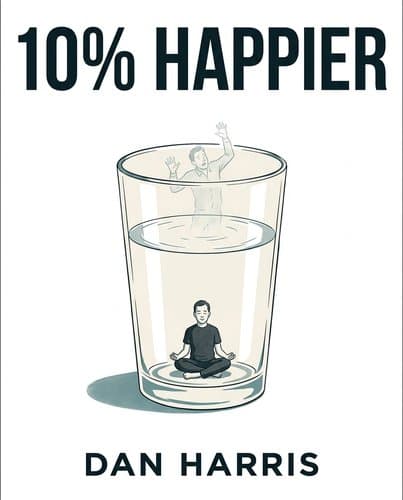
18505796_10-happier
by Dan Harris
A skeptical, driven news anchor stumbles onto a counterintuitive truth: meditation won't make you blissfully zen, but it will create just enough space between…
In Brief
A skeptical, driven news anchor stumbles onto a counterintuitive truth: meditation won't make you blissfully zen, but it will create just enough space between your worst impulses and your actions to make you sharper, calmer, and 10% less likely to self-destruct on live TV.
Key Ideas
Same mechanism drives ambition and anxiety
The inner narrator that drives your ambition and the one that generates your anxiety are the same mechanism — training one trains the other, and ignoring both is how you end up having a panic attack on live television
Returning is meditation's only true rep
Meditation's basic instruction is three steps, and the entire value is in the third: sit, feel the breath, and when your mind wanders — which it will, constantly — gently return. The returning is the rep. More reps, more benefit.
Creating space prevents making problems worse
'10% happier' is not false modesty — it is a precision rejection of the self-help industry's core dishonesty. The practice won't solve your problems; it creates just enough space between stimulus and reaction that you stop making them worse.
Useful planning survives the anxiety test
The Buddhist concept of prapañca — the mind's tendency to colonize the future with worry cascades — has a practical solution: ask 'Is this useful?' Legitimate planning survives the question. Maniacal overthinking does not.
Detachment from outcomes improves performance directly
'Letting go' is not the same as going soft. Non-attachment to outcomes is a performance enhancer, not a resignation — it allows you to work with full effort while remaining functional when results don't cooperate.
Compassion rewires the brain for reward
Compassion practice is not altruism — it is rational self-interest. Research shows it reduces cortisol, activates the brain's pleasure centers, and makes colleagues more cooperative. The Dalai Lama calls it 'wise selfish.'
Consistent practice physically alters stress baseline
Neuroplasticity means your baseline for stress reactivity is not fixed. Eight weeks of consistent meditation practice produces measurable changes in the brain regions governing impulse control and stress response — the gym analogy is not a metaphor, it is structurally accurate.
Who Should Read This
People working on personal growth in Mindfulness and Meditation, especially those tired of generic motivational advice.
10% Happier
By Dan Harris
12 min read
Why does it matter? Because the inner voice you trust to keep you sharp is the same one that will eventually burn you down.
Here's a thought you've probably never questioned: that relentless, catastrophizing voice in your skull is the reason you're good at what you do. The anxiety keeps you sharp. The striving keeps you ahead. Silence that thing and you're just another person watching Netflix in sweatpants.
Dan Harris believed the same thing — right up until five million people watched him have a panic attack live on Good Morning America. He was a war correspondent, an ABC News anchor, a guy who'd outworked everyone in every room he'd ever entered. And the very engine that drove all of it — the ambition, the hypervigilance, the never-enough hunger — was quietly wiring him for collapse.
What he found afterward wasn't a guru or a lifestyle overhaul. It was something stranger: a way to keep the drive while defusing the self-destruction. No robes required.
Your Ambition and Your Anxiety Are the Same Voice — and It Has Terrible Judgment
On June 7, 2004, Dan Harris was reading a routine news item to 5.019 million viewers when his body staged a mutiny. His heart started hammering, his mouth went dry, his palms went slick — and then, live on national television, he lost the ability to form coherent sentences. The broadcast transcript captures the moment of collapse: he informed America that statins might lower the risk of 'cancer production.' His face had drained of color. He couldn't get out.
What made the meltdown so instructive wasn't the panic attack itself — it was the decade-long machine that built it. Harris had spent years running on the same fuel most high-achievers consider their secret advantage: relentless forward motion, a hunger for the next thing, a refusal to sit still. He went from a $5.50-an-hour radio job in Maine to a network anchor chair at ABC by his late twenties, then volunteered for war zones after 9/11 — Afghanistan, Pakistan, Iraq — and discovered what he calls the 'journalistic heroin' of combat reporting. The danger felt good.
What he didn't notice was that the same engine driving the achievement was also preventing him from processing any of it. Back in New York, he couldn't feel the horror he'd witnessed, but his body could — and it expressed that stored-up distress as a low-grade depression he was entirely unaware of. To recreate the electric charge of combat, he started using cocaine and ecstasy. He was, by his own reckoning, a functioning wreck: the most productive correspondent in the building, quietly priming his own nervous system for catastrophe.
A psychiatrist needed about five minutes to diagnose what Harris had missed entirely. The cocaine had flooded his brain with adrenaline, leaving him simultaneously the tiger and the person trying not to become the tiger's lunch. The panic attack wasn't an interruption of his high-performance life. It was the logical conclusion of it.
Harris's story makes this uncomfortably clear: the voice that tells you to check your email during a conversation, to skip sleep to get ahead, to stay in constant motion so you never have to feel anything — that's not a separate problem from your anxiety. It's the same voice. The same system that generates your drive generates your dread. Left unexamined, it doesn't make you successful and then anxious. It makes you successful by making you anxious, until eventually the bill comes due on live television in front of five million people.
The Self-Help Aisle Won't Save You — and Neither Will Vague Enlightenment
The self-help industry's core failure isn't that it's too mystical. Even its most credible figures are extraordinary diagnosticians and useless pharmacists — they can describe your disease with uncanny precision, then hand you a pamphlet instead of a prescription.
Harris discovered this through Eckhart Tolle, a small German spiritual teacher with the wardrobe of a Communist-era librarian whose book landed in his life like an unexploded grenade. Tolle's central argument was startlingly accurate: every human being is tyrannized by an internal narrator — a voice that runs continuous commentary, compares you unfavorably to everyone else, and treats the present moment as an obstacle to be cleared rather than a life to be lived. Harris, lying in bed reading at two in the morning, recognized this voice immediately. It was the one that had told him, over the years, that cocaine was a reasonable idea, that throwing papers at a producer was justified, that a receding hairline meant career ruin and a flophouse in Duluth. He'd always assumed this voice was him. Tolle's revelation was that it wasn't — it was a kind of parasite, mistaken for the host.
The diagnosis was stunning. The prescription was not. When Harris flew to Toronto to interview Tolle in person and asked him directly how to stop the voice, Tolle suggested taking 'one conscious breath' and becoming 'aware of the inner energy field of your being.' This from a man who claimed he hadn't aged since his spiritual awakening at twenty-nine and had achieved such perfect equanimity that a reckless driver cutting him off felt, to him, like a 'gust of wind.' Maybe. But none of that told Harris anything he could actually use the next morning when he was pacing his office over an assignment he didn't get.
The rest of the spiritual marketplace was no more helpful and considerably more dangerous. The Law of Attraction — the philosophy powering a self-help empire built on the idea that positive thinking literally attracts good outcomes — ended, in one documented case, with three people dead in an improvised sweat lodge in Arizona. The teacher running the 'Spiritual Warrior' retreat preached harmonic wealth and physical perfection; he was eventually led away in leg irons.
What he had was a perfect picture of the problem and nothing to do about it.
The 2,500-Year-Old Framework That Neuroscience Keeps Accidentally Rediscovering
What if the most accurate map of your mind wasn't written by a neuroscientist, but by someone sitting under a tree in northeast India twenty-five centuries ago?
Harris stumbled toward this answer not through a spiritual awakening but through his future wife handing him two paperbacks by a Harvard-trained psychiatrist named Mark Epstein. Reading them, Harris realized with some embarrassment that everything he'd found compelling in Eckhart Tolle — the relentless mental chatter, the compulsive wanting, the inability to stay present — wasn't Tolle's insight. Tolle had borrowed it, without much credit, from the Buddha. The original observation was 2,500 years old and came with an actual vocabulary.
The term that stopped Harris cold was 'prapañca' — a Sanskrit word for the mind's tendency to take one bad piece of news and instantly colonize an entire imagined future. You notice you're losing your hair, and before the thought has finished forming, you've mapped a trajectory: hair gone, career finished, flophouse in Duluth. Buddhism had named this exact mental move millennia before anyone had an MRI machine, and named it precisely: the 'imperialistic tendency of mind.' Harris had been running this program his whole career without knowing it had a name, let alone a cure.
Epstein's framework read less like religion than like a clinical manual someone had been compiling for 2,500 years. The Buddhists had catalogued the mind's failure modes with the patience of naturalists: 'comparing mind,' 'wanting mind,' 'monkey mind.' Their core claim was that suffering comes not from ambition but from clinging — from treating temporary outcomes as permanent ground. Harris had spent his career operating on the motto that insecurity was simply the price of security. Buddhism said the premise was wrong: there is no permanent security, and the suffering isn't the price of striving — it's the price of pretending the ground won't shift.
Then the neuroscientists arrived and started accidentally proving all of it. A Harvard MRI study found that eight weeks of meditation caused measurable structural changes in the brain: the prefrontal cortex — responsible for self-awareness and measured response — grew thicker, while the amygdala, the region governing our most primitive threat responses, physically shrank. The ancient diagnosis of 'monkey mind' turned out to map almost perfectly onto a specific, scannable neural structure that you could, with practice, literally shrink. The Buddha called it suffering. The researchers called it the default mode network. They were describing the same thing.
Meditation Isn't Bliss — It's Repetitive Mental Push-Ups That You Will Hate at First
Think of meditation the way you'd think about learning to do a pull-up. You grab the bar expecting to rise smoothly, and instead you just hang there, trembling, discovering muscle groups you had no idea were this weak.
Harris's first attempt happens on a beach house bedroom floor, BlackBerry alarm set for five minutes. The instruction set he'd read was almost insultingly simple: sit down, feel your breath go in and out, and when your attention wanders, gently bring it back. The whole practice lives in that third step. And here's what the third step actually looked like: 'In. Out. In.' — then immediately: the word 'shrubbery' and why it sounds good. Then an evolutionary question about enjoying the smell of your own filth. Then a hip-hop show concept he'd call 'Rap Van Winkle.' Then an itch. Then the serious matter of whether he was more of a 'baller' or a 'shot caller.' Five minutes. An eternity. When the alarm went off, he'd returned to his breath maybe a dozen times and wandered off three hundred.
Here's what he realized when he opened his eyes: that was the workout. Not the moments of focus — the returning. Every time you notice your mind has bolted and you drag it back, that's a rep. The instruction isn't 'don't think.' It's closer to 'notice that you're thinking, again, and come back, again.' The mind will wander to lunch, to the 1990 Oscars, to something embarrassing you said in 2003. You notice. You return. Repeat until the alarm goes off and you feel vaguely defeated.
What makes meditation so different from the rest of the solutions Harris had tested is this: Tolle offered luminous descriptions of inner peace but no method for getting there. The Law of Attraction crowd promised that the right mental posture would rearrange the universe for you. Buddhism — real Buddhism, as Epstein had explained it — offered something far less glamorous: a practice you could do on a hotel room floor that would, over time, build the capacity to notice your thoughts without being ambushed by them. The payoff wasn't bliss. It was a slight but real gap between stimulus and reaction — the difference between noticing 'I'm angry' and becoming consumed by it, versus noticing 'I'm angry' and having a half-second to decide what to do. Harris came to think of this gap as the whole game. You won't feel serene. You'll feel like you're holding a live fish that keeps thrashing. That, it turns out, is exactly the point.
The '10% Happier' Argument Is More Radical Than It Sounds
A producer asked Harris one day why he meditated. He'd faced this question before and always fumbled it — launching into lengthy explanations that ended with people edging away. This time something snapped into focus and he just said it: 'I do it because it makes me 10% happier.' Her expression shifted immediately. A flicker of scorn became actual interest. 'Really?' she said. 'That sounds pretty good, actually.'
He'd stumbled onto something more precise than it appeared. The number wasn't false modesty — it was a deliberate argument against every other claim in the self-help genre. Those claims run one direction: transformation, liberation, the revolution of your entire being. Harris had spent years investigating that promise and watching it collapse. Tolle promised the end of the ego. The Law of Attraction promised the universe would rearrange itself for optimistic thinkers. The '10%' framing said something entirely different: not that your life will become unrecognizable, but that a modest, real, measurable improvement is available and worth having. The honesty was the point.
The real test came not in conversation but in the daily grind of morning television — reading scripts about animals in suits, performing dance segments with a cardboard box on his head, absorbing a senior producer's frank verdict that his voice was too grating for him to ever anchor a major weekday newscast. Mindfulness didn't make any of this stop. What it provided was a small but genuine buffer: the difference between being swept into irritation and noticing the irritation arriving. Not alleviation. Mitigation. The 90% of life that stays difficult, stays difficult. The practice just stops you from being a puppet to your own reaction.
That's the actual claim, and it's quieter and more durable than anything the self-help industry will sell you. The buffer is real. The grating voice, the bruising verdict, the cardboard-box indignity — they don't disappear. They just lose their grip.
Being Less of a Self-Obsessed Jerk Turns Out to Be Excellent Career Strategy
Practicing compassion, the Dalai Lama told Harris, is ultimately an act of selfishness — and that was the only framing capable of getting through to him.
Harris had dismissed Buddhist loving-kindness as the one part of the package he could safely ignore. He was willing to accept the neuroscience, the stress reduction, the productivity case. But boundless compassion? That sounded like something you'd embroider on a throw pillow. Then he sat across from the Dalai Lama and asked, with barely concealed skepticism, whether self-centeredness wasn't necessary for professional success. The answer reordered his thinking: 'We are selfish, but be wise selfish rather than foolish selfish.' The foolish version protects your ego at every turn and ends up exhausting you. The wise version recognizes that eroding the ego's sharp edges actually makes you feel better — that concern for other people is one of the more efficient routes to your own relief. A light went off in his head.
The scientific corroboration was almost embarrassingly on point. Researchers at Emory ran compassion meditators through stressful scenarios — including pointing a television camera at them, which Harris found particularly rich — and measured significantly less cortisol than in non-meditators. Practicing warmth toward others was literally changing how their bodies responded to pressure.
Back at ABC, Harris ran the experiment. He tried making eye contact and smiling at colleagues, even difficult ones, and found they became more cooperative, more willing to help, easier to work with. His private summary: being mellow turned out to be 'a great manipulation tool.' The self-interested case for not being a jerk had survived contact with reality.
The ambitious, anxious voice in your head doesn't require extermination — just enough distance from it to stop treating its every dispatch as a direct order. Harris's word for what creates that distance: compassion. His follow-up word: surprisingly.
'Stop Being So Zen': Why Letting Go and Going Soft Are Not the Same Thing
Harris spent months convincing himself that the Buddhist concept of non-attachment was making him a better professional. He was meditating daily, extending goodwill toward difficult colleagues, releasing his grip on outcomes. And then his boss, Ben Sherwood — a Rhodes Scholar who reportedly watched every minute of every broadcast — sat him down in a corner office surrounded by glass jars of pretzels and a bunch of bananas and told him the plain truth: he'd stopped hustling, he'd lost his edge, and he needed to become a leading man again. The meeting ended with six words Harris hadn't anticipated: 'Stop being so Zen.'
The diagnosis landed because it was accurate. He'd been watching from his couch as colleagues scooped him on the Arab Spring and the Japanese tsunami, mistaking passivity for equanimity, going soft and calling it enlightenment. His wife had already told him the same thing in fewer words. She said he'd been 'gelded' by his own practice.
That night, over dinner with his therapist friend Mark Epstein, Harris got the corrective framing he needed. Epstein called it 'Hide the Zen' — a shorthand for a real distinction. The pitfall of the meditative path, Epstein explained, is a kind of spiritual drift where letting go of ego becomes indistinguishable from letting go of effort. Presence without strategy isn't enlightenment. It's just drift with better posture.
What Harris had confused was the target. Mindfulness isn't asking you to stop wanting things or stop working hard. It's asking you to stop letting the outcome own you while you work. The goal is what he eventually called 'supple relentlessness' — showing up fully, chasing the story, fighting for the assignment, while holding the result loosely enough that losing it doesn't detonate your nervous system. That's not the same as not caring. It's caring without the ego's death grip on how things have to turn out.
The version of ambition mindfulness removes is the reactive, panicking kind — the one that made Harris throw papers at a producer in Boston, the one that built the panic attack. What it leaves behind is the same drive, running cleaner.
The Voice Is Still There — You Just Don't Have to Do Everything It Says
In a Rio favela — covering a story there — a drug lord made a joke, or maybe a threat, it was genuinely unclear, and something in Harris noticed that the old voice was still there, still running its familiar program of worst-case scenarios and catastrophic projections. It hadn't been evicted. It had just lost its keys. That's the whole thing, really. The 10% solution was never a promise that the anxious, ambitious narrator in your head goes quiet. It's the promise of one inch of daylight between what that voice says and what you actually do. Not enlightenment. Not transformation. Just enough space to notice the dispatch before you follow the order. The voice will tell you to panic, to grasp, to catastrophize the hairline all the way to the flophouse. You'll hear it. You just won't always have to obey. That inch, it turns out, is where everything important happens.
Notable Quotes
“Researchers report people who take cholesterol-lowering drugs called statins for at least five years may also lower their risk for cancer, but it’s too early to . . . to prescribe statins slowly for cancer production.”
“I do it because it makes me 10% happier.”
“That sounds pretty good, actually.”
Frequently Asked Questions
- What is 10% Happier about?
- 10% Happier follows a skeptical news anchor who discovers meditation after an on-air panic attack exposes the cost of unchecked ambition and anxiety. The book makes a rigorous, science-backed case that mindfulness is not a wellness cliché but a trainable skill that creates space between impulse and reaction. Harris demonstrates that the inner narrator driving ambition and generating anxiety are the same mechanism, and ignoring both leads to crisis. Through neuroscience research and practical teaching, he shows how consistent meditation produces measurable changes in brain regions governing impulse control and stress response.
- How does meditation actually work according to Dan Harris?
- Meditation's basic instruction is three steps, and "the entire value is in the third: sit, feel the breath, and when your mind wanders — which it will, constantly — gently return. The returning is the rep. More reps, more benefit." Harris uses a gym analogy to explain that neuroplasticity means your baseline for stress reactivity is not fixed. Eight weeks of consistent practice produces measurable brain changes. Unlike wellness clichés, the practice works by creating a gap between stimulus and reaction, allowing you to stop making problems worse rather than solving them entirely.
- Is 10% Happier just another self-help book?
- No — "10% happier" is not false modesty but a precision rejection of the self-help industry's core dishonesty. Harris explicitly argues that the practice won't solve your problems; instead, it creates just enough space between stimulus and reaction that you stop making them worse. This honest framing separates the book from typical self-help promises. The book is grounded in neuroscience and personal skepticism rather than motivational platitudes. Harris demonstrates that meditation is a trainable skill with measurable brain changes, not a magic cure, making it more rigorous than conventional wellness advice.
- What are the key practical techniques from 10% Happier?
- The book teaches two main practical approaches. First, meditation's three-step process: sit, feel the breath, and when your mind wanders, gently return — the returning is the training. Second, Harris addresses prapañca, the mind's tendency to colonize the future with worry cascades. The solution is asking "Is this useful?" when anxious — legitimate planning survives; maniacal overthinking does not. Additionally, Harris discusses non-attachment to outcomes as a performance enhancer rather than resignation, allowing full effort while remaining functional when results don't cooperate.
Related Book Summaries

Read the full summary of 18505796_10-happier on InShort