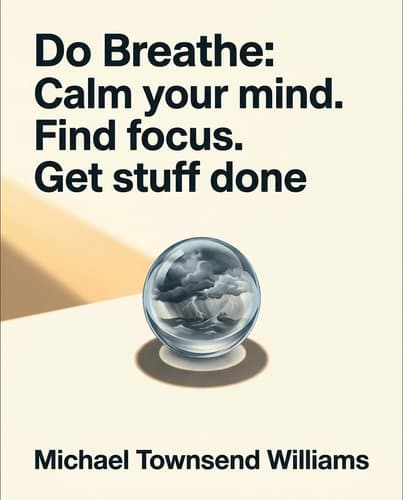
25555823_do-breathe
by Michael Townsend Williams
Your breath is the most powerful productivity tool you own—and you've been using it wrong. Learn how a simple shift in your exhale can switch off stress on…
In Brief
Your breath is the most powerful productivity tool you own—and you've been using it wrong. Learn how a simple shift in your exhale can switch off stress on demand, and how calm isn't a retreat from performance but the biological engine that drives it.
Key Ideas
Exhale longer to activate relaxation
The exhale is your stress off-switch: breathing out slightly longer than you breathe in stimulates the parasympathetic nervous system and triggers the relaxation response. Start with a 3-count inhale, 6-count exhale.
Care first, then optimize focus
Before optimizing your focus, ask whether the task deserves it. Merlin Mann's 'Step Zero' — first, care — is the prerequisite no productivity app can provide.
Habits are systems, not willpower tests
Habits are engineering problems, not willpower problems. Identify the true reward driving a habit (often not what you think), then swap the routine while keeping cue and reward fixed.
Breathing cascades into sustained performance
Breathing well is a cornerstone habit: it cascades into clearer thinking, better decisions, easier conversations, and more sustainable energy — one change that makes other changes more likely.
Full recovery enables peak performance cycles
Flow requires full recovery between cycles. If you skip rest after peak performance, you won't be able to handle the struggle phase of the next cycle — this is why 'always on' is self-defeating.
Structure amplifies care, doesn't replace it
The Pomodoro Technique and theme days (Jack Dorsey's system) are structural solutions, but only after you've confirmed you genuinely care about the work — structure amplifies care, it doesn't replace it.
Wellbeing through dynamic rhythm, not balance
Welldoing is not balance — it's dynamic alternation. Breathe in, breathe out. Work hard, rest fully. The rhythm itself is the practice.
Who Should Read This
People working on personal growth in Mindfulness and Focus, especially those tired of generic motivational advice.
Do Breathe: Calm your mind. Find focus. Get stuff done
By Michael Townsend Williams
10 min read
Why does it matter? Because the breath you're not paying attention to is running your whole day.
You're breathing right now. You have been for your entire life. Which is exactly why you've never thought about it — and exactly why it's been quietly running your stress levels, your focus, and your best thinking without your permission. Most people treat calm as the reward for getting everything done. This book makes the opposite case: calm is the mechanism that makes getting everything done possible, and breath is the switch. Not in a wellness-retreat, scented-candle way. In a cortisol-clearance, prefrontal-cortex way. The man making the argument has earned the right to make it — through grief, through addiction, through years of watching stressed professionals rediscover something they were born knowing how to do. What follows isn't a relaxation guide. It's a performance argument, built from the one lever most people never think to pull.
A Man Dancing to 'Every Breath You Take' With Tears on His Face
A bar in Kuala Lumpur, the night after his brother died. Michael Townsend Williams is on the dance floor, Sting's voice filling the room, tears running down his face — and the song is called 'Every Breath You Take.' He'd flown out to sort through Jonathan's affairs after the 31-year-old fell from the balcony of his fifteenth-floor apartment. The song title doing double duty as the book's entire argument, though Williams didn't know it yet.
What he did know was that the life he'd been living was a wreck. He's careful to describe himself not as a polished advertising professional but as a drunk one — a production man who kept the work moving while alcohol filled the space where interests, hobbies, and self-awareness might otherwise have lived. He puts it plainly: addiction hollows you out until only itself remains. His brother's death didn't just break his heart; it cracked open the question he'd been avoiding. He hated the rut. He wanted out. He just had no idea where out was.
Sobriety, it turned out, had a direction. As the grief and the alcohol cleared, yoga surfaced — something he'd long used to manage stress and depression, a refuge rather than a passion. The passage into teaching happened sideways, during a family holiday at a yoga retreat in Dorset, where he unexpectedly led a class and felt something he hadn't felt before.
None of the breathing exercises, the practical steps, or the physiological explanations in this book come from someone who was always calm. They come from someone who needed them to function. That's the difference.
Your Stress Response Was Built for Lions, Not Email
Stress isn't something that happens to you. It's a physiological program you're running — often without knowing it started.
The fight-or-flight response evolved to handle genuine emergencies: predators, starvation, physical threat. Adrenaline floods the system, heart rate climbs, muscles prime for action. It's a brilliant piece of engineering for a world that no longer exists, because the same cascade now fires when you miss a train or walk into a difficult meeting. The WHO called stress the health epidemic of the twenty-first century, and a large part of why is this mismatch: an emergency mechanism running on a daily schedule, wearing down the heart and the mind.
Here's what makes it a loop rather than just a reaction. Being stressed changes how you breathe — faster, shallower, higher in the chest. Breathing that way signals danger back to the nervous system, which deepens the stress response, which tightens the breathing further. Most people in the middle of a bad afternoon have no idea they've been caught in this cycle for hours.
Breaking it doesn't require meditation or a weekend retreat. The exhale is the off switch. Breathing out activates the parasympathetic branch of the nervous system — the system responsible for calm, digestion, recovery. Breathing in does the opposite. So when the out-breath runs slightly longer than the in-breath, you're literally tipping the body's internal scales toward rest. That's the mechanism behind Tony Schwartz's claim, published in the Harvard Business Review, that a single focused minute can clear the stress hormone cortisol from the bloodstream entirely — the exact number may be approximate, but the direction is real. You can reach into the stress loop and interrupt it, deliberately, through something you're already doing six hundred million times in a lifetime.
The technique is simple enough to state in a sentence. Breathe from the belly rather than the chest, through the nose rather than the mouth, and let the out-breath run a little longer than the in-breath. Each part has a reason: belly breathing is efficient and calming; the nose filters, warms, and conditions the air; the extended exhale activates the off switch. What changes is that you're doing it on purpose instead of letting the loop run you.
Richard's Morning Is Probably Your Morning
Richard's alarm goes off at seven. He doesn't get up. For the next half-hour he lies there rehearsing everything he didn't finish yesterday, cataloguing how tired he feels, deciding he's already behind. When he finally moves, there's no shirt — the one he wanted is still in the laundry. He grabs a breakfast bar, misses a real goodbye to his family, and walks to the station composing a mental list of grievances. On the train he reads free news about things he can't influence, notices a competitor's campaign that's better than his, checks the football results. By the time he walks into his office he's already defeated. Two hours in a meeting he didn't need. Three cappuccinos to stay upright. Lunch at his desk, sandwich in one hand, unanswered emails on the screen, ideas for the afternoon conspicuously absent.
Nothing catastrophic happened to Richard. No crisis, no single terrible decision. Just a sequence of small ones — the extra thirty minutes horizontal, the skipped breakfast, the news cycle chosen as mental wallpaper — that compounded into a day he couldn't find his way inside of. The exhaustion he feels by lunchtime isn't the cost of his workload. It's the cost of how he got to work.
Now run the same day differently. Clothes laid out the night before, so there's nothing to decide at seven. Five minutes of breathing before the porridge. Comedy on the headphones instead of headlines. Hourly five-minute breaks rather than a caffeine drip. The last meeting of the afternoon conducted on foot. Same job, same commute, same pressures — but the energy Richard brings to face them is a different thing entirely.
The argument is this: energy isn't a fixed quantity that your workload depletes. It's a renewable resource that your habits either replenish or squander, mostly before nine in the morning. The decisions that determine how you'll feel at three in the afternoon are already made by the time you get on the train. Which means the day is more recoverable than it looks — but only if you catch it early enough.
Distraction Is Usually a Symptom, Not the Disease
What if the reason you can't focus isn't a technique problem? What if it's a caring problem?
Merlin Mann, a writer and podcaster, calls this 'Step Zero' — and he insists it comes before any other advice about productivity or attention. His formulation is blunt: chronic distraction is usually evidence that you don't actually want to do the thing you're trying to force yourself to do. No timer, no app, no ambient music track will teach you how to care about something you don't care about. That's entirely on you. Which means the honest question to ask before optimizing your focus isn't 'how do I stay on task?' — it's 'do I even want to?'
If the answer is no, or not really, then the most useful move isn't a better system. It's figuring out what belongs on your 'not to do' list permanently.
If the answer is yes — if you genuinely care — then Williams draws on a 2,000-year-old framework that turns out to be an uncomfortable mirror. Patanjali's Yoga Sutras describes five states of mind: Scattered, Dull, Distracted, Focused, and Mastered. Most of us live in the third one, what the tradition calls the 'monkey mind,' able to concentrate for a few minutes before skittering off again. State four is different. It's the feeling of being so absorbed in a problem that you look up and an hour has gone by without effort — attention that sustains itself rather than something you constantly haul back by the collar. The goal isn't to berate yourself for starting in state three. It's to recognize it as the starting point.
Meditation is the mechanism Williams recommends for making that move. Richard Davidson, a neuroscientist at the University of Wisconsin-Madison, identified two specific things regular practice strengthens: the brain's ability to shift attention deliberately, and its ability to resist pulling toward distraction. Both are trainable. The chapter closes with a breath-counting exercise designed to build exactly that: counting down from fifty, phase by phase, until you're simply sitting with your breath. Less technique, more practice. The care has to come first. The rest follows.
Calm Isn't the Opposite of High Performance — It's the Prerequisite
Flow is where the Section 4 care about your own state starts to pay dividends — because you can't enter it without one.
Five times more productive. That's what a ten-year McKinsey study found when it tracked top executives in flow states versus out of them — not marginally better, not noticeably sharper, but five times. Which reframes the entire conversation. Breathwork and calm aren't the soft end of the performance spectrum. They're the entry point to the hard end.
Flow isn't a lucky accident that visits creative geniuses. It's a four-stage cycle with a specific structure, and your position in that cycle determines almost everything. Jamie Wheal, who runs the Flow Genome Project — a research and training organization focused on flow states — maps it this way: Struggle, Release, Flow, Recovery. You begin in discomfort. The challenge is real, the risk of failure is real, and the temptation to quit is highest precisely here, before anything rewarding has happened. Most people do quit. The ones who don't move into Release: they've built the skill, and now they have to trust it enough to stop white-knuckling and let it run. Then Flow arrives — the chess player's state, where concentration becomes automatic and the roof could fall in without registering. After that comes Recovery, which gets neglected almost universally, and which matters more than most people realize: skip it, and when the next Struggle comes around you won't have the reserves to get through it.
The breath governs the threshold between outside and inside the cycle. When your breathing rhythm synchronizes with your heart rhythm, the body enters what physiologists call coherence — and Alan Watkins describes this as the biological mechanism underlying what elite performers mean when they talk about the flow state. Not a metaphor for calm. The sync happens through slow, smooth, rhythmic breathing: roughly five seconds in, five seconds out, sustained. That pattern brings your nervous system into alignment, which is what makes Release possible — because you can't let go of the effort and trust your skill while your stress response is still running the show.
The sequence isn't complicated. Breath produces coherence. Coherence makes calm available. Calm allows Release. Release is the door into Flow. And Flow, it turns out, isn't something you wait for — it's something you breathe your way toward.
You Can't Think Your Way Into a New Habit — You Have to Redesign the Loop
Think of a habit as a vending machine: the coin slot and the delivery tray are fixed, but the button you press in the middle is yours to change. That's the mechanical reality sitting beneath all the talk about willpower and discipline — and it changes the project entirely.
A Duke study from 2006 found that more than forty percent of what people do each day isn't deliberate at all. It's automatic. Which means the leverage isn't in trying harder — it's in redesigning the machinery.
Charles Duhigg's own case is the clean illustration. He was eating a cookie from the cafeteria at three in the afternoon every day, gaining weight, couldn't stop. So he ran an experiment: each time the urge arrived, he wrote down where he was, what time it was, how he was feeling, who was nearby, and what he'd just been doing. The pattern that emerged wasn't about hunger or sugar. He'd been working alone for hours. The reward the habit was delivering wasn't the cookie — it was five minutes of human company. He swapped the routine: instead of walking to the cafeteria, he'd find a colleague and chat. The urge disappeared. So did the weight. Same cue, same reward, different path between them.
Breathing well sits at the far upstream end of this kind of chain. The author calls it a cornerstone habit — one that doesn't just replace a single bad routine but sets off a cascade of better ones. Regulate your breath in a stressful moment and you lower your cortisol enough to think clearly. Think clearly, and suddenly the backlog doesn't look like a wall. Clear it and you feel in control. Feel in control and you find the nerve for the conversation you've been avoiding. One exhale, lengthened deliberately, starts the whole sequence moving. The loop is redesignable. You just have to know which part to touch.
The Tension the Book Doesn't Fully Resolve (And Why That's Honest)
Can a book about breathing tell you to care deeply about your work and simultaneously advise you not to care too much about the outcome? That's not a rhetorical trick — it's a genuine crack running through the middle of this one.
The Focus chapter borrows from Merlin Mann the idea that attention follows caring: you can't manufacture concentration for something that doesn't matter to you. The prescription is to pursue only what genuinely moves you. Then the Courage chapter reaches into Hindu philosophy for karma yoga — acting without attachment to results. Both pieces of advice are wise. Together they create a puzzle the book never quite solves: if deep caring is what makes focus possible, how do you hold that caring loosely enough that outcomes don't grip you?
The book gestures at resolution — something about directing energy toward the present action rather than the imagined result. But it never lands that synthesis as cleanly as it lands, say, the mechanics of the exhale. Anyone who has poured themselves into something they loved and then watched it land badly will know exactly what this crack feels like. The absence of a clean answer isn't a flaw in the writing. It's an honest reflection of a tension that doesn't resolve neatly in practice either.
What this means for you as a reader: take the advice in sequence but not as a closed system. The breathing works. The organization works. The science of coherence and flow is solid. Where the book asks you to hold two things at once — care and non-attachment — the right response isn't to pick one. It's to recognize that the tension is the point, and that the next question isn't how to dissolve it but how to work well inside it.
Being and Doing Were Never Actually in Opposition
Michael Townsend Williams is in a terraced house in Seven Sisters, London, doing a Tibetan breathing exercise — breathing in the suffering of the world, breathing out compassion — inside what looks, from the street, like a perfectly ordinary home. Inside, it's a full Tibetan Buddhist temple, colour and candlelight and incense. The ordinary and the sacred occupying exactly the same space. He didn't know it at the time, but that image was the whole book in miniature.
Here's the coincidence that crystallised it. In 1999, depressed after his brother's death, Williams was handed a self-help book by a writer named John-Roger. There was a chapter on being and doing, the spiritual and the practical. He wasn't ready for it. Years later, building out his productivity system, he picked up David Allen's Getting Things Done — a different world entirely, task lists and workflows — and noticed the dedication: to spiritual teacher J.R., meaning John-Roger, the exact same person. The two worlds weren't just compatible. They'd been in conversation the whole time. Williams just hadn't been listening — and sitting with that, the recognition that the answer had been in his hands twice before he could receive it, is what the whole book grows out of.
Out of that recognition came the word he coined in 2011: welldoing. The idea isn't balance — balance implies a fixed midpoint you're supposed to reach and hold. The idea is dynamic alternation, which medicine now calls allostasis: stability achieved through continuous adjustment, not through stillness. Sleep cycles move through light and deep phases. Effort requires rest to sustain itself. Every breath is an inhalation followed by an exhalation. Nothing stays constant. Everything keeps moving. The stability is in the rhythm, not in any particular moment of the rhythm.
The Latin word for breath is spiro. Inspiration. Williams ends the book by asking you to teach someone else to breathe well — because the rhythm isn't something you complete and file away. It's something you pass on. Which means it was never really yours alone to begin with. The breath is the metronome. The rest follows.
What the Sting Song Already Knew
That man on the dance floor didn't know he was already holding the answer. Neither do most of us, most of the time — we're looking for the lever while our hand is already on it. Six hundred million breaths in a lifetime, and the one you're taking right now is the one you can actually do something with. Just a simple biological fact: the exhale is longer than the inhale, and your nervous system reads that as permission to stand down. Calm isn't the prize you collect after you've finished everything. It's the condition under which finishing becomes possible. Williams calls it welldoing — not a balance you achieve and hold, but a rhythm you keep returning to, the way breathing itself never arrives anywhere, just continues. In, out. Work, rest. The stability was never in the stillness. It was always in the motion between.
Frequently Asked Questions
- What is "Do Breathe: Calm your mind. Find focus. Get stuff done" about?
- "Do Breathe" makes the case that "calm is a prerequisite for sustainable productivity, not an obstacle to it." Michael Townsend Williams combines neuroscience, habit theory, and practical techniques like the Pomodoro method to build focus, manage energy, and sustain productivity without burnout. The book emphasizes that breathing well cascades into clearer thinking, better decisions, and easier conversations. Before optimizing focus, Williams teaches that you must ask whether the task genuinely deserves it—a principle Merlin Mann calls "Step Zero: first, care." The book positions calm not as a luxury but as a foundation for all sustainable work.
- What is the core breathing technique in "Do Breathe"?
- The central technique is: "The exhale is your stress off-switch: breathing out slightly longer than you breathe in stimulates the parasympathetic nervous system and triggers the relaxation response." Williams recommends starting with a 3-count inhale and 6-count exhale to activate your body's natural relaxation response. This physiological approach grounds the book's philosophy—that calm is a nervous system state you can cultivate deliberately. The longer exhale directly engages your parasympathetic system, making breathing a practical, immediate tool for managing stress and improving focus. This foundational technique underpins the entire productivity system in the book.
- How does "Do Breathe" teach habit formation?
- Williams teaches that "Habits are engineering problems, not willpower problems." Rather than relying on willpower, the approach is to identify the true reward driving a habit—which is often not what you think—then change the routine while keeping the cue and reward fixed. This reframes behavior change as a design problem: understand the system, not the character. The book emphasizes that breathing well is a cornerstone habit because it cascades into clearer thinking, better decisions, and more sustainable energy. By mastering this foundational habit, other positive changes become more likely and easier to build.
- What does "Do Breathe" teach about sustainable productivity?
- "Welldoing is not balance — it's dynamic alternation. Breathe in, breathe out. Work hard, rest fully. The rhythm itself is the practice," Williams writes. The book emphasizes that flow requires full recovery between cycles; skipping rest after peak performance prevents handling the next cycle's struggle phase. This is why "'always on' is self-defeating." The book presents structural solutions like the Pomodoro Technique and theme days (Jack Dorsey's system), but only after confirming genuine care for the work—"structure amplifies care, it doesn't replace it." The rhythm of alternating work and recovery becomes the practice itself.
Related Book Summaries

Read the full summary of 25555823_do-breathe on InShort