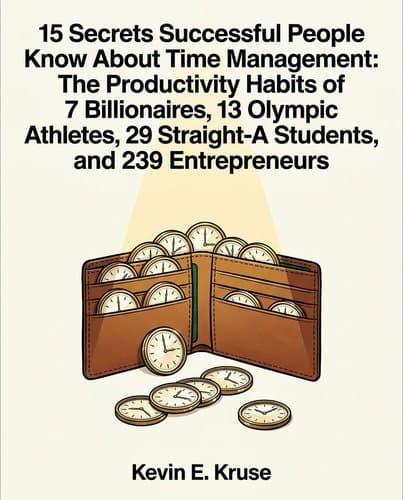
27139721_15-secrets-successful-people-know-about-time-manag
by Kevin E. Kruse
Most people hand their 1,440 daily minutes to other people's urgencies—then wonder why they never finish what matters. Kruse distills the counterintuitive time…
In Brief
15 Secrets Successful People Know About Time Management: The Productivity Habits of 7 Billionaires, 13 Olympic Athletes, 29 Straight-A Students, and 239 Entrepreneurs (2015) distills the time habits of over 200 high achievers into actionable systems for reclaiming your day.
Key Ideas
Schedule commitments like doctor visits
Replace your to-do list with a time-blocked calendar: if something matters, schedule it as a recurring appointment and treat it as non-negotiable as a doctor's visit — rescheduled if necessary, never simply dropped.
Protect first two hours for MIT
The night before each workday, identify your single Most Important Task (MIT) and protect the first two hours after waking for it exclusively — before email, before meetings, before any reactive work.
Email three times daily using 4Ds
Check email only three times a day (morning, noon, evening), set a 21-minute timer per session, and apply the 4 D's to every message immediately: Do it, Delegate it, Defer it to a calendar entry, or Delete/Archive it — never re-read the same email twice.
Design systems against failure modes
When the urge to procrastinate hits, ask 'How will my future self sabotage this?' then design around that specific failure mode now: remove the junk food, block the app, schedule the workout before breakfast rather than trusting willpower to show up later.
Decline commitments you wouldn't accept tomorrow
Before accepting any future commitment, ask: 'Would I agree to this if it were scheduled for tomorrow?' If no, decline it today — your future calendar will not be emptier than your current one, and the obligations you already carry will still be there.
Protect your peak energy hours exclusively
Track your hourly output or energy for one week by time of day to find your personal performance window, then guard those hours exclusively for your highest-leverage work — lower-energy hours are for meetings, admin, and email.
Break rhythmically within focused sprints
Build deliberate recovery into your workday through 25-90 minute focused sprints followed by short breaks: the top 10% most productive employees work fewer consecutive minutes and take more breaks than everyone else — grinding longer is the strategy that produces less.
Who Should Read This
People working on personal growth in Time Management and Focus, especially those tired of generic motivational advice.
15 Secrets Successful People Know About Time Management: The Productivity Habits of 7 Billionaires, 13 Olympic Athletes, 29 Straight-A Students, and 239 Entrepreneurs
By Kevin E. Kruse
8 min read
Why does it matter? Because you're not short on hours — you're short on the right mental model for spending them.
The problem isn't that you don't have enough time. You have exactly as much as Warren Buffett, Sheryl Sandberg, and every Olympic athlete who ever won gold. The real problem is harder to admit: you keep volunteering your minutes away — to urgent-feeling emails, to meetings nobody needed, to commitments that looked manageable from three months out and turned into ambushes. The calendar doesn't lie. Every yes is a no to something else, and most people have never stopped to audit what they're actually trading. Kevin Kruse was one of those people. He spent years interviewing billionaires, Olympians, straight-A students, and hundreds of entrepreneurs not to study them from a distance, but because he'd watched his own best hours evaporate and needed to know why theirs hadn't. What he found rewrites the story you've been telling yourself about why you're busy. You don't have a time shortage. You've just never decided to stop giving it away.
You Guard Your Wallet. You Give Away Your Time. Only One Can Be Earned Back.
Think about how carefully you protect a wallet: the back-pocket check on a crowded street, the momentary panic when you can't find it, the PIN memorized and never written down. Now think about last Tuesday. Did someone interrupt your morning with "got a minute?" that stretched to forty-five? Did you drift into a meeting that had nothing to do with your actual work? You probably shrugged both off as the cost of being collegial.
Here's what makes that asymmetry strange: if someone pickpocketed you, you'd feel violated. Surrendered minutes feel like rounding errors.
Kevin Kruse arrived at one distinction the hard way, handing his best hours to whoever showed up first while running a digital learning company: money lost can be replaced. You can earn it back, invest it, borrow it. But the forty minutes you spent in a meeting that could have been an email are simply gone. Health deteriorates and recovers. Friendships fade and reform. Time has no equivalent mechanism. It moves in one direction, and nothing you accumulate later compensates for what you spent earlier.
Knowing this is different from feeling it. Kruse made it physical by taping a single number on his office door: 1,440, in 300-point Arial bold, no explanation. When colleagues asked what it meant and he explained — 1,440 minutes in a day, each one gone the moment it passes — something shifted. One employee stopped mid-sentence and said he didn't need to talk anymore; it could wait until Monday's team huddle. Kruse hadn't written a policy or held a training. The number did it: turned an abstraction into arithmetic, and arithmetic into a different decision.
Every morning, you start at 1,440. What happens next is the only question.
Your To-Do List Is Optimized for Feeling Productive, Not for Doing What Matters
He sat down to work on a quarterly strategy document, cleared seven quick items off his list in twenty minutes, and looked up to realize he'd spent his sharpest hour on things that barely mattered, and still felt vaguely behind.
The mechanism is the format. A list treats "buy paper clips" and "write the quarterly strategy document" as equivalent line items. When you sit down, your brain does what any rational system would: clears the quick wins first. Five tasks crossed off feels like progress. The 90-minute work that actually matters sits at the bottom, deferred again, because the list gave you no signal it should come first.
The feeling of being vaguely behind has a name. Every uncompleted item is a small cognitive alarm that won't stop buzzing, and psychologists call this the Zeigarnik effect: unfinished tasks generate low-level mental noise that keeps firing until the goal is resolved. iDoneThis found that 41 percent of to-do list items are never completed. That's not a list of tasks. That's a collection of permanently ringing alarms.
The fix is counterintuitive. Florida State researchers found you don't need to complete a task to silence the nagging — you only need to make a concrete plan to do it. Scheduling something on your calendar is enough to tell your brain the goal is handled and cut off the intrusive thoughts. The relief doesn't come from finishing; it comes from committing to a time. The list keeps the alarm ringing indefinitely. A calendar entry turns it off.
Kruse's answer follows: move everything that genuinely matters off the list and onto calendar blocks. Daily exercise gets a recurring slot, where it can't be edged out by "reply to Mark's email." A strategic report needing two hours of focused thought gets those two hours blocked before anything else crowds them out. The later in the day a block sits, the more likely some urgency will eat it.
The list is fine for errands. For work that matters, scheduling the task is the work.
You're Spending Your Peak Cognitive Hours on Your Lowest-Value Work
What if the problem with your workday isn't its length, but where in it you're putting your best thinking?
Duke behavioral economist Dan Ariely put it bluntly in a Reddit Q&A: the typical person takes their two sharpest hours of the day — the first two hours after fully waking — and fills them with things that require almost no cognitive effort. Email. Social media. Inbox triage. These feel productive because they generate visible motion: messages answered, notifications cleared. But they don't require the cognitive horsepower actually available in those hours. Ariely called this one of the saddest mistakes in time management: burning premium fuel on a trip to the corner store.
The brain's capacity for deep concentration peaks early and erodes as the day fills with decisions and interruptions. By the time most people turn to work that actually matters, they're running on a depleted tank, which is why it feels hard and slow, and why they keep deferring it to tomorrow.
Kruse's prescription is to identify what he calls the Most Important Task: the single action with the highest leverage toward your most important current goal. Protect those early hours for it before anything reactive gets in. (He admits he once scheduled a sales call during his sharpest hour because it felt productive, then realized he'd burned his best thinking on something that didn't require thinking at all.) The MIT isn't the longest item on your list; it's the one where a focused hour moves something genuinely important forward. For a salesperson building a client base, that's cold calls. For a startup founder trying to raise funding, it's the pitch deck. The specifics vary; the logic holds: whatever requires your best thinking gets your best hours, not whatever arrived in your inbox overnight.
Adding a tired hour at the end of an already-depleted day produces a fraction of what one protected hour at the start produces. You don't need a longer day. You need to stop treating your peak hours as a warm-up for the real work, when they are the real work.
Procrastination Isn't a Willpower Failure — Your Future Self Is Quietly Sabotaging You
Kruse was halfway through the chapter on procrastination when he noticed he hadn't started the thing he was actually supposed to be working on: research and slides for a $54,425 speaking engagement. He had chosen writing — easier, more pleasurable — over the harder thing. He was, in that moment, living the chapter.
The confession matters because it dismantles the excuse most people carry: that procrastination is a character flaw, evidence of weak discipline, a problem the sufficiently motivated can simply overcome. Psychologist Joseph Ferrari has found that roughly 20 percent of American adults qualify as chronic procrastinators. These aren't people who lack ambition. They're people operating with the wrong model of what's happening.
The problem is what psychologists call time inconsistency. Your present self makes confident commitments on behalf of your future self: I'll eat the salad, I'll watch the documentary, I'll do the workout. Your future self then arrives and immediately renegotiates, choosing the fries, the Will Ferrell movie, the couch. The failure feels like weakness, but it's structural. Your future self is not the person who made the plan. They never were.
Once you see the pattern clearly, the solution changes entirely. Willpower is the wrong tool. It asks you to fight a battle you're already losing. The better move is to redesign the terrain before your future self shows up.
One of Kruse's friends cracked this. She was trying to eat better, and she knew herself well enough to know that willpower would collapse the moment fries appeared. So whenever fries arrived at a restaurant, she opened the salt shaker and poured the whole thing over the plate before she could eat a single one. Inedible. Done. She hadn't tried harder; she had made the failure mode physically impossible.
The mechanism isn't willpower. It's terrain.
Every Yes You Give Today Is a Debt Your Future Self Has to Pay
A college student emailed Kevin Kruse to say she admired his work and wanted to suggest him for a campus speaker series. He said sure. First yes.
A month later, an administrator confirmed a date and mentioned there'd be no fee. Kruse's standard rate ran $12,500 to $22,500, but he kept one slot a month for pro bono work. He checked his calendar: three months out, the week was completely clear. He said yes. Second yes.
As the date approached, a student asked if he'd arrive a couple of hours early to record a radio interview. Of course. Third yes. A week before, a professor asked if he'd stop by an economics class earlier in the day. He was already going to be there. Fourth yes.
When the day arrived, it had filled the way future days always do. His daughter had a school play that afternoon. He missed it. A corporation had offered a full-fee $22,500 keynote for that date. He turned it down. An Australian TV program wanted a live satellite interview. Already booked.
Kruse calls this the "distant elephant" problem. In the distance, even giants look small. A commitment three months out registers as almost nothing, because the future calendar always looks emptier than the present one. What you can't see are the other elephants still approaching — the sick kid, the boss's project, the daughter's play that hasn't been scheduled yet. Every obligation you carry now, you'll still carry in six months. The future isn't lighter. It just hasn't filled in yet.
The fix isn't better evaluation of individual requests. It's a standing policy. The difference between successful and very successful people, Buffett said, is that the very successful say no to almost everything. Not most things. Almost everything. Because any yes given today is a debt your future self has to service, on a day already crowded with debts they didn't see coming.
A Tired Hour and a Sharp Hour Aren't the Same Hour — But You've Been Scheduling Them That Way
Monica Leonelle had been writing for years and producing about 600 words an hour (half the professional baseline) when she decided to run her process like an experiment. She started small: 25-minute sprints, then a mandatory five-minute rest before the next. Her output jumped 50%. Then a wrist injury forced her off the keyboard entirely and onto dictation, and she gained another 33%. Once freed from the desk, she discovered she could dictate while walking outside — one more 25%. No additional hours of writing anywhere in this sequence. She finished at 3,500 words an hour. Nearly 6x where she'd started. The same days. Just different conditions.
The calendar block, the captured task, the MIT: none of them return their full value if the person working them is depleted. Every system in the preceding chapters assumes you can execute. That assumption fails when energy fails. The machinery is real. Energy is what runs it.
The Draugiem Group confirmed it across an entire workforce. They installed software to track employee time and productivity. Their top 10% most productive workers weren't logging more hours. They worked fewer consecutive minutes, averaging 52, then stopped for 17-minute breaks. The rest pushed through and produced less. Recovery wasn't a concession these workers made to their limits. It was what produced their output.
Rest isn't the absence of work. It's a production input. A depleted hour costs you twice: in the reduced output it generates, and in the recovery time you need before real focus returns. The real case for managing your energy isn't just avoiding those penalties. It's what sharp attention produces when you point it at the right work. Your MIT, the one task that moves the needle most, done in your sharpest state isn't just easier to finish. The work itself is different. The thinking goes deeper. The output earns the time. That's the multiplier no scheduling system can manufacture. The Pomodoro timer, the midday walk, the hard stop at a reasonable hour — these look like surrenders, but they're the system working as designed.
The 1,440 Minutes You Already Have Are Enough
The number taped to that office door didn't unlock hidden hours or slow the clock. It made something abstract concrete: each minute that passed was gone, and tomorrow opened onto exactly the same supply. No more, no less, regardless of what you accomplished or avoided today.
That recognition matters more than any system — though a better system helps. It's accepting that the 1,440 you wake up with are already enough, if you stop surrendering your sharpest hours to your easiest tasks. The question was never where to find more time. You've always known where it is. Tomorrow's answer starts with the first hour — whether it goes to what matters most, or to whatever arrived in the inbox while you slept.
Notable Quotes
“in Arial, bold, 300-point font. How I Beat Back Time Thieves Every time I walked into my own office, I passed that giant”
“sign as a reminder. Tick, tick, tick. I could not be careless with my minutes. But what also happened was that when people stopped by to ask,”
“and I would say yes, they would immediately ask,”
Frequently Asked Questions
- What is the main premise of "15 Secrets Successful People Know About Time Management"?
- The book distills the time habits of over 200 high achievers—including billionaires, Olympic athletes, straight-A students, and entrepreneurs—into actionable systems for reclaiming your day. It shows "how to replace reactive busywork with intentional scheduling, protect your peak hours for your highest-leverage tasks, and build the focus routines that separate top performers from everyone else." By understanding these habits, readers learn to prioritize strategically and treat their time as a finite resource that requires deliberate allocation and protection against constant interruptions.
- What is the Most Important Task (MIT) strategy in the book?
- To maximize your highest-impact work, identify your single Most Important Task the night before and "protect the first two hours after waking for it exclusively — before email, before meetings, before any reactive work." This ensures your peak mental energy is reserved for what matters most. By starting your day with your MIT rather than reacting to emails and messages, you build momentum and guarantee your most critical work gets completed before competing demands fragment your attention throughout the day.
- What does Kevin Kruse recommend about email management?
- The book advises checking email only three times a day—morning, noon, and evening—with a 21-minute timer for each session. "Apply the 4 D's to every message immediately: Do it, Delegate it, Defer it to a calendar entry, or Delete/Archive it — never re-read the same email twice." This batching approach prevents email from dominating your day. By containing email to specific windows with strict processing protocols, you reclaim hours previously lost to constant checking and deliberation.
- What strategy does the book recommend for overcoming procrastination?
- To overcome procrastination, identify your personal failure modes and eliminate them through environmental design rather than relying on willpower. The book suggests: "When the urge to procrastinate hits, ask 'How will my future self sabotage this?' then design around that specific failure mode now: remove the junk food, block the app, schedule the workout before breakfast rather than trusting willpower to show up later." By structuring your environment proactively, you sidestep decision fatigue and create conditions that make the desired behavior the path of least resistance.
Related Book Summaries
Read the full summary of 27139721_15-secrets-successful-people-know-about-time-manag on InShort