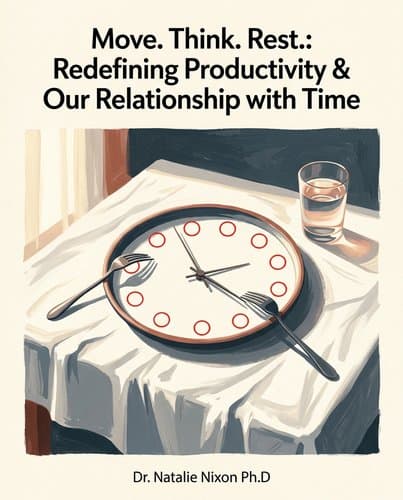
223296082_move-think-rest
by Dr. Natalie Nixon Ph.D
Communication debt is silently destroying your best work—and busyness isn't the cause, your architecture is. Learn how to eliminate inbox anxiety, reclaim deep…
In Brief
Move. Think. Rest.: Redefining Productivity & Our Relationship with Time (2025) diagnoses the hidden architecture behind overload — unfiled emails, purposeless meetings, and fractured attention — and replaces it with concrete systems for reclaiming control. Dr.
Key Ideas
Name your communication debt cost
Name your communication debt: if you feel a low-grade anxiety about all the messages you haven't answered yet, that sensation has a cost — and the system in this book is designed specifically to eliminate it, not manage it
Architecture problem, not effort shortage
Run the math before you complain about being busy: count your daily emails, multiply by two minutes, add your meeting hours — if the total exceeds your working hours, the problem isn't your effort, it's your architecture
Inbox is processing, not storage
Treat your inbox as a processing station, not a storage facility: every message you've read and left sitting there is a decision you've postponed, not a task you've handled
Batch email, delay first check
Batch your email into distinct 'review' and 'process' sessions rather than monitoring it continuously — and consider delaying your first check until mid-morning to protect the proactive thinking your best work requires
TESST framework eliminates decision avoidance
Apply TESST to every message before leaving it: Take action, Empower someone else, Suspend to your task list, Store for reference, or Trash — any message that doesn't fit one of those five bins is a decision you're avoiding
Go offline while processing backlog
Go offline before processing your inbox — new mail arriving while you work through a backlog is the dirt being shoveled back into the hole you're digging
Three emails then call instead
Invoke the Three-Email Rule: if a thread has gone back and forth more than three times, pick up the phone — five minutes of conversation will resolve what twenty emails cannot
Numbered lists trigger brain satisfaction
Use numbered lists in email instead of paragraphs or bullets — the brain experiences a specific satisfaction from checking off numbered items that prose and bullet points don't trigger
One sentence meeting purpose test
Test every meeting you schedule with one sentence: 'At the end of this meeting we will have/know/do ___.' If you can't complete that sentence, don't schedule the meeting
Fifteen minutes processing after meetings
Build 15 minutes of processing time into your calendar after every hour of meetings — without it, the decisions and action items from the meeting will evaporate before they're acted on
Who Should Read This
Readers interested in Time Management and Focus, looking for practical insights they can apply to their own lives.
Move. Think. Rest.: Redefining Productivity & Our Relationship with Time
By Dr. Natalie Nixon Ph.D
9 min read
Why does it matter? Because your inbox is not your priority list — and treating it like one is costing you more than time.
You end the day depleted, inbox still climbing, and somewhere under the fatigue is a question you haven't quite let yourself ask: if you were busy every single hour, why does it feel like nothing actually got done? The uncomfortable answer is that busyness and productivity have almost nothing to do with each other — and the systems most people rely on were quietly designed to keep them reactive, not effective. Your inbox isn't a to-do list. Your calendar isn't a strategy. And that low-grade anxiety humming beneath your workday has a name — and it isn't a personal failing. This book doesn't ask you to grind harder. It asks you to look clearly at what's actually stealing your attention, name it precisely, and then take it back.
The Low-Grade Anxiety You've Learned to Ignore Has a Name
How many times have you checked your phone in the last hour without meaning to? That reflex — the quick glance, the badge count, the scroll that solves nothing — has a name, and it isn't a personal weakness. Tech entrepreneur Henry Poydar called it communication debt: the persistent, low-grade feeling that you owe a reply to everyone who has ever sent you anything. It's the psychological weight of those red notification badges multiplying across your apps — texts, missed calls, voicemails, emails arriving while you're already reading emails. The discomfort is real, and it compounds quietly, like interest on a debt you keep rolling over.
Here's what makes it a structural trap rather than a discipline problem: the 'always on' environment was built to generate exactly this feeling. Every ping is a small demand, and because demands feel urgent, the brain starts treating an asynchronous tool — email, which was designed with a natural time delay built in — as a live conversation that requires an immediate answer. The system rewards responsiveness so consistently that staying on top of your inbox starts to feel like the job itself.
But reacting to whoever sent something most recently isn't the same as deciding what matters. The moment you spend your morning answering messages rather than driving your own agenda, you've handed the wheel to whoever happened to write to you last night. That's the actual cost: not wasted minutes, but surrendered agency. Naming communication debt doesn't solve it, but it does something important — it relocates the problem from your character to your environment. Which means the fix isn't trying harder. It's building a different system.
The Math of Your Workday Is Already Broken Before You Start
The workday you're trying to optimize is already broken before you sit down. Not in a motivational-poster way — in a literal arithmetic way.
Here's the calculation that changes how you see the problem. The average professional receives around 100 emails a day after basic spam filtering. Spend two minutes on each — reading, deciding, responding — and you've consumed 3.5 hours. Add a modest three hours of meetings, which is conservative for most knowledge workers, and you've eaten 6.5 hours of an eight-hour day. That leaves ninety minutes for everything else: the project that requires sustained thinking, the proposal you've been meaning to draft, the work that actually advances something. Except those ninety minutes don't arrive in a clean block — they're scattered in ten-minute gaps between interruptions, which means the deep work doesn't happen at all. It gets pushed to evening, or the weekend, or that vacation where you promised yourself you'd finally disconnect.
This is why work colonizes dinner tables. Not because people lack discipline or boundaries, but because the architecture of the workday never had room for proactive work to begin with. The reactive load — emails and meetings — fills the day completely before you've attempted a single thing you actually chose to do.
The immediate lever is sorting what's actually in that inbox. Most of what arrives isn't a colleague waiting on you — it's marketing you half-wanted, newsletters you subscribed to optimistically, and automated notifications from systems you use. Separating genuine human-to-human communication from everything else means the number demanding real attention shrinks dramatically before you've changed a single behavior. The math gets better the moment you stop treating every message as the same category of obligation.
Efficiency won't fix this — the fix is architectural, changing what arrives, what stays, and what you do with it.
Your Inbox Is a Mailbox You Keep Stuffing Back Full
Picture this: every day you walk to your mailbox, pull out the mail, open each envelope, read what's inside, and then stuff everything back in. Tomorrow the letter carrier drops a fresh batch on top. Bills you've already seen, catalogs you might flip through someday, a notice that actually needed a response — all of it compressing into a growing pile. A week in, you're technically "on top of your mail" because you've read it. But are you? That is precisely what your inbox looks like when you use it for storage.
The behavior has a name: skim and skip. You open a message, register its contents, decide it needs something more than a quick reply, and leave it sitting there — marked unread, maybe flagged — to be re-read the next time you scroll through. Then you re-read it again. And again. The inbox accumulates a sediment layer of deferred decisions, and every time you open it you're paying a small tax on work you already did once and still haven't finished.
The shift that makes every other tactic feel obvious rather than arbitrary is this: an inbox is a processing station, not a storage facility. Its only job is to receive things. A message that stays in your inbox after you've read it isn't a message you've managed — it's a decision you've postponed, and it will keep costing you attention every time you see it. Once you accept that, the question changes. Instead of "have I read this?" the question becomes "what does this require, and where does that go?" A task gets moved to a task manager. A reference gets filed. Something disposable gets deleted. The inbox empties not because you've worked faster but because you've stopped asking it to be something it isn't.
This isn't a productivity hack. It's a change in what the inbox is for — and once that model is in place, the first thing that changes is when you open the inbox at all.
Reacting Instantly to Every Message Is a Skill You Trained Yourself Into — and Can Train Out Of
Checking email the moment it arrives is not a personality trait. It's a habit you built, and you built it in both directions: you trained yourself to respond immediately, and in doing so you trained everyone around you to expect it. The good news is that habits learned in one direction can be learned in another.
The core confusion is about what kind of tool email actually is. Email was designed with a time delay built in — it's asynchronous by nature, the digital equivalent of leaving a note on someone's desk. But when you monitor your inbox continuously and answer the moment something lands, you've turned it into a phone call. Your nervous system starts treating every notification as a live interruption. You stop noticing the pull because it's always there — and any stretch of quiet starts to feel like falling behind rather than focus. You've accidentally rewired your capacity for deep work by treating the wrong tool as urgent.
The practical repair is batching — choosing specific windows during the day to give your inbox full attention, rather than scattering that attention across every waking hour. But batching has two distinct modes worth keeping separate. Reviewing is a fast pass: skim for anything genuinely time-sensitive, delete the disposable, file what's already resolved. Triage, not engagement. Processing is the slower, focused work of moving real tasks out of your inbox and onto your task list, where they can be properly prioritized against everything else competing for your time.
For mornings especially: delay the first check until mid-morning if you can. The hours immediately after you sit down are when your executive function is sharpest, and spending them in your inbox means handing that resource to whoever emailed you overnight. Most of the day, the inbox is closed. You're not missing things — you're protecting the mental space where actual work happens.
Five Decisions That Empty an Inbox for Good
Imagine it's a Tuesday afternoon and you're staring at 4,000 messages. You've told yourself you'll 'deal with it this weekend' enough times that you've stopped believing it. The inbox doesn't feel like a backlog anymore — it feels like a verdict.
The fix isn't a weekend. It's a decision tree.
Every message is an open question, and open questions are what create the cognitive drag. The TESST framework — Take immediate action, Empower someone else, Suspend to your task list, Store for reference, or Trash it — converts each message from a question into a closed answer before you move to the next one. Five options cover every case. Quick reply under two minutes? Handle it now, then file or delete the message. Longer task? Don't leave the email as a stand-in reminder — extract the action to your task list and move the email out. Someone else should own it? Forward it, add a 'waiting for' note, and move on. Reference only? File it. No value? Gone. The inbox empties not because you've worked through everything but because you've stopped leaving decisions half-made.
The catch is that none of this works if you're online while you do it. Processing email with your inbox live is like bailing a boat while someone holds the tap open — by the time you've cleared three messages, four more have arrived and you've never actually gotten closer to the bottom. Going offline before a processing session isn't a quirky setting; it's the only configuration in which the math of clearing works.
For days when the backlog is genuinely large, the practical model is a deliberate unscheduled block — not a few stolen minutes, but a protected stretch of hours where you work through the pile in full. Five options, offline, nothing left open. What changes is just the scale.
An empty inbox isn't perfection. It's a weekly reset — the difference between knowing what's on your plate and hoping you haven't forgotten anything. That peace of mind is the point.
The Messages You Send Are Also Part of the Problem
How much of the inbox chaos landing in your colleagues' lives are you actually generating yourself?
That's the uncomfortable pivot. Every tactic covered so far treats overload as something that arrives at you. But every person managing their own inbox is also someone else's incoming mail. The habits that slow you down are the same ones you're probably inflicting on the people you work with, which makes communication etiquette a shared infrastructure problem, not a personal one.
The clearest example is the cc. Most people add names to that field out of a vague sense of courtesy — keeping people 'in the loop' feels considerate, and it's nearly zero effort. But consider what it actually does. The recipient has to read the message just to determine whether it's relevant to them. Even if it is, they may not extract what the sender intended. And if the message isn't addressed to them directly, there's a reasonable chance they won't read it at all. The sender feels like they've communicated. They haven't. They've redistributed the cognitive load. The cleaner move: if someone needs to know a specific thing, send them a separate message that tells them exactly that thing — no inference required, no risk of it being skimmed past.
The Three-Email Rule runs on the same logic. If a thread has bounced back and forth more than three times without resolution, it stops being email and becomes a five-minute phone call. Three exchanges is usually enough to realize you're talking past each other; anything beyond that is just email pretending to be a conversation.
Choosing the right channel matters for the same reason. Someone texts you a deadline — you see it, then forget it, because there's nowhere to attach it to anything. Anything with a due date or real complexity needs to land somewhere the recipient can connect it to their task system. That means email. The question isn't which channel costs you the least effort to send; it's which channel costs your recipient the least effort to act on.
None of this requires a policy memo. It just requires asking, before you hit send, whether you're making someone else's day harder or easier. That single habit, multiplied across a team, is what changes communication from a source of drag into a shared resource.
A Meeting Without a Sentence Is a Meeting That Shouldn't Exist
Imagine you get a meeting invitation with no subject line, no agenda, just your name and a time slot. You accept it anyway, because declining feels risky and you assume someone knows what it's for. An hour later, seven people file out of a conference room having confirmed nothing, decided nothing, and scheduled a follow-up to figure out what the first meeting was supposed to accomplish. That's not a meeting. That's an expensive way to avoid thinking.
The filter that prevents it is a single sentence. Every meeting, before it earns a spot on anyone's calendar, must complete this: 'At the end of this meeting we will have, know, or do _________.' If the organizer can't fill in that blank, the meeting isn't ready to exist — it should be a shared document, an email thread, or a five-minute call instead. The test works because it forces the organizer to do the thinking upfront rather than outsourcing it to a room full of people billing time. A meeting where the answer is 'we will have decided which vendor to hire' is worth scheduling. A meeting where the answer trails off into 'we will have, you know, touched base' is not.
Once a meeting clears that bar, two more decisions follow. First, who actually belongs in the room — not who should be kept informed, but who has a specific function: making the decision, contributing expertise, or recording what was resolved. Second, build fifteen minutes of processing time after every meeting hour. Without it, the decisions made in the room dissolve before they reach anyone's task list. That buffer isn't padding — it's the moment the meeting's value gets captured or lost for good. A meeting that ends with everyone knowing exactly what they own is the only kind worth the time it cost.
The Inbox Was Never the Point
The people across the table from you, at work and at home, are getting whatever's left after the notifications have taken their share. That's the real cost, and it's the one that doesn't show up in any productivity audit. Every system in this book — the batching windows, the five-category sort, the one-sentence meeting test — is a means to the same end, and that end isn't a tidy inbox. It's the version of you that has enough mental room left to actually care about things. Constant reactivity doesn't just steal hours. It gradually hollows out the quality of your attention until the people you love most are running on your scraps. The tactics stick when you remember what they're protecting. Build the system once, defend it with some conviction, and you won't just work better — you'll show up more fully to the conversation at dinner, the weekend that actually feels like a weekend.
Notable Quotes
“I only check email periodically throughout the day. If your message is of a more urgent or timely nature, please call me.”
“Does this require action? Is there anything I need to do, either now or in the future, related to this email?”
“Hi, Shannon. I’m writing to summarize our meeting. Marianne, I’m copying you because I wanted you to know what we agreed upon yesterday.”
Frequently Asked Questions
- What does the TESST method teach you to do with every email?
- The TESST method is a five-category system for processing every message before leaving it. Apply TESST to each email: Take action, Empower someone else, Suspend to your task list, Store for reference, or Trash. According to the book, "any message that doesn't fit one of those five bins is a decision you're avoiding." This framework transforms your inbox from a storage facility into an active processing station, eliminating the limbo where unaddressed emails create ongoing anxiety and decision fatigue.
- What is communication debt and why does it matter?
- Communication debt is the low-grade anxiety you feel about messages you haven't answered yet—a sensation that has a measurable cost to your productivity. Rather than simply managing this overwhelm, Dr. Nixon's system is designed to eliminate communication debt entirely. The book teaches concrete methods including batching email into distinct review and process sessions, implementing the Three-Email Rule, and treating your inbox as a processing station. These systems work together to free you from the constant mental weight of unresolved communication.
- What is the Three-Email Rule and when should you apply it?
- The Three-Email Rule addresses the biggest cause of communication debt: endless email threads. The rule is direct: "if a thread has gone back and forth more than three times, pick up the phone." The book states "five minutes of conversation will resolve what twenty emails cannot." This approach transforms low-value written exchanges into high-impact verbal communication. By recognizing when email has become inefficient, you reduce inbox volume and produce actual decisions instead of circulating messages that perpetually lack resolution.
- What concrete productivity systems does this book teach?
- The book provides multiple frameworks including the TESST method for email processing and structured meeting protocols. Batch email into distinct "review" and "process" sessions rather than monitoring continuously, delaying your first check until mid-morning to protect deep thinking time. Test every meeting with one sentence: "At the end of this meeting we will have/know/do ___." Additionally, build 15 minutes of processing time into your calendar after every hour of meetings to ensure decisions and action items are acted upon rather than forgotten.
Related Book Summaries
Read the full summary of 223296082_move-think-rest on InShort