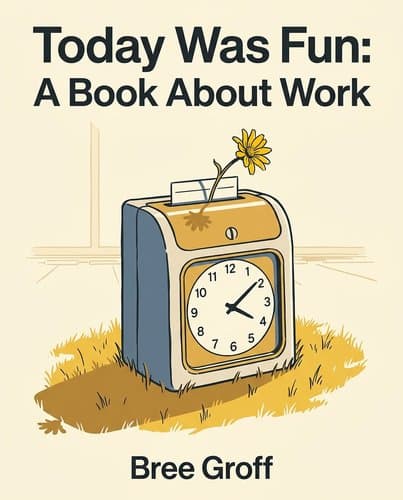
217387770_today-was-fun
by Bree Groff
Work will consume five-sevenths of your waking life—so stop treating joy as a bonus and start demanding it as the baseline. Bree Groff dismantles hustle…
In Brief
Work will consume five-sevenths of your waking life—so stop treating joy as a bonus and start demanding it as the baseline. Bree Groff dismantles hustle culture with concrete tools: pre-mortems, trust-account reciprocity, and the brutal question of whether you actually want the prize you're chasing.
Key Ideas
Direct Impact Over Scale Metrics
Replace 'impact at scale' as your measure of meaningful work with 'am I making life better for the specific people in front of me?' — that's a sufficient and more honest source of purpose.
Build Trust Through Time Banking
Use the deposit-and-withdrawal model: proactively return time to your team when work is slow, so when you genuinely need 9pm effort, it's a meaningful ask from a trust account, not an extraction.
Pre-Mortem Prevents Project Failure
Run a pre-mortem before high-stakes projects: assume it has already failed and work backward. Prospective hindsight surfaces preventable risks that forward planning misses.
Question Every Achievement Before Sacrifice
Ask 'Do I Want That Prize?' before sacrificing non-work time for a professional achievement — distinguish between genuine desire and a five-foot teddy bear you'll have to carry everywhere.
Diversify Sources of Life Purpose
Design a 'portfolio life' with multiple active sources of meaning so that a bad day at work is just a bad day at work, not a bad day of life.
Schedule Spaciousness for Creative Thinking
Schedule one Do Nothing Day per project cycle — no deliverables, just thinking — because the Muse doesn't show up for grinding; she shows up for spaciousness.
Lead With Emotional Transparency and Context
When you're grumpy or anxious as a leader, name it and name the source: 'I'm anxious about Friday's deadline, not about you.' Your team is reading your body language anyway — give them the right information.
Who Should Read This
Business operators, founders, and managers interested in Work-Life Balance and Professional Growth who want frameworks they can apply this week.
Today Was Fun: A Book About Work
By Bree Groff
15 min read
Why does it matter? Because wishing away the workweek is wishing away your life.
You check your phone before you say good morning. You count down to Friday. You tell yourself the exhaustion is temporary, the trade-off is worth it, and somewhere in the back of your skull you know neither of those things is true. Bree Groff has done the thinking in the kind of rooms where people don't have the luxury of postponing this question — and she came back with an argument that isn't about working less or finding your passion or locating some mythic purpose large enough to justify the grind. It's stranger than that. She wants the Tuesday itself to be worth having. Not as a stepping stone to the weekend, not as a deposit against future retirement bliss, but as actual life — which is, she'll remind you gently and then not so gently, the only kind you're getting.
You've Been Optimizing for the Wrong Thing This Whole Time
Bree Groff is sitting in a rehabilitation center listening to a lounge singer work through Sinatra classics when the man pauses between songs and offers this unrequested philosophy: the best thing you could say at the end of your life is that you had some good laughs with good people. Groff looks around at the nodding heads — patients in their seventies and eighties, people who have done the math — and nearly cries. Not because the sentiment is surprising, but because she recognizes, right there, that she has been optimizing for something else entirely. Metrics. Promotions. The right answers on a performance review.
That's the jolt the book opens with: not that work is miserable, but that we've quietly agreed to measure it by the wrong things. The Sunday Scaries, the TGIF reflex, the colleague with the thousand-yard stare by Wednesday — we absorb all of this as background noise, just the cost of doing business. Groff's argument is that we've mistaken the cost for the price tag.
She reaches back to a physics class she once taught to offer a cleaner definition: work is force times distance. Effort that moves something. That's it. No suffering built in, no prestige required. Everything painful we associate with work — the approval chains, the performative busyness, the assumption that meaningful work must also be grueling — we added ourselves. The difference between work that actually moves something and work that produces only the appearance of motion is the difference between leaving a room tired and leaving it hollow. One costs you something real. The other costs you something you can't get back.
The actual metric, the one that holds up at 95 when you're leaving instructions for your own funeral, is whether the experience itself was worth having.
The NASA Janitor Story Is a Lie They Tell You to Work Harder
The NASA janitor story gets told in conference rooms and leadership retreats as a parable about purpose — the one where he tells President Kennedy he's 'helping put a man on the moon.' Groff used to tell it herself. Then she stopped, because she realized it implies something quietly harmful: that your work only counts if you can trace a line from your daily tasks to some civilization-altering outcome. That a janitor mopping floors needs to believe he's advancing humanity, or his work lacks meaning. Groff calls this 'impact at scale,' and she argues it's less a philosophy than a corporate convenience — the kind that benefits people at the top. CEOs and presidents slot naturally into the grand-mission narrative. Everyone else has to perform contortions to feel like they belong in it.
Her counter-proposal is blunt: the janitor could have said he was making life a little better for Anne in engineering and Joe in communications, the actual people whose hallways he cleaned. That answer doesn't have the same cinematic quality. But it's honest, and Groff thinks it should be enough — because it is enough for Anne and Joe, whose days are genuinely improved by someone who shows up and does the work well.
She sharpens this with a question worth sitting with: what actually shaped your life more, your favorite teacher or the textbook that reached millions of students? A kindergarten teacher touches maybe thirty kids a year. Over a career, that's around twelve hundred people — a number that sounds modest the moment you start measuring by scale. But the teacher who made you love reading, or convinced you that you were smart, bent the arc of your specific life. Scale didn't do that. Proximity did.
And here's the part that tends to land quietly: somewhere out there, you have probably been that teacher for someone. You just never found out. The human-sized version was always the real thing.
The Business Costume Is Exhausting Everyone — Especially the People Pretending Hardest
Think about what you actually do when you get dressed for work. You pull on something that signals competence before you've said a word. The costume comes first. The work comes later.
Groff's point is that we've spent decades building an entire performance around this idea, and it costs more than most people realize — especially the ones working hardest to maintain it. She draws a sharp distinction between being professional and looking professional. Being professional means delivering good work, respecting people's time, keeping your composure when things go sideways. Looking professional means tailored clothes, corporate jargon, and performing the right kind of busyness. Somewhere along the way, we started rewarding the second and calling it the first.
The people most exhausted by this are the ones who can't just wear the costume — they have to wear the mask too. Picture what that actually involves: you walk into a room and start calculating. Soften the accent. Drop the reference you were about to make. Laugh at the thing that isn't funny. Present a version of yourself that fits the room without tipping anyone off that you're doing it. This is code-switching, and it runs on a hidden tax. Indeed surveyed its users and found that forty percent of Black workers believed their careers would suffer if they stopped. LaFawn Davis, Indeed's chief people and sustainability officer, describes what the constant calculation does over time: when you can't stop monitoring who you need to be in a given room, it chips away at confidence. The business costume isn't neutral for everyone. For people who already fit the dominant mold, it's mildly uncomfortable. For everyone else, it's a second job.
And for what? Groff points out that knowledge workers routinely sacrifice sleep, nutrition, and mental health to maintain the appearance of hustle, even as professional athletes treat their bodies as precision instruments to be carefully maintained. A financial advisor who brags about never sleeping is not a serious professional. He's someone making important decisions with a degraded brain. The costume and the performance don't make the work better. They just make the work look like work.
If the Work and the Hang Are Good, Nobody Needs a Badge Swipe
What would actually get you to show up somewhere willingly — the policy requiring you to be there, or the fact that something genuinely good is happening when you arrive?
Groff spent a year teaching seventh-grade math, and she learned early that threatening distracted thirteen-year-olds into paying attention was a losing strategy. Her mentor, a veteran named Lyle Hatridge, handed her the insight that reframed everything: the best classroom management is a great lesson plan. If the class is compelling — surprising, social, a little competitive — you don't have to fight for attention. You have it. The teachers who struggled were the ones lecturing for fifty minutes and wondering why no one was listening.
She applies this directly to the return-to-office debate, and the logic holds embarrassingly well. BetterUp data on over a thousand mandated employees found higher burnout, more stress, and greater intentions to quit. Gallup research shows that even a thirty-minute commute lifts stress and anger measurably. The mandate doesn't produce presence — it produces resentment and the appearance of presence. If leaders want people together, make together worth showing up for: real collaboration, space to be human, something you couldn't get from a screen. Drop the tracking. Create the great lesson plan.
The same logic governs how Groff thinks about leadership at the team level. She uses a deposit-and-withdrawal framing — and the concrete version looks like this: a manager who knows a crunch period is coming spends the slow week before it telling people to actually leave early, not assigning backlog work, not scheduling optional syncs. Just: we're good, go take a nap. When the nine-pm email arrives two weeks later, it lands as a genuine need instead of extraction. Game theory supports this: the optimal opening move in any cooperative system is generosity. Adjust only if someone takes advantage. Start by treating everyone as a high performer who cares, and deal with exceptions as exceptions.
One tool that makes this concrete: a user manual, a short document where each teammate describes how they work best — when they're sharpest, how they prefer to get feedback, what drains them. New to the team? Read the manual before your first one-on-one. You walk in already knowing something true about the person. There's also a daily zero-to-five check-in (a number texted or dropped in Slack, where five means you're drowning and zero means you've got capacity) and a listening technique borrowed from child development that mirrors back what someone said before jumping to solutions. None of these require a policy. They just require deciding to treat your colleagues like people worth knowing.
Brilliant Work Comes From Spaciousness, Not Suffering
Milton Glaser spent a weekend doing something his client definitely didn't ask for. He had been hired to design a wayfinding system for a sprawling pharmaceutical campus — signs, maps, bus route markers, the usual. Then Monday arrived and he walked into the studio with a sketch of a bakery shaped like a cake. Not a revised signage proposal. A bakery. His reasoning, relayed by his longtime collaborator Sue, was straightforward: the researchers trudging across that campus with its prestigious architecture didn't need to know which building was which. They needed warm bread to take home at the end of the day. That was the more essential human need. That was the thing worth solving.
The story sounds absurd until you sit with it — and then it starts to sound like the only sane response to a problem everyone else was approaching too narrowly. Glaser's imagination wasn't bounded by what the client asked for, because he wasn't starting from the functional request. He was starting from the emotional experience of the people who had to live inside that campus every day. The wayfinding system would get people to their buildings. The bakery would remind them that life was about more than being practical.
Groff uses this to make a larger argument about where brilliant work actually comes from — and it isn't from grinding longer or filling every hour with deliverables. Glaser didn't arrive at the bakery idea during a thirty-minute brainstorm or between back-to-back status meetings. It arrived over a weekend, in the spaciousness between obligations. (Stanford research puts a number on this: creative output rises roughly sixty percent when people are walking versus sitting.) Taylor Swift describes the songwriting experience as grabbing a glittery cloud floating past at exactly the right moment. For someone without a songwriter's schedule, that cloud shows up in the gap between the meeting that ended early and the one that hasn't started yet — not in the calendar block labeled 'deep work' at 2pm on Tuesday.
The brain is the instrument, and most of us are playing a Stradivarius we've been treating like a cardboard box. We chug caffeine to override the need for sleep. We skip lunch. We fill every gap with a meeting and call it productivity. Then we wonder why nothing we make feels alive.
Groff's prescription is a Do Nothing Day — a full day with no deliverables, no agenda pressure, just thinking. She suggests two decks of creative prompt cards, a park, some snacks, and explicit permission to produce nothing. It sounds like a luxury. But she argues it's actually the work. When the only goal is to let the mind wander freely, the ideas that have been waiting for room finally find it.
Your Mood Is the Weather — Your Team Lives in It
Picture a thermostat you can't adjust, mounted in a room where everyone has to work. Whatever temperature the person at the front sets, that's what everyone breathes. They can put on sweaters, they can fan themselves, but the baseline is always whatever the thermostat says. That's your mood, if you hold any authority in a group.
Most leaders understand this in theory and respond by doing something counterproductive: they suppress. Smile through the stress. Project calm. Keep the mask up. What they don't realize is that the body announces what the face is trying to hide. Even setting aside the science of micro-expressions, anyone who's worked for another human being knows this: the exasperated sigh in a hallway, the flash of tension across the jaw during a presentation, the slightly too-long pause before answering a question. Your team reads all of it, usually before you've said a word. And when those signals arrive without explanation, people fill the silence with their own interpretations — most of which are worse than the truth. Did I do something wrong? Is the project failing? Are we getting laid off?
The actual skill isn't suppression. It's narration. A leader who says 'I'm distracted today because we're moving apartments and my head is somewhere else — the project is fine, you're all doing well' has handed the team something they can work with. It names the weather. It takes the mystery out. The team can stop decoding and start working.
Groff calls this being a 'non-anxious presence,' a phrase borrowed from family therapist Edwin Friedman, who developed it in the context of family systems therapy. Friedman's idea was that a calm presence inside an anxious system de-escalates rather than amplifies — the anxiety doesn't spread if someone in the room has named it and claimed it as theirs. Crucially, it doesn't mean being empty of anxiety. It means the anxiety has a label and a source, so it isn't radiating silently into everyone around you. The professional tradition of masking emotion gets sold as composure. What it actually produces is a room full of people quietly trying to figure out if they should be worried, which is the least productive use of a brain anyone has yet devised.
Tell the team you're grumpy. Tell them you're worried about the launch. Tell them you're proud of what happened in Tuesday's meeting. The thermostat doesn't have to run the room — but pretending it doesn't exist doesn't turn it off.
Excel, Goddess of Workaholism, Is Stealing Your 40 Remaining Visits
Here is a fact that will not leave you alone once you do the arithmetic: overwork has a body count, and the bodies belong to your actual life. The trade-off is real, and most of us have been lying to ourselves about the exchange rate.
Groff personifies the voice doing that lying as Excel, Goddess of Workaholism — a corporate siren who knows exactly which justification will hook you. Peak wealth-building years. Colleagues who will lap you if you ease up. Kids who will eventually understand. Retirement, always retirement, glowing on the horizon like a promised land you will reach just as soon as you have nothing left to enjoy. The whispers are not crazy — that is the trap. Each one sounds like reasonable adult thinking. Together they conspire to hand over the most irreplaceable parts of your life to a bottomless pit that will never signal when it has had enough.
If your child is eight years old right now, you probably have ten more years before they leave home — but once they hit thirteen, friends displace parents as the gravitational center of their world. Which means something closer to five more years of the relationship as it currently exists. Five years out of a ninety-year life. Do the fraction. By the time they turn eighteen, roughly ninety percent of the total time you will ever spend together as parent and young child is already behind you. The same math runs in reverse for your own parents: if they are seventy and live in another city, and you see them twice a year at holidays, you may be looking at forty visits in total. Forty. Not an abstraction — forty actual occasions, each one using up more of whatever health they have left, since right now is almost certainly the best they will ever feel.
The response Excel offers to this arithmetic is purpose. When you have already sacrificed sleep, family dinners, and soccer games for work, your brain needs to believe the sacrifice was worth it — because if it wasn't, the implications are devastating. So the internal narrative inflates: you are not writing marketing copy, you are changing culture through storytelling; you are not skipping bedtime, you are modeling work ethic. And just like that, the ledger balances. Meanwhile, Groff notes, your arteries are stiffening in serene indifference to how important you are.
The circuit breaker she offers is a single question — Do I Want That Prize? — applied the moment ambition or obligation beckons. Not whether society wants you to want it, not whether your résumé has been pointing toward it, but whether you, specifically, actually want what success in this direction would deliver. Groff tested this on herself when she noticed envying politicians and executives who had climbed higher than she had. She walked the question all the way to its logical conclusion — what would that get me? — and found, underneath the social pressure to want more, that she genuinely did not want the prize. That clarity is not resignation. It is knowing you have forty visits left and refusing to spend them in service of a prize you never actually wanted in the first place.
Peak Life Isn't the Adriatic. It's a Parking Lot in Suburban Chicago.
Bree Groff is standing in a CarMax parking lot in suburban Chicago, waiting for an Uber, when it hits her. Not a thought exactly — more like a physical sensation, wave after wave of gratitude for something so ordinary it barely registers as a thing at all: she can go home to her mother. Not for much longer, she knows it in her bones. But right now, today, she can. That parking lot, that Tuesday, that completely unremarkable fact — that was Peak Life.
The setup matters because Groff had introduced the concept with a vacation story: friends bobbing on inflatable flamingos in the Bay of Kotor, the kind of moment you want to freeze and live in forever. Easy to label that as Peak Life. The CarMax story is the real argument. Peak Life isn't the Adriatic. It's any ordinary moment you recognize, before it's gone, as one you would trade everything to keep.
Most of us are waiting for the moment to be big enough to deserve our full attention. Meanwhile the actual moments — the Tuesday ones, the mundane ones, the ones that only reveal themselves as irreplaceable in retrospect — pass through us while we're finishing something else. The problem isn't that life moves too fast. The problem is that we anesthetize ourselves against it with busyness and then wonder why the years blurred.
The structural fix she offers is a portfolio life — not diversifying your income, but diversifying your joy. When work is your entire identity, a bad day at work is a bad day of life. A layoff isn't a setback; it's an existential crisis, because the thing that got taken wasn't just a job, it was the whole story you were telling about yourself. Spread yourself across active projects — being present as a parent, getting genuinely healthy, doing work you care about — and work becomes one meaningful slice of something larger rather than the whole pie. The test is your calendar. It doesn't lie about your actual priorities the way your stated values do.
She also names the activities with no goal at all — things you do purely because you like them, with no optimization attached. Not exercise in service of longevity, not reading in service of skills. Just a jigsaw puzzle. Just an afternoon that ends when it ends. If your brain has been trained to treat rest as laziness, doing nothing on purpose is harder than it sounds. The point isn't leisure as reward. The point is that some of your hours should belong to no outcome.
The book closes where it began — with mortality as the clarifying force. Groff watched her mother die and came away with two instructions for herself: pour all your love out, and soak everything in. Both directives. Both urgent. The terminal condition isn't her mother's cancer. It's the one you and I share. The CarMax parking lot is available every day. The question is whether you notice it while you're standing in it.
The Only Question Worth Asking Before Friday
The tools are already in your hands. Give time back before you need to ask for it. Block a day with nothing on it. Ask yourself, honestly, whether you actually want the thing you're about to sacrifice a Tuesday for. Build a life with enough going on that one bad meeting doesn't capsize the whole vessel. None of this requires a sabbatical or a crisis to make it urgent. What it requires is the slightly uncomfortable decision to stop treating the workweek as a waiting room. The CarMax parking lot isn't a metaphor for loss — it's a map. It's pointing at whatever ordinary, unremarkable moment you're standing in right now, the one that will only announce itself as irreplaceable after it's gone. You don't have to wait for that announcement. You can notice it today, while it's still happening, while there's still something to do about it.
Notable Quotes
“We’re good for today… go sign off!”
“We don’t need anything at the moment. Go take a nap!”
“I’ve got it from here. Go fish! Or whatever else you feel like.”
Frequently Asked Questions
- What is Today Was Fun: A Book About Work about?
- The book challenges the belief that meaningful work requires large-scale impact or significant sacrifice. Instead, Bree Groff argues that joy at work is a legitimate and necessary goal. She provides practical tools—including pre-mortems, portfolio thinking, and deposit-and-withdrawal team dynamics—for designing a work life where you don't wish away your days. The core argument is that making life better for the specific people in front of you is a sufficient source of purpose. The book emphasizes that fulfilling work is accessible and doesn't demand constant sacrifice.
- What are the key takeaways from Today Was Fun by Bree Groff?
- Key takeaways include measuring meaningful work by asking "am I making life better for the specific people in front of me?" rather than impact at scale. The deposit-and-withdrawal model emphasizes "proactively return time to your team when work is slow, so when you genuinely need 9pm effort, it's a meaningful ask from a trust account, not an extraction." Other important concepts include running pre-mortems before high-stakes projects, designing a portfolio life with multiple sources of meaning, and scheduling "one Do Nothing Day per project cycle — no deliverables, just thinking." Leaders should transparently name their emotions.
- How does the deposit-and-withdrawal model work in Today Was Fun?
- The deposit-and-withdrawal model is a team dynamics framework that builds trust and reciprocity. The key principle is that you should "proactively return time to your team when work is slow, so when you genuinely need 9pm effort, it's a meaningful ask from a trust account, not an extraction." By regularly giving time and flexibility during slower periods, you create goodwill and earned reciprocity. When you need your team to go above and beyond, the request emerges from a foundation of trust rather than feeling extractive. This approach prevents burnout by keeping high-effort asks exceptional rather than normalized.
- How should you approach work-life balance according to Today Was Fun?
- Rather than pursuing perfect balance, Groff recommends designing a "portfolio life" with multiple active sources of meaning beyond work. This way, a bad day at work is just a bad day at work, not a bad day of your entire life. She also advocates scheduling "one Do Nothing Day per project cycle — no deliverables, just thinking" because creativity requires spaciousness rather than constant grinding. Before sacrificing personal time for professional achievements, ask "Do I Want That Prize?" to distinguish genuine desire from social pressure. This ensures your sacrifices are intentional and reflect your actual values.
Related Book Summaries
Read the full summary of 217387770_today-was-fun on InShort