45996732_a-beginner-s-guide-to-the-stock-market
by Matthew R. Kratter
Everything your instincts tell you to do in the stock market is wrong—low P/E stocks are cheap for a reason, all-time highs are buy signals, and news is…
In Brief
Everything your instincts tell you to do in the stock market is wrong—low P/E stocks are cheap for a reason, all-time highs are buy signals, and news is already priced in before you read it. Master the counterintuitive rules that separate consistent investors from perpetual losers.
Key Ideas
Verify Market Hasn't Already Priced News
Before acting on any news, ask whether the market has already priced it in — a stock that falls on great earnings is telling you the forward guidance was weak, not that the market is wrong.
Low P/E Indicates Imminent Earnings Decline
Never buy a stock because its P/E looks low. A P/E under 10 almost always signals future earnings are about to collapse; the stock is priced exactly right, not incorrectly cheap.
All-Time Highs with Volume Signal Entry
When a stock breaks to all-time highs on above-average volume with price above its 50-day moving average, that is an entry signal — not a warning. Every seller who wanted out has already left.
Position Size: One Percent Maximum Risk
Risk no more than 1% of your total account on any single trade. Set your stop-loss at a technical level (the 50-day moving average) before you enter the position, not after.
Dividend Aristocrats Deliver Exponential Wealth Growth
Buy Dividend Aristocrats — companies that have raised dividends every year for 25+ consecutive years — or the NOBL ETF, and reinvest every dividend payment. The effective yield on your original cost grows with every passing year.
Mandatory: Experience, Price Floor, Due Diligence
Never short a stock until you have at least five years of trading experience. Never buy stocks priced under $10. Never act on someone else's idea without doing your own research — tips come without stop-loss levels.
Pricing Power Sustains Dividend Growth Forever
Look for businesses with pricing power: can they raise prices without losing customers? Companies that can (Coca-Cola, Apple) compound value indefinitely. Those that can't earn thin margins forever and will never sustain rising dividends.
Who Should Read This
Business operators, founders, and managers interested in Investing and Personal Finance who want frameworks they can apply this week.
A Beginner's Guide to the Stock Market
By Matthew R. Kratter
11 min read
Why does it matter? Because the market has already priced in every instinct you're about to act on.
You already know the basics. Buy low, sell high. Avoid stocks at all-time highs. They have nowhere to go but down. When good news drops, buy fast before everyone else piles in. Feels right, doesn't it? Here's the problem: every one of those instincts is mechanically backwards, and the market has been quietly taking money from people who think exactly like you do. The stock market isn't a scoreboard of the present — it's a pricing machine for six months from now. By the time you see the cheap stock, the great earnings report, the exciting headline, the market has already chewed through all of it. What looks like opportunity is usually a trap that's already been set. That gap — between what beginners feel and what markets reliably reward — is what this book maps, and it starts with a concept that reframes everything.
The Market Already Priced In the News You Just Read
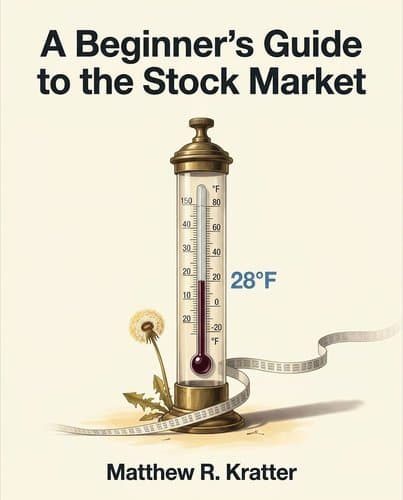
Imagine a thermometer that doesn't measure how cold it is outside right now — it measures how cold it will be in three months. You look at it in July and see 28°F, and you think it's broken. It's not. That's the stock market.
Most people approach stocks the way they'd approach a weather report: they look at what's happening in the economy today and use that to decide what to do. In early 2009, that logic pointed clearly in one direction. The headlines were grim. Millions of Americans had lost their jobs. Home foreclosures were everywhere. The financial system had nearly collapsed. If you followed the news — and the news was all bad — you sold, or you stayed out.
The market had already moved on.
While people were still surveying the wreckage, stock prices had quietly bottomed and started climbing. The rally didn't happen because the economy recovered. It happened because the market was pricing in a recovery that hadn't arrived yet. By the time unemployment peaked and housing stabilized and the all-clear was finally visible, stocks had already run. The people who waited for confirmation bought near the top of a move that had started in the depths of the crisis.
Wayne Gretzky, explaining his dominance on the ice, once said he skated to where the puck was going to be, not where it had been. Markets do exactly this: constantly, mechanically, without sentiment. Every price you see on a screen is a collective bet on what a company will look like three to six months from now, assembled from everything the world's fastest traders and algorithms have already digested. The present barely registers.
This reframes everything. The cheap stock that looks like a bargain might be cheap because earnings are about to collapse. The market already knows something you don't. The expensive stock that looks overpriced might actually be cheap because earnings are about to explode. Price is never a snapshot of now. It's always a forecast.
The practical implication is uncomfortable. The news hits the tape — and the tape moves before you finish reading it. A company reports a blowout quarter: profits up 40%, revenue crushing estimates. You go to buy. The stock opens 8% lower. That's not a mistake. Somewhere in the earnings call, management said something cautious about next quarter, and institutional traders — the mutual funds and pension funds moving billions of dollars at a time — had already started selling before you finished reading the headline. The great earnings were already in the price. What matters now is what comes next.
Get this straight before you do anything else in markets: the market is not a mirror of today. It's a machine that has already read tomorrow's newspaper, and it's setting prices accordingly.
A Low P/E Is Not a Discount — It's a Warning Label
If the market prices the future, a P/E ratio isn't a snapshot of what the company is worth. It's the market's verdict on where earnings are headed. You pull up a stock screener and sort by price-to-earnings ratio, lowest first. Near the top: Blockbuster, the video rental chain, at a P/E of 2. For every dollar the company earned, you were paying two dollars to own a piece of it. Scroll down and Netflix shows up at 26 — thirteen times more expensive by this one measure. The logic seems airtight: Blockbuster is the deal.
A P/E ratio tells you how many dollars you're paying per dollar of earnings. At 15, you're paying $15 for every $1 of annual profit, roughly what the broad market has averaged historically. At 26, you're paying a premium. At 2, you're getting a steal. That's how most people read it.
Here's what that reading misses: the market isn't pricing last year's earnings. It's pricing the earnings it expects to see. In late 2009, the market had already concluded that Blockbuster's earnings were about to disappear. Netflix was stealing every customer the chain had. The P/E of 2 wasn't a discount. It was the market's verdict that the denominator in that fraction was about to collapse toward zero.
Netflix, meanwhile, was earning $116 million in 2009, with the whole company valued at roughly $3 billion. Expensive, yes — until you run the math forward. By 2018, Netflix's earnings had grown to $1.2 billion. Divide the 2009 market cap by those 2018 earnings and you get a P/E of 2.50. The "overpriced" stock was the genuine bargain. The "cheap" one was priced exactly right: for a business in terminal decline.
That's what the forward-looking machine does to P/E ratios. A low P/E almost never means the market missed something obvious. It almost always means the market sees something coming that hasn't hit the income statement yet.
The rule is blunt: treat any stock trading at a P/E of 10 or below as a warning, not a bargain. The companies that end up there usually carry crushing debt loads, falling revenues, or products the world has already moved on from. The label "cheap" is doing dangerous work. What it really signals is that earnings are about to get cheaper still.
Blockbuster filed for bankruptcy in 2010. Netflix became one of the most valuable companies on the planet.
The Safest Moment to Buy Is When a Stock Looks Most Expensive
So if valuation ratios don't tell you when to buy, what does? Most people's instinct: never at an all-time high. The price has run up, someone else already made all the money, and there's nowhere left to go. That instinct is wrong in a specific and exploitable way.
An all-time high means every person who bought the stock at any point in its history is sitting on a profit. The break-even sellers are gone. The bag-holders who swore they'd get out the moment they were made whole — they've already exited. The only people still in pain are short-sellers, traders who borrowed shares betting the stock would fall. At an all-time high, they must buy back those shares to limit their losses, whether they want to or not. That forced buying adds fuel. Coverage follows. New buyers arrive. The move becomes self-reinforcing.
Contrast that with a stock bouncing off a 52-week low. Everyone who bought above that price is waiting to get out. The moment the stock climbs back toward their cost basis, they sell. Every recovery attempt runs into a ceiling of accumulated damage. The structural setup couldn't be more different.
The entry checklist is concrete: the stock hitting new 52-week or all-time highs, price above its 50-day moving average (the stock's average closing price over the last fifty sessions), and that 50-day above the 200-day. All three together confirm an uptrend with no structural ceiling above. If the stock also just gapped up (opened significantly higher than the previous day's close) on a strong earnings report, there's an extra push: large funds can't buy their full position in a day, and that institutional accumulation tends to lift the price for days or weeks after the initial pop.
The hard part isn't the entry. It's sizing the position so a wrong call doesn't crater the account. The rule: risk no more than 1% of capital per trade. On a $100,000 account, that's $1,000. Enter at $100 with the 50-day sitting at $95 and you're risking $5 per share — 200 shares is the limit. The stop defines the size. The size limits the damage.
The instinct to wait for a safer entry, some pullback to confirm the runup is real, usually means you never buy at all. Or you buy later at a higher price with worse structure. The all-time high is the signal, not the warning.
The Janitor Who Died with $8 Million Never Needed a Hot Tip
Ronald Read worked a gas pump in Vermont for years, then swept floors at a J.C. Penney department store. He drove old cars and wore a coat held together with a safety pin. When he died at 92, the people settling his estate found an $8 million fortune — every dollar of it in dividend stocks he'd been quietly accumulating and reinvesting for decades.
The story lands differently once you understand what dividends do over time. Read wasn't playing a complex game. He was exploiting a mechanism most people overlook: when a company pays you cash every quarter and you use that cash to buy more shares, those new shares generate their own dividends, which buy more shares still. The returns don't add. They multiply.
Here's what that looks like with one number. Take a stock priced at $60 that pays a 3% annual dividend ($1.80 per share each year). Decent, not dramatic. Now suppose the company raises that dividend 7.2% every year, which many strong businesses do routinely. After ten years, the annual payout has doubled to $3.60. You still paid $60 for the share. Your effective yield on that original cost is now 6%, and climbing. Hold long enough and the income stream starts to look absurd relative to what you spent.
Warren Buffett bought Coca-Cola in 1988. His effective dividend yield on those original shares now exceeds 60% annually. Every year and a half, Coke pays him more in dividends than he originally spent buying them. That's patience applied to the right kind of company.
The right kind matters. Coke can raise the price of a can by ten cents without losing a single customer. You don't check the price on a Coke the way you check the price at the pump. A gas station priced ten cents above the competitor across the street watches traffic walk. One business has pricing power; the other is hostage to whoever undercuts it. The dividend keeps compounding at Coke because the underlying business protects its margins and keeps growing the cash it returns to shareholders. The companies that can do this tend to be strong brands with no real substitute: Colgate, Johnson & Johnson, McDonald's. Commodity producers can't; any competitor can squeeze the margin to nothing.
Ronald Read didn't need a hot tip or a Bloomberg terminal. He needed businesses with pricing power, dividends he could reinvest, and enough patience to leave them alone. Read wasn't trying to outwit the forward-looking machine. He was doing something different — finding businesses the machine systematically undervalues, because a pricing mechanism calibrated to the next six months will never fully account for a dividend that doubles every decade. He wasn't faster. He was patient in a way the machine isn't built to be. But none of that compounding happens if you blow up the account before the first dividend reinvests.
Surviving the First Year Is the Only Edge That Matters
November 2015. Joe Campbell went to bed with $37,000 in his account. He had shorted KaloBios Pharmaceuticals, a small pharmaceutical stock trading under a few dollars a share. The trade made sense to him. The stock looked weak. He had conviction.
He woke up to a different reality. KaloBios had skyrocketed overnight. The $37,000 was gone, and he owed his broker $106,000 on top of that. There was no exit. Brokers can pursue that debt through court, going after savings, assets, everything. One night turned a $37,000 account into a six-figure liability.
The story is instructive because of the mechanism. Campbell didn't lose because he was unlucky. He lost because he broke two specific rules simultaneously: he shorted a stock, and that stock was a penny stock. Each rule exists because there's a documented way it destroys beginners, and he triggered both at once.
Shorting means borrowing shares, selling them, and hoping to buy them back cheaper. Your upside is capped (a stock can only fall to zero), but your downside is unlimited. When you're long and wrong, you lose what you put in. When you're short and wrong, you owe what you never had.
Stocks under $5 are the classic penny stock cutoff, but the same logic extends to $10. These stocks tend not to trend. They mean-revert: they spike and fall back, often irrationally, driven by thin trading volume and small float — the limited number of shares actually available to trade. On a $100 stock, a $1 move is 1%. On a $5 stock, that same $1 is 20%. The volatility isn't a feature. It's a mechanism for transferring money from people who don't understand position sizing to people who do.
The other commandments work the same way. Each one is a fence around a specific trap. Buying 52-week lows sounds like contrarian discipline until you understand the cockroach theory: when a company first reports bad news, it is almost never the only bad news. General Electric fell from $30 to $7 not in one announcement but through a cascade: each quarter, another problem surfaced, morale deteriorated, talent left, capital got harder to raise. The market priced in the next cockroach before retail investors finished reading about the first one. The fence isn't about missing occasional bargains. It's about not standing in front of something that's still moving.
Margin does the same thing with arithmetic. A 10% loss on a fully margined account is a 20% account loss. A 50% drawdown requires 100% gains just to return to even. Most beginners don't run those numbers in reverse before they start. The rule isn't caution. It's math.
Trading someone else's ideas has a subtler trap: you won't hold through volatility, because conviction requires having done the work yourself. A stock drops 15% on noise. The person who built the thesis holds. The person who got a tip from a friend sells at the bottom.
The five commandments feel like a list of things to get to eventually. They're not. They're the minimum viable behavior for staying in the game long enough to learn anything. The fastest way to lose in the market isn't bad luck. It's breaking rules you haven't yet fully believed.
Simple Rules, Not Easy Execution
Everything in this book takes an afternoon to understand. The P/E trap, the all-time-high entry, the 1% rule, the compounding arithmetic behind a company that raises its dividend every year without fail — none of it is complicated. You understand it right now. That's not the hard part.
The hard part is February, when a friend texts you about a stock under $5 that "can't miss," and you know the rule but convince yourself this one is different. The hard part is watching a stock break to new highs and feeling, viscerally, like you missed it, when the structure is actually telling you to buy. These commandments don't feel hardest when you're calm. They feel hardest when they matter most.
The traders who survive aren't smarter. They're the ones who stopped negotiating with themselves mid-trade. Survival isn't a consolation prize — it's the prerequisite. You can't compound what you've already lost.
Notable Quotes
“it has such a high P/E”
“is the quantity of shares that have been sold short by those who believe that the stock will go down. Scroll down the far-right column, and you will see”
“over the counter bulletin board”
Frequently Asked Questions
- What does it mean when a stock falls after good earnings?
- When a stock falls after positive earnings, it signals weak forward guidance, not market error. Markets price in expected future performance rather than past results. Before acting on any news, you must ask whether the market has already priced it in. A decline following good earnings typically means investors expected stronger guidance or performance ahead. This counterintuitive signal teaches beginners that market reactions provide crucial information about expectations, not confirmation of what news headlines suggest about whether a company is performing well or poorly.
- Is a low P/E ratio a sign that a stock is undervalued?
- No—a low P/E ratio almost always signals future earnings collapse, not hidden value. The book explicitly states: "A P/E under 10 almost always signals future earnings are about to collapse; the stock is priced exactly right, not incorrectly cheap." Beginners often assume low multiples indicate bargain prices, but this misunderstands how markets function. A depressed valuation ratio exists because markets correctly anticipate declining profitability. Recognizing this pattern prevents costly mistakes built on the false assumption that cheap-looking valuations offer superior opportunities for wealth building.
- What technical signals indicate the right time to buy a stock?
- All-time highs combined with above-average volume and prices above the 50-day moving average create optimal entry points. The book states: "When a stock breaks to all-time highs on above-average volume with price above its 50-day moving average, that is an entry signal — not a warning." This setup indicates all sellers who wanted to exit have already left, creating momentum for new buyers. This approach contradicts most investors' instinct to buy weakness. The convergence of multiple technical factors removes emotion from entry timing decisions.
- How should you use dividend investing to build wealth?
- Buy Dividend Aristocrats—companies that have increased dividends for 25+ consecutive years—or the NOBL ETF, then reinvest all dividends. The book teaches that "The effective yield on your original cost grows with every passing year" through compounding and company dividend increases. This passive strategy delivers wealth accumulation without requiring active stock-picking expertise. The combination of rising dividends from company actions and compounding from reinvestment creates exponential returns across decades. This approach suits beginners because it minimizes speculation risk while systematically building long-term purchasing power and financial security.
Related Book Summaries
Read the full summary of 45996732_a-beginner-s-guide-to-the-stock-market on InShort