231148075_the-art-of-spending-money
by Morgan Housel
Most people optimize for earning more money while never questioning whether they're spending it on what they actually want—versus what they've been conditioned…
In Brief
Most people optimize for earning more money while never questioning whether they're spending it on what they actually want—versus what they've been conditioned to want. Morgan Housel's framework exposes the gap between your stated values and your bank statements, then closes it.
Key Ideas
Reverse obituary reveals your actual priorities
Run a 'reverse obituary': write what you want yours to say, then notice what's absent — the gap between that and what you're spending on reveals misaligned priorities
Status purchases fail the desert island test
Apply the desert-island test to any major purchase: if no one could see it, would you still want it? If the answer is no, you're buying status, not utility
Wanting less creates richer happiness than earning
Use the contentment formula: your happiness equals what you have minus what you want — meaning you can get 'richer' by wanting less, not just by earning more
Age 80 regret test guides major purchases
When deciding whether to spend or save on something big, use Bezos's regret minimization framework: project to age 80 and ask which choice you'd regret not making. The answer varies by person — generic advice fails here
Saved dollars purchase independence and freedom
Treat every dollar saved not as a sacrifice but as purchasing a unit of independence — freedom to quit a bad job, absorb a crisis, or simply not feel rushed
Authenticity test: would you want it secretly?
Run the internal benchmark test on financial decisions: 'Would I be happy with this result if no one other than me and my family could see it?' If not, you're performing, not living
Contrast gaps produce more happiness than upgrades
Look for what you spend on that creates contrast rather than constant luxury — occasional treats produce more happiness than perpetual upgrades because the brain responds to the gap, not the level
Who Should Read This
People working on personal growth in Personal Finance and Wealth Building, especially those tired of generic motivational advice.
The Art of Spending Money: Simple Choices for a Richer Life
By Morgan Housel
12 min read
Why does it matter? Because the question 'how should I spend my money?' is really the question 'what do I actually want from my life?'
A man walks out of a high-end furniture show, spots the valet staff watching him, and announces he just spent $21,000 on an armchair. Then, noticing their stunned faces, adds: "Boys, I know. It's crazy. But when you have money, this is what you're supposed to do." Supposed to do. Not want to do — supposed to. That small phrase contains the entire problem. Most financial misery isn't caused by having too little money. It's caused by outsourcing your desires — quietly, gradually — to what other people expect you to want. The fancy car, the status vacation, the armchair nobody actually likes. The question how should I spend my money? is secretly a different question entirely: what do I actually want from my life? The gap between those two questions is where the real trouble lives.
You Don't Actually Want the Things You're Spending Money On
Here is the uncomfortable truth about every purchase you're fantasizing about right now: your brain doesn't actually want it. What your brain wants is the anticipation of getting it. The thing itself is almost beside the point.
Dopamine is engineered for pursuit, not possession. It fires during the chase and goes quiet once you arrive. Which means the moment you get the car, the house, the watch, the feeling you were chasing has already relocated to whatever you don't have yet. The goalpost doesn't move because you're weak-willed. It moves because that's the design.
You can watch this play out at any income level. You dream of any car at all. Then you get a modest one and start noticing the nicer ones. Then you get that one and suddenly there are even nicer ones. The chain runs all the way up — millionaires eyeing hundred-millionaires, billionaires eyeing the people above them — until you reach the very top of the wealth ladder, where the only thing left to want is immortality. That's not a joke. That's just where it eventually points.
Richard Nixon articulated what happens when you actually get there. After leaving office, he spent time around some of the wealthiest people alive and came back with a bleak report: they were drinking too much, talking too much, thinking too little. No purpose. He put it simply — if you've never had a big house or nice travel, those things carry enormous meaning. Once you have them, they carry none. The wanting was the whole experience.
Will Smith said something almost identical after his career peaked. So did Rick Rubin: "It's hard to get really depressed until your dreams come true. Once your dreams come true and you realize you feel the same way you did before, then you get a feeling of hopelessness." Which is worth sitting with before the next purchase.
What You're Really Buying When You Buy an Expensive Car
Bill Koch, the billionaire energy heir, spent decades assembling what he believed was one of the greatest wine cellars on earth — 43,000 bottles, including four he'd paid $400,000 for because they bore Thomas Jefferson's handwritten signature on the glass. Then historians from Jefferson's estate told him the bottles were counterfeits. So were hundreds of his rarest and most expensive wines. A forger named Rudy Kurniawan had been blending cheap vintages, slapping on forged labels, and selling them to the most sophisticated collectors in the world for years — undetected, because the fakes tasted just as extraordinary as the real thing.
The question is: if the wine tasted identical, why did the revelation destroy Koch's enjoyment of it? If he wanted great wine — the sensory experience, the pleasure of a good glass — the fake served him perfectly. The answer is that Koch wasn't buying wine. He was buying proof. Proof that he owned something almost no one else on earth could have. The wine was the vessel; the status was the point.
Here's a cleaner way to find your own version of that same motivation. Imagine yourself on a deserted island with no one watching. Would you still want the thing you're about to buy? When the answer is yes, that's utility — the comfort, the convenience, the pleasure you'd value even if no one ever knew you owned it. When the answer gets complicated, you've found something else.
Most aspirational spending — the car that's a size above what you need, the watch that costs three times what a cheaper one would — is nearly pure status. The problem isn't that status is shameful. The problem is that it's so bad at delivering what it promises. The people whose opinions actually matter to you — your closest friends, your family — are measuring you by almost nothing you can purchase. They're tracking your humor, your kindness, how you show up when things go wrong. Everyone else is barely paying attention, and when they do notice the car or the watch, they're admiring the object, not you. You spent a fortune to impress strangers who forgot about you before they reached the next light.
The Happiness Formula Nobody Talks About: It's the Gap, Not the Amount
Michael May spent the first forty-six years of his life completely blind. Then a surgery restored his sight, and as he walked out of the doctor's office, something stopped him cold in the waiting room. Not a painting. Not a window. The carpet. A standard, drab office carpet. He grabbed his wife's arm: look at those shapes, look at those colors. He glanced around at the other patients sitting there, waiting calmly, and could not understand it. His biographer later captured the moment precisely: how could a person just sit there when such a carpet was happening? At one point May paused and whispered to himself, "That's blue. Oh my gosh, that's blue."
He was experiencing more joy from that carpet than most people get from the finest meal they've ever eaten. Not because the carpet was extraordinary, but because the contrast was. Going from never having seen anything to seeing something — even something unremarkable — produced a gap so enormous that ordinary office flooring became overwhelming.
That gap is the whole game. There is no such thing as an objectively good experience. Every feeling of "good" is just the distance between where you are now and where you were before, or where you expected to be. The contrast, not the quality, generates the feeling.
Shackleton's crew understood this without trying to. After nineteen months trapped in Antarctic ice — rowing in lifeboats, temperatures hitting ten below zero, surviving on whatever seals they could catch — they finally reached a whaling station on a remote island. What they received: a lukewarm bath, some food that may have been half-stale, a warm place to sleep. One crew member wrote in his diary that it was one of the finest days he had ever experienced. A pleasure to be alive. Not because the bath was exceptional. Because the gap between frozen and warm was the largest imaginable.
Most people assume happiness scales upward with quality — better hotel, better meal, better car, more happiness. But what scales is contrast. The first paycheck, moving a bank account from five dollars to five hundred, can feel richer than doubling ten million, because the gap is larger. A rare dinner out at a place you've been looking forward to can generate more pleasure than a private chef serving five-star meals three times a day — because by the third meal, there's nothing to contrast it against.
Which means you can become wealthier in two directions. Push your circumstances up. Or pull your expectations down. The second lever is quieter, less glamorous, and far more reliable — and when it works, ordinary things start doing what that carpet did for Michael May.
The Status Game Is Designed So You Can Never Win It
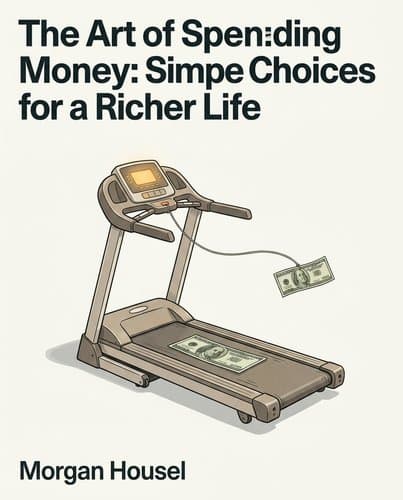
Imagine a treadmill with a carrot suspended from a pole attached to the belt. The faster you run, the faster the carrot moves. That's the status game — not as metaphor, but as operating system.
C. S. Lewis mapped the mechanics of this in an essay written decades before social media made everything worse. He called it the Inner Ring. Life, he observed, presents itself as a nested series of exclusive circles. When you're outside any given ring, nothing looks more appealing than getting in. But the moment you cross the threshold, the ring you just entered stops feeling special, and your eyes fix on the next one. Josh Kushner — entrepreneur, venture capitalist, someone who moves in rooms most people will never see — once got courtside seats at a Knicks game through a connection. Courtside. Close enough to feel the players' energy. It should have been enough. Then his friend looked five seats to the left and said, quietly, that those seats over there were actually better. The ring had already moved.
The game is unwinnable by design, and the design is simple: what makes something high-status is precisely that others don't have it. When they get it, the thing loses its value — not because it changed, but because exclusivity was the whole point, and exclusivity is gone. Yale undergraduates used to catch a train to New York to see Hamilton, the hottest ticket on Broadway. Then Hamilton came to Yale. And the students who saw it on campus didn't feel lucky — they felt like they'd missed something, because the thing that made it worth seeing was that you had to go to New York to see it. Status lives in the gap between what you have and what someone else doesn't. Close the gap, and you've destroyed the thing.
Buzz Aldrin walked on the moon — the second human being in all of history to do so — and by some accounts spent years quietly tormented by not being first. If 'second man on the moon' can feel like a consolation prize, no purchase, no upgrade, no next-ring admission will ever feel like enough. The game has no finish line because the finish line is always someone else's position.
Rich vs. Wealthy: Why the Vanderbilts Lost Everything
On the morning of his twenty-first birthday, Reginald Claypoole Vanderbilt inherited $12.5 million — roughly $350 million in today's dollars — and set about spending it as fast as humanly possible. His occupation, when asked, was 'Gentleman.' His two ruling passions were liquor and gambling. By forty-five, the liquor had won: cirrhosis so severe that blood backed up through his liver and into the veins of his esophagus, which ruptured while his family watched.
One family's chapter in a longer story of almost operatic waste. Cornelius Vanderbilt, Reggie's great-great-grandfather, left heirs a fortune estimated at $300 billion in today's dollars — more, allegedly, than the US Treasury held at the time. Within sixty years, almost nothing remained. One family member offered the clearest diagnosis anyone ever gave: the Vanderbilts didn't devote themselves to pleasure regardless of expense. They devoted themselves to expense regardless of pleasure. The game was spending, not living. And because that game has no finish line, everyone lost.
Here's the distinction worth carrying out of that wreckage: being rich means having money in the bank. Being wealthy means being in control of what that money does to you — your personality, your ambitions, your sense of who you are. The Vanderbilts were among the richest people who ever lived and, by that second definition, nearly bankrupt from the start. Their inheritance didn't fund a life. It became a debt, called in one generation at a time.
The contrast is Chuck Feeney, who cofounded Duty Free stores and accumulated around $8 billion. He road-tested the Vanderbilt life — luxury apartments across three continents, yachts, private jets, the whole performance — and walked away from it. It simply wasn't what made him happy. Giving money away was. So that's what he did, eventually parting with 99.99% of his fortune while flying coach and living in a small apartment. He wasn't performing austerity. He was using his wealth as a tool to do the thing that actually satisfied him.
The question this forces is uncomfortable: if vast wealth can be a liability to happiness rather than a guarantee of it, what exactly are you chasing? More money doesn't resolve that. It just raises the stakes — which is where the sailors come in.
Two Sailors, One Race: The Only Financial Question That Actually Matters
In 1968, a weekend sailor named Donald Crowhurst set out to circumnavigate the globe alone and nonstop — despite owning no boat, having almost no experience, and knowing his newly built vessel was barely seaworthy. He went anyway, because the attention was already too good to walk away from. The BBC had filmed him. His hometown was watching. A businessman had bankrolled the whole operation on the condition that Crowhurst finish or pay everything back. Within weeks, his boat began leaking. His electronics died. He knew the Southern Ocean would likely sink him. So he stopped sailing and started lying — drifting in the calm Atlantic for months, radioing fake coordinates back to England, maintaining two logbooks. His sloppy math accidentally made him look like he was breaking speed records. The press made him a national hero. Then the leading legitimate sailor, panicked by a competitor closing fast, pushed his boat until it broke apart and sank. Crowhurst was now going to win. That was the worst possible outcome: winning meant expert scrutiny, logbooks examined, fraud exposed. His diary entries in the final days read like a man dissolving. The boat was found adrift eleven days later. No damage. No accident. No Crowhurst.
Bernard Moitessier was sailing the same race from the opposite psychology. An expert French sailor, he didn't even bring a radio — he preferred solitude. Five months in, legitimately on track to win, he flagged down a passing cargo ship and handed the crew a note addressed to the Sunday Times: he was continuing toward the Pacific Islands, he wrote, because he was happy at sea. He turned toward Tahiti, dropped out, built a house on the beach, and grew his own food. The detour was so long that he inadvertently set the world record for the longest nonstop solo sail — over 37,000 miles. His book about the voyage doesn't mention it.
Warren Buffett once framed this as a question: would you rather be known as the world's best investor while actually being the worst, or thought of as the worst while actually being the best? Most people feel the pull in both directions when they hear it. That tension is the whole thing. Every purchase you make sits somewhere on that same axis — does it make other people think better of you, or does it give you something you'd value with no one watching?
Crowhurst needed an audience so badly that he destroyed himself constructing a fake one. Moitessier found his satisfaction so completely internal that winning a historic race wasn't worth interrupting it for. The distance between those two men is the distance between a life spent managing other people's impressions and a life spent following your own signal. When you stop needing to impress strangers, your desires contract. When your desires contract, what you already have starts to feel like enough. On any personal balance sheet, that's probably the largest asset most people will never think to count.
Independence Is Something You Can Buy Right Now
What does saving $100 actually cost you today? Most people answer quickly: $100. A dinner skipped, a shirt unpurchased, something real and present traded for something distant and hypothetical. That framing treats saving as sacrifice — a transaction between your present self and some stranger in the future who happens to share your face.
Here's the reframe: that $100 isn't spent or denied. It's converted. Into optionality. Into the ability to say no to a bad situation, absorb a crisis without begging, leave a job that's eating you alive. The only difference between a savings account and a new television is what you got for your money — and for a lot of people, the ability to say no trades better than the television.
Antoine Walker made this vivid by going the other direction. Over twelve NBA seasons, he earned roughly $25,000 every single day and spent accordingly: cars swapped whenever a nicer one appeared, thirty people on his personal payroll, a house for his mother with ten bathrooms. By 2010, a bankruptcy judge was making his decisions for him. Twelve million in liabilities, four million in assets, a lifetime of choices handed over to someone with no stake in his happiness.
John Urschel played in the same league, barely. A fifth-round pick who earned less in his entire career than Walker earned in eleven weeks. Urschel saved nearly all of it, lived within his means, and when football ended he did what he wanted next: a PhD, then a professorship at MIT. His summary of his financial position: "I don't ever need to worry about money." Walker's was filed in federal court.
The useful thing about independence is that it isn't binary. It exists on a spectrum, and every additional dollar of savings moves you up it in ways that matter immediately. Getting from zero savings to a small emergency fund means a flat tire doesn't ruin your month. Getting to six months of expenses means a terrible boss no longer owns you the way they did yesterday. The goal doesn't have to be total financial independence to be worth pursuing — every level delivers something real right now, not someday.
That's the quiet reframe: you're not denying yourself today in order to gift something to a future version of you. You're converting dollars into options — and that transaction is already complete the moment you make it.
The Fastest Way to Get Rich Is to Stop Performing for an Audience
Every few years, the same story surfaces: someone with no financial education and a modest paycheck dies leaving tens of millions of dollars. No dramatic trades, no hot tips, no performance. They just saved and invested for decades inside what amounted to a completely private universe — never measuring themselves against neighbors, never checking whether their returns beat some index last quarter, never needing anyone else to validate the plan. Quiet compounding is the most powerful financial skill there is, because it's the one that makes every other skill actually work.
When you stop needing an audience, your time horizon extends automatically. You're no longer anxious about what last month's statement looks like to someone else, which means you can absorb the short-term volatility that kills most long-term strategies. Most people fail at long-term investing not because they pick badly, but because comparison anxiety pushes them to act — to do something visible and explainable — right at the moment when doing nothing would have won. Quiet compounding removes that pressure entirely.
There's a diagnostic question worth keeping close: would you be satisfied with this outcome if no one other than your family could ever see it? That question filters out everything performative and leaves only what you actually value. When the answer is yes, you've found your real goal. When it gets complicated, you've found a social game disguised as a financial one — and social games are unwinnable, because there is always someone getting richer faster.
The practical upshot connects to everything in this book. Savings buys independence. Independence extends your time horizon. A longer time horizon is where compounding lives. None of that requires a high income or sophisticated strategy. It requires only the behavioral discipline to play your own game privately — to let the portfolio grow in silence while the people performing for an audience churn their way to average. Slow has all the power.
The Only Financial Goal Worth Having
Housel's own financial life doesn't look like anything you'd find in a personal finance magazine. No color-coded spreadsheets, no target date funds optimized to the decimal, no quiet competition with whoever lives two blocks over. Just enough saved that he goes to bed without a knot in his chest, and wakes up able to spend the day roughly how he'd choose. That's the whole thing. It sounds deceptively simple until you realize how few people actually have it — not because they lack the money, but because they've been measuring their life against someone else's and finding it short. The raw material for that kind of calm is probably already in your hands. The only thing standing between you and it is the habit of looking sideways instead of in.
Notable Quotes
“You can taste the love of the vintner,”
“stay here and you will hardly notice any difference between Midtown Manhattan and the Serengeti.”
“People are often bad at knowing how to spend their money,”
Frequently Asked Questions
- What is 'The Art of Spending Money' about?
- Morgan Housel's 2025 book examines how spending habits reveal the gap between what people truly value and what social pressure drives them to want. The work offers practical frameworks to help readers align their financial decisions with their actual priorities and build genuine wealth through independence rather than status. Housel argues that true richness comes from understanding what you actually need versus what you're pressured to desire, using strategic decision-making tools to close that gap. The book focuses on simple choices leading to a genuinely richer life aligned with personal values.
- What are the key frameworks in 'The Art of Spending Money'?
- Housel presents several actionable frameworks for evaluating spending decisions. The desert-island test asks whether you'd still want a purchase if no one could see it. The reverse obituary exercise reveals misaligned priorities by comparing desired legacy to current spending. The contentment formula shows happiness equals what you have minus what you want. Bezos's regret minimization framework projects to age 80 to determine which choice you'd regret not making. The internal benchmark test asks whether you'd be happy if only family could see the result, revealing when you're performing rather than living.
- How does the desert-island test help evaluate purchases?
- The desert-island test is a revealing framework: ask whether you'd still want a major purchase if no one could see it. According to Housel, "if the answer is no, you're buying status, not utility." This distinction is crucial because status purchases don't increase wellbeing—they only create relative satisfaction. By isolating a purchase from social observation, you strip away social pressure and external validation, revealing your genuine desire. This helps identify which spending truly serves your values and which serves only your image, enabling more intentional financial decisions.
- Can you actually get richer by wanting less?
- Yes, according to Housel's contentment formula: happiness equals what you have minus what you want. You can increase happiness and feel richer without earning more by simply wanting less. Housel reframes saving as empowerment: "Treat every dollar saved not as a sacrifice but as purchasing a unit of independence — freedom to quit a bad job, absorb a crisis, or simply not feel rushed." Rather than chasing endless earnings to fuel consumption, this approach shifts focus to recognizing what truly matters and reducing unnecessary wants, transforming financial discipline from deprivation into genuine freedom.
Related Book Summaries
Read the full summary of 231148075_the-art-of-spending-money on InShort