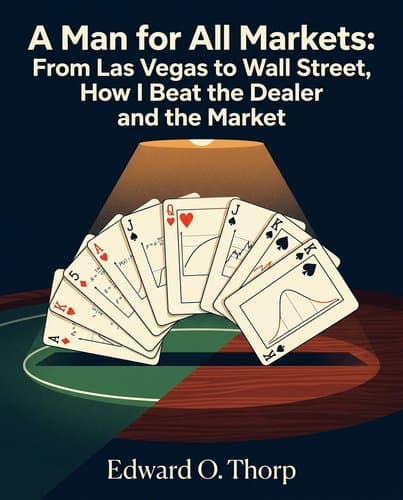
25733505_a-man-for-all-markets
by Edward O. Thorp
A mathematician who cracked blackjack and roulette then applied the same probabilistic thinking to Wall Street, beating markets for 50 years.
In Brief
A mathematician who cracked blackjack and roulette then applied the same probabilistic thinking to Wall Street, beating markets for 50 years. Thorp's memoir reveals how questioning accepted wisdom, sizing bets correctly with Kelly Criterion, and respecting leverage separates genuine edge from gambling with extra steps.
Key Ideas
Verify conventional wisdom through personal investigation
Check accepted wisdom for yourself before accepting it — Thorp's entire career began with the question 'but is it actually true that you can't beat the casinos?'
Edge requires comfort at position size
Having a mathematical edge is necessary but not sufficient. The constraint is deploying it at stakes you can sustain emotionally — advance your bet size only when you're genuinely comfortable at the current level.
Leverage amplifies risk not just returns
Leverage is not amplified return; it's amplified fragility. A 3% decline wipes out equity at 33:1 leverage. Being right on direction while wrong on sizing is still ruin — as Thorp learned with silver in the 1960s and watched LTCM prove in 1998.
Kelly Criterion determines optimal bet sizing
The Kelly Criterion offers a principled answer to the sizing question: bet a percentage of your bankroll proportional to your edge divided by the odds. Use half-Kelly if uncertain about your probability estimates, which in investing you almost always should be.
Index funds optimal for passive investors
For most investors without a demonstrable, specific edge, a low-cost index fund is not a consolation prize — it's the mathematically correct choice. The arithmetic is unavoidable: active investors as a group equal the market before costs, and trail it after.
Emotional discipline matters more than selection
Compounding's enemy is not ignorance but panic. The biggest returns come not from superior stock selection but from not selling at the bottom — which requires building a portfolio you can emotionally hold through 30-50% drawdowns.
Character assessment precedes financial analysis
When evaluating any investment opportunity or manager, ask first about honesty and character. Madoff's fraud was mathematically provable in 1991 from public records. The investors who stayed did so because of social proof, not evidence.
Who Should Read This
Readers interested in Investing and Wealth Building, looking for practical insights they can apply to their own lives.
A Man for All Markets: From Las Vegas to Wall Street, How I Beat the Dealer and the Market
By Edward O. Thorp & Nassim Nicholas Taleb
14 min read
Why does it matter? Because the same thinking that beats the casino beats the market — and almost nobody uses it.
Most people assume the casino and the stock exchange operate by fundamentally different rules — one is luck dressed up as entertainment, the other is serious capital allocation governed by rational prices. Edward Thorp spent fifty years proving that distinction is mostly mythology. The same mathematical habits that let him beat blackjack in 1961 — verify everything yourself, quantify your edge, manage risk before chasing return — turned out to be exactly what Wall Street was missing. Not because markets are games of chance, but because both are systems with exploitable structure for anyone willing to look rather than assume. Thorp looked. What he found, from Las Vegas casino floors to the wreckage of Long-Term Capital Management, is that brilliant people blow up for predictable reasons while disciplined thinkers compound quietly — and the difference between the two has almost nothing to do with intelligence.
The Only Advantage That Actually Matters Is Checking for Yourself
A twelve-year-old boy in a worn flannel shirt sits alone in a federal building in downtown Los Angeles, working through a radio theory exam while fifty adults scratch away around him. He'd ridden twenty miles by bus to get there. A few weeks later, he's a licensed amateur radio operator — one of the youngest in the country. Everyone assumed the exam required years of study. Thorp just went and checked.
That habit is his real edge, and it has nothing to do with talent in the conventional sense. When the mathematics community had proved no betting system could beat a casino, Thorp asked what assumptions that proof actually required. When Richard Feynman — one of the century's greatest physicists — told him roulette couldn't be beaten, Thorp felt encouraged rather than discouraged. If Feynman hadn't figured it out, probably nobody had.
The crystal set planted this instinct early. A primitive radio built from wire, a mineral crystal, and headphones — and suddenly voices from hundreds of miles away, carried by invisible waves. What it taught him was specific: phenomena you can't see directly still obey rules, and those rules are findable by anyone willing to sit down and think. Once you find them, you can use them. Most people accept the consensus about what the rules allow. Thorp checks.
This is the habit that beats blackjack, prices options before Black-Scholes, and builds one of the most successful hedge funds in history.
Not genius. Verification.
'You Can't Beat the Casinos' Was Wrong. What Else Is?
The mathematical proof that you can't beat a casino rested on a hidden assumption almost nobody thought to question. For games where each spin, roll, or flip is independent — roulette, craps, coin tosses — the proof holds perfectly. No betting system, however clever, can overcome a negative expected value when every trial resets to the same probabilities. The casinos hadn't changed blackjack's rules because nobody in the industry noticed that blackjack isn't that kind of game.
When cards are dealt from a deck and not returned, the probabilities for every subsequent hand shift. A deck depleted of 5s plays differently than a full deck. This distinction — between fixed-probability games and games with memory — is the crack Thorp found. Every proof that winning systems were impossible had been aimed at the wrong target.
The number that makes this visceral: when Thorp programmed MIT's IBM 704 to analyze decks with specific cards removed, eliminating all four 5s swung the house's 0.21% edge to a 3.29% player advantage — more than three percentage points, triggered by four cards. The computer finished in ten minutes what would have taken a thousand years by hand. The implication was immediate: a player who tracked which cards had been played could identify, in real time, when the remaining deck was 5-depleted and bet accordingly.
Thorp tested the live version with ten dollars at a Vegas table in late 1958, playing a simplified strategy. He lost eight-fifty and went home satisfied. What hooked him wasn't the game — it was the crowd around the table, offering confident wrong advice, mocking correct plays, operating on pure superstition dressed up as experience. The gap between what people believed about blackjack and what was actually true was enormous. He planned to fill it.
The Edge Is Nothing Without the Nerve to Use It
A midnight-blue Cadillac pulls up outside Thorp's Cambridge apartment on a gray February afternoon. Out steps a short, white-haired man in a long cashmere coat — Emmanuel Kimmel, about sixty-five, who describes himself as a businessman from New Jersey. He hands Vivian a strand of pearls pulled from a tangled mass in his coat pocket and introduces his two companions as nieces. Thorp takes this at face value. Vivian does not. Thirty years later, Thorp learns Kimmel allegedly built his fortune through bootlegging and numbers running with the don of New Jersey, the second most powerful mobster in the United States in 1935.
The detail matters because of what Kimmel proposed next: backing the Nevada trip with $100,000 — ten times what Thorp had in mind. Thorp held at $10,000. Then, on the last night at Harvey's Wagon Wheel on Lake Tahoe, they broke the bank twice. Thorp won $6,000 and tried to leave. Manny, having ignored every instruction and overbet wildly, had won $11,000. He refused to go. In the next forty-five minutes he gave it all back — because for him it was luck, not math, and luck feels like it continues.
That's what Thorp was trying to prevent with his betting ramp: double the minimum with a 1% edge, four times with 2%, capping at ten times with 5% or better. Kimmel found this excruciating. But Thorp's reasoning was simple — he needed to bet only at stakes where he could stay calm, because the counting breaks down the moment you're anxious about the money. Emotional unsteadiness isn't a character flaw you push through; it's the channel through which the edge leaks out. You can't track a six-deck shoe while panicking.
Having an edge only converts to profit if you can hold position during losing runs. What Thorp says he carried out of Nevada and into markets wasn't the card-counting method — it was the understanding that the bottleneck is always the person deploying the math, never the math itself.
The World's First Wearable Computer Was Built to Beat Roulette
August 1961, Las Vegas. Claude Shannon — the mathematician who invented information theory — is standing at a roulette wheel writing down numbers like every other system-chaser in the casino. He is not a system-chaser. Sewn into his shoes are silent mercury switches. Wired under his clothes is a twelve-transistor computer the size of a cigarette pack. At the far end of the table, apparently a stranger, Edward Thorp sits waiting. Running up his neck, painted to match his skin, are steel wires thinner than a human hair — sourced after an hour of phone calls to a supplier in Worcester, Massachusetts — leading to a speaker pressed into his ear canal.
When the rotor completes a revolution, Shannon clicks his big toe. A musical scale starts playing in Thorp's ear. When the ball has roughly three revolutions left, another toe-click. The tempo shifts. One final click when the ball completes its next orbit — and the tones stop. The last note Thorp heard names the cluster of five neighboring numbers on which to bet. A normal bettor covering five numbers wins about five times in thirty-eight. Their computer-guided bets won one time in five — a 44% edge against a house that had, until recently, seemed unbeatable by definition.
The wires kept snapping and casinos could kill the whole scheme by calling 'no more bets' before the spin. Shannon handed Thorp something more durable than the device itself: a 1956 paper by mathematician John Kelly on optimal bet sizing. The Kelly Criterion — bet in proportion to your edge, never more — became the thread Thorp would pull from blackjack through roulette and eventually into the stock market. Two systems, one principle.
Wall Street Is Just a Casino Where the House Doesn't Know the Odds
The stock market isn't more complex than gambling — it just feels that way because most participants have no idea whether they have an edge. Thorp knew the difference between thinking you have an edge and being able to prove it, and Wall Street was full of people who'd never made that distinction.
His tuition arrived early. In the late 1950s, Thorp bought 100 shares of Electric Autolite at $40 a share — based on a newspaper story, no further analysis. The stock fell to $20. He held for four years until it recovered, sold at break-even, and felt relieved. Vivian named both mistakes: first, you bought something you didn't understand, which means you had no real edge over someone throwing darts; second, once it dropped, you used your purchase price as your exit criterion — as if $40 had some relationship to what the stock was actually worth, rather than just being the number that erased your embarrassment. The errors aren't specific to Thorp. They're the default mode of almost every market participant, from first-time retail investors to fund managers who should know better.
The lesson Thorp drew wasn't 'study companies harder.' He needed a provable edge — something with the same mathematical structure as card counting, where he could say with precision why the numbers favored him. He found it in warrants. A warrant gives its owner the right to buy a company's stock at a fixed price before a set deadline. Because the warrant and the underlying stock move together, their relative prices follow a discoverable relationship. When that relationship gets distorted, you buy the underpriced one, short the overpriced one, and pocket the difference when prices realign — hedging away most of the directional risk in the process. In 1967, Thorp worked out a clean formula for what a warrant should cost, using the logic that two ways of owning the same exposure must eventually price the same. He was already trading from it when Fischer Black sent him a prepublication copy of the Black-Scholes paper two years later — the identical formula, this time with a rigorous proof. He was unsurprised.
The gambling background gave him two things most investors never develop: certainty about when an edge actually exists, and the discipline to size bets so that a temporary wrong move doesn't end the game before the edge pays out. Being right on direction is not the same as surviving long enough to collect. You can have a winning thesis and still go to zero if the position is sized to leave no room for the market to be wrong before it's right — which is a different problem entirely, and the one that eventually destroyed LTCM.
They Had the Formula. They Forgot About Ruin.
Think of a brilliant poker player who can calculate expected value perfectly — pot odds, hand probabilities, optimal bet sizing — but who keeps their entire bankroll on the table at once. They're right about the math of winning. They haven't thought about the math of ruin. One catastrophic hand and they're done, even though the strategy was sound. The edge is real. The ruin arrives anyway.
Thorp watched this happen over and over again, at escalating scales, across thirty years on Wall Street. The people running toward disaster weren't fools. They were, if anything, overqualified. Long-Term Capital Management launched in 1994 with Nobel laureates Robert Merton and Myron Scholes on the letterhead, a former Federal Reserve vice chairman among the partners, and the central banks of eight countries as investors. They understood the math of expected returns with a precision most fund managers can't approach. What they treated as an afterthought was the math of leverage — specifically, that borrowing thirty to a hundred dollars for every dollar of your own money means a small percentage move in the wrong direction doesn't reduce you, it eliminates you. When markets moved against them in 1998, LTCM lost ninety percent of its capital in weeks. The Federal Reserve coordinated a rescue. Thorp had been invited to invest and declined, specifically because Meriwether had a history of taking outsized risks and the firm's theorists lacked the street smarts to know what they didn't know.
Ten years later, the same error played out at civilizational scale. In 2004, five major investment banks — Goldman Sachs, Morgan Stanley, Merrill Lynch, Bear Stearns, Lehman Brothers — persuaded the SEC to let them borrow thirty-three dollars for every dollar of their own capital. At that leverage ratio, a three percent decline in asset values erases equity completely. Then creditors, seeing the insolvency, demand repayment immediately. The assets get sold into a falling market. Prices fall further. More margin calls. Within four years of that regulatory change — exactly as long as it took leverage to destroy LTCM — three of those five banks ceased to exist as independent firms.
What unnerves Thorp about all of this isn't that nobody ran the numbers. It's that the people running the numbers were the ones who built the leverage in the first place. The blackjack players he'd watched in 1958 — confidently advising each other, dismissing correct plays, mistaking noise for wisdom — had simply moved into nicer buildings.
Madoff's Trades Were Fake. Thorp Proved It in 1991.
How did the largest investment fraud in history go undetected for decades when the evidence was sitting in public exchange records, available to anyone who cared to look?
In the spring of 1991, a client hired Thorp to review their hedge fund holdings. One manager's numbers looked extraordinary — consistent monthly gains of one to two percent, no losing months, a strategy supposedly built on buying stocks while layering offsetting options around them. Thorp ran the basic math first: options properly priced with no net cost should produce no excess return over time. Consistent monthly profits from this structure weren't just unlikely. They were theoretically impossible.
So he went to the exchange records. He analyzed roughly 160 individual options trades from the client's account statements. Half of them had simply never happened — the exchanges showed no activity on those dates. For many of the remaining trades, the quantity attributed to just two client accounts exceeded the total volume traded by every participant in the market combined. He then asked a contact at Bear Stearns to identify the actual buyers and sellers of the residual trades. None could be connected to the manager's firm. The trades were invented. The account statements were fiction.
Thorp told his client directly: the evidence is in public records, not inference. The client pulled his money and got out whole.
The manager was Bernard Madoff. His scheme ran another seventeen years, eventually claiming $65 billion in fabricated account balances. The fraud wasn't hidden — it was simply unexamined. Across that entire period, investors deferred to the social proof of other investors, treating the consensus 'everyone says he's legitimate' as stronger evidence than arithmetic. Thorp's own phrase for that instinct: the lunacy of lemmings.
The Market Isn't Efficient — But You Probably Can't Beat It Anyway
Markets are genuinely inefficient — and that fact is almost useless to you. Both things are true simultaneously, and understanding why is the whole game.
The 3Com and PalmPilot episode makes the case as cleanly as anything Thorp has seen. On March 2, 2000, when PalmPilot's IPO launched, the market valued PalmPilot at $53 billion as a standalone company — while simultaneously valuing 3Com, which still owned 94% of PalmPilot, at only $28 billion. The arithmetic was public, simple, and damning: the market was saying the rest of 3Com — a profitable company with $8 cash per share — was worth negative $22 billion. Thorp's son Jeff spotted it before the IPO. At one point during trading, you could acquire 135 shares of PalmPilot by buying 100 shares of 3Com for $9,000, while buying those same 135 shares directly cost $14,850. A front-page New York Times story explained this in plain English the following morning. It had almost no effect on prices. Thorp and Jeff shorted PalmPilot, bought 3Com, waited six months for the spin-off to deliver the shares, and earned 82% on a trade that was nearly riskless. The inefficiency was real, dramatic, and staring at millions of investors in the face.
The gap between 'the market misprices things' and 'you can profit from it' is enormous, and most people never clear it. Exploiting the 3Com trade required identifying it before the crowd, having the capital and brokerage relationships to short a hard-to-borrow stock, and the nerve to hold a position that looked wrong to almost everyone else while a Times story explaining your thesis changed nothing. Thorp's honest summary: before costs, all active investors together must equal the index by definition — they collectively own the market. After fees and trading costs, they must trail it. The math is automatic. Most people who believe they have an edge are wrong, and the test isn't whether you can explain the edge afterward — it's whether you could have explained it, in advance, well enough to stake real money. Almost nobody passes.
Bet Bigger When You're Right. Bet Smaller When You're Uncertain.
Imagine you've discovered a coin that lands heads 55% of the time. You've verified it, tested it, you're certain. Now someone asks: how much of your savings do you bet per flip? The obvious temptation is to bet as much as possible — you have an edge, so more money means more profit. But bet your entire bankroll on any single flip and one bad outcome ends everything. Bet too little and you leave most of the compounding on the table. There's an answer to this problem, and it's precise.
John Kelly, a physicist at Bell Labs, published it in 1956. The formula is clean: optimal bet size equals your edge divided by the odds. With a 2% edge at roughly 1:1 payoffs — what Thorp found in favorable blackjack situations — you bet 2% of your total bankroll, not a fixed dollar amount, not whatever feels right. Kelly proved that this specific sizing rule will, over a long run, outperform every other strategy. Not just by a little — given enough flips, Kelly beats every alternative. Overbetting a real edge is as destructive as having no edge at all; doubling your bets above the optimal fraction actually reduces long-run wealth.
The honest caveat Thorp adds: Kelly requires knowing your probabilities, and in investing you never know them exactly. The solution is conservative estimates, and — because full Kelly produces swings that are psychologically brutal — most practitioners bet half-Kelly or less.
Bill Gross co-founded PIMCO, which at its peak managed over a trillion dollars. He learned Kelly at Nevada blackjack tables in 1969 and never stopped applying it: no single credit position ever exceeded 2% of the portfolio, a direct translation of Kelly sizing into bond markets. Professional blackjack, he said, was being played in his trading room, and that discipline was central to the firm's success.
The framework doesn't change. You find the edge first. Then sizing is the strategy.
Carolyn's Berkshire Shares and the Price of Panic
Carolyn was a house cleaner who received a $6,000 accident settlement in 1985 and wanted it to pay for her children's college education. She badgered Thorp for investment advice until he relented — reluctantly, because she knew nothing about securities — and arranged for her to buy two shares of Berkshire Hathaway at $2,500 each. She made one promise: never sell without calling him first.
She didn't call. When the market crashed in October 1987 and Berkshire fell with it, she sold at $2,600 a share — barely above what she paid. By the time her children would have been finishing college in early 2003, each of those shares was worth somewhere between $60,000 and $74,000.
The numbers are almost cruel in their precision. Carolyn didn't lose because she picked the wrong stock. She held one of the greatest wealth-compounding instruments of the twentieth century for two years and walked away with almost nothing. The enemy wasn't ignorance — it was the completely rational-feeling panic that arrives when a price drops and your body insists the damage will keep coming. Selling felt like taking control. It was the opposite.
Compounding's enemy isn't the math. It's the moment the market drops and your hands reach for the phone.
The Dance, Not the Destination
There's a version of Thorp's story where the point is the systems — the card counting, the Kelly sizing, the warrant formula. But Thorp closed his fund in 2002 not because it stopped working, but because he'd solved it. So he went back to what he'd always done when the problem was finished: he started thinking about something else. He passed on ventures he believed would make him extremely wealthy because he'd already done the arithmetic that matters most — what is the time actually worth, and what are you spending it on?
His wife Vivian read 150 books a year at 700 words per minute. He timed her secretly for an hour to verify it — of course he did. When she died in 2011, her brother said at the memorial: nobody can take away the dance you have danced. That's the only sentence in this book that doesn't need a proof.
The edge Thorp spent his life building is real and reproducible. But it's an instrument, not a destination. Franklin's line was that time is the stuff life is made of. The only question the math can't answer is what dance you want to dance.
Notable Quotes
“A Winning Strategy for Blackjack”
“A Favorable Strategy for Twenty-One,”
“Are you working on anything else in the gambling area?”
Frequently Asked Questions
- What is 'A Man for All Markets' about?
- "A Man for All Markets" (2016) traces mathematician Edward Thorp's journey from card counting in Las Vegas to managing a hedge fund on Wall Street. The book demonstrates how probability-based thinking and disciplined risk management overcome seemingly unbeatable systems. Thorp reveals that "having a mathematical edge is necessary but not sufficient. The constraint is deploying it at stakes you can sustain emotionally." His narrative spans decades of market adventures including currency trading and the 1998 LTCM crisis, while teaching fundamental lessons about leverage's dangers, the Kelly Criterion, and why most investors should embrace index funds rather than fight the market.
- What does Edward Thorp teach about leverage and position sizing?
- Edward Thorp teaches that "leverage is not amplified return; it's amplified fragility. A 3% decline wipes out equity at 33:1 leverage." Being right on direction while wrong on sizing causes ruin: Thorp experienced this through silver losses in the 1960s and witnessed Long-Term Capital Management's 1998 collapse confirm it. The Kelly Criterion offers a principled framework: "bet a percentage of your bankroll proportional to your edge divided by the odds." The real constraint is emotional sustainability—advance your bet size only when genuinely comfortable at the current level. Thorp advocates using half-Kelly when probability estimates are uncertain, which is appropriate for most investors.
- What does Thorp recommend for investors without a specific edge?
- For investors without a demonstrable, specific edge, "a low-cost index fund is not a consolation prize — it's the mathematically correct choice." Active investors as a group "equal the market before costs, and trail it after," making this arithmetic unavoidable. Rather than fighting through stock picking, most should capitalize on compounding through consistent, low-cost passive investing. Thorp emphasizes "compounding's enemy is not ignorance but panic"—selling during drawdowns destroys long-term returns. "The biggest returns come not from superior stock selection but from not selling at the bottom," which requires holding through 30-50% declines. This positions index investing as a rational strategy.
- How does emotional discipline factor into Thorp's investment philosophy?
- Emotional discipline is central to Thorp's philosophy. He teaches that "the constraint is deploying it at stakes you can sustain emotionally"—profitable betting requires executing your edge at sustainable levels rather than simply finding one. Building a portfolio you can hold through 30-50% drawdowns matters more than stock-picking skill; "compounding's enemy is not ignorance but panic." Thorp emphasizes that "when evaluating any investment opportunity or manager, ask first about honesty and character." He notes: "Madoff's fraud was mathematically provable in 1991 from public records. The investors who stayed did so because of social proof, not evidence." This integration of mathematics with psychology defines successful investing.
Related Book Summaries
Read the full summary of 25733505_a-man-for-all-markets on InShort