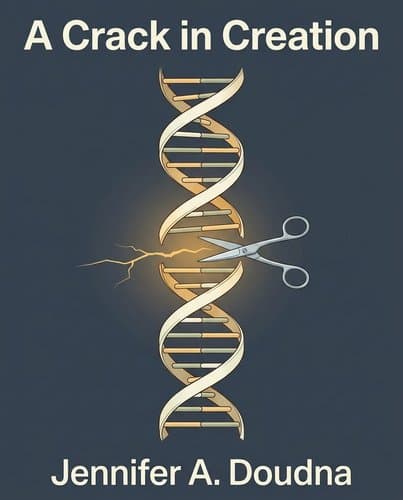
30971755_a-crack-in-creation
by Jennifer A. Doudna
The scientist who co-invented CRISPR—a tool that collapsed gene-editing costs from $25,000 to $40—confronts the terrifying implications of what she built: a…
In Brief
The scientist who co-invented CRISPR—a tool that collapsed gene-editing costs from $25,000 to $40—confronts the terrifying implications of what she built: a molecular cut-and-paste that works identically whether curing a child's disease or rewriting the human germline for every generation that follows.
Key Ideas
Reprogrammable RNA addresses enable universal targeting
CRISPR works by reprogramming a bacterial immune protein (Cas9) with a 20-letter RNA 'address' — change the address, redirect the cut to any gene in any organism. The tool stays the same; only the destination changes.
Cost collapsed 625-fold in mere years
The shift from previous gene-editing tools to CRISPR reduced the cost of targeting a specific gene from roughly $25,000 and months of specialized work to roughly $40 and an afternoon — a collapse that was nearly instantaneous, not gradual.
Somatic-germline divide marks ethical bright line
The somatic/germline distinction is the book's central ethical bright line: edits to living patients die with them; edits to embryos propagate through every descendant of every future generation. The mechanism for both is identical.
Gene drives spread irreversibly through populations
Gene drives (CRISPR-powered self-replicating inheritance systems) can spread a trait to 97–99% of a wild population within generations — making any environmental release effectively irreversible, with no recall mechanism once deployed.
Therapy-enhancement line lacks molecular basis
The therapy-to-enhancement line exists in rhetoric but not in molecular biology: EPOR, LRP5, MSTN, and DEC2 are well-characterized single-gene targets that could enhance endurance, bone density, muscle mass, and reduced sleep need using the same cut-and-repair mechanism used to treat genetic disease.
Scientific self-governance relies on voluntary trust
The Napa moratorium was a voluntary scientific appeal, not law — and a manuscript describing CRISPR experiments in human embryos was already circulating at major journals while the group drafted it. Self-governance in science runs on trust, not enforcement.
Who Should Read This
Science-curious readers interested in Biology and Scientists who want to go beyond the headlines.
A Crack in Creation
By Jennifer A. Doudna & Samuel H. Sternberg
10 min read
Why does it matter? Because the most powerful tool for rewriting life is already in use, and the people who built it are still deciding what it means.
You probably think CRISPR is coming. It's already here. Dogs with engineered muscle mass. Crops immune to blight. A one-year-old girl whose leukemia had beaten chemotherapy, a bone marrow transplant, and three other interventions — until gene-edited T cells sent it into remission.
The inventory of what this technology has already done reads like a draft of the next century, filed early.
Jennifer Doudna helped write it. A bench biochemist studying how bacteria fight viruses, she accidentally handed humanity a tool capable of rewriting any genome on Earth. This book is her attempt to reckon with what comes next — and the central problem isn't the technology. It's that the distance between curing a sick child and engineering the children of the future isn't a wall. It's a slope. And the people best qualified to stand guard on that slope built the path themselves.
Everything You're About to Read Is Already Happening
The editing of life has already begun — not in controlled experiments awaiting approval, but in living animals, growing crops, and, in at least one laboratory, human embryos.
Consider what it took to produce a beagle with the musculature of a bodybuilder. Scientists identified the gene that governs how far muscle tissue can grow, changed a single letter in it — one character out of the roughly three billion that make up a mammal's genome — and the resulting dog looked like nothing natural selection had ever produced. Still a beagle, with the same fur and the same eyes, whose body had simply followed a different instruction. These animals exist. You could meet one.
That single-letter change reveals something broader: the genome is editable, in any organism, with a precision earlier tools couldn't approach. CRISPR has since been turned on crop DNA, on livestock, and, most startling of all, on elephant cells. Each substitution nudges a living genome closer to one that vanished twelve thousand years ago. De-extinction isn't a thought experiment. It's an active research project.
Then there are human embryos. Chinese scientists have already applied CRISPR to them: nonviable ones, not intended for implantation, but real. The tool that rearranged a beagle's musculature has been pointed at the cell that, under different circumstances, becomes a person. Jennifer Doudna, who helped build that tool, isn't asking whether this trajectory continues. She's asking what it means that it will, and whether anyone is thinking carefully enough about the answer. But there's an earlier question: how, exactly, did this tool get here?
The Most Powerful Tool in Biology Came From Asking Why Bacteria Don't Get Sick
In 2006, a geomicrobiologist named Jill Banfield called Doudna's Berkeley office unprompted. She'd found Doudna's lab website via Google and wanted to discuss something she called, over the phone, "crisper" — she didn't define the term, only said it had appeared in her data and might connect to Doudna's work on RNA interference, the mechanism cells use to silence specific genes. Would Doudna meet for coffee?
They met at a campus café. Banfield arrived with a notepad and drew a bacterial cell, then its chromosome, then a row of alternating shapes along one side: diamonds and squares, diamonds and squares. The diamonds were all identical, the same short DNA sequence repeated with perfect regularity. The squares between them were each unique. This was CRISPR. Nobody had found a convincing explanation for what these strange repetitive regions did.
The strangeness was in those unique spacer sequences. Multiple research teams had recently found that many matched the DNA of viruses that attack bacteria, and the more viral matches a bacterium stored in its CRISPR array, the more resistant to infection it became. Bacteria appeared to be keeping a molecular record of past enemies: an adaptive immune memory that nobody had imagined single-celled organisms capable of maintaining.
Doudna didn't rush in. No obvious application, no path to any technology. She was drawn because the biology was genuinely unexplained, and the literature was almost embarrassingly thin, a handful of articles against four thousand already published on RNA interference. Something important was hiding here.
What followed was a chain of encounters nobody arranged. A postdoc candidate named Blake Wiedenheft showed up for his interview, and when Doudna asked what he wanted to work on, he answered with a question: had she heard of CRISPR? By the time he left, he had the job. Years of biochemical work mapped the system: how bacteria capture snippets of viral DNA during an infection, how those snippets become RNA, how the RNA scans for matching sequences in the next attacking virus. Then, at a 2011 conference in Puerto Rico, a French scientist named Emmanuelle Charpentier pulled Doudna aside during a free afternoon. Walking through the cobblestone streets of Old San Juan, Charpentier described a protein called Cas9, the system's final weapon, the piece that actually cut viral DNA apart. Nobody knew exactly how. Would Doudna collaborate?
The postdoc assigned to the problem, Martin Jinek, eventually found that Cas9 needed two RNA molecules to cut DNA at all, and that with both present the cuts were clean and precise. He fused the two into one molecule to simplify things. To test whether this machine could target any sequence, not just viral DNA bacteria had evolved to recognize, he picked a target for no reason except availability: a jellyfish gene for green fluorescence. He designed five guide sequences in an afternoon. All five cut cleanly at exactly the intended spots.
Nobody designed this as a gene editor. Nobody knew what CRISPR did when Banfield sketched those alternating shapes on her notepad. What you're left with is a tool that came from following an anomaly — from asking, without knowing the answer, why some bacteria seemed to survive viral attacks that killed others.
When Editing a Gene Drops from $25,000 to Forty Dollars, the World Doesn't Gradually Change — It Tips
Imagine trying to find a specific address using a navigation device built for a single destination: useful once, useless everywhere else. That was gene editing before CRISPR. Editing a human gene called CLTA at a Berkeley lab using older technology required months of specialized work and a corporate partner whose product cost $25,000 per gene target.
Those earlier tools, called zinc finger nucleases, required engineers to build a bespoke protein for every new DNA sequence they wanted to cut. Change the target, start over from scratch. That single constraint kept gene editing confined to a few well-funded labs willing to pay and wait.
CRISPR eliminated the constraint entirely. The cutting protein, Cas9, never changes; only a 20-letter RNA guide does. Designing that guide means typing a text string that matches the DNA you want to cut. When Martin needed that cut, he built the guide at his laptop in minutes for tens of dollars in reagents.
The gap between months and minutes, between $25,000 and forty dollars, meant the technology spread more like software than laboratory equipment. Within two years, Addgene, a nonprofit, was shipping 60,000 CRISPR plasmids annually to researchers in over 80 countries at $65 each. What had once demanded a corporate partnership could now be ordered like a textbook.
What Doudna found thrilling — and quietly unnerving — was that the same simplicity that put CRISPR in every research lab put it everywhere else too.
The Same Tool That Saved Layla Richards Can Also Edit Children Who Haven't Been Born
Layla Richards was one year old when her doctors in London ran out of options. She had acute lymphoblastic leukemia — the most common childhood cancer — but in the most aggressive form any of her physicians had seen. Chemotherapy hadn't stopped it. A bone marrow transplant hadn't stopped it. An antibody drug hadn't stopped it. Her immune system, already ravaged by a disease that attacks white blood cells, had been stripped so bare that there weren't enough T cells left to harvest, edit, and give back. Her doctors had begun preparing her family for her death.
What happened next required a coincidence: the same hospital housed a laboratory that had been editing donor T cells using TALENs (a gene-editing technology that preceded CRISPR) for cancer immunotherapy trials. The cells were there. Layla's doctors applied for access under compassionate use, the last-resort provision for patients with no remaining options.
Those T cells had been given three edits: one to direct them toward leukemia cells, one to stop them from attacking Layla's own tissues (they came from a donor, not from her), and one to help them persist inside her body long enough to do their work. Within weeks of the infusion, her leukemia began retreating. Months later, following a successful bone marrow transplant, she was in complete remission.
The ground shifts when you sit with that. Gene editing wasn't assisting an existing treatment — it was the last option between a one-year-old and death, and it worked. That changes the terms of every subsequent conversation.
That success created a specific pressure. If we can edit T cells outside the body and cure a child who's already dying, we have the same tool that, applied to a fertilized egg before implantation, before a person exists yet, could prevent that child from inheriting the disease at all. The efficiency argument writes itself. The emotional argument writes itself. Doudna felt both, and also felt, beneath the wonder, something tightening. Somatic edits affect only the patient. Germline edits — changes made to embryos — copy into every cell of every generation that follows. The person hasn't been born yet. They have no say. And the edit can't be undone.
When Your Own Discovery Gives You Nightmares, It's Time to Call a Meeting
The email arrived in Sam Sternberg's inbox sometime in 2014. Sternberg was a graduate student in Doudna's lab; the sender, a woman he'd never met — call her Christina — wanted to discuss a business opportunity involving CRISPR. They arranged dinner at an upscale Mexican restaurant near the Berkeley campus. Over cocktails, Christina got to it: she was building a company to offer couples the first healthy CRISPR baby. Not hypothetical. She needed a scientist. Was Sam interested?
He excused himself before dessert.
When he told Doudna, she found she couldn't dismiss it the way she might have a year earlier. Christina's pitch rested on steps already routine in research labs and fertility clinics: generate embryos in a dish, inject CRISPR with instructions for the target gene, implant the ones with the desired edit. The only gap between the pitch and a living person was someone choosing to proceed. And Christina was clearly prepared to choose.
What followed was less a moral argument than something more physical. Tens of thousands of CRISPR reagent kits had already been shipped to labs in dozens of countries. The protocols for editing mammalian embryos were in published papers, freely available. She'd built something precise and distributed it, and it was everywhere now, and she couldn't recall it.
The nightmare arrived around this time. In it, a colleague walks her to a meeting room to introduce her to someone wanting to learn about CRISPR. The man waiting is prepared, pen out, paper ready, there to listen. His face is a pig's face; she'd worked with humanized pig tissue long enough that the image had lodged somewhere useful to dreams. She recognizes him anyway: Adolf Hitler, waiting for his tutorial. She woke with her heart pounding.
What makes the dream disturbing rather than melodramatic is its bureaucratic normalcy. No threat, no violence — just a monster who showed up to the tutorial, prepared and attentive. CRISPR doesn't distinguish between the researcher trying to cure beta-thalassemia (a blood disorder) and someone with a very different agenda. The tool works the same way for both. Doudna had built it. She had explained it in papers read by tens of thousands of people. She could not now decide who deserved access.
The image stayed with her: the prepared monster, the open notebook. Paul Berg had done something similar in 1974 when recombinant DNA became possible: called a moratorium, assembled scientists and policymakers, forced a collective decision before someone made an irreversible one unilaterally. Doudna organized a smaller version (roughly twenty people, a Napa Valley inn, January 2015). The goal was a white paper calling on researchers worldwide to hold off on germline experiments until the ethics could be worked through publicly.
At that meeting, one of her colleagues mentioned, almost in passing, that a manuscript describing CRISPR experiments on actual human embryos was already circulating at major journals.
The paper urging restraint was still being drafted. The work it meant to prevent had already been done.
There Is No Wall Between Curing Disease and Designing Children — Only a Slope
The cut that fixes a disease mutation and the cut that installs a genetic advantage are molecularly identical: the same protein, the same guide RNA mechanism, the same edit. What separates therapy from enhancement is only what the operator typed into the guide sequence.
One gene makes the stakes concrete. Mutations in EPOR confer exceptional cardiovascular endurance — the same effect as erythropoietin, Lance Armstrong's doping drug of choice. Those mutations exist naturally in some human bodies, and CRISPR could write them into an embryo the same way it corrects a sickle cell mutation. MSTN works similarly: suppress it and muscle mass increases sharply; children born with MSTN mutations have been documented with extraordinary strength before they can walk. The guide sequence that could spare a child from Huntington's disease could, swapped for a different twenty-letter string, give that child's sibling a physiology most people never have.
The regulatory architecture meant to hold this line barely exists, and the gap already has an address: Shenzhen, 2018, where He Jiankui implanted gene-edited embryos, announced the births at an international conference, and was sentenced under Chinese domestic law while every other country's response amounted to a statement of concern. The U.S. Director of National Intelligence's 2016 threat assessment had listed gene editing alongside nuclear and chemical weapons; Congress responded by blocking the FDA from reviewing relevant applications rather than legislating. No international body has defined where therapy ends, and none could stop a well-capitalized clinic that chose a more permissive jurisdiction.
Doudna doesn't end with policy. She ends with two people who stopped her after talks to speak privately. The woman's sister had been destroyed by a rare genetic disease — voice breaking, eyes wet — and she said she would erase that mutation from the human population without hesitation. The man had watched his father and grandfather die of Huntington's; three of his sisters carried the gene. He didn't ask what she thought. He asked what she would do. Her final position is neither prohibition nor enthusiasm. She helped build this, she cannot unbuild it, and she believes the scientists who made it possible cannot hand it to regulators and retreat into the lab. What CRISPR eventually does to the human germline will partly depend on whether the people who understand it best are willing to stay in the room.
The Question Nobody Gets to Unanswer
The woman who approached Doudna after the talk didn't come to offer a policy position. She came because her sister's disease had taken everything, and CRISPR had made something that once felt like fixed fate feel suddenly like a choice someone could make. That shift — from inevitable to optional — is what this technology does to grief, and to ambition, and eventually to what you're willing to call normal.
What you carry out of this isn't a verdict. Once the line between inevitable and optional shifts, it doesn't shift back. And "normal" becomes a word that someone, somewhere, is now responsible for. That's the weight the science lays down and doesn't pick back up.
Notable Quotes
“pressing need to further improve the fidelity and specificity of the CRISPR/Cas9 platform”
“the sort of deranged motivation that sometimes prompts people to do things.”
“strong stance against gene editing in, or gene modification of, human cells to generate viable human [fertilized eggs] with heritable germ-line modifications.”
Frequently Asked Questions
- What is CRISPR-Cas9 and how does it work?
- CRISPR-Cas9 is a gene-editing tool that works by reprogramming a bacterial immune protein (Cas9) with a 20-letter RNA 'address.' By changing the address, researchers can redirect the cut to any gene in any organism. The tool stays the same; only the destination changes. This revolutionary approach enables precise genetic edits across any living organism. The technology's elegance lies in its simplicity: the mechanism remains constant while only the target location changes, making it universally applicable to genetic editing challenges across all species and genetic sequences.
- How did CRISPR reduce the cost of gene editing?
- CRISPR dramatically reduced the cost of gene-editing from roughly $25,000 to roughly $40, representing a nearly instantaneous technological collapse rather than gradual improvement. Before CRISPR, targeting a specific gene required months of specialized work by trained researchers. Now, the same task takes an afternoon with minimal resources. This cost reduction fundamentally transformed genetic science by making gene-editing accessible to laboratories with limited budgets. The shift enabled rapid experimentation and research proliferation, democratizing access to genetic engineering tools that were previously restricted to well-funded institutions.
- What is the difference between somatic and germline edits?
- The somatic/germline distinction is the book's central ethical bright line: edits to living patients die with them; edits to embryos propagate through every descendant of every future generation. Somatic edits target adult cells and affect only the individual receiving treatment, making the changes non-heritable and contained. Germline edits target reproductive cells or embryos, creating permanent changes that pass to all future descendants. Critically, the mechanism for both is identical—only the target cell type differs. This distinction creates the book's fundamental ethical framework, separating treatments with limited scope from interventions with permanent, multigenerational consequences.
- What are gene drives and why are they irreversible?
- Gene drives are CRISPR-powered self-replicating inheritance systems that can spread a trait to 97–99% of a wild population within generations, making any environmental release effectively irreversible, with no recall mechanism once deployed. Unlike traditional genetic modifications, gene drives propagate themselves through populations without external intervention, resembling a spreading wildfire. Once deployed in nature, there is no mechanism to stop or reverse the spread. This irreversibility raises profound ecological and ethical concerns, as unintended consequences could cascade through entire ecosystems, demonstrating why environmental applications demand exceptional caution before any potential release.
Related Book Summaries

Read the full summary of 30971755_a-crack-in-creation on InShort