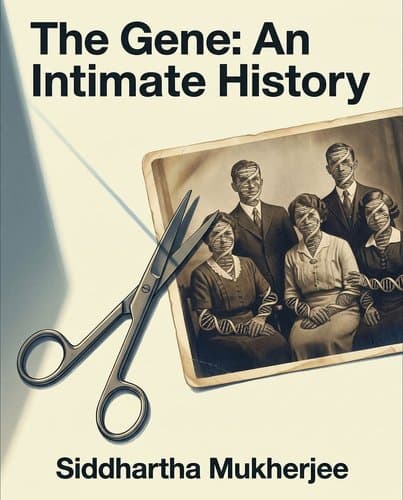
27276428_the-gene
by Siddhartha Mukherjee
From a family haunted by hereditary madness to the CRISPR revolution, Mukherjee reveals why the tool that could cure schizophrenia is the same one that erases…
In Brief
From a family haunted by hereditary madness to the CRISPR revolution, Mukherjee reveals why the tool that could cure schizophrenia is the same one that erases the cognitive variation behind genius—and why our ethics are moving far slower than the science already rewriting us.
Key Ideas
Genetic discovery enables harmful ranking
Eugenics was not a corruption of genetic science — it borrowed genetics' exact vocabulary and logic. Any discovery that enables ranking organisms by heritable 'fitness' will be used to do so, and history suggests the gap between discovery and weaponization is shorter than the time needed to build ethical guardrails.
Irreducible randomness limits genetic predictability
The formula for any complex trait is: genotype + environment + epigenetic triggers + chance. Genes establish possibilities, not certainties. But 'chance' here means genuinely irreducible randomness — not hidden variables science will eventually map — which limits how much predictive power even a complete genome sequence can provide.
Gene editing reshapes identity itself
Separated identical twins share not just physical features but invented humor, recurring nightmares, political conviction, and religiosity — at correlations matching or exceeding type 1 diabetes, considered unequivocally genetic. This means gene editing is not only a medical intervention; it operates on the substrate of identity itself.
Eliminating risk requires eliminating diversity
The genetic variants most strongly associated with schizophrenia risk appear to cluster with variants involved in synaptic configurations linked to divergent cognition. Eliminating risk means eliminating variation — and we currently have no tool precise enough to do one without touching the other.
Ethics lag behind CRISPR acceleration
The acceleration of CRISPR is not reversible: what took viral gene delivery four years to fail at, CRISPR accomplished fourteen times in six months. The philosophical question of where curing ends and erasing begins is not moving at the same speed as the technology — which means the species is already making decisions it hasn't resolved.
Who Should Read This
Science-curious readers interested in Biology and Evolution who want to go beyond the headlines.
The Gene: An Intimate History
By Siddhartha Mukherjee
10 min read
Why does it matter? Because the power to read your genome is already the power to rewrite it — and no one knows where curing ends and erasing begins.
Most people arrive at genetics through medicine. It explains inherited disease, might someday fix it. Reasonable. Also only half the story. Siddhartha Mukherjee opens not in a laboratory but in a visiting room in Calcutta, watching his cousin sit across from him, barely recognizable — the aliveness behind his eyes gone. The madness is hereditary. The family has circled this knowledge for decades without saying it aloud. What they couldn't have known is that the decades they were living through would end with scientists holding tools capable of rewriting the instructions that shaped them. That's where this book turns dangerous. Not because the science is alarming — because the science is working. The same knowledge that might spare a future Moni from his suffering could also erase the very variation that makes us who we are. There's no clean line between curing a disease and erasing a person. This book is the argument.
The Gene Becomes Real When the Subject Is Someone You Love
In the winter of 2012, Siddhartha Mukherjee traveled with his father to a psychiatric institution in Calcutta to visit his cousin Moni, whom he hadn't seen in nearly two decades. He expected to recognize him. He did not. Moni was forty-eight but looked close to sixty, his body reshaped by years on antipsychotics, his gait the tentative shuffle of someone just learning to walk. When Mukherjee mentioned his sister's name, Moni asked whether he'd married her. Their conversation moved forward like a press interview, Moni addressing him as a journalist who'd materialized from nowhere.
But the detail that stopped Mukherjee wasn't the memory loss or the shuffling gait. The Bengali word moni means gem, and in common use it also names the sparkling points of light at the center of each eye. What Moni had lost, precisely and completely, was the thing his name described. Whatever used to animate his eyes had been extinguished — daubed over in gray, as though someone had crept in with a tiny brush and canceled the light.
That visit opens The Gene, and the family it introduces is the book's moral engine. Three members of Mukherjee's family were overtaken by mental illness: Rajesh, who burned through escalating cycles of mania until he died at twenty-two; Jagu, who retreated into a private paranoid world and eventually vanished into a religious sect; and Moni, decades later. Moni recapitulated Jagu's illness so faithfully — voices commanding him to act, the same slow withdrawal, the same voluntary institutionalization — that the grandmother's earlier theory simply collapsed. She had believed the family's madness was caused by the trauma of Partition. But Moni had never been displaced. He'd lived in Calcutta his entire life. The pattern was coming from inside.
Mukherjee discloses all of this to his future wife before proposing: the family history, the pattern. That is what skin in the game looks like. He is also a father who can't entirely stop himself from wondering what his daughters' genomes might eventually say.
[Author: confirm "daubed over in gray, as though someone had crept in with a tiny brush and canceled the light" is sufficiently paraphrased from Mukherjee's prose for copyright.]
Sixty Years After Mendel's Peas, a Rape Victim Was Sterilized in His Name
Eugenics didn't distort genetic science. It borrowed its vocabulary (discrete heritable units, variant fitness, transmissible traits) and followed its logic to a place ethical thinking hadn't gone yet. The distance between Mendel's monastery garden and a surgical room in Virginia was sixty-two years.
William Bateson knew where the logic pointed the moment he named the field. When he coined "genetics" in 1905, he left a warning you can still read today: "In some country, at some time not, perhaps, far distant, that power will be applied to control the composition of a nation." Any framework for ranking organisms by heritable fitness will eventually be used to rank organisms by heritable fitness. That's not an irony — it's a law.
Carrie Buck was barely twenty-one when the law reached her. She had been raped by her foster family's nephew and became pregnant; her foster parents resolved this by having her declared mentally deficient. The same category had already been applied to her mother Emma, who had been interned at the Virginia State Colony for Epileptics and Feebleminded after being arrested for vagrancy. Emma wasn't mentally ill in any documented sense. She was poor, sometimes sold sex, and drank. The colony had no public transportation in or out. Patients rarely left.
Carrie's infant daughter Vivian was examined by a social worker who testified, with evident uncertainty, that the baby had "a look about it that is not quite normal." Three generations: exactly what colony superintendent Albert Priddy needed to take to the courts and establish a precedent for mass sterilization. He wasn't distorting anything. College genetics textbooks assigned eugenics research alongside Mendel's ratios. Priddy said imbecility and criminality were heritable in the same discrete way that seed color was heritable in peas. He applied what the field had given him.
The Supreme Court voted 8-to-1 to uphold the forced sterilization. Oliver Wendell Holmes, celebrated for his skepticism of received wisdom, wrote the majority. He compared the procedure to mandatory vaccination, summarized three generations of a family he'd never met, and wrote that "three generations of imbeciles is enough." That October, Carrie was given morphine, moved to an infirmary, and operated on. Her fallopian tubes were tied and cauterized. She was discharged in good health.
Sixty-two years earlier, Mendel had been alone in the garden with his forceps, trying to understand something basic about how traits survive across generations. The gap between that solitary inquiry and the surgical room in Lynchburg is exactly how quickly a framework for sorting organisms by heritable worth becomes a mandate to act on it. The next discovery about what those instructions contained would be made the same way: by accident, by theft, and by a race between people who weren't supposed to be racing.
The Discovery That Unlocked Modern Biology Was Made With Data Shared Without Consent
On a Saturday evening in May 1952, while her colleagues were at the pub, Rosalind Franklin set up her X-ray camera, adjusted the humidity in the chamber, and waited. She had already solved what had defeated everyone else: DNA flickers between two forms as it dries, blurring every image. With the molecule held steady by the moisture, the picture she captured that night — "V. Good. Wet Photo," she wrote in her red notebook — was the sharpest X-ray of DNA ever produced.
Several months later, Watson came to King's College to visit Maurice Wilkins. Franklin was still working in her office down the hall when Wilkins walked to a drawer and pulled out Photograph 51. He did not ask her permission. He did not tell her. Watson looked at the image and his pulse went up. The black cross pattern across the film could only mean one thing: DNA was a helix. He didn't write anything down (a mistake he'd made before), so on the train back to Cambridge he reconstructed what he remembered on a newspaper margin. By the time he jumped over his college's back gate, he was certain: DNA had to have two intertwined strands. Important biological objects, he told Crick the next morning, come in pairs.
What followed was quick: cardboard base-pair cutouts, Erwin Chargaff's base-pairing ratios clicking into place (adenine always pairs with thymine, cytosine with guanine), a metal model assembled in the Cavendish basement. The double helix appeared in Nature in April 1953. Watson, Crick, and Wilkins shared the Nobel Prize in 1962. Franklin had died four years earlier, of ovarian cancer at thirty-seven.
The discovery arrived through institutional asymmetry: Wilkins treating Franklin's data as his to share; Watson seizing what he hadn't earned. Mukherjee names this plainly and moves on. The same dynamic is now operating at a different scale: when He Jiankui announced in 2018 that he had CRISPR-edited the germlines of two human embryos, the international scientific community found out at a conference. No oversight body had been consulted. The babies had already been born. The scientists now deciding who gets to rewrite the human germline are the heirs of a tradition that has never been careful about who owns a discovery, or who gets to decide what comes next.
Separated at Birth, They Dyed Their Hair the Same Shade of Auburn — Genes Encode More of You Than Experience Can Overwrite
Daphne and Barbara were raised in different Englands. Daphne's adoptive father was a prosperous metallurgist; Barbara's was a municipal gardener. In 1950s Britain, those two lives occupied nearly separate worlds: different schools, different accents, different expectations, different futures. They had been given up for adoption as infants by an unmarried Finnish student and had never met. Every received idea about identity — class, schooling, the world you grew up in — said they should have become very different people.
When University of Minnesota psychologist Thomas Bouchard brought them to Minnesota for his study of twins raised apart, researchers had the same reaction: these two were going to be difficult to study. Both burst into laughter at the smallest provocation; the staff called them the giggle twins. They played pranks on the researchers and on each other. Both were exactly five feet three inches tall, with crooked fingers. Both had dyed their hair an unusual shade of auburn (not the same brand, but the same choice, independently arrived at). Both had fallen down stairs as children and broken their ankles, developed a fear of heights, and enrolled in ballroom dancing lessons to work through it. Both had met their husbands at those lessons.
The detail hardest to explain away isn't the height or the hair. It's the dancing. Two women raised at opposite ends of the English class system, who had no idea the other existed, each broke an ankle, each developed the same fear, and each found the same solution, which led both of them to their husbands. Coincidence starts to lose meaning when you find it repeating across study after study.
Bouchard's study compiled data from 56 pairs of separated identical twins. The correlation for IQ came out at 0.70. The correlation for personality, temperament, political attitudes, and religiosity landed at 0.50 to 0.60, nearly identical to the correlations found in twins raised together. For comparison: the concordance rate for type 1 diabetes, a disease scientists consider unambiguously genetic, is 0.35. Genes explained more of who these people were — their politics, their faith, their sense of humor — than a shared childhood did.
What the separated-twin data does to your sense of self is something like vertigo. The story you've been telling yourself — that you are primarily the product of what happened to you, who raised you, what you read, where you lived — turns out to be only partly true, and perhaps not the largest part. Much of what you experience as choice was already drafted before you were born.
That's unsettling enough as a fact about personhood. It becomes a different kind of problem when you consider that scientists are now developing the tools to edit those drafts. If genes encode the color of your eyes and, apparently, the shade you'd independently choose to dye your hair, the fear you'd develop after a specific injury, the way you'd find love, then rewriting genes isn't correcting a blueprint. It's rewriting a person.
The CRISPR Scissors Cannot Tell Schizophrenia from the People Who Had It
What if the genetic variants that raise schizophrenia risk are also involved in building the synaptic architecture that underlies certain forms of creative cognition — and no sequence in the human genome addresses one without touching the other?
This is not a speculative worry. In January 2016, researchers identified C4A and C4B, gene variants long associated with elevated schizophrenia risk, as key drivers of synaptic pruning in the developing brain. The brain builds more synaptic connections than it needs, then cuts the excess throughout childhood and into early adulthood; the C4 proteins appear to direct that pruning. Elevated C4 activity means over-pruning, which means disrupted connectivity, which appears to underlie the cognitive collapse at the heart of the illness. The same gene variants turn up in sporadic autism and bipolar disorder. And the broader network of genes implicated in schizophrenia risk (not just C4, but variants scattered across at least 108 chromosomal regions) overlaps with the configurations associated with what Mukherjee calls "creative effervescence": the elevated cognitive drive that connects Byron's mania to Rajesh's all-night problem-solving marathon and to whatever was sparkling in Moni's eyes before it was extinguished.
Mukherjee doesn't romanticize this. The devastation is real. But you cannot separate the phenotype of the illness from the phenotype of whatever else those same configurations are doing in different people under different circumstances. And if the phenotypes can't be separated, the genotypes can't be either.
CRISPR arrived fast, and without ceremony. A postdoctoral researcher in Mukherjee's lab spent four years attempting to introduce a single defined genetic change using standard viral delivery, without success. After switching to CRISPR in 2015, she introduced fourteen targeted alterations in fourteen human genomes, including embryonic stem cells, in six months. Meanwhile, a team in China had already edited human embryos (unintended mutations appearing in a third of them) and was already refining the approach for another attempt. The technology is not waiting for the philosophy.
Whatever guardrails he proposes, the same problem applies — they define what counts as suffering, and the people doing the defining are the ones whose genomes are already considered normal.
The book leaves you with a posture rather than a verdict. Any tool precise enough to rewrite the heritable instructions of a human being is also precise enough to rewrite something that wasn't on the list. Illness might progressively vanish, but so might identity. Traumas might be erased, but so might history. Mutants would be eliminated, but so would human variation. The scissors exist. The question of what they're actually cutting remains open.
The Question the Genome Cannot Answer for Itself
The circle that closes here is not a comfortable one. For most of human history, the genome was fate — something you inherited, endured, passed on. Now it is also a decision. Organisms built by genes can rewrite the genes that build organisms. That loop doesn't resolve; it just spins faster. The CRISPR scissors that might give a child born without an immune system a full life cannot distinguish between the mutation that hollowed out Moni's eyes and the variation that first lit them — and those may be, at some level we don't yet see clearly, the same thing. You are alive at the moment the species can edit its own memory, its own future, its own capacity for variation. Mukherjee doesn't tell you what to do with that. Neither does anyone else. That, precisely, is the problem you've inherited.
Notable Quotes
“Buck was packed off to the colony in Lynchburg.”
“in 1924, came in three distinct flavors: idiot, moron, and imbecile. Of these, an idiot was the easiest to classify—the US Bureau of the Census defined the term as a”
“She was admitted to the colony. She would spend the rest of her lifetime in its confines. Before her mother had been carted off to Lynchburg in 1920, Carrie Buck had led an impoverished but still-normal childhood. A school report from 1918, when she was twelve, noted that she was”
Frequently Asked Questions
- How does eugenics relate to genetic science according to The Gene?
- According to Mukherjee, eugenics was not a corruption of genetic science — it borrowed genetics' exact vocabulary and logic. Any discovery enabling the ranking of organisms by heritable 'fitness' will be used to do so, and history suggests the gap between genetic discovery and weaponization is shorter than the time needed to build ethical guardrails. The book reveals that the same tools enabling genetic medicine also enable genetic control, demonstrating this is a fundamental structural problem in scientific discovery rather than merely historical misuse.
- What determines complex traits according to The Gene?
- The formula for any complex trait involves genotype, environment, epigenetic triggers, and chance. Genes establish possibilities, not certainties. Crucially, "chance" means genuinely irreducible randomness, not hidden variables science will eventually map. This fundamental limitation constrains how much predictive power even a complete genome sequence can provide. Mukherjee demonstrates that genetic determinism is unfounded: understanding the probabilistic relationship between genetic code and characteristics helps readers grasp why genes influence but do not determine identity, personality, and complex human traits.
- What do separated identical twins reveal about genes and identity?
- Separated identical twins share not just physical features but invented humor, recurring nightmares, political conviction, and religiosity at correlations matching or exceeding type 1 diabetes, considered unequivocally genetic. This evidence demonstrates that genes shape identity beyond disease prevention. Gene editing therefore operates not only as medical intervention but on the substrate of identity itself. The implications are profound: editing genes means potentially altering fundamental aspects of personality, belief systems, and psychological characteristics that constitute core elements of individual identity.
- Why does CRISPR technology raise ethical concerns in The Gene?
- "The acceleration of CRISPR is not reversible: what took viral gene delivery four years to fail at, CRISPR accomplished fourteen times in six months." Mukherjee argues that "the philosophical question of where curing ends and erasing begins is not moving at the same speed as the technology." This temporal mismatch creates a critical problem: the species is acquiring unprecedented power to rewrite the genome while fundamental ethical questions about treatment versus enhancement remain unresolved. Decisions about genetic editing are being made without adequate moral deliberation.
Related Book Summaries

Read the full summary of 27276428_the-gene on InShort