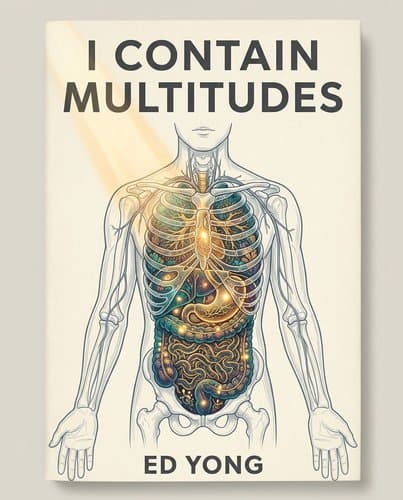
27213168_i-contain-multitudes
by Ed Yong
The trillions of microbes living inside you aren't passengers—they shape your immune system, gut health, and even brain development, making the concept of the…
In Brief
I Contain Multitudes (Augu) reveals that every animal — including every human — is a walking ecosystem of trillions of microbes that build, defend, and regulate the body. Drawing on cutting-edge microbiology, Ed Yong shows how diet, antibiotics, and modern hygiene reshape these communities, and what that means for immunity, disease, and long-term health.
Key Ideas
Antibiotics destroy beneficial bacteria alongside pathogens
Every antibiotic course kills beneficial microbes alongside pathogens — the collateral damage is real and compounding; reserve antibiotics for genuine necessity and ask your doctor whether a course is truly required.
Fiber feeds bacteria that strengthen gut
Fiber doesn't just aid digestion — it feeds the specific gut bacteria that seal your gut wall, calibrate your immune system, and produce short-chain fatty acids your cells run on; a low-fiber diet is a starvation diet for your microbiome.
Breastfeeding cultivates critical infant microbiome health
Breastfeeding is fundamentally a microbial act: the indigestible sugars in human milk (HMOs) exist specifically to cultivate B. infantis, which then nourishes the infant, blocks pathogens, and releases compounds linked to brain development — formula cannot replicate this.
Probiotic marketing misrepresents actual colonization success
The word 'probiotic' on food packaging means almost nothing — commercial strains were chosen for shelf stability, not gut fitness, and most pass through without colonizing. The candidates that actually matter (Akkermansia muciniphila, Faecalibacterium prausnitzii, B. infantis) are only now entering clinical trials.
Dysbiosis compounds; diversity is the moat
Dysbiosis is self-accelerating: once a microbial community tips toward pathogenic species — whether in a coral reef, a human gut, or a hospital room — the disruption compounds. Diversity is the moat that keeps pathogens out, and excessive cleaning or antibiotic use removes that moat.
Fecal transplants cure resistant infections reliably
Fecal microbiome transplants already cure antibiotic-resistant C. difficile infections at a 94% rate, versus 27% for the best antibiotic. If you or someone you know faces recurrent C. diff, FMT is not experimental — it is the evidence-based first choice.
Who Should Read This
Science-curious readers interested in Biology and Nutrition who want to go beyond the headlines.
I Contain Multitudes
By Ed Yong
8 min read
Why does it matter? Because the "individual" you think you are is a comfortable fiction.
You think of your body as yours — a single organism, steering itself through a world of microbial threat. That assumption is intuitive, medically reinforced, and almost entirely wrong. When scientists try to draw the line between where you end and your microbes begin — anatomically, developmentally, genetically, immunologically — every framework gives out at the same place. The microbes aren't passengers. They help construct your gut architecture, calibrate your immune system, and reach into brain chemistry in ways that still unsettle the researchers who proved it. Ed Yong's I Contain Multitudes doesn't make the case that microbes matter to your health. It makes the case that the category of "you" was always a comfortable fiction. What you actually are is an ecosystem — stranger and older and more entangled than any bounded self could ever be.
You Are Not a Single Organism — You Never Were
At San Diego Zoo on a summer afternoon, Rob Knight, a microbiome researcher, presses a cotton swab against the nose of Baba, a white-bellied pangolin. Baba is coiled around a zookeeper's waist, utterly unbothered, while Knight rolls the bud across his face for a few seconds and lifts it away. The white fuzz now holds millions of bacterial cells harvested from one animal's snout. Ed Yong notes that the same exercise could be run on Knight, on himself, on you.
There's no clean line between you and your microbiome. Every definition people use to draw it fails.
We treat bacteria as invaders because the ones that made history were killers. Fewer than a hundred bacterial species cause infectious disease in humans; the thousands colonizing your gut right now are mostly harmless, and many are essential. The bacteria-as-enemies framing is a cultural scar from the pathogen minority — a fragment of microbial life mistaken for the whole.
The harder question is what this does to our sense of self. Take the developmental definition — everything that grows from a single fertilized egg — and you find squid and zebrafish that can't build normal bodies without microbial instructions, or insects that rely on bacterial enzymes to complete metabolic reactions their own cells can't manage. Take the genetic definition, and microbial DNA permanently integrated into host genomes blurs the line further.
Then there's the immune system. It's supposed to be the arbiter of self versus non-self, the body's mechanism for drawing exactly this distinction. But it was partly built by microbes during early development. The cells and signals that learn to recognize what belongs to you were shaped, in infancy, by the same organisms they're meant to police.
Every framework collapses. The boundary between you and your microbiome was never a biological discovery. It was a working assumption, and the evidence keeps refusing to uphold it.
Microbes Don't Just Live in Your Body — They Helped Build It
Think of your genome as the materials list for a building: lumber, wiring, concrete. The blueprint is written somewhere else. That somewhere else, it turns out, includes your microbes.
Margaret McFall-Ngai spent nearly three decades studying a thumb-sized Hawaiian bobtail squid to establish exactly this. The squid houses luminous bacteria called Vibrio fischeri in chambers on its underside, which cast a faint downward glow that cancels the squid's silhouette against moonlit reef water. What McFall-Ngai discovered is how this partnership forms — and it is nothing like a tenant moving in.
When a hatchling squid first encounters V. fischeri, nothing happens. Two cells, still nothing. But the moment five cells make contact with the squid's light organ, scores of the squid's own genes switch on. Some produce antimicrobial chemicals — a targeted cocktail that kills every competing microbe while leaving V. fischeri unharmed. Others release enzymes that break down the squid's surface tissue, generating a signal that draws in more V. fischeri from the surrounding water. V. fischeri starts outnumbered a thousand to one, yet this single species engineers the host's surface into terrain that kills every competitor and welcomes only itself. Then it moves inside.
Once V. fischeri reaches the organ's inner crypts, the squid's body remodels around it: the crypts widen and fill with cells that envelop the bacteria, the entrance narrows, the ducts constrict, the cilia waste away. The light organ locks into its mature form and will never accept another colonist. McFall-Ngai recognized how extraordinary this was: a bacterium had used the host's own genetic machinery to drive development. The squid's genome contains the capacity to build the organ; V. fischeri determines when and how that capacity gets used.
The same script runs in mammals: germ-free mice grow stunted intestines, and a single microbe can rebuild them.
Development is not a solo performance. An animal's genome sets the stage, but microbes have always had lines in the script.
The Line Between 'Good Bacteria' and 'Bad Bacteria' Is One That Scientists Cannot Draw
What separates a "good" bacterium from a "bad" one? The health industry has a confident answer: good bacteria are the ones in probiotic yogurt; bad ones are the ones your doctor destroys with antibiotics. Yong's response is to hand you a single microbe and ask you to put it in one category.
Wolbachia was first collected from mosquitoes near Boston in 1924, formally named in 1936, then largely forgotten. When scientists started reading microbial DNA in the 1980s, they kept stumbling over it; researchers studying insects on separate continents realized they were all tracking the same organism. Wolbachia passes to the next generation only through eggs, not sperm, which makes females its vehicle and males a dead end. So it manipulates ruthlessly. In the blue-moon butterflies of Fiji and Samoa, it kills male embryos outright, tipping the sex ratio to a hundred females per male. In woodlice, it hijacks male hormone production and converts males into females. In certain wasps, it enables females to reproduce entirely by cloning; treat them with antibiotics and males reappear. It infects at least forty percent of all arthropod species.
Call that parasitism. Then explain the apple orchards of Europe in autumn. Among the yellowing leaves you can find small green islands resisting the seasonal die-off: the work of leaf-miner caterpillars that almost all carry Wolbachia. The bacterium releases hormones that keep the leaf alive long enough for the caterpillar inside to reach adulthood. Cure the Wolbachia and the leaf yellows on schedule, drops, and takes the caterpillar with it — still a larva, weeks short of pupation.
Same organism, opposite outcomes. The variable is the host and the relationship, not the microbe. Mutualist and pathogen aren't things a bacterium is — they're states it occupies. Gut bacteria are essential inside the gut and lethal if they breach the gut wall into the bloodstream; the species doesn't change, the address does. "Good bacteria" names a relationship under specific conditions. Change the conditions and the label goes with them.
A Healthy Ecosystem Dies the Same Way Whether It's a Coral Reef or a Human Gut
The clearest natural experiment in how ecosystems tip into disease took place not in a lab but underwater, in the middle of the Pacific.
In August 2005, marine biologist Forest Rohwer plunged into the waters of Kingman Reef, a sliver of rock three and a half thousand miles from California, uninhabited by anyone. The water was so clear it felt like floating in air. Fifty grey reef sharks circled him, each one roughly human-sized. Manta rays. Schools of snapper. Forty-five percent coral cover everywhere he looked. It was, he later wrote, a Hollywood reef.
Seven hundred kilometers to the south lay Christmas Island, home to around five thousand people. There, Rohwer found some of the deadest reefs he'd ever seen: ghost-pale coral skeletons draped in slime, turbid water flecked with particles, no sharks in a hundred hours of diving. Captain Cook's navigator had documented "sharks innumerable" there in 1777. Settlement began in earnest in 1888. That was all it took.
The mechanism took years to trace. Humans kill grazers (the surgeonfish and parrotfish that browse fleshy algae down to lawn height). Without grazers, algae spread. As they spread, they leach dissolved organic carbon into the water — sugars, what Rohwer calls hamburgers for microbes. Normally those sugars travel up the food chain, ending up locked in sharks' flesh. Once the sharks are gone, the sugars stay at the bottom, fueling an explosion of pathogenic bacteria. Around Kingman, ten percent of waterborne microbes belonged to disease-causing families. Around Christmas Island, fifty percent did. The corals were drowning in a soup brewed from their own ecosystem's collapse — and being destroyed by microbes they'd always carried, now suddenly overfed and out of control.
Jennifer Smith, who was on the same expedition, confirmed the mechanism with an elegant experiment: she separated coral and algae in adjacent tanks with a filter fine enough to block microbes but not dissolved chemicals. Within two days the coral was dead. Antibiotics saved it. The algae hadn't sent in outside attackers; they had armed the corals' own resident microbes against them.
This is dysbiosis: normally benign microbes shifting into a pathogenic configuration because their ecosystem has been disrupted. Modern medicine has spent decades inadvertently engineering this same failure: antibiotics that flatten diversity, processed diets that starve what survives. The reef and the gut fail the same way.
Microbes Are an Evolutionary Upgrade You Can Acquire in Days
The coral reef story shows how fast things can go wrong. The woodrat story shows how fast they can be fixed, and why the microbiome makes that possible at all.
Evolution has always had a time problem. Mutations accumulate slowly, generation by generation, and a species facing a new predator or a new toxic plant usually just loses. But the microbiome changes the math: it is a layer of biology that can be borrowed, shared, and updated on timescales closer to weeks than millennia.
The clearest demonstration lives in the American desert. The creosote bush arrived in the Mojave around 17,000 years ago, and the woodrats there eventually learned to eat it — its resin, which would kill a lab rat many times over, bothers them not at all. Their counterparts in the Great Basin, where creosote never spread, have no such tolerance. The ecologist Kevin Kohl wanted to know where that tolerance actually lives: in the rodents' own genes, or somewhere more portable.
He gave naive Great Basin woodrats a fecal transplant from experienced Mojave ones. Within days, they could eat creosote resin without harm. The proof was in their urine: creosote toxins darken and discolor a rodent's waste. After the transplant, it ran pale and almost translucent. The gut bacteria from the Mojave animals were breaking down the poison before it could reach the bloodstream.
To confirm this, Kohl ran the reverse: he gave experienced Mojave woodrats antibiotics that stripped their gut bacteria away. Fed creosote-spiked food, they performed worse than naive Great Basin rodents ever had. In two weeks, he had erased 17,000 years of accumulated tolerance.
17,000 years acquired, two weeks erased. That gap marks the difference between what your genome can do and what your microbiome can do. The genome is a record of what worked across geological time. The microbiome is a library of currently running solutions you can borrow today.
The microbe does the slow work; the animal borrows the result. The bacteria evolved creosote-breaking enzymes over many generations; the woodrat acquired the capability in a meal. Your genome is a fixed inheritance. Your microbiome is a loan you can take out today.
The Medicine That Actually Works Treats Your Microbiome Like a Garden, Not a Battlefield
On January 4, 2011, just before dawn in Cairns, Australia, Scott O'Neill held a small plastic cup and walked toward a suburban house. About twenty people were watching. He'd spent decades working toward this moment. "Are you ready?" he asked. The crowd cheered. He pulled off the lid, and a few dozen mosquitoes flew out into the morning air.
These were Aedes aegypti — the mosquitoes that spread dengue fever to 400 million people a year. O'Neill was releasing more of them. Each one carried Wolbachia (the same bacterium, now weaponized differently), which blocks dengue viruses from replicating inside the mosquito's body. His strategy was conversion, not extermination. Wolbachia spreads via a reproductive trick: infected females produce more viable eggs than uninfected ones, so the bacterium gradually takes over. Release enough infected mosquitoes, then wait.
Within four months, 80 to 90 percent of mosquitoes in those Cairns suburbs carried Wolbachia. No new dengue cases have been recorded since.
The logic is purely ecological. You don't drain the swamp; you change what lives in it. Every microbiome intervention that has actually worked treats microbial communities as ecosystems to be shaped, not enemies to destroy.
The same year O'Neill opened his cup, a Dutch clinical team was demonstrating the same principle inside human bodies. Patients with recurring Clostridium difficile infections — brutal, antibiotic-resistant diarrhea — were randomly assigned to receive vancomycin, the standard antibiotic, or a fecal microbiota transplant: a dose of healthy donor stool carrying a functioning microbial ecosystem. The trial stopped early. Vancomycin had cured 27 percent. The transplant had cured 94. Researchers deemed it unethical to keep giving anyone the antibiotic. FMT shows up in a fourth-century Chinese emergency medicine text. People have done this for 1,700 years without knowing why it worked. Now they do: C. diff thrives in a gut stripped of diversity by antibiotics. A transplant floods that vacancy with a competing ecosystem and crowds it out.
This is what it looks like at every scale: a continent, a gut, a hospital ward. Hospital air, sealed against the outdoors, fills with patient-derived pathogens. Outdoor air is full of harmless environmental microbes. Florence Nightingale noticed during the Crimean War that patients recovered better when she opened windows. She had no knowledge of microbiology. She just observed that it worked.
That changes what medicine can be.
What You Can't Unsee After This
Stand outside a zoo long enough and you'll notice something: every creature in every enclosure is itself an enclosure. The giraffe is a walking continent of microbes. So is the researcher studying it. So are you. Yong's book doesn't ask you to feel differently about yourself — it asks you to see more accurately. And once you do, the everyday decisions start to look different: the antibiotic prescription you don't push back on, the formula versus the breast, the hospital with the sealed windows. These aren't just medical choices. They're ecosystem management. The collaboration has always been running. We are, improbably, the first partners who know it exists.
Notable Quotes
“mice don't have autism, which is a human neurobiological construct shaped in part by social and cultural perceptions of what is considered normal”
“I don't think anyone would ever claim that you can reproduce autism in a mouse model,”
“It's inherently limited, but it is what it is.”
Frequently Asked Questions
- How do antibiotics affect your microbiome?
- Every antibiotic course kills beneficial microbes alongside pathogens, and "the collateral damage is real and compounding." Yong urges reserving antibiotics for genuine necessity and asking your doctor whether a course is truly required. Many infections resolve on their own, and unnecessary antibiotic use depletes the microbial communities defending your body. The microbiome can recover, but repeated disruptions make recovery increasingly difficult. This cumulative damage has long-term consequences for immunity and health. Being selective about antibiotic use preserves the microbial defenses your body depends on.
- Why is fiber important for your microbiome?
- Fiber feeds specific gut bacteria that seal the gut wall, calibrate the immune system, and produce short-chain fatty acids your cells run on. Yong emphasizes that "a low-fiber diet is a starvation diet for your microbiome." These bacteria are essential for maintaining the intestinal barrier, preventing pathogens from crossing into the bloodstream, and regulating immune responses. The short-chain fatty acids they produce power cells throughout the body. Without adequate fiber, the microbial communities that keep you healthy gradually weaken, leading to increased inflammation and disease risk.
- What is dysbiosis and why does microbial diversity matter?
- Dysbiosis—when a microbial community tips toward pathogenic species—is self-accelerating, occurring in coral reefs, human guts, and hospital rooms. Once disruption begins, it compounds. "Diversity is the moat that keeps pathogens out," and excessive cleaning or antibiotic use removes this protection. When beneficial bacteria decline, pathogenic ones gain space and resources, reproducing faster. This accelerates further decline of competitors. Recovery becomes harder because initial disruption creates conditions favoring pathogens. Maintaining microbial diversity through cautious antibiotic use and diverse fiber intake protects against cascading dysfunction.
- Is fecal microbiome transplant effective for treating C. difficile?
- Fecal microbiome transplants cure antibiotic-resistant C. difficile infections at a 94% rate, compared to 27% for the best antibiotic. According to Yong, "FMT is not experimental—it is the evidence-based first choice." A single transplant of healthy microbiota restores the protective microbial community that prevents C. difficile overgrowth. Conventional antibiotics can kill C. difficile but fail to restore microbiome diversity, allowing C. difficile to resurge when treatment stops. FMT addresses the root problem: restoring the microbial ecosystem that keeps pathogens suppressed.
Related Book Summaries
Read the full summary of 27213168_i-contain-multitudes on InShort