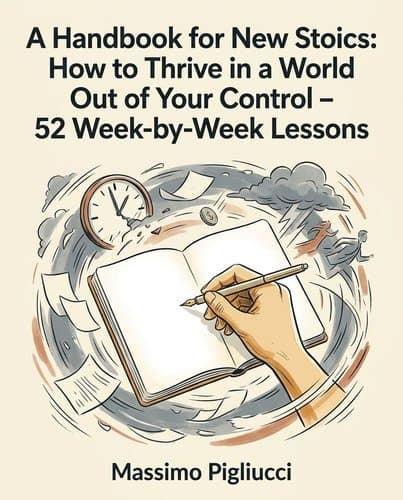
42085305_a-handbook-for-new-stoics
by Massimo Pigliucci
Suffering isn't caused by bad events—it's caused by wanting outcomes you can't control. This 52-week Stoic training program systematically rewires your desires…
In Brief
A Handbook for New Stoics: How to Thrive in a World Out of Your Control - 52 Week-by-Week Lessons (2019) presents Stoic philosophy as a practical psychological training program. It teaches readers to redirect desire away from external outcomes — which are never fully controllable — toward their own judgment and conduct, which always are.
Key Ideas
Focus effort on what you control
When something outside your control goes wrong, don't try to not care about the outcome — redirect your desire from the outcome to the part you fully control: your effort, your preparation, your conduct. That's the only desire that cannot fail.
Rehearse calm before stressful events
Before any stressful event, spend 5-10 minutes imagining specifically what could go wrong and rehearsing your calm response. This is premeditatio malorum — not pessimism but removing the sting of surprise, which is what turns manageable setbacks into crises.
Shift perspective with second-person writing
When you're stuck inside your own anxiety, write about your problem in the second person or by your own name ('Here's what you're facing, Rob'). Marcus Aurelius used this technique throughout the Meditations. The pronoun shift alone activates the cooler perspective you'd naturally extend to a friend.
Voluntary discomfort builds nervous resilience
Once a week, deliberately do something mildly uncomfortable — a cold shower, a smaller lunch, the longest checkout line — not as punishment but as proof to your nervous system that discomfort is survivable. Voluntary exposure to minor hardship is how you stop being ambushed by involuntary hardship.
Delay anger at first physical signal
At the first physical signal of anger (the adrenaline rush, the heat in your face), do not try to reason it away — just delay. Count slowly, take a walk, recite the alphabet. The intervention window is Phase 2, between the involuntary physical reaction and full emotional assent. Wait too long and reason has left the room.
Nightly review prevents repeated failures
Each night, review the day with three questions: Where did I go wrong? What did I do right? What remains undone? Pardon yourself for failures — the past is outside your control — but commit not to repeat them. This is Seneca's practice and it's structurally identical to what psychologists now call cognitive journaling.
Who Should Read This
Thoughtful readers interested in Stoicism and Self-Improvement willing to slow down and wrestle with ideas.
A Handbook for New Stoics: How to Thrive in a World Out of Your Control - 52 Week-by-Week Lessons
By Massimo Pigliucci & Gregory Lopez
10 min read
Why does it matter? Because what you call bad luck is mostly misplaced judgment — and judgment can be retrained.
Stoicism has an image problem. The word has come to mean something like: endure quietly, feel nothing, demonstrate toughness by showing no evidence of being human. That version is useless — and it's not what the Stoics taught.
What they actually argued was precise and almost scandalous: your suffering isn't produced by circumstances. It's produced by the judgments you attach to circumstances — and judgment is the one thing that is always, completely, yours. Not luck. Not talent. Not other people's behavior. Yours.
This book is the 52-week training program that follows from that claim. Not philosophy as uplift, but philosophy as systematic practice: Seneca's letters alongside clinical research, fictional case studies, and weekly exercises designed to retrain where your desires and aversions (the things you chase and the things you flee) actually land. The goal isn't unshakeable calm. It's happiness that was never contingent on the world behaving.
Your Suffering Isn't About What Happened — It's About What You Expected to Happen
Mike walks into his 25-year college reunion and looks around. Nothing catastrophically wrong happened to him tonight. No one insulted him, no disaster struck. Yet he feels like a failure. His classmates Aziz and Saliah are still together, a couple since sophomore year, while Mike's own marriage barely made it five years. His old roommate Steve still has his athletic build while Mike's potbelly has only grown. Steve made it to the C-suite; Mike stagnates in middle management, selling products he doesn't believe in. The room is ordinary, but Mike is quietly devastated.
Nothing in that room caused his suffering. The cause is the gap between what he expected his life to look like and what it became — a gap that lives entirely inside his head.
The Stoic diagnosis is more precise than it sounds. Epictetus, a man who started life as a slave and became one of Rome's most celebrated teachers, opens his practical guide to Stoicism with a single, almost obvious observation: some things are completely within your control (your judgments, your intentions, your deliberate choices) and everything else is not. Your body, your reputation, your career, other people's opinions of you: none of these are fully yours to determine, no matter how hard you try.
The source of suffering is staking your peace of mind on outcomes you can't guarantee. The authors call this the "best bet argument": when you bet your happiness on variables outside your control, you've voluntarily handed a portion of your wellbeing to random chance. Lose that bet enough times and the losses start to feel like facts about who you are, not consequences of a bad wager. Mike didn't just have a difficult marriage and a middling career. He built an internal ledger where his worth depended on results that were never fully his to command, then absorbed the losses when the dice came up short.
Beneath every external outcome (the promotion, the relationship, the physique) there's a layer that belongs entirely to you: your effort, your values, how you conduct yourself. The Greeks called what that produces ataraxia: serenity. When your desires are aimed only at what you can actually guarantee, you always get what you want. Not because the world cooperates, but because you've stopped asking it to.
There Is One Category of Goal You Can Always Achieve
The dichotomy of control becomes genuinely useful only when you notice what it's actually proposing: not that you lower your ambitions, but that you change the object of desire entirely.
Consider the promotion scenario the authors use. You want a promotion. That desire is entirely reasonable, but it's aimed at the wrong target. Whether you get promoted depends on your colleagues' performance, your boss's mood on a given Thursday, office politics you can't see, maybe even whether it rains and your boss gets stuck in traffic and arrives irritable. You've built your emotional wellbeing on a variable you don't control.
The Stoic move is precise. You don't stop caring about the promotion; you shift what you're actually desiring: instead of wanting the outcome, you want to do the best possible work. Those aren't the same thing. The outcome isn't yours to guarantee, but the quality of your effort is entirely yours. When your desire is aimed at doing the best work you're capable of, you cannot fail. Not "probably won't fail" — cannot. Failure becomes logically impossible, because the thing you wanted was the effort, and the effort is something only you supply. Excellent work probably improves your chances of promotion anyway, but now the promotion is a bonus, not the measure of your success.
Alice's two-column table from Week 1 shows how far this logic extends. What she's really mapping is where her initial judgment landed: desire begins with a judgment about what's worth having, and the sequence only stays yours if that first step is aimed at what you can actually deliver. Going into a nerve-wracking meeting with her boss, she lists what was and wasn't in her control. The most revealing row: conscious nervous thoughts belonged on the left (her control), while the physical sensations of anxiety, the racing heart, the body's automatic alarm, belonged on the right. Even inside your own mind, not everything is yours. But once the automatic response fires, what you tell yourself next is entirely yours. The involuntary reaction is weather. Your interpretation of it is a choice.
That's the Stoic shift in miniature. The meeting didn't produce Alice's dread. Her judgment did — the belief that the meeting's outcome would determine something important about her worth. Aim the judgment at the effort instead of the result, and the emotional calculus changes with it. You haven't given anything up. You've just stopped betting on a game you were never running.
Reading About Stoicism Is About as Useful as Reading About Riding a Bicycle
Think about the last time someone explained a physical skill with words alone. The explanation was probably accurate. And the moment you actually tried it, you discovered that knowing what to do and being able to do it are not remotely the same thing. Understanding lives in one place; the trained response lives somewhere else, built through repetition until it runs without thinking.
Week 5 makes this point about Stoicism explicitly: just as no one learns to ride a bicycle from instructions alone, no one becomes virtuous simply by reading Epictetus. You need to practice. And this changes how you read everything in the prior sections. The logic of the dichotomy of control is sound. The argument for aiming desire at effort rather than outcomes is correct. But grasping a principle and having it fire automatically when you're upset, tired, or stuck in traffic are entirely different states, and only the latter changes how you actually behave.
James, late for a job interview he can't afford to miss, sitting in gridlocked traffic, proves the point. At some level he probably knows the traffic is outside his control and his distress is self-inflicted. But when an emotion completely hijacks your reasoning—what the Stoics called a passion—intellectual knowledge is beside the point. James can't bring himself to make the obvious, zero-cost, potentially salvageable phone call to warn the interviewer he's running late. His understanding was genuine. His trained response wasn't there when he needed it.
This is what the book's 52 exercises are engineering: a trained response that gets there first.
Those exercises run across three disciplines. The first is desire: aim your wants only at what you can control, and you always achieve them. The second is action: how you behave toward other people and external events when things go wrong. When a deal falls through, the discipline of action asks not how to recover the deal but how to remain someone you'd recognize. The third is assent: examining the automatic impressions your mind generates before acting on them. Together they map the full psychological sequence: what you pursue, what you do when the world doesn't cooperate, and what you tell yourself between stimulus and response. Cognitive behavioral therapists would recognize this architecture. The Stoics were working the same territory two thousand years earlier, with different vocabulary and equal precision.
Stoics Don't Suppress Grief — They Vaccinate Against It Before It Arrives
Yu Yan sits in the front row at her son's funeral, unable to cope. He died in a motorbike accident. Sudden, senseless. She had practiced Stoicism. She is falling apart anyway.
The authors wouldn't call that a failure. Seneca is explicit: he isn't asking you to sit unmoved at a funeral, to feel nothing when someone you love dies. That numbness, Seneca argues, is a deficiency, not a virtue — the mark of someone who never learned to care, not someone who learned to cope. What the Stoics are after is equanimity, a serenity that holds through both grief and joy, that lets you feel fully without being annihilated by what you feel.
To get there, they propose something that initially sounds like the opposite of compassion. Epictetus advises his students: when you kiss your child goodnight, remind yourself they are mortal. The authors call this the most unsettling instruction in all the Stoic writing that survives. Co-author Massimo admits he cringed reading it as a parent. It sounds like a prescription for constant dread. Who wants to hold their child and think about their death?
The historical context changes the calculation. Marcus Aurelius, the most powerful man in the Western world, had the most famous physician of Roman antiquity as his personal doctor. He had thirteen children. Only four survived to adulthood. When Epictetus wrote that you might kiss your wife and child goodnight and never see them again, this was not philosophical speculation. It was the texture of ordinary Roman life, from the lowest slave to the emperor himself.
We are not ancient Romans. Child mortality is down, life expectancy is up, and medicine has advanced in ways Marcus couldn't have imagined. Loss still arrives without warning: accidents, illness, the thousand forms of irreversible change. The Stoics weren't cultivating dread. They were building immunity before the disease arrived.
The authors describe this practice as a vaccine: deliberate, low-dose exposure to the idea of loss before loss is actual. Week 15 asks you to list things you'd miss if they disappeared — starting with the easy ones and moving toward what scares you. Then work through them over the week: the television on Monday, harder things by Friday. Each day, a concrete when-then prompt anchors the habit. Whenever you sit down to watch TV, you tell yourself, "this will break one day." Not brooding. Just a brief acknowledgment that what's in front of you is temporary.
There's an unexpected side effect: gratitude. People who practice this consistently report appreciating what they have more — because they've stopped treating its continued existence as a given.
Between the Insult and Your Anger, There Is a Moment You Have Never Noticed
Why does knowing you're overreacting make no difference in the moment it's happening? You can be fully aware that your anger is disproportionate, fully convinced it will embarrass you, hurt someone you love, get you fired — and still not stop. Understanding the problem has no purchase on the problem.
Seneca's answer is that you're intervening too late. Modern emotion-regulation research confirms the same structure: physiological arousal fires before conscious evaluation, and the window for rational intervention is the brief cognitive step between noticing the arousal and deciding what it means.
He mapped anger in three phases. The first is involuntary: the adrenaline surge, the flush of heat, the physical alarm your nervous system fires whether you want it to or not. This phase cannot be prevented. The second is brief and cognitive: you recognize what's happening and reach a rapid internal verdict on whether the anger is justified. The third is where assent happens: you've ruled yes, this anger is warranted, and reason steps aside. By phase three, you're not reasoning anymore. You're moving through an emotion that has already claimed you.
The intervention window is phase two. Only phase two.
Emotions aren't responses. They're verdicts. The circumstance presents itself; the mind silently rules on it; the emotion follows from the ruling. Which means the emotion is the product of a judgment, and judgments can be trained.
Epictetus's instruction is almost comically simple: when a harsh impression arises, pause and say it aloud: Stop. You're an impression, a mental image of what happened, and you might be wrong about what it means. Then apply the dichotomy of control. Is what's agitating you actually within your complete power? If not, it cannot threaten what matters: your character, your capacity to act with virtue. What sounds like philosophy-speak is a phase-two intervention, a wedge driven into the space between stimulus and assent, before the automatic slide into phase three.
But the book is honest about the gap between understanding this and actually doing it. Seneca used the image of cloth dyeing: some dyes color fabric on contact; others require the cloth to be steeped many times before the color holds. A maxim understood once colors the surface. A maxim rehearsed daily during calm, built into implementation intentions, returned to before the situations that reliably provoke you. That one eventually permeates the weave. The pause doesn't arrive because you've grasped the structure intellectually. It arrives because you've rehearsed the pause until it becomes the automatic first move.
Here's the inversion: the only thing fully within your control (the assent, the verdict you pass in phase two) is also the only thing generating the emotion. Circumstances don't produce your anger. Your judgment about circumstances does. Your emotional life is more structurally available than it has ever felt — the window is brief, the training is real, and the window is yours.
What the Dog Tied to the Cart Already Knows
The Stoics made a promise that sounds smaller than it is: not that things will go well, but that how things go is never the whole story. Epictetus could be enslaved and remain free in the only sense that finally mattered. The philosophy works on three fronts: what you pursue, how you treat people when things go wrong, and what you tell yourself between stimulus and response. What they found — and what 52 weeks of practice is quietly building in you — is that the dichotomy of control isn't a coping mechanism. It's a structural fact about where your happiness actually lives. Every impression that arrives, from the trivial to the devastating, carries the same question: is this mine to determine? Most of the time, it isn't. Your response always is. Do that work long enough, and you don't merely understand the principle. You become what the practice describes.
Notable Quotes
“since it is listed first (for good reason, as we'll soon see).”
“here is the English translation of hypolepsis, literally”
“(similar to scooping up an idea or viewpoint—you're grabbing under it to grasp or cradle it). These can be types of thoughts, and are not necessarily fully conscious ones. Epictetus may have listed”
Frequently Asked Questions
- What is A Handbook for New Stoics about?
- A Handbook for New Stoics presents Stoic philosophy as a practical psychological training program. It teaches readers to redirect desire away from external outcomes toward their own judgment and conduct, which are fully controllable. Each of the 52 weekly exercises builds mental discipline through concrete practices drawn from Marcus Aurelius, Epictetus, and Seneca. Rather than treating Stoicism as abstract theory, the handbook transforms these ancient insights into actionable techniques for managing anxiety, anger, and setbacks in modern life. The core principle is that only desires directed toward your own judgment and conduct cannot fail.
- What are the key practices taught in A Handbook for New Stoics?
- The handbook teaches six core practices for developing Stoic resilience. These include premeditatio malorum—spending 5-10 minutes imagining what could go wrong and rehearsing calm responses to remove the sting of surprise. The book recommends writing about problems in second person to gain perspective, deliberately exposing yourself to mild discomfort weekly to prove discomfort is survivable, and delaying anger through techniques like counting or walking. Finally, each night practice Seneca's three-question review: "Where did I go wrong? What did I do right? What remains undone?" These structured exercises transform Stoic philosophy into practical daily habits.
- How should you handle anxiety according to A Handbook for New Stoics?
- The handbook teaches that when stuck inside your own anxiety, you should write about your problem in the second person or by your own name. Marcus Aurelius used this technique throughout the Meditations. The pronoun shift alone activates the cooler perspective you would naturally extend to a friend. Additionally, practicing premeditatio malorum—imagining specific outcomes and rehearsing calm responses—removes the element of surprise that transforms manageable setbacks into crises. Weekly exposure to mild discomfort also desensitizes your nervous system. Finally, delay anger at its first physical signal by counting slowly, taking a walk, or reciting the alphabet, intervening in the window between involuntary reaction and full emotional assent.
- Is A Handbook for New Stoics worth reading?
- A Handbook for New Stoics is valuable if you seek practical tools grounded in ancient philosophy. Rather than offering abstract Stoic theory, Pigliucci and Lopez provide 52 concrete weekly exercises that treat Stoicism as psychological training. The handbook addresses modern challenges like managing stress, anger, and uncontrollable outcomes through evidence-backed techniques like cognitive journaling and deliberate exposure to discomfort. Each lesson connects directly to your daily life, making philosophical principles immediately actionable. If you want to understand how Stoicism applies beyond theory—especially how redirecting desire toward controllable elements like your conduct brings resilience—this handbook delivers practical wisdom accessible to beginners.
Related Book Summaries
Read the full summary of 42085305_a-handbook-for-new-stoics on InShort