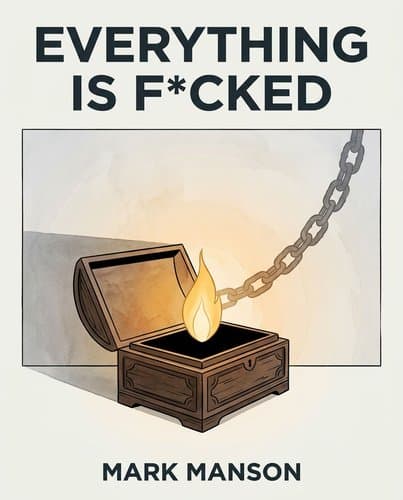
40574441_everything-is-f-cked
by Mark Manson
Hope is the engine of your suffering, not the cure—every self-help system profits by keeping you perpetually insufficient. Manson reveals why acting from…
In Brief
Everything Is F*cked (Marc) argues that hope itself — not its absence — is the engine of human suffering, keeping people perpetually dissatisfied and bargaining with the future.
Key Ideas
Emotion drives change, not intellect
Every failure of self-control is an emotional problem, not an information problem. You don't act differently because your Feeling Brain hasn't agreed to — not because you lack discipline. The entry point for change is always emotional, never intellectual.
Dissatisfaction systems maintain baseline suffering
Whatever sits at the top of your value hierarchy is your God Value — and every system that sells hope (religion, ideology, self-help) stays in business by keeping you dissatisfied with yours. When a self-improvement plan leaves you perpetually insufficient, that's a feature of the system, not a flaw in you.
Antifragility grows through stress exposure
Pain is a universal constant — the hedonic treadmill always returns your baseline happiness to roughly the same point regardless of what happens. Stop trying to engineer a pain-free life. Instead, build antifragility: systems and habits that gain capacity from stress rather than ones that collapse under it.
Principle replaces bargaining in maturity
When you act in order to get something in return — to feel better, to earn approval, to secure a future outcome — you're in adolescent bargaining mode. When you act from the principle itself (honesty for its own sake, care as an end in itself), you've crossed into adult virtue. The difference is whether you're treating people as ends or means.
Threat perception expands as threats shrink
The feeling that everything is getting worse in an objectively improving world is neurologically guaranteed: as real threats decrease, the brain expands its definition of 'threat' to maintain its baseline vigilance. Collective anxiety about civilizational decline is not evidence that things are declining — it may be evidence that things have improved.
Freedom through chosen limitation and sacrifice
Real freedom is choosing what to sacrifice, not maximizing options. The more deliberately you limit your desires, the less the external world can hold you hostage. Every unconditional commitment expands what you're capable of; every diversion you chase in avoidance of discomfort narrows it.
Who Should Read This
People working on personal growth in Existentialism and Ethics, especially those tired of generic motivational advice.
Everything Is F*cked
By Mark Manson
11 min read
Why does it matter? Because the hope keeping you going might be the thing keeping you stuck.
The assumption is that hope is what saves you. When everything collapses — the relationship, the career, the story you told yourself about how your life was supposed to go — hope is what everyone tells you to hold onto. It's the antidote. It's the whole point.
Mark Manson's argument is that this is exactly backwards. Hope isn't what pulls us out of suffering. Hope is what generates it — structurally, reliably, every single time. The ambition, the relationship: all of it is wired to leave you more dissatisfied after it works than before you started. That's not cynicism. That's neuroscience and philosophy and two centuries of civilizational data landing on the same uncomfortable conclusion.
The question this book actually answers isn't "how do I find more hope?" It's "what do you build your life on once you realize hope has been running the scam?"
The Only Man to Enter Auschwitz Voluntarily Wasn't Sustained by Hope
In the spring of 1940, a Polish army officer named Witold Pilecki walked up to an SS checkpoint in Warsaw and got himself arrested on purpose.
His plan was to infiltrate Auschwitz (a new German prison camp where thousands of Polish officers were disappearing), organize the prisoners, spark a mutiny, and break them out. His commanding officers thought he had lost his mind. They were probably right. He went anyway.
What he found was worse than anyone on the outside had imagined. Prisoners were shot at morning roll call for fidgeting. Men were worked to death on tasks that served no purpose except exhaustion. Within his first month, a third of his barracks were dead. He responded by building a resistance unit from scratch: a chain of command, smuggling rings for food and medicine, and a transistor radio assembled from stolen batteries and scavenged parts. He threaded intelligence reports out of the camp inside laundry baskets.
When Jewish prisoners began arriving by the tens of thousands, Pilecki's dispatches became frantic. He was witnessing industrialized mass murder. Millions would die. He begged the Polish Home Army to bomb the gas chambers if they wouldn't liberate the camp. His reports eventually reached the Allied command.
Everyone assumed he was exaggerating.
The rescue never came. In 1943, Pilecki accepted that and escaped — faking illness, bluffing his way to a bakery shift near the camp perimeter, cutting the telephone wire at 2 a.m., changing into stolen clothes, and sprinting to a river under fire.
After the war, he kept spying, this time on the Soviet-backed Communist government. When warned in 1947 that arrest was imminent and offered safe passage to Italy, he declined. A free Poland was the only thing that gave his life meaning, he said. Without it, he was nothing.
The Communists tortured him for nearly a year. He told his wife that Auschwitz had been trivial by comparison. He never gave them anything. At his 1948 show trial, facing execution, he made one final statement: he had tried to live such that in the moment of death, he would feel joy rather than fear.
Here's what's worth sitting with: every concrete hope Pilecki held — the prison break, the Allied rescue, a free Poland — failed completely. His heroism ran on something harder to name: values that demanded action regardless of outcome. Which raises an uncomfortable question: if that's what drives the best humans, what exactly is hope doing for the rest of us?
You Don't Have a Willpower Problem. You Have an Emotion Problem.
Why do you know exactly what needs to change and still not change it?
You know the diet. You've read the article. You've set the alarm, bought the journal, made the resolution. And yet — again — nothing. The standard explanation is willpower: you don't have enough discipline, enough information, enough effort. The explanation feels intuitive, which is exactly why it's wrong.
Consider what happened to Elliot. A tumor the size of a baseball was removed from his frontal lobe. His IQ, memory, spatial reasoning, even his ability to reason through moral dilemmas all tested fine. What no one caught was that the surgery had destroyed his capacity to feel. His emotional life had been flattened to a uniform gray. This is what Manson calls the Feeling Brain: not irrational, not stupid, just running on an entirely different logic than the part of you that reads self-help books.
The consequences were catastrophic in ways no cognitive test could predict. Elliot skipped investor meetings to shop for office supplies. He watched James Bond marathons while his marriage collapsed. He was defrauded by a scammer and lost his savings. He lost his job, his family, his home. All while completely aware that things were going wrong and completely unable to care. A colleague showed him photographs of murder scenes and starving children. Elliot sat there, acknowledged he once would have been disturbed, and felt nothing.
It took neuroscientist Antonio Damasio to sit with Elliot systematically and map what was actually breaking down. What he found: Elliot could narrate what he had done in perfect detail. He simply had no why. Without the ability to feel that one outcome is better than another, without the basic signal of caring, decision-making collapses entirely.
This is the part most self-help books get backwards. Procrastination, relapse, avoidance — every failure of self-control is an emotional problem, not an informational one. You don't need to know more. You need to feel differently. Somewhere in your emotional architecture, you've already concluded you don't deserve the change. The Thinking Brain can read twelve books on nutrition; if the Feeling Brain has decided you're not worth the effort, you'll still be halfway through a burrito by chapter three. Trying harder addresses the wrong problem entirely.
Every Belief System Is Secretly Designed to Keep You Dissatisfied
Every belief system that promises to fix you is structurally designed to fail — because a fixed follower is a former follower, and former followers don't pay.
That's the operating logic of every hope-delivery system ever built. Manson's image: human pain works like Whac-A-Mole. Knock down one suffering, another surfaces immediately. Knock faster, they come back faster. There is no final mole. There is no winning state. The game doesn't end; it just changes shape.
The self-help seminar knows this. The pyramid scheme absolutely knows this. You sign up, you fail to achieve the promised transformation, and instead of concluding that the promise was fraudulent, you conclude that you weren't trying hard enough. The leader collects the fee and books the next seminar. This cycle — promise heaven, engineer guilt, pocket the difference — works because it routes the disappointment inward. The problem is never the system. The problem is always you.
Scale this up and you get the whole of political and religious history. A movement begins with what Manson calls a God Value: the highest principle in the hierarchy, the thing people actually care about at the start. But movements that win accumulate power. And accumulated power has its own demands. Gradually, the original principles get subordinated to protecting what's been gained. The God Value quietly shifts from the founding ideal to the institution's own survival. Jesus becomes the Inquisition. The revolution becomes the purge. The wedding vows become the custody settlement. Not because the founders were hypocrites, but because this is what success does to a value hierarchy. The moment you're protecting what you have, you've stopped building what you wanted.
Manson's most unsettling line: the only thing that can truly destroy a dream is to have it come true. The dissatisfaction is the architecture itself.
What If Hope Isn't the Antidote to Evil — But Its Engine?
The myth of Pandora's box gets read as comfort. The gods unleashed every evil into the world but left one gift at the bottom: hope, the antidote to everything that escaped. Manson flips this. What if hope didn't stay in the box as a cure? What if it just didn't escape with the others — because it is one of the others?
Here's the evidence. Hitler hoped to produce an evolutionarily superior human race. The Soviets hoped for global equality under communism. Western democracies spent the 20th century toppling governments and financing dictators in the name of economic freedom. Every major atrocity of the modern era ran on hope, not cynicism, not hatred for its own sake. Vivid, organized, shared hope for a better world.
The reason this keeps happening isn't bad luck or bad actors. It's structural. Hope requires that something be broken right now. You can't build hope around a world that's already fine. Hope has nothing to grip. So it generates an enemy: whatever stands between you and the future you believe in. That enemy defines your in-group and out-group, your righteous cause and its obstacle. The conflict that follows doesn't threaten the hope; it sustains it. Take the enemy away and the hope dissolves with it. Which means the causality runs the other way: everything being fucked doesn't create the need for hope. Hope needs everything to be fucked.
The only exit Manson finds is in Friedrich Nietzsche, the 19th-century philosopher who called it amor fati — love of fate: wanting nothing to be different, not forward, not backward. Not tolerating reality. Loving it. Act, but without hope for something other than this moment. Be better. Not hope for better.
The Goal Isn't Less Pain. The Goal Is a Different Relationship With It.
June 11, 1963. A small turquoise car leads a procession of monks and nuns through a busy Saigon intersection. They stop. A cushion is placed in the center of the street. A 73-year-old monk named Thich Quang Duc walks to it, folds himself into lotus position, and closes his eyes. A second monk opens the car trunk and empties five gallons of gasoline over his head.
Quang Duc picks up a match. He strikes it against the asphalt without opening his eyes.
As fire engulfed him, skin turning black, robe disintegrating, he didn't move. No flinch. No sound. No expression. David Halberstam, the New York Times correspondent, later wrote that he couldn't cry, couldn't take notes, couldn't think. The man next to him was burning to death with the composure of someone waiting for a train.
The photograph won a Pulitzer. Diem's government collapsed within months.
Manson isn't interested in the political history. He's interested in the question the image raises: what kind of relationship with pain makes that possible?
The standard assumption is that a good life means progressively less pain. That growth is really just the elimination of friction. Studies from the 1980s and '90s tracked people with beepers, asking them to rate their happiness at random moments. Cancer diagnosis. Lottery win. Baseball game. Grocery store. Almost everyone wrote down seven, every time. Pain spikes. Joy spikes. Reality returns to seven. The hedonic treadmill is always running. You can't outrun it. It is your baseline.
The corollary nobody wants: avoiding pain doesn't protect you from pain. It just shrinks the life you're able to live to what you can already handle. Every step away from discomfort is a step toward fragility.
This is what Nassim Taleb called antifragility — the idea that some systems don't merely resist stress but actually grow from it — and Manson applies it to the mind with the same logic. The human body works this way physically; the mind works the same way emotionally. What Quang Duc demonstrated wasn't the absence of sensation. It was sixty years of training himself to meet pain without adding a second layer of suffering on top of it. Buddhism has a name for this: the two arrows. The first arrow is the raw sensation. It hits regardless. The second is the interpretation (the self-pity, the story you spin about what it means), and that's where you actually break. The second arrow is always a choice.
The goal isn't a life with less fire. The goal is becoming someone the fire can't own.
The One Principle That Doesn't Secretly Require Hope to Work
Think about why you're honest with people. Most of us, if we're truthful, tell the truth because lies get complicated: they require tracking, they get exposed, they damage trust we need later. We're honest because it pays. Which means we're being conditional. Which means our honesty isn't, at its core, very different from our dishonesty. Both are tools aimed at the same project: managing outcomes in our favor.
That's the adolescent trap, and most functioning adults are stuck there. Children do what feels good now. Adolescents are cleverer: they defer gratification, follow rules, perform virtue, but the math is still self-serving. The adult is the rare person who does the honest thing not because of what happens next but because honesty is the right end in itself, a commitment chosen regardless of outcome.
From a single-room apartment in Königsberg, Prussia, Immanuel Kant developed what might be the only ethical principle structurally immune to corruption: the Formula of Humanity. Act so that you treat every consciousness (yourself included) as an end, never merely as a means.
Manson's sharpest test case: say you decide to make your wife happy, but the real goal is sex. Her happiness is now a means to your end. Kant says this is structurally identical to lying, to violence, to cheating — not equally bad in degree, but identical in kind. You've subordinated another consciousness to your own goals. You've made her a mechanism rather than a person.
What makes the Formula durable is that it asks nothing of the future. It doesn't require the belief that honesty will be rewarded, that love will be returned, that good things happen to good people. It's the only ethical framework that doesn't secretly require hope to function. You treat the person in front of you as an end because they are one, not because of what that treatment will eventually produce.
The ripple isn't engineered. It just happens. Your honesty with yourself becomes honesty with others, which becomes their honesty with themselves — not through ideology, but through each person in each moment deciding whether this is a transaction or a human being.
Don't hope for a better world. Be one.
The Better the World Gets, the Worse It Feels — and We're Building Systems That Guarantee It
The problem isn't that you lack the right tools. The problem is that the civilization around you is built to undermine them.
Harvard researchers once quietly reduced the proportion of blue dots in a sequence. Participants started calling purple ones blue. The brain doesn't hold a fixed threat threshold; it recalibrates to match whatever's around it. So as wars and famines recede, the threshold doesn't disappear. It shifts. Smaller things get reclassified as crises to fill the space. Progress doesn't produce relief. It produces sensitivity.
In 1928, Edward Bernays (Sigmund Freud's nephew, which explains quite a bit) was hired to get American women smoking. He didn't argue. He staged women lighting cigarettes at the Easter Sunday Parade in New York, told reporters they were lighting "torches of freedom," and fed the photographs to national newspapers. Manufactured from start to finish. It worked because it hijacked genuine emotional energy; the suffragette movement was barely a decade old. Bernays had found what the entire business world had missed: purchasing decisions live in the Feeling Brain. From that discovery came celebrity endorsements, engineered shame, and every ad campaign since. Locate the insecurity, amplify it, sell the cure.
Which brings us to the logical endpoint: AI. Not the Terminator. The concierge. A system that learns your emotional patterns faster than you do, detects discomfort before it surfaces as a conscious thought, and collapses the gap between wanting something and having it. Frictionless. That's the pitch. But the gap between wanting and having is where values live, where decisions get made, where character forms under pressure. Collapse it and you're not free. You're just in a prettier cage.
The result is a feedback loop. The brain recalibrates away from genuine suffering and grows sensitive to smaller things. The economy floods that sensitivity with diversions that numb without resolving. Fragility deepens. Demand for more diversions grows. The book calls this fake freedom: variety mistaken for liberation. It produces citizens too fragile to tolerate the discomfort actual democracy demands. The tolerance of opposing views. The willingness to compromise. The acceptance that sometimes things won't go your way.
The individual tools this book offers — antifragility, Kant's Formula, unconditional virtue — are real. But they're practiced inside a system that profits from your weakness. That's not a reason to abandon them. It's a reason to understand the scale of what you're up against.
The Question Witold Pilecki Never Had to Ask
Pilecki's last words contain no hope. "I have tried to live my life such that in the hour of my death I would feel joy rather than fear." That's not optimism. It's accounting. A ledger settled in each moment rather than deferred to a future that might not arrive. But here's what Manson doesn't quite square: his greatest example of human courage was a man animated specifically by hope for a free Poland — a hope the Soviet interrogators methodically destroyed. What they couldn't destroy was the character underneath it. Maybe that's the point.
The Blue Dot effect, the Feelings Economy, the AI that will soon promise to dissolve every last discomfort. Manson calls that last one the Final Religion — the promise that a technology fluent enough in your preferences will make hope unnecessary by making disappointment impossible. All of it scales the same problem to civilizational size. None of it is solved by hoping harder. Pilecki didn't get a free Poland. He just chose to be the kind of person who would have deserved one. The question isn't whether you should hope. It's whether you'd act exactly the same way if you knew the answer was no.
Notable Quotes
“overthrow a government and enslave a population to your faulty ideology”
“Auschwitz was just a trifle”
“I have tried to live my life such that in the hour of my death I would feel joy rather than fear.”
Frequently Asked Questions
- What is Everything Is F*cked about?
- The book argues that hope itself—not its absence—is the engine of human suffering, keeping people perpetually dissatisfied. Drawing on psychology and philosophy, Manson explains how systems that sell hope (religion, ideology, self-help) maintain dissatisfaction. He shows that lasting change starts with emotions rather than information, and genuine freedom comes from committing to unconditional values over outcomes. Rather than seeking a pain-free life, Manson advocates building antifragility: systems and habits that gain capacity from stress. The core insight is that accepting pain as inevitable and choosing what to sacrifice, rather than maximizing options, leads to true maturity and freedom.
- Why does Mark Manson say failures of self-control are emotional problems?
- Manson argues that every failure of self-control is an emotional problem, not an information problem. You already know what you should do; the issue is that your Feeling Brain hasn't agreed to it. He explains that lasting change isn't driven by acquiring more knowledge or willpower—it requires emotional buy-in. The entry point for change is always emotional, never intellectual. When you understand something intellectually but still struggle to act, it's because your emotions haven't been convinced. This insight reframes self-improvement efforts from discipline-focused approaches to addressing the underlying emotional resistance that prevents behavioral change.
- What does Mark Manson mean by your God Value?
- Your God Value is whatever sits at the top of your value hierarchy—what you ultimately organize your life around. Manson argues that every system selling hope (religion, ideology, self-help) keeps you dissatisfied with your God Value to stay profitable. These systems create a perpetual gap between where you are and where you're supposed to be, making you feel perpetually insufficient. When a self-improvement plan leaves you feeling inadequate, that's intentional—a feature designed to maintain engagement, not a flaw in you. By recognizing this pattern, you can distinguish between values that are genuinely yours and those imposed by external systems.
- What does unconditional commitment mean according to Mark Manson?
- Unconditional commitment means acting from a principle itself, not to secure an outcome—honesty for its own sake, care as an end in itself. When you act to get something in return—approval, security, feeling better—you're in adolescent bargaining mode. Adult virtue emerges when you treat people as ends, not means. Manson argues that real freedom comes from choosing what to sacrifice rather than maximizing options. Every unconditional commitment expands your capacity; every diversion you chase to avoid discomfort narrows it. This shift reframes maturity as commitment to values rather than pursuit of outcomes.
Related Book Summaries
Read the full summary of 40574441_everything-is-f-cked on InShort