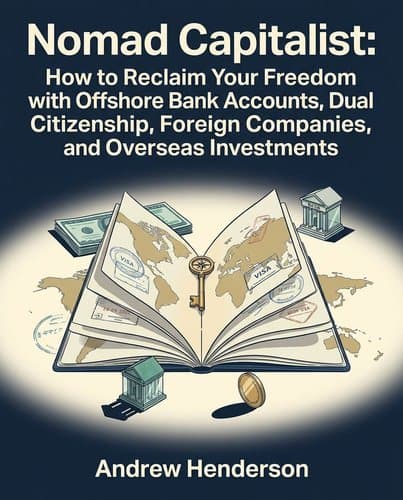
39800235_nomad-capitalist
by Andrew Henderson
Your birth country is a default setting, not a life sentence—legally restructure your taxes, banking, citizenship, and investments by treating the world as a…
In Brief
Your birth country is a default setting, not a life sentence—legally restructure your taxes, banking, citizenship, and investments by treating the world as a menu of options. Flag Theory shows you exactly which countries to use for what, so you keep more of what you earn.
Key Ideas
True Tax Cost Multiplies By Reinvestment
Calculate your tax bill's real cost by multiplying it by your reinvestment return multiple — if every dollar you reinvest returns $3, a $43K tax bill costs you $129K in foregone growth, not $43K.
Use Each Country's Comparative Advantage
Apply Flag Theory: use each country for what it does best — bank in Singapore for safety, incorporate in Georgia or Estonia for low tax rates, invest in frontier markets for growth. No single country wins on all dimensions.
Open Offshore Accounts Before Window Closes
Open an offshore bank account before you need one — Georgia ($7 minimum deposit), Romania, and Singapore are accessible starting points, and the window narrows as FATCA compliance eliminates US-client programs yearly.
Verify Location Independence Precedes Offshore Structure
Test whether your income is 'location-independent' before building any offshore structure: if your work travels with a laptop, you likely qualify for offshore structuring; if you appear in US federal court for US clients, you probably don't.
Check Citizenship By Descent Eligibility Now
Evaluate your citizenship by descent eligibility now — Ireland alone has 10 million non-resident passport holders, suggesting far more people qualify for a second passport than know it.
Daily Inaction Cost Reveals True Urgency
Treat the daily cost of inaction as a real number: divide your annual tax bill by 365 and ask whether today's research cycle was worth that amount — if the answer makes you uncomfortable, use it.
Enter Frontier Markets Before Safety Arrives
When scouting frontier markets, the key test is whether the window is still open: if a place already feels safe to most investors you know, the entry-price advantage has likely closed.
Hire Local Experts For Cultural Fluency
Hire local professionals — lawyers, translators, assistants who understand the cultural deal-making norms — rather than trying to impose your home-country negotiation style on markets that run on personal relationship and patience.
Who Should Read This
Business operators, founders, and managers interested in Personal Finance and Wealth Building who want frameworks they can apply this week.
Nomad Capitalist: How to Reclaim Your Freedom with Offshore Bank Accounts, Dual Citizenship, Foreign Companies, and Overseas Investments
By Andrew Henderson
9 min read
Why does it matter? Because the financial constraints you accept as fixed — your tax rate, your banking options, your passport privileges — are almost entirely self-imposed by an unexamined loyalty to wherever you happened to be born.
You didn't choose where you were born — but somewhere along the way, you started acting like you did. Like the place that issued your first passport also issued the final word on where you should bank, how much tax you should pay, and where you're allowed to live. That's not loyalty. That's conditioning.
Remove the label and the choice becomes obvious. Singapore hasn't had a bank failure in fifty years. Georgia will open a bank account for you in ten minutes. Get residency in a territorial-tax country and you stop paying tax on foreign income, legally and permanently. You're not in the best country for any of this. You're in the only country you ever thought to ask.
This is the Pepsi Challenge applied to countries — and this book is the blind taste test.
You've Been Choosing Brand, Not Formula — and the Formulas Aren't Even Close
A grandmother stands in a shopping mall, coaxed by her granddaughter into a taste test she has no reason to take. She has never had a Pepsi in her life. Two cups, no labels. She tries both and picks one. When the brand is revealed, she sits with the result for a moment, then concludes she must have just chosen Pepsi — she'd never had it before in her life.
That ad ran in the 1980s and rattled Coca-Cola badly enough that executives changed the century-old formula in a panic. What the Pepsi Challenge exposed: Coke's dominance had almost nothing to do with taste. The brand had conditioned millions of people to feel loyalty before the drink ever touched their lips. Strip the label, and the conditioning collapses. The grandmother, unburdened by decades of association, just chose what she actually preferred.
Henderson uses this not to sell soft drinks but to describe a mechanism. Countries work on the same principle. The United States has built one of the most powerful national brands on earth, assembled from culture, language, global media, and a mythology of opportunity that makes its citizens feel, without much examination, that they're already in the best place for everything. Banking. Taxes. Safety. Investment.
Strip the label and compare the formulas. The US banking system: 365 failures between 2008 and 2012, another dozen or two in a typical year, and a federal deposit insurer holding less than one percent of the funds it promises to cover, backed by a government carrying tens of trillions in debt. Other banking systems run on a different formula. Strip the brand, and the gap gets difficult to explain away.
The grandmother didn't decide one morning that Coke was her brand. It accumulated over years without her noticing. Most financial decisions work the same way. You didn't choose your bank by weighing it against anything — it was just there when you needed one.
The Number on Your Tax Bill Is Not the Real Loss
Here's a thought experiment most of us encountered in elementary school and promptly forgot. A penny, doubled every day for a month, grows to $5,368,709. Teachers use it to illustrate compounding, then move on. What they don't cover is what happens when you apply a 30% tax on each day's gains. The penny still doubles, but the government takes its cut at every step. The final number: $48,197. Not five million. Not even close to a hundred thousand. Forty-eight thousand dollars.
Henderson's point is blunt: those two numbers describe the same money, the same interest rate, the same thirty days. The only variable is taxes. Not talent, not effort, not strategy. Just taxes. The saying that death and taxes are life's only certainties doesn't apply in Abu Dhabi. They're sitting with the $5 million version.
Most entrepreneurs think of their tax burden as the check they write in April. That number is real, but it's the wrong number. The right number is what that money would have become if it had stayed in the business.
Tim was a 24-year-old running an Amazon operation in San Diego, clearing $9,000 a month, when his accountant handed him a $43,000 tax bill for his first year in business. He didn't have it. He was already stretching for inventory financing at double-digit interest rates, because every dollar he reinvested returned three. Henderson walked him through the actual math: the real cost wasn't $43,000. It was $129,000 — the three-times return he couldn't generate because the government had taken the principal. Every year the structure stayed the same, the gap compounded further.
The California engineer making $200,000 at a tech company, the affiliate marketer doing $1 million a year, the SaaS founder clearing $120K ARR — they all hit the same ceiling. The economy prices everything right up to the edge of what you can afford, and taxation ensures you never build enough surplus to escape the level. Rent, services, competition all adjust to meet your income. The leak is structural, not incidental.
The question is how long you let the $5 million version of your money stay at $48,197.
A Second Passport Is Insurance Against a Risk That Feels Impossible Until It Isn't
Laurent arrives at Henderson's Four Seasons suite in Dubai carrying an aluminum briefcase that looks built to stop stray gunfire. Heavy French accent, salt-and-pepper hair, and a brisk efficiency: he takes fingerprints, then hands Henderson a blank green passport to flip through while he finishes the paperwork. The cover reads Union des Comores in two languages Henderson doesn't read. Laurent knows exactly what he's doing: it's the move a pet shop owner makes when he lets the family take the puppy home just for the weekend. The return rate is nearly zero.
Within the time it takes to eat a hotel fruit basket, Laurent shakes Henderson's hand and welcomes him as the newest citizen of the Comoros Islands. Total cost: $45,000. The Comorian passport opens roughly 47 countries visa-free (mostly African nations, though Hong Kong, Malaysia, and Indonesia are in the mix). Henderson's goal was diversification. One government no longer has sole authority over his movements, his assets, and his options.
That distinction matters more than it sounds. During the Arab Spring — the 2011 uprisings that swept the Middle East and North Africa — Egyptians and Syrians who had established second residencies or citizenships elsewhere could leave when conditions collapsed. Those without an alternative were effectively trapped; no developed country was eager to accept them even as tourists. Nobody had seen the timeline coming. Crises of this kind don't build slowly and then announce themselves; they build slowly, then arrive all at once.
The acquisition paths are specific and legal. Citizenship by descent costs almost nothing if a parent or grandparent held Italian, Irish, Polish, or other qualifying citizenship. Panama's Friendly Nations Program requires a $5,000 bank deposit and a few days per year in the country; citizenship comes after five years. Economic citizenship programs start around $100,000 for a Caribbean passport. None require breaking a law. Most don't require moving anywhere permanently. What they require is deciding before the moment when you wish you had.
The Best Banking System in the World Wants Your Money — and It's Not Where You Bank
Your bank is ranked 40th safest in the world. Not a prediction — a published finding. Thirty-nine countries have more stable banking systems than the one holding your money right now.
Henderson walked into a Romanian bank in Bucharest, sat down across from a banker named Teodora, and had an account open in 25 minutes. Passport only. When he thanked her for making it easy, she looked genuinely puzzled. In her mind, of course a bank should make it simple for you to give them money. The friction is a Western pathology, not a banking norm.
Singapore's system has operated for over fifty years without a single bank failure. The US has had more than 550 since 2000. American banks often keep one or two cents per dollar of deposits on hand; the FDIC, which is supposed to backstop all of it, holds less than 1% of the funds it guarantees. The insurance exists precisely because the system requires it.
The practical entry point is Georgia. Henderson opens accounts there for a $7 minimum deposit in roughly ten minutes: single-click currency conversion, exchange spreads as low as 0.13% on large transfers, 5% annual interest on USD term deposits. Services most Americans can't access at home.
The caveat is timing. When the US passed FATCA in 2010 — requiring foreign banks to report every American-held account or face a 30% withholding penalty — Hong Kong and Singapore quietly stopped accepting US clients. Those who had accounts before FATCA passed kept them; those who waited found the door closed.
Safer alternatives exist with better numbers, and most are still open to Americans. That last part is the one with an expiration date.
Your Tax Rate Is a Choice — It's Just That Nobody Told You That
When you hear "offshore company," what picture forms? A shadowy lawyer, a briefcase, a numbered account on a Caribbean island that doesn't show up on maps? That picture is doing a lot of work to keep your tax rate where it is.
A consultant working in California pays federal income tax plus roughly 13% in state income tax — the highest state rate in the country. Move to Las Vegas and that 13% disappears. Same federal bill, same business, same clients. The only change is a state line. Nobody calls this a scheme. Millions of American businesses do exactly this every year.
Henderson's point is that crossing a national border is mechanically identical to crossing a state line. An offshore company is incorporated under the laws of another country. That's it. Delaware instead of California is the same category of decision. The stigma isn't legal substance; it's association with an older generation that used offshore structures to hide money. Those days are largely over — more than a hundred countries now share financial information automatically, which means the remaining reasons to go offshore are the same boring, legal ones that send companies from Sacramento to Reno.
The options are specific. Henderson's team found more than forty countries that lowered their corporate tax rates in recent years. Estonia charges zero on profits kept inside the business; distributions get taxed at 20%, but retained earnings compound untouched. Georgia, Montenegro, Bulgaria, and Singapore all land at 10% or below. These aren't hiding places. They're countries actively competing for exactly the kind of business a mobile consultant or e-commerce seller already runs.
The exotic part was always the reputation, not the structure.
By the Time Frontier Markets Feel Safe to Invest In, You've Already Missed Them
Arnaud Curtat was one of the best pastry chefs in Bangkok when he moved further east — not to open a restaurant, but to take a hotel job in Siem Reap, Cambodia. His Thai wife, suddenly without work, rented a storefront for $250 a month and started selling carved fruit to locals. When that worked, she added small cakes. When those sold out, she called her husband. Within a year, Arnaud had quit the Sofitel and joined her.
They named the business The Blue Pumpkin. Fresh bread sold out before they could restock it. Arnaud used his hotel connections to land bulk orders across Siem Reap. The fruit stand grew into a bakery, the bakery into an ice cream operation, the operation into nine company-owned locations with distribution in virtually every supermarket and tourist zone in the city. A decade in, he sold just over half his stake for approximately $1 million. They now plan to franchise into Thailand and Malaysia, potentially the first Cambodian brand to expand abroad.
A French pastry chef. A $250 storefront. No government approval, no months of certification classes, no equipment standards committee. In Cambodia, you rent a space, put up a sign, and start baking.
Compare that to the same business in California, where you'd spend months navigating health permits, food handler certifications, zoning boards, and advertising ordinances before the first loaf left the oven. The barrier to entry in developed markets doesn't just cost money. By the time you're through it, the market is already full of people who got there first. High barriers create high competition. High competition means low margins. Low margins mean you stay where you are.
Most people run this risk calculation backward. Frontier markets feel dangerous — unfamiliar systems, uncertain infrastructure. But from the mid-1990s through the mid-2010s, Cambodia went 20 years without a recession, shrugged off the 1990s Asian financial crisis and the 2008 global collapse entirely, and now returns 10–15% rental yields on property that earns low single digits in the UK.
That's what "frontier" means. Not dangerous. Time-limited.
The Real Bottleneck Is Never Information — It's Not Knowing What Today's Delay Costs
How long have you been meaning to open an offshore bank account?
Henderson ran an annual conference in Cancun for three years — keynote speakers who moved markets when they spoke, hundreds of attendees who flew in to hear them. Standing on stage at the third one, he announced he was done. The reason: a woman had attended all three conferences, heard every talk, networked with every offshore expert in the room, and only then asked him where to get the paperwork to open a foreign bank account. A process that would have taken her a few days — something she could have done on any random Tuesday for the previous two years.
His term for what she was doing was "faux action taking": the kind that feels productive because it involves effort, travel, and money, but produces no change in the underlying structure of your life. The conference was producing sophisticated consumers of information, not actors.
Henderson calls this the "Thai massage principle." A fist grinding into a knotted shoulder hurts more than the knot itself. So people tolerate the knot. The passive ache becomes background noise, something you adjust your sleep position around and eventually stop noticing. Taxes work the same way. Paying 40% on your income becomes ambient. The effort of restructuring (finding lawyers, opening accounts, possibly relocating) registers as additional pain layered on top of what you're already carrying, not the thing that ends it.
Your tax bill divided by 365 is the daily rate of that delay. Henderson eventually paid more in three months of taxes (he was running upward of $60,000 a year at that point) than the $15,000 he'd refused to pay the lawyer to fix it permanently. The woman in Cancun paid three years of ticket prices, flights, and hotel rooms, plus two years of taxes in the interim, before asking the question she could have asked on day one.
The bottleneck was never information. She had all of it. The gap was between knowing and doing, and it had a price she was paying whether she noticed it or not.
The Only Certainty Is What Happens If You Change Nothing
The uncertainty isn't whether the offshore structure will work, or which country makes sense, or whether you qualify for a second passport. Those are real questions with real answers, and most people who ask find the answers better than expected. The only number that carries no uncertainty at all is 46% — roughly what a California entrepreneur pays combining federal and state — arriving again next year, on schedule, regardless of whether you decided anything. Henderson's first recommendation isn't a company formation or a residency visa or a real estate wire transfer. It's a bank account. Georgia. Ten minutes. Seven dollars. Not because the account solves anything on its own, but because nothing else starts without it. Divide your annual tax bill by 365. That's what today cost. Tomorrow has the same price. The arithmetic doesn't wait for you to feel ready.
Notable Quotes
“I know! I've never had a Pepsi in my life. It must be better!”
“he said, his hand outstretched for mine.”
“Now, all you need to do is send the money,”
Frequently Asked Questions
- What is Flag Theory in Nomad Capitalist?
- Flag Theory is the core framework that suggests using each country for what it does best rather than seeking one perfect jurisdiction. According to the book: "use each country for what it does best — bank in Singapore for safety, incorporate in Georgia or Estonia for low tax rates, invest in frontier markets for growth." This multi-jurisdictional approach allows high earners to legally reduce taxes, protect assets, and expand opportunity by routing their financial life through strategic locations based on merit. Henderson argues that geography is a choice, not a constraint, making this framework essential for anyone seeking financial optimization.
- How does Nomad Capitalist calculate the true cost of taxes?
- The book teaches multiplying your tax bill by your reinvestment return multiple to reveal its real impact. Henderson explains: "Calculate your tax bill's real cost by multiplying it by your reinvestment return multiple — if every dollar you reinvest returns $3, a $43K tax bill costs you $129K in foregone growth, not $43K." This calculation demonstrates that taxes represent lost compound growth over time, not merely current-year expenses. By understanding this true cost, readers can better justify offshore structuring investments and recognize why tax reduction is critical to long-term wealth accumulation rather than just annual savings.
- What are the eligibility requirements for offshore structuring in Nomad Capitalist?
- The primary requirement is location-independent income. The book states: "Test whether your income is 'location-independent' before building any offshore structure: if your work travels with a laptop, you likely qualify for offshore structuring; if you appear in US federal court for US clients, you probably don't." Additionally, Henderson recommends evaluating citizenship eligibility by descent, noting that "Ireland alone has 10 million non-resident passport holders, suggesting far more people qualify for a second passport than know it." These prerequisites determine whether offshore planning is legally and practically appropriate before implementing any international financial strategy.
- What countries does Nomad Capitalist recommend for opening offshore bank accounts?
- Henderson recommends Georgia, Romania, and Singapore as accessible starting points, emphasizing urgency: "Open an offshore bank account before you need one — Georgia ($7 minimum deposit), Romania, and Singapore are accessible starting points, and the window narrows as FATCA compliance eliminates US-client programs yearly." Georgia stands out with its minimal $7 barrier to entry, while Singapore is highlighted as ideal for safety. The book stresses that waiting delays opportunity, as regulatory compliance and changing policies are narrowing access windows for international account holders over time.
Related Book Summaries
Read the full summary of 39800235_nomad-capitalist on InShort