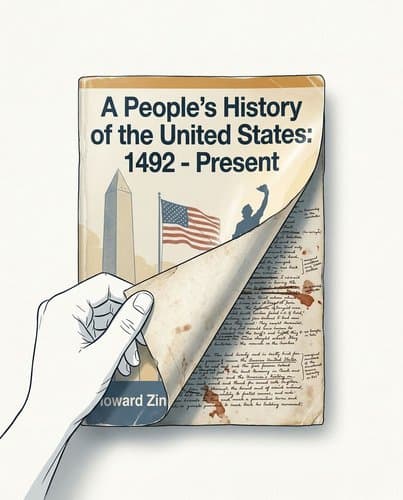
2767_a-people-s-history-of-the-united-states
by Howard Zinn
America's official history is a masterclass in control: every expansion of rights—from emancipation to the New Deal—was a calculated concession engineered to…
In Brief
America's official history is a masterclass in control: every expansion of rights—from emancipation to the New Deal—was a calculated concession engineered to neutralize a more dangerous threat from below. Zinn rewrites five centuries of "progress" as a recurring cycle of solidarity, suppression, and strategic reform, told from the side that keeps losing ground.
Key Ideas
Acknowledging evil without accountability deceives readers
When a historical account names an atrocity in a sentence and then spends pages celebrating the perpetrator's heroism, the acknowledgment is more ideologically dangerous than silence — it gives readers the feeling of confronting truth while training them to treat mass death as an acceptable footnote to progress.
Racism invented to prevent class solidarity
American anti-Black racism was not inherited from ancient tribalism; it was deliberately constructed in the 1670s by colonial planters who needed to break an emerging cross-racial solidarity among the poor, by offering white servants just enough — land, weapons, social status — to make them identify upward rather than across.
Rights granted to prevent radical change
Each major expansion of rights in American history (the Revolution, Emancipation, the New Deal, the Civil Rights Act) was timed not primarily to moral awakening but to the calculation that a controlled concession would neutralize a more radical threat — meaning the gains were simultaneously real and engineered, which changes what you think they require to defend.
Working-class opposed wars, media inverted truth
Throughout American history, grade-school-educated and working-class people have been more likely to oppose foreign wars than college-educated people — the media narrative of the 'working-class hawk' was an inversion of the actual polling data, serving the interests of the professional class that manages the wars.
Middle-class expendability threatens system survival
The American political system survives not primarily through force but by distributing small privileges to a large middle stratum — teachers, technicians, managers, professionals — who then maintain it as a buffer between the elite and the dispossessed; history shifts when enough of those people recognize that the system they protect classifies them as expendable when convenient.
Who Should Read This
History readers interested in World History and Social Issues who want a deeper understanding of how we got here.
A People’s History of the United States: 1492 - Present
By Howard Zinn
10 min read
Why does it matter? Because the progress narrative you were taught was engineered to make you stop asking questions.
You were probably taught that American history is a story of imperfect progress: slavery ended, women got the vote, workers got rights, and if things move slowly, they move in the right direction. That story is not wrong, exactly. But it has a mechanism it never mentions. Each of those expansions — emancipation, the New Deal, the Civil Rights Act — happened not when moral conscience peaked, but when something more radical threatened to happen without it. Howard Zinn doesn't argue conspiracy. He hands you the primary documents: a slave trader's manifest, a soldier's diary from a war he didn't understand. Then he steps back. Notice what just happened there. The progress remains real. It just turns out to have been designed. And once you see the design, you can't unsee it.
The Most Dangerous History Admits the Atrocity and Quickly Moves On
Samuel Eliot Morison was Harvard's most decorated Columbus scholar — a sailor himself who had retraced the Admiral's crossing of the Atlantic. In his 1954 biography, he stops halfway through to name what Columbus and his successors did to the indigenous people of the Caribbean. The word he uses is "genocide." He uses it accurately.
One page. Then the book moves on.
By the final paragraph, Morison is celebrating Columbus's indomitable will, his seamanship, his faith. No flaw, he concludes, darkened the Admiral's most essential quality: his skill at sea.
Howard Zinn's observation about this is the opening argument of A People's History: Morison's move is more effective than lying. A historian who simply omitted the massacres could be caught, exposed, dismissed. But Morison names the crime in the tone of a man who has discharged his scholarly duty, then spends his pages on the romance of a great navigator. The reader finishes feeling they've been given the full picture. They have not.
Denial is a gamble: a historian who never mentions the massacres can be caught and dismissed. Naming the crime and moving on is safer, because it looks like honesty. The word "genocide" is right there on the page; the reader's guard drops. By the time the book is celebrating the Admiral's seamanship, the ledger already feels settled. What makes this work is the calm authority of scholarship: when a politician minimizes a massacre, you notice the minimizing. When a Harvard professor does it, the proportion feels like wisdom.
It tells you whose story this history was written for.
American Racism Wasn't Inherited — It Was Engineered to Break a Cross-Racial Coalition
The story Americans tell about racism is that it's ancient — a primal fear of difference inherited from less enlightened times. Zinn's evidence points elsewhere: American anti-Black racism was manufactured, in a specific decade, to solve a specific political problem. That problem was Bacon's Rebellion.
In 1676, Virginia's poor — white frontiersmen, indentured servants, and enslaved Black men — fought together so effectively that the colonial governor fled burning Jamestown and England dispatched a thousand soldiers. At the two final holdout garrisons, reports described "four hundred English and Negroes in Armes" and "three hundred freemen and African and English bondservants." When the naval commander offered pardons, most laid down their weapons. Eighty Black men and twenty white men refused even then.
The planter class understood what had nearly happened. Poor whites and enslaved Black people had more in common with each other than either had with the men who owned the land. They'd already been running away together, hiding each other, sleeping together, enough that Virginia had passed laws forbidding such associations. What if this continued, at scale, with guns?
The answer wasn't purely military. Yes, the planters passed brutal slave codes. But they also gave freed white servants corn, muskets, and fifty acres of land. Edmund Morgan traced the result: once the small planter had a modest stake, he stopped seeing the wealthy neighbor as an extortionist and started seeing him as a protector of shared interests. The coalition didn't need to be defeated in battle — it needed to be dissolved from within, by giving one side just enough that betrayal felt like advancement.
Racism was the ideological layer over that transaction. Declaring white workers superior to Black workers cost the planter class nothing. It gave poor whites something to own when they owned almost nothing else. And when desperation pushed the two groups toward each other again, there was now a screen of contempt in the way.
Virginia's governing class had solved their problem, and the solution held. The men who stood together at those two garrisons, refusing pardons, weapons still in hand, were the last time that alliance formed at anything like that scale. What the planters put in place in the 1670s — the slave codes, the fifty acres, the legal architecture of white superiority — was still running two centuries later.
The Revolution, the Emancipation, the New Deal: Each Was Designed to Go Just Far Enough
What actually triggers the big moments of American liberation? The standard answer is moral pressure: injustice becomes unbearable, conscience catches up to law, and reluctant leaders finally act. Zinn's evidence points to a different mechanism. Each major expansion of rights arrived calibrated to the minimum needed to neutralize the most dangerous threat.
Lincoln's private letter to Horace Greeley in August 1862 makes this visible. Greeley, the Tribune's editor, had written demanding that Lincoln enforce emancipation law. Lincoln's reply was precise: "My paramount object in this struggle is to save the Union, and is not either to save or destroy Slavery. If I could save the Union without freeing any slave, I would do it." Not hedged. Explicit. The man history remembers as the Great Emancipator wrote, in his own hand, that slavery's fate was a variable to be adjusted for strategic purposes.
The Emancipation Proclamation, issued four months later, bore this out. It freed slaves only in Confederate territory, explicitly excluding the four slave states Lincoln was still courting: Maryland, Kentucky, Missouri, Delaware. The London Spectator caught the logic instantly: "The principle is not that a human being cannot justly own another, but that he cannot own him unless he is loyal to the United States." Enslaved people in Union states received nothing. Liberation arrived as a military side effect in certain territories, not as a moral commitment to the people most immediately threatened.
In the 1930s, the sit-down strikes made the same mechanism newly legible. By 1937, workers had staged 477 of them, occupying factories, locking out strikebreakers, acting before union leadership even knew strikes were happening. An AFL organizer described phone calls from workers who had "thrown the manager out and got the keys" before asking anyone. The Wagner Act and the National Labor Relations Board arrived to give the disruption a formal channel — grievances filed, elections held, contracts signed. John Lewis of the CIO was candid about what that bought: "A CIO contract is adequate protection against sit-downs." Sociologists Frances Fox Piven and Richard Cloward spent years studying what the trade looked like from the workers' side. Their conclusion: the years of wildcat action, before formal organization, were when workers held the most leverage. The power came from disruption, and the institutions built to represent workers were also what ended it.
The gains were real — unions, wages, emancipation, legal rights. They changed lives. But each expansion arrived timed not to moral awakening but to the threshold of concession needed to dissolve the coalition threatening the existing order. That calibration doesn't erase the liberation. It explains why every liberation stopped exactly where it did.
For Every Rebellion That Got Absorbed, Someone Kept the Fire Going
At a mass meeting in St. Louis in the summer of 1877, a Black man who worked the steamboat levees addressed the room. The Workingmen's Party had, in the previous days, achieved something with no precedent in American history: they had shut down every freight line in the city, staffed neighborhood soup kitchens, and maintained public order without police. Now he wanted to know whether the solidarity would extend to him. "Will you stand to us regardless of color?" The crowd of thousands shouted back: "We will!"
It lasted days. Federal troops came, arrested the executive committee that had briefly been running the city, and forced the strikers to surrender. The wage cuts stayed. Within months, National Guard armories with gun-loopholes were under construction in every major American city — the establishment's way of recording that it had been genuinely frightened.
What Zinn catalogs across these chapters is a tradition the official story consistently buries — and the burying is the point. If the labor uprisings of the 1870s are forgotten, the next generation of workers must figure out from scratch that solidarity is possible, that a general strike can work, that racial lines can dissolve under shared desperation. The organizers of the IWW (Industrial Workers of the World) were arrested regularly for giving speeches on street corners, which turned bystanders into radicals faster than any pamphlet. In 1980, eight Catholic activists broke into a General Electric plant in King of Prussia, Pennsylvania, smashed nuclear missile nose cones with sledgehammers, and poured their own blood on the parts; the jurors who convicted them said afterward they thought the defendants were right. These weren't isolated moments. They were threads in something continuous.
Official history is invested in calling these rebellions isolated and finally defeated because a resistance that failed and was forgotten is manageable. A resistance that failed and was remembered is a seed. The establishments that built those armories knew this. That is why they built them.
The People Most Likely to Oppose the Wars Were the Ones Sent to Fight Them
The American working class has been more skeptical of American wars than the professional class that manages them. The surveys say so plainly. And like the cross-class coalitions that kept forming and being suppressed across the same decades, that skepticism had to be buried — the official story required a different working class.
The University of Michigan tracked opinion throughout Vietnam. Americans with grade school educations consistently favored withdrawal more than college graduates did. June 1966: 41 percent of grade-school respondents wanted out immediately; 27 percent of college graduates agreed. By September 1970 both groups had turned against the war, but the gap held: 61 to 47. The real margin was probably larger, because standard polls were systematically undercounting antiwar sentiment among lower-income Americans. The method was missing the people most opposed. What television gave the country instead was construction workers in hard hats attacking student demonstrators in New York, footage that ran until the image hardened into fact. The working-class hawk was the story. The surveys said the opposite.
The same inversion runs sixty years earlier. When the United States moved to suppress Philippine independence after 1899, the soldiers most likely to question the mission were the ones most likely to recognize it. Black soldiers from the 24th Infantry, men who went home to lynching and segregation, were deployed against Filipino rebels who had put up posters in English asking why "The Colored American Soldier" would fight for white empire against people of color. Sergeant Patrick Mason wrote to the Cleveland Gazette that he felt sorry for Filipinos and doubted they would ever be fairly dealt with. David Fagan read those same posters and drew his own conclusion. He crossed over: accepted a commission in the rebel army and led Filipino forces for two years against the American troops he'd once marched with. What he crossed toward was visible in the posters themselves: a people fighting a government that had decided their lives were an acceptable cost, the same calculation applied to Black Americans at home. The Army put a price on his head.
What the surveys and the letters share is the same logic: the costs fell on people who had no part in starting these wars and no share in what was won. The men who cleared the Philippines went home to whatever they'd left. Standard Oil and Bethlehem Steel moved in on the mines. The papers kept insisting the working class was the war's most enthusiastic constituency. Some believed it. Fagan didn't.
The System Needs Your Cooperation More Than You Need It — and It Will Spend You When It's Convenient
Imagine you're hired as a night watchman for a building you don't own. You get a uniform, a slightly better wage than the janitor, and the feeling of being trusted with something valuable. The owners are rarely there; you represent the institution to the people who come and go. Then one night there's an emergency. The owners are notified first. Nobody calls you.
This, in compressed form, is Zinn's theory of how power sustains itself. Not primarily through force — you can't station a soldier behind every worker, teacher, and nurse — but through small rewards distributed to millions of people who then defend the structure as though it belongs to them. He calls them the guards: soldiers and police, yes, but also ministers, social workers, technicians, professionals. Slightly privileged, somewhat secure, positioned as a buffer between the elite and those the system has nothing for. "If they stop obeying," Zinn writes, "the system falls."
The proof appears not in the labor chapters but in the book's closing pages. When American military planners learned that U.S. prisoners of war might be held one mile from the center of Nagasaki, the War Department's reply was brief: targets previously assigned remain unchanged. The guards — men in uniform, fighting for their country — were expendable when they became inconvenient to the operation. The Establishment, Zinn concludes, will spend its guards when the calculation requires it.
That expendability hadn't gone unnoticed. By the early 1970s, surveys showed 70 to 80 percent of Americans distrustful of government, business, and the military — a disillusionment that had spread into the professional middle class, the very people the system depends on most. The book ends not with a conclusion but a wager. Zinn bets that recognition, once it reaches the people doing the maintaining, breaks the arrangement. When the guards understand they are guards — not partners, not beneficiaries, but expendable inside a structure that will trade their lives for operational continuity — the system loses its most essential resource: their cooperation. History has turned on exactly that moment before. His argument is that it could again.
What the Wager Actually Requires
Here's what Zinn is really asking you to sit with: the system you were raised to maintain needs you more than it will ever admit, and it will sacrifice you the moment the math says to. The POWs a mile from Nagasaki's center. The soldiers who came home to whatever they'd left while Standard Oil moved in on the mines. The guards who believe they're partners until they aren't. Five hundred years of this, and the machine is still running — not because it's invincible, but because enough people show up each day to run it. That's the wager: not that justice is inevitable, but that people eventually recognize themselves in the people the machine grinds. He did. That's what this book is — an argument that once you see it clearly enough, staying inside it becomes a choice you have to consciously make. And choices can go the other way.
Notable Quotes
“The cruel policy initiated by Columbus and pursued by his successors resulted in complete genocide.”
“This is a Mercator projection for long-range navigation-for short-range, you'd better use a different projection”
“subject to occasional conflicts and quarrels, but fundamentally a community of people with common interests. It is as if there really is a”
Frequently Asked Questions
- What is A People's History of the United States about?
- This book retells American history from the perspective of the colonized, enslaved, and exploited rather than the powerful. Published in 1980 by Howard Zinn, it reveals how elites have repeatedly used calculated concessions to neutralize radical movements and how cross-racial solidarity has been systematically dismantled throughout U.S. history. The work provides a framework for understanding why American reforms often preserve the very structures they appear to challenge. Rather than celebrating the achievements of the powerful, Zinn examines history from below, showing how ordinary people have been marginalized in traditional historical narratives and how systematic inequalities were deliberately constructed rather than naturally evolved.
- How does Zinn explain the construction of American racism?
- Zinn argues that American anti-Black racism was deliberately engineered, not inherited. "American anti-Black racism was not inherited from ancient tribalism; it was deliberately constructed in the 1670s by colonial planters who needed to break an emerging cross-racial solidarity among the poor, by offering white servants just enough — land, weapons, social status — to make them identify upward rather than across." Understanding racism as a deliberate product of specific historical decisions changes how we approach it today. This analysis reveals that systemic racism can theoretically be dismantled through conscious effort and cross-racial solidarity-building, positioning it as a changeable political structure rather than an immutable cultural inheritance.
- What are the key takeaways from A People's History of the United States?
- A major revelation is that American rights expansions—the Revolution, Emancipation, the New Deal, the Civil Rights Act—were timed not primarily to moral awakening but to calculated concessions designed to neutralize more radical threats. These gains were simultaneously real and engineered, changing what defending them requires. Additionally, Zinn reveals how acknowledging historical atrocities while celebrating perpetrators is ideologically dangerous. "When a historical account names an atrocity in a sentence and then spends pages celebrating the perpetrator's heroism, the acknowledgment is more ideologically dangerous than silence — it gives readers the feeling of confronting truth while training them to treat mass death as an acceptable footnote to progress." Understanding these patterns helps readers recognize manipulation in contemporary narratives.
- Why does Zinn argue the American political system persists?
- The American political system survives not primarily through force but by distributing small privileges to a large middle stratum—teachers, technicians, managers, professionals—who then maintain it as a buffer between the elite and the dispossessed. However, the system contains a critical vulnerability: "history shifts when enough of those people recognize that the system they protect classifies them as expendable when convenient." This insight is crucial because it identifies when middle-class interests might align with demands for systemic change. Understanding this dynamic explains why genuine transformation requires coalition-building that reveals shared vulnerability rather than appeals to preserve the existing order.
Related Book Summaries
Read the full summary of 2767_a-people-s-history-of-the-united-states on InShort