28789644_blood-at-the-root
by Patrick Phillips
In 1912, white mobs expelled every Black resident from Forsyth County, Georgia—and kept them out for seventy-five years through falsified records, complicit…
In Brief
In 1912, white mobs expelled every Black resident from Forsyth County, Georgia—and kept them out for seventy-five years through falsified records, complicit courts, and institutional silence. Phillips reveals that racial cleansing isn't one act of violence but a conspiracy renewed by ordinary people choosing, again and again, to forget.
Key Ideas
Ordinary Acts Sustain Racial Cleansing
A racial cleansing is sustained by chains of small, ordinary acts — a sheriff who disappears at a convenient moment, a coroner who writes 'parties unknown,' a county clerk who records a stolen land transfer without raising an eyebrow. Accountability requires naming each link in that chain, not just the most dramatic violence.
Specific Choices Determined Forsyth's Outcome
The Hall County counter-example is the book's most important fact: the same wave of night-rider violence, one river away, in the same year, was stopped in twenty-four hours once a planter grabbed a shotgun and a sheriff chose to make arrests. Forsyth's total cleansing was not an inevitable product of its era — it was produced by specific people choosing specific inaction.
Erasure Becomes Normalized Through Silence
Active forgetting is a form of violence. Forsyth's erasure required ongoing institutional labor — falsified land records, competing historical committee reports, seventy-five years of bureaucratic silence — and each layer of erasure made the next generation of enforcement feel like simple common sense rather than a crime being continued.
Law and Mob Share Goals
The legal system and the mob are not natural opposites. In Forsyth, the same men ran both: the judge who presided over the Knox trial later masterminded a lynching; the defense attorneys became lynchers; the jury included future Klansmen. Phillips's lesson is structural: in a system built on white supremacy, formal legality and extralegal violence pursue identical ends by coordinated means.
Silence Is Continued Institutional Consent
The Felker Ward report to the 1987 biracial commission offers the clearest principle: 'Silence is interpreted as consent.' Every community that has chosen not to formally reckon with its own history of racial violence is still making that choice — and that choice is still doing work.
Who Should Read This
History readers interested in World History and Social Issues who want a deeper understanding of how we got here.
Blood at the Root: A Racial Cleansing in America
By Patrick Phillips
11 min read
Why does it matter? Because the most dangerous racial crime in American history wasn't done by monsters — it was done by neighbors, and then maintained by clerks.
In 1987, sixteen-year-old Patrick Phillips arrived late to what he thought was a peace rally in his hometown of Cumming, Georgia — and found himself inside a KKK victory celebration, a noose overhead, a PA system screaming "Raise your hands if you love White Power." His parents were fifty yards away, hiding below the windows of a police cruiser. This book is about what made that moment possible — not just the racial cleansing of 1912, when every Black resident of Forsyth County was driven out at gunpoint, but the seventy-five years of maintenance required to keep it in place. A coroner writing "parties unknown." A county clerk recording a fraudulent deed. Phillips shows you how racial cleansing actually works: not as catastrophe, but as a thousand ordinary choices, sustained across generations.
Forsyth's All-White Demographics Weren't a Relic — Someone Kept Them That Way
On the afternoon of July 26, 1980, Melvin Crowe drove down to Lake Lanier to see for himself. Word had spread along Athens Park Road: there were Black people at the public park — an Atlanta firefighter named Miguel Marcelli and his girlfriend Shirley Webb, up from the city for a company picnic, playing volleyball and wading in the shallows, apparently unaware of where they were. Crowe watched, then drove to a friend's house and came back with Bob Davis, who brought a pistol. The plan, Crowe said later, was to shoot out their tires.
As Marcelli and Webb drove out that evening, Davis stepped from the truck and fired. The bullet entered Marcelli behind the left ear, close enough to his brain that surgeons would later warn of permanent neurological damage. The car flipped. Webb dragged herself out through the shattered rear window and ran toward a group of men on a hill above the road — only to find them pointing and laughing. A neighbor named Keaton heard the crash, met Webb staggering toward him covered in blood, told her his wife would call the police, and went back inside his house. Crowe's elderly aunt Ethel, who lived next door, saw Webb crying in the road outside her window. Asked at trial what she'd done, she stared into her lap: "Nothing... I was scared."
When detectives arrived at Crowe's door the next morning, he didn't wait for a question. "Somebody has got to keep the niggers out of Forsyth County," he said. "I'm glad it happened."
What made that statement something other than the raving of an isolated bigot was the history behind it. Melvin Crowe was blood kin to the Crow family of Oscarville: Bud, Azzie, and Mae Crow, the same family at the center of the county's 1912 racial cleansing, when white night riders drove out every one of Forsyth's 1,098 Black residents at gunpoint. His father Burton had been nine years old that year and had described what he witnessed to Melvin many times. Standing less than a mile from where Mae Crow was found beaten in the woods sixty-eight years earlier, Melvin Crowe understood himself as a guardian, not a perpetrator. The all-white county was his inheritance. He was keeping it.
Two all-white juries convicted Crowe and Davis. They were the first convictions for racial violence in Forsyth in nearly seventy years. The local paper responded by announcing that the "myth" of Forsyth's bigotry had been exploded, and called the county's demographics "simply a happenstance." The word that might have fit better was policy.
A Racial Cleansing Has Mechanics — and They Are Disturbingly Ordinary
On the morning Mae Crow went missing, Marvin Bell drove out to Oscarville with the rest of the county's leading men, looking for clues. Bell was thirty-five, a local baseball star and cousin to one of Georgia's most celebrated politicians — a man who had once called Black citizenship "legislative folly intended to harass and humiliate the white people." When Bell spotted a group of Black teenagers watching the commotion from the yard of Pleasant Grove Church, he walked over, chatted amiably, and produced a hand mirror he said he'd found in the nearby woods. Did it belong to anyone? A fourteen-year-old farmhand named Ernest Knox said yes. He'd bought it at Shackelford's store. Bell nodded, said he knew a place nearby to get some water, and invited the boy along for the drive.
What happened at the well, the newspapers never reported. A woman named Ruth Jordan, who had been a teenager in Oscarville that day, described it six decades later in a letter: Bell stopped the car, told Knox to get out, announced that he knew the boy had committed the crime, and when Knox denied it, took the rope from the well's bucket and coiled it around the teenager's neck. Knox confessed. By the next morning, headlines across Georgia announced that the accused rapist had freely confessed. No newspaper mentioned the well. No newspaper mentioned the rope.
The same logic held the following day, when a mob broke down the county jail door with a sledgehammer, dragged a Black man named Rob Edwards through the Cumming square by a rope, hoisted him from a telephone pole's crossarm, and fired into his body until, one witness said, it was mangled into something hardly resembling a human form. The killers came without masks; reporters identified them as farmers known to all the countryside. County coroner W. R. Barnett examined the body, recorded the bullet holes and skull fractures, and wrote that Edwards had died at the hands of parties unknown. No inducement required. Barnett simply used the phrase the form required, the phrase everyone used when a Black man died at white hands in Georgia in 1912. The institution absorbed the killing and returned a clean document.
By late October, the night riders clearing out Forsyth's remaining Black residents had refined the process to its simplest form. They no longer needed torches. A bundle of sticks left on a porch step was enough. Families who had lived in the county for decades would find it at dawn and be across the county line by noon — cows unmilked, crops standing, the door left open behind them. Nothing that could be called a crime. The terror had become so efficient it barely needed to be performed.
The Courthouse Was Not the Antidote to the Mob — It Was the Mob's Next Move
In Forsyth County in October 1912, the difference between a lynch mob and a jury was largely procedural.
When Judge Newton Morris opened State of Georgia v. Ernest Knox, he announced that the proceedings would "uphold the majesty of the law." The prosecution was a roster of political power: Eugene Herbert Clay, the mayor of Marietta and son of a U.S. senator; J. P. Brooke, the solicitor general. When Morris asked eight attorneys to defend Knox, each offered an excuse. Four said they couldn't serve because they'd already been retained by the prosecution. Morris appointed whoever was left: land-deed specialists and one lawyer who was twenty-one years old — barely older than the defendants he was assigned to defend.
The night before the trial, Morris walked through the military camp where the prisoners were held and had a private fireside conversation with Jane Daniel, Oscar's sister and the recent widow of the lynched Rob Edwards. No transcript was kept. By morning, Jane had agreed to testify for the prosecution. She told the court that Knox had attacked Mae Crow, and that she'd been forced to hold a lantern while the men raped Crow's unconscious body. No defense attorney asked the obvious question: is it plausible that the widow of a man just killed by a white mob volunteered this story to the same men who'd allowed it to happen?
Nineteen minutes of jury deliberation produced a conviction. His co-defendant Oscar Daniel followed that evening. Morris sentenced both to hang, granting them exactly one extra day beyond the legal minimum, then spent the next morning praising the soldiers' "courageous and gentlemanly" conduct and commending the white community's "admirable restraint."
Three years later, Morris masterminded the 1915 abduction of Leo Frank — a Jewish man wrongfully convicted of murder — from the state penitentiary, directed the lynching, then staged his own arrival at the scene minutes afterward to persuade a New York Times reporter that he had tried to prevent it. The men seated at the Knox defense table, Fred Morris and Howell Brooke, were among Frank's lynchers. Two Knox jurors later joined the local Klan. Sheriff Reid, guarding the courthouse door that October, stood beside them in a white robe.
When descendants of expelled Black families came to the Forsyth County Courthouse in 1987 searching for trial records, they found the page without trouble. For seventy-five years it had been marked with a length of hemp rope cut from the hangman's noose, kept between the pages of the court's own official minutes, not as evidence but as a souvenir.
Across the Same River, in the Same Year, the Same Violence Was Stopped in Twenty-Four Hours
Hall County sits directly east of Oscarville, across the Chattahoochee River. In fall 1912, it had every ingredient Forsyth had. Displaced Forsyth refugees flooded Gainesville's roads, stoking white resentment. Night riders sent anonymous letters demanding Black workers be fired. A mob at a railroad siding dragged a Black mail-car worker in uniform off the Southern Railway's flagship train. Joe Hood and his family spent one night barricaded behind mattresses while shotgun shells tore through their walls. The violence was identical. The racial panic was identical. The Jim Crow legal culture was identical.
Then someone made a different choice.
When five night riders came to force Black sharecropper Bill Hurse off the farm where he worked, the property owner, a wealthy white planter named Raymond Carlile, grabbed his shotgun and walked out to meet them. He returned fire. He chased the raiders down. He captured one of them and delivered the man personally to Sheriff William Crow, with enough information to identify the rest. Crow, who happened to be a distant cousin of the murdered white girl whose death had triggered the Forsyth cleansing, went out the next morning with a posse. Within days, four men stood convicted for the Hurse attack. Five more went to jail for driving Black bricklayers off a Gainesville construction site. Their names ran on the front page of the local paper.
A journalist sent by the NAACP later reported that Hall County officials had resolved, in those first hours, to spend whatever it took — "ten thousand dollars if necessary" — to stop the violence before it spread. Eleven arrests in twenty-four hours. The terror subsided within days.
A witness who had watched Forsyth's cleansing run to completion later put it plainly: if detectives had come in at the start and convicted just one or two night riders, "the rest would have been frightened." That was all it would have taken. One planter with a shotgun. One sheriff who showed up.
Forsyth had neither.
After the Last Family Left, Forsyth Built a Second Erasure — and Called It the Natural Order
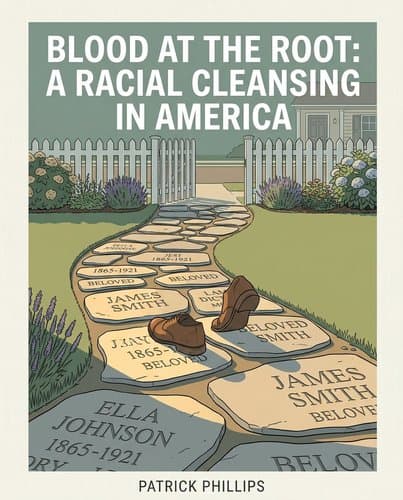
Near the end of her time living in Forsyth, Helen Matthews Lewis walked up to a neighbor's front door and stopped. Something was wrong with the stepping stones along the path. She leaned down. The faint markings she'd been walking over weren't weather-worn grooves — they were names. Someone had dug up stones from a Black cemetery, hauled them home, and laid them face-up as a garden path.
Lewis had moved to Forsyth in 1934 as a ten-year-old. She grew up in a county where the absence of Black people was total, enforced, and to her schoolmates, simply unremarkable. She'd watched her father, a county mail carrier, escort an elderly Black man on a bicycle out of the county because he feared the man would never make it through on his own. The violence that had cleared Forsyth in 1912 had receded into folklore, retold with something like pride: the county had "run the niggers out," and that was that.
The stepping stones made legible what the county preferred to obscure: the erasure required labor. Uprooting gravestones demands tools and a deliberate trip to a burial ground. Someone had chosen to do this work. Journalist Elliot Jaspin's survey of the courthouse property books documented thirty-four Black landowners who had never sold their property at all, who had fled and left behind land accumulated over lifetimes. What followed was routine: white neighbors walked to the courthouse, paid back taxes on land they didn't own, and county clerks transcribed the transactions without comment. Georgia's adverse possession law provided the legal cover — seven years of peaceable occupation ripened into title. Everyone in the courthouse knew the original departures had been anything but peaceable. The clerks recorded the transfers anyway. Within three years, nearly two-thirds of unoccupied Black-owned farmland had changed hands this way.
When the Brotherhood Marches of 1987 finally forced a public reckoning, the same labor was still underway. A biracial committee convened by the governor spent ten months and produced two competing reports. The white members attributed the 1912 exodus partly to the boll weevil (a crop pest that hadn't reached Georgia until 1915, three years after the expulsions). Their conclusion: "Forsyth County has no apologies to make to anyone." Black committee member Felker Ward's counter-report offered four words in reply: "Silence is interpreted as consent." The governor disbanded the committee. The stolen land, by then beneath some of the most expensive real estate in metropolitan Atlanta, stayed where it was.
The Promise That Was Never Kept
Kathleen Hutchins Anderson was in her eighties when a researcher arrived with a tape recorder, in the spring of 1987 — the same spring Forsyth's biracial commission issued its formal verdict: the county had no apologies to make to anyone. She described leaving a doll behind when the family fled in 1912, and asking her grandmother Catherine what had happened to it. Catherine, who had been born into slavery, told her a pack of wild dogs got into the house and tore it up. She'd buy a new one just as soon as they got back. She never went back. Both things happened in the same spring, and both were true at once. That's where Phillips leaves you: with a grandmother's protective lie, an eight-year-old's lost doll, and a return the crime had made impossible — still, officially, nothing.
Notable Quotes
“he was helping bring an employer's harvested crops to market. But to black churchgoers, he was also well known as a preacher, and as the son of Reverend Silas Smith, one of the area's leading clergymen, whose ornate signature had graced the bottom of”
“black preacher, who had dared to question a white woman's worth.”
“according to one witness, and”
Frequently Asked Questions
- What is Blood at the Root: A Racial Cleansing in America about?
- Blood at the Root reconstructs the 1912 expulsion of every Black resident from Forsyth County, Georgia, examining how ordinary officials, legal institutions, and neighbors sustained this racial cleansing across generations. Author Patrick Phillips traces the structural mechanisms that enabled the violence—from deliberate forgetting to falsified records—demonstrating that racial cleansing wasn't orchestrated solely by mobs but perpetuated through the compounding choices of those who selected silence and inaction over intervention. The book provides readers a framework for understanding how communities can systematically erase people and history through institutional and personal complicity.
- How did ordinary people enable racial cleansing in Forsyth County?
- A racial cleansing is sustained by chains of small, ordinary acts — a sheriff who disappears at a convenient moment, a coroner who writes 'parties unknown,' a county clerk who records a stolen land transfer without raising an eyebrow. Rather than viewing racial violence as the work of exceptional actors, Phillips demonstrates how accountability requires naming each link in the chain of inaction and complicity. By examining these bureaucratic and personal choices—the decisions to look away, to falsify records, to maintain silence—the author reveals that the cleansing wasn't perpetrated by monsters but by ordinary officials making ordinary choices that enabled extraordinary violence.
- What role does silence play in racial violence according to Blood at the Root?
- Active forgetting and institutional silence are forms of violence themselves. Phillips shows that Forsyth's erasure required ongoing institutional labor—falsified land records, competing historical committee reports, and seventy-five years of bureaucratic silence—with each layer of erasure making subsequent enforcement feel like simple common sense rather than a crime being continued. The book emphasizes the Felker Ward principle: "Silence is interpreted as consent." Every community that hasn't formally reckoned with its racial violence is still making that choice—and that choice continues to do work in perpetuating historical erasure and denial.
- What is the significance of the Hall County counter-example?
- The Hall County counter-example demonstrates that the 1912 racial cleansing wasn't inevitable. The same wave of night-rider violence occurred one river away in the same year, but was stopped in twenty-four hours once a planter grabbed a shotgun and a sheriff chose to make arrests. Phillips uses this example as powerful evidence that Forsyth's total cleansing was produced by specific people choosing specific inaction, not by historical inevitability. It reveals how different leadership choices could have prevented the ethnic cleansing entirely.
Related Book Summaries
Read the full summary of 28789644_blood-at-the-root on InShort