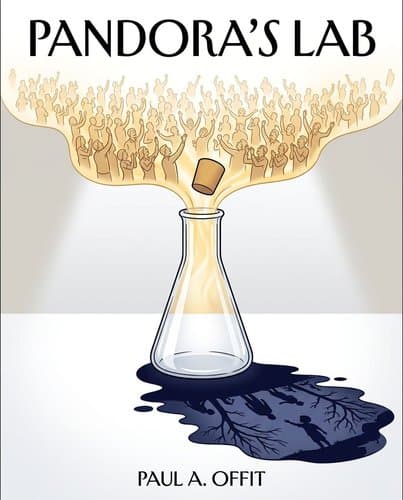
30213950_pandora-s-lab
by Paul A. Offit
Heroin was marketed by doctors, lobotomies won a Nobel Prize, and eugenics had university chairs—history's worst scientific disasters weren't driven by…
In Brief
Heroin was marketed by doctors, lobotomies won a Nobel Prize, and eugenics had university chairs—history's worst scientific disasters weren't driven by ignorance but by credentialed optimists with thin data and unshakeable consensus. Seven case studies expose why prestige and agreement are the most dangerous ingredients in bad science.
Key Ideas
Question study size, duration, replication
Before trusting any 'studies show' claim, ask three questions: How many people? For how long? Has anyone else independently reproduced the result? Dreser's 1898 standing ovation rested on four workers and four weeks of data.
Consensus becomes obstacle to correction
Cultural consensus can accelerate catastrophe — when Nobel laureates, major universities, and government agencies all endorse an idea, the agreement itself becomes the primary obstacle to correction. Respectable backing is not the same as reliable evidence.
Both action and inaction kill
The precautionary principle cuts in both directions: refusing to use an effective treatment kills just as surely as using a harmful one. 'Better safe than sorry' requires data to be wisdom; without it, it's just a different kind of recklessness.
Credentials only certify specific domains
Credentials signal past performance in a specific domain — they do not validate claims made outside it. Evaluate study design and reproducibility, not the CV or prize shelf of the person making the claim.
Scientists must engage contradictory evidence
Watch what happens when a scientist's hypothesis is directly contradicted: if the response is to engage the evidence, the science is working. If the response is to attack the integrity of the researchers, the hypothesis is probably failing.
Recognize the catastrophe template pattern
The repeating template for preventable scientific catastrophe: a desperate, genuine need — thin data that looks promising — cultural momentum that outruns scrutiny — reputational authority that insulates the claim from challenge. Recognizing the template is how you catch it before the body count.
Who Should Read This
Science-curious readers interested in World History and Technology History who want to go beyond the headlines.
Pandora's Lab
By Paul A. Offit
9 min read
Why does it matter? Because the worst scientific catastrophes in history were cheered, not condemned, when they happened.
We tell ourselves a flattering story about scientific catastrophe: somewhere in the background, there's a bad actor — a corrupt executive, a negligent researcher, an ideologue who bulldozed the evidence. That story is comfortable because it keeps the problem at a distance. Pandora's Lab dismantles it case by case, and what it exposes is harder to sit with. The same chemist made both aspirin and heroin. The man who discovered how to feed seven billion people also pioneered chemical warfare. The conservationist who helped save the American bison handed Adolf Hitler a scientific framework for the Holocaust. Every disaster in this book was endorsed by Nobel laureates, funded by Carnegie and Rockefeller, praised by Harvard and the New York Times, and welcomed by a public desperate for progress. Paul Offit's subject isn't villainy. It's something more difficult to guard against: distinguished people responding to urgent problems with not nearly enough data.
Every Medical Disaster in History Started as a Standing Ovation
In September 1898, a German chemistry professor named Heinrich Dreser walked to a podium at the 70th Congress of German Naturalists and Physicians and told the assembled scientists that he had solved one of medicine's oldest problems. Morphine was destroying lives: addiction, dependence, overdose. Dreser had the safe replacement: a compound five times more powerful than morphine, he said, and entirely free of its addictive properties. The room gave him a standing ovation.
Bayer, Dreser's employer, named the drug "heroin" (from the German for heroic) and released it without a prescription the following year. If you wanted aspirin that year, you needed a doctor's note; aspirin carried a risk of stomach irritation. Heroin was the safer drug. Both came from the same man. Felix Hoffmann, a postdoctoral student at Bayer, made them using the exact same chemical technique applied to two different starting compounds.
Dreser was not deceiving anyone. His data were real: rats and rabbits had responded well, four factory workers had loved the drug enough to ask for more, a handful of patients had taken it for about four weeks. In 1898, that counted as sufficient evidence. He stood before his peers and presented what he believed, and they responded with genuine excitement, because the findings looked exactly like progress.
The opioid story is harder to reckon with than it should be. Every entry point involves capable, well-meaning people responding to a real problem with real optimism — and data that was simply too thin to hold the weight being placed on it. Morphine had been introduced as the safe alternative to opium; the chemist who isolated it, Friedrich Sertürner, was so alarmed by what he'd created that he published a warning, which everyone ignored. Heroin was introduced as the safe version of morphine. Oxycodone, a century later, was introduced as the safe version of heroin. And in the 1980s, a New York pain specialist named Russell Portenoy launched a national campaign urging American doctors to prescribe opioids more freely — built on a study of 38 patients.
Each generation was certain it had learned from the previous disaster. Each was right that the old drug was dangerous and wrong that the new one wasn't. The standing ovation always came before anyone counted the bodies. That is the pattern.
The Man Who Fed Three Billion People Gassed Thousands — and Felt No Contradiction
Fritz Haber synthesized nitrogen from thin air, fed billions of people who would otherwise have starved, and supervised the first large-scale chemical weapons attack in history — all without experiencing anything he recognized as moral conflict.
The nitrogen problem was existential. Nitrogen, the fourth essential element in every human body, comes only from soil, and farming depletes it faster than nature replaces it. At the turn of the twentieth century, even farming every inch of arable land could feed at most four billion people. Today over seven billion people are alive. Three billion of them exist because of what Haber invented. Fifty percent of the nitrogen in every human body arrived there through the process he developed in 1909.
The same chemistry makes high explosives; WWI gave him the opportunity to prove it. He went further. In April 1915, near the Belgian town of Ypres, he opened the valves on 6,000 canisters of chlorine gas. A yellow-green cloud four miles wide swept into the Allied trenches. Birds dropped from the sky. Five thousand soldiers died; fifteen thousand more were permanently disabled.
A week later, Haber and his wife Clara hosted a dinner party. They argued afterward. Clara, one of Germany's first women to earn a chemistry doctorate, told her husband that what he had done at Ypres was organized killing, not science. After Fritz fell asleep that night, she took his service pistol to the garden, fired a test shot, and then shot herself in the chest. Their fourteen-year-old son Hermann found her bleeding in the dark and screamed for his father. Fritz had taken a sleeping pill and could not be woken. Clara died before morning. The next day, Haber left for the Eastern Front.
He never understood what she had objected to. A dead soldier was a dead soldier — the method of killing was irrelevant. He had simply applied chemistry to war the same way he had applied it to agriculture, and Germany had won the advantage either way. To Haber, there was no contradiction to feel.
There is a final accounting. Under Haber's supervision, German scientists developed a cyanide-based pesticide called Zyklon, first with a warning odorant, then without. The odorless version, Zyklon B, was used by the Nazis to kill over a million Jews in concentration camps. Among the dead were Haber's own relatives: the daughter of his half-sister, her husband, and their two children. But near the end of his life, realizing he had armed the regime now turning against his people, he said: "I have put fire in the hands of small children." Even that admission fell short.
Scientific Racism Wasn't a Fringe Theory — It Had an Advisory Board from Harvard and Yale
In 1917, Madison Grant stood among California redwoods that had been alive since the birth of Christianity and felt sick — not at the trees, but at the loggers destroying them. Grant had already co-founded the Bronx Zoo, rescued the American bison from extinction, and helped establish four national parks: Denali, Everglades, Olympic, Glacier. Now he founded the Save the Redwoods League. When Grant turned his attention to preserving something, it got preserved.
The year before, he had turned his attention to race.
The Passing of the Great Race, published in 1916, proposed three scientific facts: that human races were biologically distinct with Nordics at the top; that racial traits were immutable, untouched by education or environment; and that in any cross-breeding, the inferior race always dominated. Science praised the book. So did the Yale Review. So did two American presidents — Theodore Roosevelt sent Grant a personal letter calling it "a capital book." When the book was translated into German in 1925, a thirty-six-year-old in Landsberg Prison read it and wrote Grant a fan letter: "This book is my Bible." The writer was Adolf Hitler.
When evidence lands where people already want it, it gains institutional approval instead of scrutiny. Grant had misread Mendel's pea plant experiments and applied them to human civilization. The science was wrong. But the book arrived wearing the credibility of a man the establishment already trusted, and confirmed fears the establishment already felt. The Eugenics Record Office that promoted his ideas carried an advisory board including Nobel laureates, a future AMA president, and professors from Harvard, Johns Hopkins, Princeton, and Yale. Carnegie, Rockefeller, and Harriman funded it. By 1928, four hundred American colleges taught eugenics as science, and seventy percent of high school biology textbooks endorsed it.
The scrutiny never came. By the time the error was recognized, sixty-five thousand Americans had been sterilized, and Hitler had already built a government program on Grant's framework that would murder millions.
The Lobotomy Survived Not Because It Worked But Because No One in Power Wanted to Say It Didn't
Who stops a doctor who has gone too far? In the lobotomy era, nobody with the authority to matter. Walter Freeman's first ice pick lobotomy happened in his own office in 1946. He electroshocked the patient unconscious, then drove a kitchen implement through her eye socket with a small hammer. No professional body ever formally condemned him. Freeman lost his license only in 1967, when a patient died of hemorrhage during what turned out to be his last operation.
What that silence cost can be measured in one case. Rosemary Kennedy was functional before her lobotomy — she had sailed competitively, traveled overseas without a chaperone, and learned to read and write. At 15, she wrote her father: "I would do anything to make you so happy." What she couldn't suppress were occasional outbursts of anger, and in a family that treated public embarrassment as a political liability, that was enough.
A Boston neurologist had already told Joseph Kennedy that mild developmental delay was not a reason for brain surgery. Kennedy found Freeman, who diagnosed "agitated depression" and offered a simple resolution. Kennedy never told his wife.
Rosemary was 23 when Freeman operated. He asked her to count, sing songs, and name the months of the year during the procedure to gauge whether he was taking too much. He took too much. She emerged unable to read, speaking only a few words, unable to recognize anyone. Rose Kennedy stopped visiting for 20 years. Joseph Kennedy stopped visiting for the last 25 years of his life. The only family member to see Rosemary before she died in 2005 was John, who made a private stop during a Wisconsin campaign swing in 1958.
The institutional logic was straightforward. By 1940, state mental hospitals held 480,000 patients in conditions the press compared to Nazi concentration camps — one physician for every 250 patients. When institutions have nothing better to offer, they accommodate whoever claims a solution. Thorazine ended the era: a drug approved in 1954 that actually reduced schizophrenia's hallucinations, and whose side effects reversed the moment you stopped taking it. The profession moved on the instant it had somewhere else to go.
'Better Safe Than Sorry' Has Its Own Body Count
Imagine a doctor who refuses to prescribe a treatment because some patients experience side effects, while the untreated disease kills roughly one in three. No one would call this caution. We'd call it negligence. The word "safer" only means something relative to what you're comparing: in medicine, the alternative to treatment is not nothing.
That logic killed people; Sri Lanka is where you can count them.
By the early 1960s, DDT had reduced malaria cases in Sri Lanka from 2.8 million per year to 17. That number is not a typo. Seventeen cases in a country of ten million people. Then Silent Spring swept through Western policy circles, DDT spraying ended, and between 1968 and 1970 a single epidemic struck: 1.5 million infections. The people who stopped the spraying were not villains; they were responding to a book that had frightened the American public, and fright travels. But their caution had a specific, measurable consequence. Those 1.5 million people had been protected the year before.
The most unsettling part is how little evidence drove the decision. An eight-month EPA hearing produced 125 witnesses, 365 exhibits, and a 9,312-page transcript. Its finding: DDT did not cause cancer or birth defects in humans, and continued use was warranted. The EPA administrator who made the final call, William Ruckelshaus, never attended the hearing. Never read the report. He banned DDT anyway, and later called it a political decision, made in response to public sentiment.
The scientific record wasn't inconclusive. It was simply set aside.
Since the 1972 U.S. ban, approximately 50 million people have died from malaria — most of them children under five. Fifty million. Mostly children.
Caution is not a moral position. It is a calculation. Refusing to act on good evidence kills people just as reliably as acting on bad evidence, just less visibly — the deaths are dispersed across decades and continents, and no one holds a press conference for them. The precautionary principle sounds like wisdom until you ask: cautious compared to what? Every intervention forgone is a comparison you're making, whether you intend to or not. The question isn't whether to take a risk. It's which risk you're choosing.
A Nobel Prize Can Shield Bad Science From the Scrutiny It Most Needs
In 1977, Arthur Robinson carried alarming data into Linus Pauling's office. Robinson was vice president of Pauling's own institute, recruited personally and trusted. His study of cancer-prone mice had found that animals given the human equivalent of 10,000 milligrams of vitamin C daily developed cancer at higher rates than those given none. Since Pauling and his wife were both on exactly that dose, Robinson delivered the news carefully.
Pauling's response was not to look harder at the data. He threatened to have the mice killed. He demanded Robinson's resignation. When Robinson refused, Pauling had his salary withheld, his files locked, and his position dismantled. Robinson sued for $25 million; the case ran five years, cost the institute a million dollars in legal fees, and settled for $500,000. Ava Pauling continued her daily megadose. She later developed stomach cancer.
What that sequence reveals is this: the vitamin C campaign wasn't an honest mistake. It was a hypothesis maintained against mounting contrary evidence by the force of a reputation so large that contradiction looked like attack. Two unshared Nobel Prizes confer enormous credibility. They can also insulate a claim from scrutiny that would fall automatically on anyone else. When the Mayo Clinic ran two controlled trials finding vitamin C didn't treat cancer, Pauling accused the researchers of deliberate fraud. When his own institute produced contrary findings, he fired the person who found them. The hypothesis never engaged its evidence. It destroyed whoever carried it.
The question isn't whether credentials are legitimate (Pauling's were extraordinary). It's what someone does the moment their hypothesis is contradicted: engage the evidence, or attack whoever produced it? When every contrary study becomes proof of conspiracy, that tells you more about the theory than the theory does. That's the test. Keep it.
The same pattern runs through debates happening right now. Cancer screening catches tumors people will die with rather than from. GMO fears persist despite decades of safety data. E-cigarettes: smoking rates fell fastest among exactly the populations switching to vaping, and that's when multiple countries moved to ban them — the bans arrived just as the numbers were trending the right direction. Apply the test. Pandora's Lab is structured as history. It functions as a field guide.
The Calculation Never Ends — but Now You Know What to Calculate
The tool Offit is handing you isn't skepticism — skepticism cuts just as indiscriminately as credulity. What he's after is more exacting: the habit of asking, before the room starts applauding, how many people the study enrolled, who ran the contrary experiment and what happened to their career, and whether the urgency driving the research was substituting for the quality of the proof. Those questions won't produce a formula. But every disaster in this book had a moment — early, when the data was still thin — where asking them would have been enough. And if caution without evidence feels safe, the DDT numbers are worth sitting with: fifty million dead, mostly children, from a decision made on political sentiment while the scientific record said otherwise. Caution is not a value. It's a calculation. Ruckelshaus made his with 9,312 pages of testimony he never read.
Notable Quotes
“The word spread that he was the go-to doctor to get pills,”
“You've got to realize something's wrong when outside your office people are having tailgate parties,”
“Mother after mother after mother called the defendant's office and asked him to quit giving their children drugs or they would die. The defendant did not quit and they continued to overdose.”
Frequently Asked Questions
- What is Pandora's Lab by Paul Offit about?
- Pandora's Lab examines seven moments in history when well-credentialed scientists caused mass harm by acting on thin data amplified by cultural momentum. The book reveals the repeating template behind preventable scientific catastrophe and teaches readers to evaluate evidence on its own merits rather than by the reputation of those promoting it. Offit demonstrates how desperate need, premature confidence, and insulating authority create conditions where harmful ideas spread unchecked, equipping readers to recognize and resist this dangerous pattern before real-world harm occurs.
- What are the key takeaways from Pandora's Lab?
- Ask three critical questions before accepting any 'studies show' claim: How many people studied? For how long? Has anyone else independently reproduced the results? Credentials signal past performance in a specific domain but do not validate claims outside that expertise. The precautionary principle cuts both ways—refusing an effective treatment kills just as using a harmful one. Watch how scientists respond to contradictory evidence: if they engage with data, science is working; if they attack researchers' integrity, the hypothesis is probably failing. Cultural consensus can accelerate catastrophe when major institutions endorse an unproven idea.
- What is the repeating template for scientific catastrophe according to Pandora's Lab?
- The repeating template for preventable scientific catastrophe consists of four elements: a desperate, genuine need for a solution; thin data that appears promising; cultural momentum that outpaces scrutiny; and reputational authority that insulates the claim from challenge. Recognizing this template is how readers can identify potentially harmful ideas before they cause widespread harm. By understanding how each element enables the next, people can break the chain at any point—demanding better data, slowing adoption, or subjecting prestigious claims to rigorous independent verification rather than assuming credentials guarantee correctness.
- How should you evaluate scientific claims according to Pandora's Lab?
- Evaluate study design and reproducibility rather than the credentials or prize shelf of the person making the claim. Credentials signal past performance in a specific domain but do not validate claims made outside it. Before trusting any study, ask: How many people? For how long? Has anyone else independently reproduced the results? Watch how scientists respond when evidence contradicts their hypothesis—if they engage the evidence, science is working; if they attack the integrity of researchers, the hypothesis is probably failing. Never assume respectable backing equals reliable evidence; the agreement of major institutions can itself become the primary obstacle to correction.
Related Book Summaries
Read the full summary of 30213950_pandora-s-lab on InShort