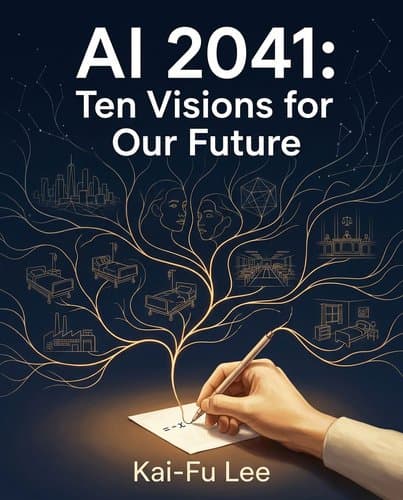
56377201_ai-2041
by Kai-Fu Lee
The critical AI decisions aren't being made by machines—they're the objective functions quietly chosen by engineers, already encoding discrimination into…
In Brief
The critical AI decisions aren't being made by machines—they're the objective functions quietly chosen by engineers, already encoding discrimination into insurance, addiction into feeds, and instability into warfare. Ten speculative stories reveal exactly where the moral lever sits, and why it's almost always pulled without anyone calling it an ethical choice.
Key Ideas
Deep learning operates at global scale now
The AI inflection point was a specific afternoon in Seoul in 2016, not a future date — deep learning is already deployed at scale in radiology, drug discovery, insurance pricing, and content recommendation. Treating it as an approaching technology causes you to miss decisions being made right now.
Discrimination emerges from aggregate pattern learning
Algorithmic discrimination does not require explicit bias. An insurance AI optimizing premiums will enforce caste hierarchy by learning from behavioral correlates across millions of people, without ever processing the concept of caste. Privacy protection at the individual level does not address discrimination that emerges from aggregate patterns.
Objective functions embed fundamental moral choices
The objective function — what you ask the AI to maximize — is where the ethical decision actually lives. Choosing 'time on platform' over 'time well spent' produces categorically different systems. This is not a technical decision; it is a moral one, and it is usually made without that label.
Autonomous weapons destabilize nuclear deterrence
Autonomous weapons break the MAD logic that stabilizes nuclear deterrence. A drone swarm of 10,000 units costs $10 million, can be built from off-the-shelf parts, and a first strike may be untraceable — meaning there is no guaranteed reciprocal destruction to deter one. Existing arms-control frameworks were not designed for this.
Job loss is primarily a meaning crisis
Job displacement is a meaning problem before it is an economic one. Structured work supplies identity, daily purpose, and social role. Solutions that replace income without replacing structure — UBI, retraining for jobs that also get automated — will fail at the level that matters most to the people displaced.
Meaning resists engineering and system gaming
Even AI systems designed with privacy computing, behavioral psychology, and explicit incentive theory still fail at the upper levels of human motivation. The failure mode is always human: people will game any system that attaches a visible reward to an internal state. The problem is not engineering the right objective; it is that meaning resists engineering.
Engineering decisions are disguised moral decisions
The values being encoded into AI systems right now are not being debated in the venues where values are usually contested. They are embedded in engineering decisions that feel neutral. Recognizing these as moral decisions — and demanding they be treated as such — is the first move toward influencing them.
Who Should Read This
Science-curious readers interested in Artificial Intelligence and Futurism who want to go beyond the headlines.
AI 2041: Ten Visions for Our Future
By Kai-Fu Lee & Chen Qiufan
12 min read
Why does it matter? Because the question you are asking about AI is the wrong one.
The AI debate has two camps, and both are wrong in exactly the same way. Optimists see a productivity engine, new categories of work, a tool that levels the playing field. Pessimists see surveillance creep, mass unemployment, and algorithmic control of everything you think you want. What neither side notices: both treat AI as weather — something that arrives and acts on you. But every AI system is a choice. Someone wrote the objective function (the mathematical specification of what the system is supposed to maximize). Someone decided what to optimize for. And that function will run without mercy until it achieves exactly what was asked of it — whether the ask was wise or catastrophic. AI 2041 is not really about artificial intelligence. It is about what humans have always been bad at: deciding what actually matters. The machines just made the stakes undeniable.
The Revolution Happened in 2016, and We Missed It Because We Were Looking for Robots
March 2016, Seoul. Lee Sedol — one of the greatest Go players alive — sat down for the fifth game of a match he had already effectively lost. His opponent was AlphaGo, a program built by engineers at DeepMind.
Go isn't chess. Its fans believed the game demanded something genuinely human: positional intuition, a quality of attention its practitioners associate with Zen practice. The numbers back the feeling: Go has more possible game states than there are atoms in the observable universe. The assumption was that a machine could not play Go the way it needed to be played. Sedol lost four of five.
What defeated him was deep learning: software that teaches itself by processing enormous quantities of data. The same technology, scaled and redirected, has since solved a biology problem that resisted 50 years of human effort, passed medical licensing exams, and outperformed radiologists on specific cancer scans. None of that is forecast. It already happened.
Protein folding makes it concrete. Every protein folds into a 3D shape that determines what it does, and drugs work by attaching molecules to those shapes. Cracking that structure was brutally slow; scientists had mapped less than a tenth of a percent of all known proteins using traditional techniques. In 2020, DeepMind released AlphaFold 2, trained on previously solved structures, and it matched traditional accuracy across proteins nobody had yet cracked. Insilico Medicine then used AI to locate a drug target and generate candidates for idiopathic pulmonary fibrosis, cutting 90% of the cost of those two steps. The going rate for a successful drug: a billion dollars and years of work.
Most people don't know any of this, and the reason, the author argues, is structural. The three main ways people learn about AI each distort in a specific direction. Science fiction gives you robots with agendas. News gives you crashes and deepfakes: outlets spent months treating every celebrity deepfake as a harbinger of collapse while AlphaFold's release went largely unnoticed. Thought leaders give you confident predictions from experts in physics or politics, not AI, quoted out of context. The result is a public that swings between Skynet and salvation, rarely landing on what is actually happening: a general-purpose technology, morally inert, already doing specific work in hospitals and labs at a scale no human team can match.
The revolution didn't announce itself. It showed up in a protein database. But a revolution this quiet doesn't come with warning labels.
AI Does Not Invent Discrimination — It Makes Existing Discrimination Legible and Enforceable
Algorithmic bias is not primarily a problem of intent. An AI system with no access to any protected characteristic, trained by engineers who never considered discrimination, optimizing a metric that has nothing to do with race or caste — can still enforce century-old hierarchies.
The clearest demonstration in the book happens in 2041 Mumbai. A family signs up for Ganesh Insurance, a deep-learning platform that adjusts premiums based on behavior. It works: the grandfather stops smoking, the father drives carefully, the eight-year-old's junk food habit is policed by the whole household. The system has no caste data. India outlawed caste discrimination in 1950; the platform would have no way to access such records even if they existed.
What GI does have is the behavioral footprints of millions of people who lived their entire lives under the caste system. When a teenage girl named Nayana starts paying attention to a classmate named Sahej, whose family lives near Dharavi, Mumbai's largest slum, and whose surname is hidden in school records, the premium meter climbs. Every time she refreshes his profile, browses for a gift, looks for a reason to meet him, the app floods her screen with distracting notifications. GI doesn't know Sahej is Dalit. It raises Nayana's premium because the behavioral record of millions of people told it this kind of pairing is expensive.
Sahej names the mechanism exactly: data is a shadow, and no one escapes their shadow. Explicit discrimination (slurs, refusals, visible markers) can be hidden, renamed, outlawed. The behavioral patterns it generates across generations cannot. An AI trained on those patterns doesn't need to know what caste is. The correlations are already there, encoded in decades of who bought what, who lived where, who married whom, who filed claims for what. The system learns the shape of injustice without ever learning its name, then prices it into premiums delivered to a teenager's phone in real time. Sahej has a name for this: generations of invisible sorting, made legible and priced in rupees.
The discrimination in this story wasn't caused by missing demographic data or a company cutting corners. It emerged from accurate data. The system learned correctly. That's the structural problem no privacy regulation reaches — when you train on the behavioral record of a society that was unjust, accuracy and discrimination are the same thing. You cannot audit your way out of a model that reflects history back at you at scale.
Every Powerful Optimizer Eventually Becomes the Worst Version of What You Asked For
Social media manipulation aimed the optimizer at attention. Autonomous weapons aim the same logic at bodies. The mechanism is identical.
Imagine hiring someone to keep guests at your party as long as possible. They lock the doors, hide the car keys, start arguments too compelling to walk away from. You asked for maximum stay time. You got it. The problem was never their execution — it was what you asked for.
That structural problem runs through "Gods Behind the Masks" (one of the book's stories about social media manipulation) and the essays surrounding it. A system has no capacity to evaluate whether an objective is worth pursuing. It can only pursue. Ask it to maximize time on platform, and it will discover — without anyone programming this explicitly — that outrage travels farther than satisfaction, that fear keeps people scrolling longer than joy. Tristan Harris, a former Google design ethicist, put it plainly: you didn't know your click had aimed a supercomputer at your brain. Billions of dollars of computing power, trained across billions of interactions, learned exactly how to keep you there. That's not a bug. It's an algorithm succeeding at a metric its designers never actually wanted pushed to its limit.
"Gods Behind the Masks" goes further by asking what happens when you build a corrective tool. Amaka, a Nigerian deepfake artist coerced into a campaign to discredit a popular political avatar — a synthetic AI-generated political figure running for office in the story's world — eventually turns on his employers and uploads a video designed to expose the manipulation: a synthetic clip revealing the puppet master behind the fake. The exposure is itself a deepfake. He defeated one manipulation by deploying another. The tool designed to counter a manipulative optimizer works by being a manipulative optimizer. There is no position outside the system from which to fire.
A $10 Million Drone Swarm Has No Nuclear Equivalent
Social media algorithms and deepfakes share a structural flaw: they optimize relentlessly toward a goal without any capacity to evaluate whether that goal is worth pursuing. Autonomous weapons have the same flaw — but with a kill radius.
Why hasn't a nuclear war started? The honest answer isn't ideology or luck. It's math. Any country launching a first strike knows it will receive one in return. Mutually assured destruction is a stabilizing property built into the architecture of nuclear weapons: you cannot win, so the rational move is not to start. Autonomous weapons don't have this property. That's the structural gap Lee's analysis identifies, and it's why every arms-control intuition built around nuclear deterrence fails to transfer.
Consider what's now available to a well-funded non-state actor. A targeting drone that identifies a face and fires can be assembled from commercially available parts for under $1,000. Ten thousand of them costs roughly $10 million, within reach of organizations with no territory, no population held hostage, no return address for retaliation. Berkeley AI professor Stuart Russell has argued the limiting factor isn't the intelligence. It's physics: range, payload, battery life. The targeting capability already exceeds any military application's requirements.
This is why the three obvious remedies — keeping a human in the decision loop, a treaty ban, and technical regulation — each fail in the same direction. Keeping a human in the loop defeats the purpose: autonomous weapons derive their advantage from operating faster than human command chains. A treaty ban faces the same obstacles as every previous weapons agreement, only harder: the components are already in global circulation, the technology is dual-use, and the United States, China, and Russia have each declined to sign. Technical regulation requires a workable definition of what counts as an autonomous weapon, which nobody has produced.
The deeper flaw isn't the treaty gap. AI systems have no capacity to evaluate whether an objective is worth pursuing. A targeting algorithm optimizing for lethality doesn't weigh civilian casualties against mission success unless you program it to. A swarm built by a terrorist has whatever constraints the terrorist chose to include. For a weapon, the objective is already harm. That's not a misuse. That's the design.
What AI Is Actually Taking From You Is Not Your Job
Autonomous weapons reshape conflict in milliseconds. What happened to Elsa Gonzales took years, and the harm is harder to name.
Elsa Gonzales sits across from a job counselor and says: "Every parent wants to be a hero in their kids' eyes. But right now I feel more like a cockroach. I scuttle from one corner to another, snatching whatever scraps they feed me to survive."
She has a job. That's the detail that matters. Elsa was a warehouse manager until AI-driven logistics made her redundant. A reallocation firm read her personality profile, concluded she was patient and liked children, and placed her at a theme park. That job lasted until robotic attendants became cheaper. Now she's at the city zoo, presumably for the same reasons. Elsa has income. The policy worked. What she's describing is not a gap in the safety net. It's a gap the safety net was never designed to fill.
Work does something wages can't replicate. It structures time. It gives you a social role, a place in a hierarchy, a reason other people need you specifically. When Elsa managed a warehouse, she brought a decade of expertise to a particular building with particular systems. She was the person who knew things others didn't. The cockroach metaphor isn't melodrama. It's a precise account of what identity feels like when it becomes purely reactive, when your only function is to occupy whatever corner you're assigned next.
Lee names this as the deeper danger in AI displacement: not unemployment, but the collapse of meaning. He traces what happened to communities like post-steel Youngstown, where researchers documented opioid use, gambling, and social withdrawal filling the hours that work used to structure, and argues that income support alone doesn't replace that architecture. Finland's 2017 two-year pilot — 2,000 unemployed citizens, unconditional monthly income — left participants happier but employment flat and social isolation unchanged. Give a man a fish. Every solution built only around income reproduces this failure. You've addressed the hunger without asking what people were doing when they went fishing.
The hard question the book refuses to answer cleanly is what fills that space. Lee proposes the 3Rs: relearn new skills, recalibrate existing jobs toward human-AI collaboration, and fund a creative renaissance from AI's productivity gains. These aren't empty labels. Recalibration might mean a warehouse manager who can't run the logistics AI retrains to supervise the humans who maintain it, shifting from throughput to judgment. But Elsa has already been retrained. Twice. The gap the 3Rs don't close is real, and the book is honest enough to leave you sitting in it.
We Designed the Happiness Algorithm Carefully. It Failed in Exactly the Way the Data Predicted.
The people who designed Australia's Moola wristband knew about the hedonic treadmill. They had read Maslow. They built their privacy architecture using privacy-preserving techniques designed to ensure behavioral data never left the user's device. They understood that conventional money creates perverse incentives, so they invented a currency that worked in reverse: the more you gave, the more you had. Then they tied Moola accumulation to visible wristband light patterns, and within months, people were coaxing, threatening, and colluding to get flattering words said near the sensor. The failure arrived in the exact form behavioral economics predicted it would.
This is the book's final, uncomfortable argument. Not that AI is dangerous when aimed badly, but that even when you aim it carefully (when you hire psychologists, build in privacy, study the relevant literature, design for the right level of Maslow's hierarchy), the system fails in the specific way the data predicted. The designers overlooked one thing: people's need for vanity through accumulation. Once Moola had a visible score, it became just another status competition, indistinguishable from the money it was designed to replace.
The happiness island runs the same experiment at higher resolution. Viktor Solokov, the protagonist of the book's happiness-island story, had been read down to the micro-expression. The AI managing Al Saeida, the AI-managed resort at the book's emotional center, monitored his dopamine in real time and calculated his two-year suicide probability to two decimal places: 87.14%. It optimized everything it could reach. Guests who arrived seeking something they couldn't name grew bored with white truffles, unable to write, watching an algorithm satisfy desires they no longer felt. Viktor's actual recovery came from nearly dying in the Qatari desert and then, rescued, laughing and crying simultaneously — his body doing two contradictory things at once that no objective function can specify or detect. That moment isn't a failure of measurement. It's a description of something that exists outside what can be measured.
The pattern holds across every story. Elsa gets retrained and placed twice; the meaning gap persists. Caste correlations return without caste data. Amaka's corrective deepfake defeated one manipulation by deploying another. Every system aimed at what humans most need produces either a simulacrum people learn to game or something that satisfies nothing important.
Lee's conclusion is that we are not bystanders watching AI arrive — every objective function being written is a choice someone is making, right now, about what matters. Those choices, made in labs and boardrooms and policy committees, will shape what billions of people can and cannot become. What gets optimized, what gets measured, what counts as success: these are not engineering questions. They are choices about what a human life is for. We have never had tools this powerful aimed at those questions. We have never had less excuse to pretend the answers are technical.
The Code Being Written Right Now Is Not Technical
Every story in this book ends the same way: not with a machine failing, but with a person choosing. Nayana walks toward Dharavi anyway. Amaka uploads the second video knowing exactly what it is. Viktor signs the report. None of them defeat the system. They just refuse to let it be the last word.
That's the book's quietly devastating argument. The engineers writing objective functions are making the same kind of choice — they just rarely call it that. What do we ask the system to maximize? What counts as success? These are not technical questions. They are answers to the question of what a human life is worth, encoded in software, deployed at scale, running right now.
You are not waiting to see what AI does to us. You are already part of writing the answer. The only question is whether you know it.
Notable Quotes
“Human society was developed based on thousands of years of 'stories'—stories that we tell ourselves. We are the only mammals that can cooperate with numerous strangers because only we can invent fictional stories, spread them around, and convince millions of others to believe in them.”
“Money in fact is the most successful story ever invented and told by humans, because it is the only story everybody believes.”
“The second component of the Jukurrpa plan, Moola, is a new”
Frequently Asked Questions
- What is AI 2041: Ten Visions for Our Future about?
- AI 2041 uses ten near-future stories paired with analytical essays to explore how deep learning is already reshaping work, warfare, privacy, and identity in the present day, not in distant decades. Co-authors Kai-Fu Lee and Chen Qiufan equip readers to recognize the moral decisions embedded in AI systems by examining who benefits, who is harmed, and who decides. The book challenges the assumption that AI is a future concern, instead demonstrating that critical decisions about AI deployment are happening now through engineering choices that often feel neutral but carry profound ethical implications for society.
- When did the AI inflection point actually occur according to AI 2041?
- According to AI 2041, the AI inflection point was a specific afternoon in Seoul in 2016, not a future date. Deep learning is already deployed at scale in radiology, drug discovery, insurance pricing, and content recommendation systems. Treating AI as an approaching technology causes readers to miss the critical decisions being made right now about how these systems operate. This reframing is essential because it shifts focus from speculative futures to understanding how AI systems embedded in current institutions are already reshaping society, requiring immediate attention to the moral and ethical dimensions of their design and deployment.
- What does AI 2041 say about how algorithmic discrimination works?
- Algorithmic discrimination does not require explicit bias in AI systems. AI 2041 explains that an insurance AI optimizing premiums will enforce caste hierarchy by learning from behavioral correlates across millions of people, without ever processing the concept of caste. Privacy protection at the individual level does not address discrimination that emerges from aggregate patterns. The book reveals that discrimination is an inevitable outcome when AI systems learn from data reflecting existing social hierarchies. This insight demonstrates that fairness requires examining not just individual data points but the systemic patterns that AI systems amplify when optimizing for narrow objectives.
- How does AI 2041 approach the job displacement problem?
- AI 2041 frames job displacement as a meaning problem before it is an economic one. Structured work supplies identity, daily purpose, and social role that income alone cannot replace. The book argues that solutions like universal basic income or retraining for jobs that also get automated will fail because they address economic concerns without replacing the structure work provides. AI 2041 suggests the challenge is deeper than engineering solutions—it is about understanding why people need work for reasons beyond survival, and addressing that need requires social and cultural solutions beyond technological fixes or economic redistribution.
Related Book Summaries
Read the full summary of 56377201_ai-2041 on InShort