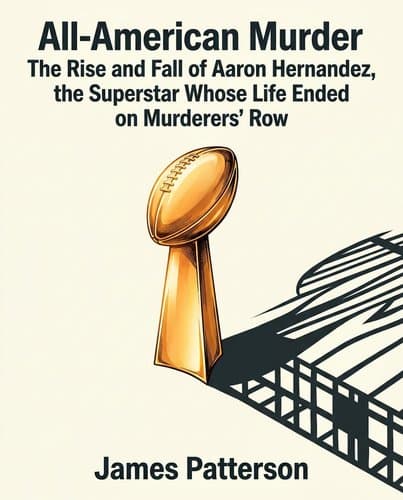
35181833_all-american-murder
by James Patterson
Every institution that touched Aaron Hernandez—family, college football, the NFL—chose to protect its investment over confronting the man, and each escape from…
In Brief
All-American Murder: The Rise and Fall of Aaron Hernandez, the Superstar Whose Life Ended on Murderers' Row (2018) traces how every institution in Aaron Hernandez's life — family, college football, the NFL — chose to protect its investment rather than confront his mounting problems.
Key Ideas
Impunity teaches exemption from rules
When an institution consistently absorbs warning signs rather than addresses them, it isn't being lenient — it is actively teaching the person that consequences are for other people. Each time Aaron escaped accountability, the lesson wasn't 'I got lucky.' It was 'the rules were never meant for me.'
Unprocessed grief redirects without accountability
Grief that isn't processed doesn't disappear — it redirects. The death of Dennis Hernandez from a routine surgery was the hinge point not because it made Aaron violent, but because it removed the one relationship whose entire purpose was Aaron's behavior rather than Aaron's output.
Victims deserve recognition as full persons
The people behind headline crimes had specific, irreplaceable lives. Safiro Furtado was working overnight office-cleaning shifts to save money before going home to Cape Verde. Odin Lloyd rolled blunts faster than anyone and played semi-pro football on his days off. Naming them is the minimum moral obligation a reader owes.
Predicted danger deliberately selected anyway
A psychological profile that scores 1 out of 10 on social maturity is not a yellow flag to be priced into a draft position — it is a prediction. The NFL read it, factored it into the fourth-round slot, and bought him anyway. Being surprised later was a performance.
We choose which conditions flourish
'Made vs. born' is the wrong question. The more honest question is: which conditions allowed what was already there to flourish? And which of those conditions did we choose to build, fund, and cheer for?
Who Should Read This
Readers interested in Social Issues and Behavioral Psychology, looking for practical insights they can apply to their own lives.
All-American Murder: The Rise and Fall of Aaron Hernandez, the Superstar Whose Life Ended on Murderers' Row
By James Patterson & Alex Abramovich & Mike Harvkey
11 min read
Why does it matter? Because every warning sign was documented — and everyone with power chose to look away.
The comfortable version of the Aaron Hernandez story is that he was a secret psychopath — charming on the surface, capable of anything underneath — and nobody saw it coming. That version is wrong. The violence wasn't hidden. It was visible, documented, and reported for nearly a decade: bar fights, shooting investigations, psychological profiles warning that he "enjoys living on the edge of acceptable behavior." Every time, someone with something to gain from his talent made it disappear: a university, a franchise, a system that had decided accountability was optional when the talent was exceptional enough. This isn't a true-crime portrait of a monster. It's a forensic account of how institutions confirmed to a damaged young man that the rules were never meant for him, and what that lesson eventually costs everyone else.
The Father Was the Only System That Actually Worked
A Bristol police officer once called Dennis Hernandez about his son — Aaron had climbed onto a car at a party and left a dent in the roof. Dennis drove down, made the boy apologize on the spot. Aaron didn't argue. He stood there and did the right thing. "Not a bad kid at all," the officer recalled. That's the system in operation.
Dennis understood the alternative. He'd grown up as one of the only Puerto Rican kids in a hardscrabble Connecticut town, and his own youth had been a catalog of poor choices — drinking, fighting, breaking into houses with his twin brother Dave and a friend named Rocco Testa. All three had been football scholarship recipients at UConn; all three dropped out. Then, in November 1977, Testa's uncle shot a police officer four times during a burglary, leaving a twenty-eight-year-old father of a toddler to bleed to death. Testa got immunity for testifying against him. Dennis and Dave hadn't been at the scene. But they'd watched the whole arc from close range: a guy they'd been breaking into houses with, now cutting a deal with prosecutors, his life forked by the same sequence of choices that had started out looking exactly like theirs. They resolved that fatherhood would be different.
Dennis became the mechanism. Pre-dawn workouts. Layup drills for hours. Suicide runs on the hills near the house on Greystone Avenue. The constant refrain: If it is to be, it is up to me. What he was building wasn't just a tight end. It was a kid who might survive the same town that nearly swallowed him.
In January 2006, Dennis went into the hospital for a routine hernia repair. He was forty-nine and healthy. He contracted a bacterial infection and died.
When a family friend named Tim Washington heard the words "Hernandez died" from a car with his coach, his first thought was that it must be Dave — Dennis's twin brother, who'd been battling cancer for years, who'd gone into remission and relapsed. Dennis couldn't possibly be dead. He was too necessary. The coach's phone rang a second time: no, not Dave. Dennis.
At the funeral — too large for the biggest parlor in Bristol, with a line stretching as far as anyone could see — Aaron, sixteen, put up a wall. His older brother DJ sobbed openly over the coffin. Aaron stood somewhere private and unreadable. That night he played basketball and scored thirty points. Thirty-one the night after that.
The people who later tried to explain what happened to Aaron Hernandez would point to many things: the CTE, the criminal associations, the fame. All of it matters. But when you trace the line back, the machinery that might have caught all of it died in a hospital from a bacterial infection after a routine procedure. After that, there was no system. Just Aaron, his talent, and a town where older Bristol kids who dealt and fought were already circling — the exact world Dennis had spent sixteen years steering him clear of.
Florida Didn't Tolerate Aaron's Violence — It Funded His Belief That Rules Didn't Apply to Him
Less than four months into his freshman year at the University of Florida, Aaron Hernandez sucker-punched a bar manager named Michael Taphorn hard enough to rupture his left eardrum. The trigger: a twelve-dollar tab for two shots Aaron hadn't ordered and didn't like. He fled the patio, losing a sneaker. Taphorn was still holding it when police arrived.
Then the institutional machinery started up. Bar co-owner Ron DeFilippo received calls from people who said they worked for Urban Meyer, but never identified themselves. The message was soft at first: it was in everyone's best interest to get the kid "under wraps" and let him go his own way. Then a second call, more direct — from someone DeFilippo understood as a Meyer handler: "Let this thing go. Anything you ever need for the Swamp, just give us a call." Future access to the program, in exchange for silence on a felony battery. Taphorn agreed to drop charges, on condition that Aaron return and apologize in person. Aaron never did.
Sometime later, staff at the Swamp noticed a car driving slowly past the front of the building. Aaron was inside, hand shaped into a gun. DeFilippo called the university again. The official he reached was not alarmed.
The response to the punch tells you more than the punch itself. The university made calls. It offered favors. It absorbed the violence as an institutional function and returned Aaron to his life with a message no seventeen-year-old could misread: your value makes you untouchable. What he drew from it wasn't relief. It was confirmation of something he'd already started to believe.
The Charming Version and the Violent Version Were Both the Real Aaron
Think of a person who sobs in his coach's office over a father he never got to say goodbye to, and then, the same afternoon, throws a punch that ruptures someone's eardrum. The tears weren't fake. Neither was the punch. That's the problem at the center of Aaron Hernandez, and it's harder to hold than simple hypocrisy.
After Dennis Hernandez died without warning in 2006, Aaron arrived in Gainesville carrying grief so raw it kept surfacing. He would break down sobbing in Urban Meyer's office, not performing, not seeking leverage, just a seventeen-year-old who'd never had a chance to say goodbye. What he asked of his coach was unusual: he wanted Meyer to retell the story of losing his own mother. Not once — repeatedly, as a ritual. Meyer found it uncomfortable and did it anyway, recognizing it as the only way Aaron had to let the pressure out. A grown man sharing his own grief, over and over, so Aaron wasn't alone in his.
Then Aaron asked if they could do morning Bible study together. Meyer said yes. Every morning, then once a week, then occasionally, then not at all. Not because Meyer stopped trying. He kept reaching out, kept proposing the deeper conversations. Aaron simply drifted. Meyer's summary: "He just seemed to change."
What makes this hard is that the drift wasn't a mask coming off. Aaron wasn't performing the Bible studies or manufacturing the grief sessions. He genuinely wanted the structure, the family, the father figure. He also couldn't sustain it. After every trip home to Bristol, teammates and coaching staff could see him regress, needing weeks to come back. His loyalty to the Bristol crowd wasn't calculation — it was the same instinct that had him calling strangers' mothers "ma" and strangers' grandmothers "grandma" the moment he walked through the door.
The book refuses to answer whether Aaron wanted to heal but couldn't, or whether the destruction was always the engine and everything else its exhaust. What it gives you instead: Meyer still reaching out, still proposing the deeper conversations. And Aaron, after every trip back to Bristol, needing weeks to return.
The Murder of Odin Lloyd Was the Fifth Time, Not the First
Alexander Bradley, who had spent years talking Aaron down from his worst impulses, woke at 6:30 in the morning with Aaron Hernandez pointing a gun at his face. He raised his right hand — the reflex of a man who'd seen enough to know what was coming — and the bullet passed through it, took off part of a finger, crossed his nose, and destroyed his right eye. Hernandez got out of the passenger side, pulled his friend from the car, and the SUV drove away into the Florida dawn.
The dispute that preceded this had lasted maybe twenty minutes. Bradley had left his cell phone at a strip club. Hernandez refused to turn around. Bradley protested: it had his kids' photos on it. Aaron offered to buy him a new one. Bradley fell asleep angry in the backseat; he woke up blinded in one eye.
February 2013. Five months before Aaron Hernandez killed Odin Lloyd.
By then, the pattern had already played out twice more. As a University of Florida freshman, Hernandez punched bar manager Michael Taphorn hard enough to rupture his eardrum (the trigger was a twelve-dollar tab he hadn't ordered), and the university subsequently pressured the bar to drop charges in exchange for future access; Aaron never delivered the promised apology. Then, in July 2012, after a stranger bumped into him on a Boston dance floor and had the bad luck to smile about it, Hernandez tracked the car carrying de Abreu's group through the city and fired six shots into it at a red light, then announced to Bradley, "I think I got one in the head and one in the chest," and wiped down the gun with a borrowed T-shirt.
That last night killed Daniel de Abreu, twenty-nine, a former Cape Verdean police officer who had come to Massachusetts to build something better for his family, and Safiro Furtado, twenty-eight, who'd been in the country less than a year. De Abreu's final two minutes, still breathing, trying to say something to his friend beside him, are the moral center of everything. Neither man recognized the person who killed them.
The accumulation is the argument. Each incident confirmed to Hernandez that his talent was a kind of immunity, that what followed violence was containment, not consequence. By the time he drove Odin Lloyd to an industrial park in North Attleboro in June 2013, he had spent years training himself to believe this was simply permitted.
Three People Who Had Plans Were Killed, and Their Names Deserve More Than a Footnote
Father's Day, Jamaica Plain. Odin Lloyd pulls into a high school parking lot in a rented black Chevy Suburban, and his coach Mike Branch stops unloading gear to stare. Odin doesn't own a car. His usual ride is a BMX bike. Branch confronts him; Odin deflects with "You know whose car it is," describing the owner only as "all right" and "cool": a man who "dropped some money at the bar the other night." Branch is a chief probation officer. He knows what he's looking at.
The rest of the day is ordinary in the way that last days often are when you read them backward. Odin plays the scrimmage. He eats barbecue with teammates. He drives his friend Darryl home in the borrowed SUV, pulling up around nine in the evening, and gets a text from Hernandez saying he needs something and wants to "step for a little." Odin tells Darryl they'll catch up soon. The next time Darryl saw his face, it was on the news.
After midnight, inside a rented Altima headed somewhere unspecified, Odin texts his sister Shaquilla a line that reads like a test of how much she knows: "U saw who I'm with." She was sitting in a car down the street when he got in. When she finally replies — her phone had been dead — he writes back one word: "Nfl." Ten minutes later, a second text: "just so you know." The sentence stops there. After that, no more messages. The book doesn't speculate on what came next, and doesn't need to.
Safiro Furtado had been in the United States less than a year, cleaning offices overnight to save money before going back to Cape Verde. Daniel de Abreu was planning to announce his marriage to his family that same Sunday. His wife, Auriza, remembered the last call: his voice, someone in the background, "Iza, let me call you back." She went to sleep. He never called. She identified him only from photographs. She said later that she'd wanted to touch him, that there had been no last word, no goodbye, no I love you. Nothing.
The NFL Bought a Known Risk — the Psychological Profile Said 1 Out of 10
The NFL knew exactly who Aaron Hernandez was before they paid him.
A North Carolina scouting firm called Human Resource Tactics assembled a psychological profile commissioned by several NFL teams ahead of the 2010 draft. Aaron scored a perfect 10 for focus, motivation, and mental quickness — and a 1 out of 10 for social maturity. The report described someone who enjoyed living on the edge of acceptable behavior and whose off-field conduct was likely to become a liability. Scouts called him a con artist: charming enough to make you want to believe him, always nearby when something happened, never quite caught holding it. Emotionally volatile. One scout put it simply: without constant supervision, Aaron was a short trip from a catastrophic decision. The drug test count varied by source (Florida's official figure was one; scouts heard as many as six), but everyone was working from the same portrait.
The Patriots drafted him 113th, a fourth-round slot, knowing all of this. The calculation was upside: exceptional talent at a discount. Two years later, they handed him a five-year, $40 million extension, with a signing bonus of $12.5 million — the largest ever paid to a tight end. On signing day, he arrived at Robert Kraft's office a little teary-eyed, pressed a $50,000 check into the owner's hands for his late wife's charity before anyone asked, and told reporters his daughter was on the way, that he intended to live as a Patriot, that he wanted to do right by his family. Ian Rapoport, standing nearby, noted the audible sincerity in his voice. Three weeks later, Aaron's number turned up in a murder victim's phone, saved under the contact name "Nigga Dis."
The Book Won't Give You the Clean Answer — and That's the Point
So which explanation do you leave with? The book hands you several: the father who died before Aaron's talent could consume him, the university that absorbed felony violence as a line item, the NFL that purchased a psychological profile so alarming it might as well have been a warning label. Each fits. None fits completely.
Five months after Aaron died by suicide in his cell at twenty-seven, Boston University researchers announced his brain showed Stage III CTE — the most severe form of the disease, and the worst case ever documented in a player that young. "Totally mangled," one researcher said. The headfirst collisions, the developing brain, the violence that escalated year by year — here, finally, was something measurable.
But the authors don't let you stop there. The point matters: many professional athletes suffer from CTE. Very few commit murder. The brain damage explains the volatility, the paranoia, the inability to walk away from conflict. It does not explain Odin Lloyd specifically, or Daniel de Abreu, or the calculation involved in driving a man to an industrial park a mile from your own house. CTE damaged Aaron Hernandez. It did not invent him.
The question the book puts to you, and leaves unresolved, is this: we built the systems that built him. Not maliciously. Through ticket sales, television contracts, and the civic religion of Friday night football, we assembled the machinery that told a kid with a 1-out-of-10 social maturity score that his talent made him exempt from consequence. We only asked who he really was after Odin Lloyd's body turned up in the weeds.
That question doesn't end with the book. Neither does the one it implies about us.
What We Were Actually Paying For
Most crime narratives bury the victims in chapter one and spend the rest on the man who killed them. This book keeps bringing them back. The CTE was real. So was the choice to get in the car. What the book finally asks you to hold is something harder than either: that the machinery which made him exceptional also convinced him the rules were decorative. We built that machinery. We funded it on Sundays, named our kids after the players, argued over draft picks on sports radio. And then Odin Lloyd turned up dead in a North Attleborough lot, and we asked — sincerely, as if for the first time — who he really was.
Notable Quotes
“It was a warm night,”
“Gobin said to Quon. The men watched the 4Runner speed up and overtake the next car.”
“My first reaction was to look in the rearview mirror. I didn't see anything. Then I said to Brian, 'Where is that coming from?'”
Frequently Asked Questions
- What is All-American Murder about?
- All-American Murder traces how every institution in Aaron Hernandez's life — family, college football, the NFL — chose to protect its investment rather than confront his mounting problems. Rather than a psychological profile of a violent individual, it's a structural account of how accumulated impunity teaches a person that consequences are for others. The book explores what happens when institutions absorb warning signs rather than address them, and examines the devastating costs that ultimately ripple through all involved.
- How did Aaron Hernandez's father's death shape his life?
- Dennis Hernandez's death from a routine surgery was the pivotal turning point in Aaron's life, functioning as what the book terms 'the hinge point.' The authors emphasize: 'Grief that isn't processed doesn't disappear — it redirects.' Crucially, the death was significant not primarily because it made Aaron violent, but 'because it removed the one relationship whose entire purpose was Aaron's behavior rather than Aaron's output.' This loss eliminated the sole person focused on monitoring his conduct.
- What warning signs about Aaron Hernandez did the NFL ignore?
- Aaron Hernandez received a psychological profile that scored 1 out of 10 on social maturity — an exceptionally low score. The book argues: 'A psychological profile that scores 1 out of 10 on social maturity is not a yellow flag to be priced into a draft position — it is a prediction.' Despite this alarming assessment, 'The NFL read it, factored it into the fourth-round slot, and bought him anyway.' The authors suggest the NFL's later shock was disingenuous, as warning signs were documented and deliberate.
- Why does All-American Murder emphasize the victims' names and lives?
- The book emphasizes that 'The people behind headline crimes had specific, irreplaceable lives.' Safiro Furtado's life exemplified this: he was 'working overnight office-cleaning shifts to save money before going home to Cape Verde.' Similarly, Odin Lloyd had his own identity and passions — he 'rolled blunts faster than anyone and played semi-pro football on his days off.' The authors argue: 'Naming them is the minimum moral obligation a reader owes.' By restoring the victims' humanity, the book resists reducing them to mere plot points.
Related Book Summaries

Read the full summary of 35181833_all-american-murder on InShort