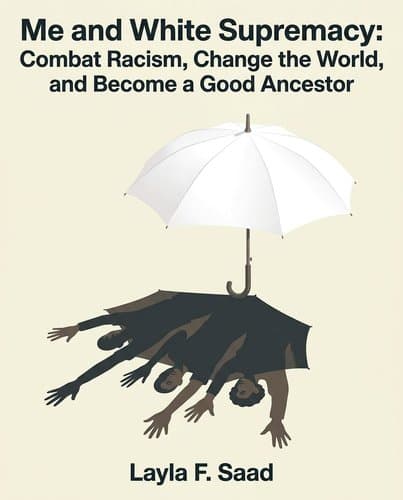
46002342_me-and-white-supremacy
by Layla F. Saad
Believing you're "one of the good ones" is not the same as doing good—and the gap between them is exactly where white supremacy survives.
In Brief
Believing you're "one of the good ones" is not the same as doing good—and the gap between them is exactly where white supremacy survives. This 28-day guided reckoning dismantles the self-protective habits—white silence, fragility, and performative allyship—that uphold racism regardless of your intentions.
Key Ideas
Ignorance About Racism Is Intentional
Ignorance about racism is not an innocent gap — it is a sustained choice made possible by apathy, convenience, and the absence of personal cost. The same list of reasons you don't know becomes a precise map of what to change.
White Supremacy Forms Societal Foundation
White supremacy is not fringe extremism. It is the foundational paradigm of white-centered societies — the default from which norms, rules, and laws are written — which means you benefit from it without holding conscious racist beliefs.
Interlocking Mechanisms Reproduce White Supremacy
White fragility, white silence, tone policing, white exceptionalism, and white superiority are not character flaws in isolated individuals. They are interlocking mechanisms that reproduce white supremacy regardless of conscious intent — each one feeding the others.
Anti-Blackness Embedded in Childhood Perception
Anti-Blackness begins at the level of childhood perception: studies show Black boys are seen as older and less innocent from age ten, and Black girls as needing less nurturing and protection across ages five to fourteen. The 'all children deserve care' principle is structurally racialized before anyone consciously applies it.
Authentic Allyship Requires Structural Commitment
Allyship cannot be self-declared and cannot consist only of visible gestures. Allyship without structural commitment — without policies, without risk, without following BIPOC leadership — is performance that centers the ally rather than the people it claims to support.
Discomfort Signals Breaking Through Numbness
The guilt, shame, and grief that surface during this work are not side effects to manage. They are evidence that the numbing effect of white supremacy is breaking down. However painful, they will never approach the pain BIPOC experience daily as a result of racism.
Commit to Practice, Not Perfection
Make commitments rather than promises. You will fail and revert. The practice is repledging after failure — not achieving a permanent state of 'being antiracist.' The motivating question is not 'how do I feel less guilty?' but 'what kind of ancestor do I intend to be?'
Who Should Read This
People working on personal growth in Social Issues and Cultural Studies, especially those tired of generic motivational advice.
Me and White Supremacy: Combat Racism, Change the World, and Become a Good Ancestor
By Layla F. Saad & Robin DiAngelo
10 min read
Why does it matter? Because the "I'm not racist" identity is white supremacy's most effective operating system.
You already know you're not racist. You voted the right way, made the right friends, read the right articles. Maybe you don't see color. Maybe you do, and you celebrate it. Either way, you've arrived at the same comfortable place: this isn't really about you.
That comfort is the whole problem.
What Layla F. Saad built (first a 28-day Instagram challenge, then a workbook downloaded by over 100,000 people, finally this book) is a systematic dismantling of the "good white person" identity. Not because good intentions are worthless, but because that self-image is doing a specific job: keeping you insulated from the work. Every behavior you've used to mark yourself as one of the good ones — the strategic silence, the colorblindness, the saviorism, the hashtag — turns out to be one of white supremacy's most reliable mechanisms. This book makes you look at how.
Ignorance About Racism Is a Sustained Choice, Not an Innocent Gap
Ignorance about racism is active, not passive — something you've been doing, without ever calling it a choice.
Robin DiAngelo, who spent years running race workshops for white corporate audiences, noticed a pattern. At the end of every session, participants asked the same question: "What do I do?" She began asking one back: "How have you managed not to know?" It's a diagnostic question. The information has always been available. Black scholars and activists have spent generations explaining in books, speeches, and social media threads exactly what they need from white people. Ignorance, in this context, isn't a deprivation. It's a choice made repeatedly and never examined.
DiAngelo turned that question into a concrete list: six reasons white people typically offer for not knowing what to do about racism. They weren't educated about it. They don't talk about race with other white people. They don't raise it with the people of color in their lives. Some don't have any people of color in their lives at all. They don't want to feel guilty. They haven't cared enough to look it up. Each item sounds, in isolation, like an explanation. Together they form a map of exactly what would need to change for the ignorance to end.
That reframing is the key move. The list locates rather than indicts. Every item is a specific, changeable thing: a conversation you haven't had, a discomfort you've avoided, a search you didn't run. That isn't the profile of someone who never had a chance to know. It's the profile of someone protecting their own comfort and calling that protection innocence.
This is where the work begins — not with the explicitly racist, not with the "bad ones" out there, but with you and the specific list of reasons you don't already know. What follows is what you've been managing not to know.
White Supremacy Is Not the KKK — It's the Water White Society Swims In
Here's what you've been avoiding: the word itself. When someone says white supremacy, most people picture a specific type: the KKK member, the neo-Nazi with a manifesto. Someone else. Someone you are not.
Layla F. Saad anticipated this. She had softer title options. Me and White Privilege or Me and Unconscious Bias would have been easier to share with family, easier to leave on a coffee table. She rejected both: calling it something softer lets most white people do exactly what they do with the extremist image — locate the problem safely elsewhere. A book about bias is about individual quirks. A book about privilege is about advantage. Neither forces a reckoning with the system itself.
That system is what Saad is naming. White supremacy, in her framing, is the dominant paradigm from which laws, norms, and institutional defaults are built in white-centered societies. It requires no conscious belief to benefit from. It was running before you were born, and it shaped which history was taught in your classroom and which neighborhoods a bank would lend in. You didn't choose it. You swam in it.
When Saad writes "so we must call a thing a thing," she isn't asking for a new vocabulary word. She's pointing out that every euphemism is a mechanism: it lets the reader position themselves outside the problem. The softer title existed as an option because the system built it that way. Choosing it is not neutrality.
Six Behaviors That Feel Normal and Keep White Supremacy Running
Saad's first week maps a system: six behaviors forming a closed loop in which each element powers the next. White fragility causes white silence. White silence protects white privilege, not through grand gestures, but through the accumulated weight of every conversation that never happens. White privilege feeds white superiority. White superiority generates white exceptionalism. And white exceptionalism ensures none of it ever gets examined.
White fragility is the loop's trip wire. Name a racial dynamic in a room of white people. Point out that the hiring committee is all white, or that the only person talked over in the meeting was the one Black woman. Someone tears up. Someone says "I'm not racist, I was raised to treat everyone the same." The conversation pivots from the pattern you named to the feelings you caused. That pivot is the mechanism.
Tone policing does the same work more politely. At the 2018 US Open, Serena Williams was fined for arguing with an umpire. Male players including John McEnroe had done the same for decades without equivalent penalty. The focus on how Williams expressed herself displaced any examination of what she was protesting. That's tone policing: prioritizing delivery over content so the message never has to be addressed.
The mechanism that anchors this loop is white superiority, and the most disturbing evidence for it comes from children. In the 1940s, Black psychologists Kenneth and Mamie Clark showed Black children between three and seven four identical dolls, two white-skinned and two dark-skinned, and asked which they preferred. Most chose the white doll and assigned it more positive qualities. The tests became foundational evidence that segregation damaged Black children's self-esteem. CNN recreated the experiment in 2010, this time including white children. Child psychologist Margaret Spencer found the opposite pattern in white kids: they attributed more positive traits to lighter-skinned dolls, which Spencer called "white bias." Her conclusion was that white children were absorbing racial hierarchies more strongly than their Black peers.
White superiority — the assumption that whiteness carries higher value — arrives before a child has language for it, drawn from toys, images, and cultural defaults that treat white as the norm. You cannot decide at thirty that you never absorbed it at four.
That's the insight that makes these six mechanisms a web. The individual-acts framework implies you can choose to be on the right side of the line. Just don't do the bad things. But these behaviors operate below the level of conscious decision. You can choose not to say something racist. You cannot choose not to have internalized white bias before you could read. What you can do is examine it. That's what exceptionalism prevents. The conviction that you, specifically, are exempt is the behavior that locks every other mechanism in place.
Anti-Blackness Begins Before Children Are Old Enough to Know the Word
The mechanism exceptionalism works to protect doesn't stay in adult systems — it operates on children.
In June 2015, fifteen-year-old Dajerria Becton was at a pool party in McKinney, Texas when a police officer grabbed her by the hair, slammed her to the ground, and pinned her there with his full body weight as she called out for her mother — unarmed, in a swimsuit, having done nothing except exist as a Black girl at a party where a white neighbor had called the police.
What the officer acted on, research confirms, is a perceptual pattern most adults share. Philip Goff, a psychologist who studies race and policing, found in 2014 that from around age ten, Black boys are consistently seen as older than they are and stripped of the default innocence white children receive. That perceptual gap correlated with something specific: the level of police force considered justified against them. Tamir Rice was twelve years old when he was shot in a Cleveland park while holding a toy gun — killed not as a child needing protection but as a threat that needed to be stopped.
The distortion extends to Black girls. Georgetown Law's 2017 study found that adults generally — not just police — perceive Black girls between five and fourteen as needing less nurturing, less protection, less comfort, and less support than white girls the same age. That perception traced directly into outcomes: harsher school discipline, more punitive treatment in juvenile court, and fewer mentoring relationships offered by teachers.
Here is what implicates you personally: the principle that children deserve care is not being applied neutrally. In practice, you extend it to some children and withhold it from others based on race — before you know anything specific about the child in front of you. You probably don't think of yourself as someone who would deny a child comfort. But if your gut, when you encounter a Black teenager, moves toward wariness before it moves toward care, that is not instinct. That is the system operating through you. The studies leave you with one question: are you willing to look at the specific form it takes in you?
If Your Allyship Doesn't Cost You Anything, It Isn't Allyship
A message arrives in Layla Saad's inbox from an organizer of a spiritual women's festival in the UK. The woman has been following the #MeAndWhiteSupremacy Instagram challenge and wants Saad to speak — the festival, she explains, has realized it needs more diverse voices.
Saad looked up the festival. The organizers, hosts, and speakers were almost entirely white. Her team came back with two questions: Was the organizer herself doing the challenge? And what policies did the festival have to protect Saad, a Black woman entering a predominantly white space to discuss race, from racial microaggressions?
The answers: no, she wasn't doing the challenge, but she'd been an ally for years. And no, there were no protective policies — because, in her words, you can't protect people from others being rude.
That phrase is the tell. The organizer wanted Saad's presence without the structural preparation to make it safe. No personal education. No institutional safeguards. She'd declared herself an ally. No one else had. What she was offering wasn't inclusion — it was a prop request.
Latham Thomas called it "optical allyship": the kind that platforms the ally rather than dismantles the systems harming the people they claim to support. The festival would have looked more diverse with Saad on the program. Saad would have absorbed whatever the audience directed at her. The organizer would have felt like she'd done something meaningful.
And then there's this, from Saad's own list of optical allyship behaviors: reading this book because you hope it will make you look more engaged. That item is aimed at you, specifically. The question isn't whether you've ever done something racist. It's asking what you're actually here for.
The Guilt and Shame You Feel Aren't Problems to Manage — They're Evidence the Work Is Real
The guilt you feel doing this work isn't a problem to manage — it's proof the work is functioning.
Saad's argument: white supremacy doesn't just distribute advantage. It also shuts down your capacity to feel the pain that advantage causes. You can't participate in a system built on other people's suffering and stay fully open to it, so the system closes you off. You move through life without registering what your racism costs other people, not because you lack empathy but because the structure you were raised inside made that weight invisible.
When you examine what you've absorbed, that numbness starts to reverse. The grief and shame that surface aren't signs you've gone too far. They are your capacity for empathy coming back online (what Saad calls rehumanizing yourself). The part of you that was shut down so you could participate comfortably is waking up.
Saad adds a calibration. However bad that guilt feels, it lands nowhere near the weight BIPOC carry as a result of the racism itself. That's not a rebuke — it's a direction check. If managing your own shame becomes the center of the work, you've reversed the current. Guilt is a signal to look outward and act, not inward and process.
A Good Ancestor Makes Commitments, Not Promises — and Repledges After Every Failure
What happens when you reach Day 29?
The structure of twenty-eight days implies a graduation. Do the exercises, journal through the discomfort, emerge having "done" antiracism. Saad dismantles that assumption in her closing chapter with a distinction that sounds semantic and isn't: the difference between a promise and a commitment.
A promise is something you will break. You will break it because being human means reverting toward comfort, and white privilege is an extraordinary source of it. Making promises about antiracism sets up a cycle of failure followed by guilt followed by retreat. The emotional exhaustion becomes its own reason to stop. A commitment works differently. A commitment can be repledged. When you slip back into white silence, into fragility, into the cozy numbness of not looking — and you will — you don't conclude you were wrong to try. You repledge. You begin again. The commitment was never a guarantee. It was a direction.
The reframe changes what the work is for. If it runs on guilt, every failure ends the project. If it runs on commitment to becoming a good ancestor (Saad's own stated purpose: to leave the world better for her children and everyone else shaped by her presence in it), then failure is a detour, not a destination. The question that motivates you isn't "Am I a good person?" That question points inward and leads to management of your own image. The question is: what kind of ancestor do you intend to be?
Butler's lines, which Saad uses to close the book, insist that a living world makes endless demands — the point is not to satisfy them but to keep answering. The twenty-eight days end. The work doesn't.
The Demands Don't Stop — Neither Does the Work
The twenty-eight days end. You do not. That's the thing Saad wants you to carry out of the book: not a checklist completed, not an identity earned, but a direction chosen. You will revert. You will go quiet when you should speak, comfortable when you should be unsettled, willfully ignorant when looking would cost you something. The only question is what you do after. Not how you feel about it, not how you explain it to yourself — what you do. The commitment isn't to a permanent state of being antiracist. It's to the repledging that follows every failure. The reward for that isn't absolution or belonging or even certainty that you're getting it right. It's integrity: the alignment between what you said you were building and what you're actually building for everyone who comes after you.
Notable Quotes
“situated higher up; of higher rank, quality, or importance.”
“The tests showed that the Black children were far less likely to respond with white bias. Dr. Spencer concluded,”
“The idea of whiteness being”
Frequently Asked Questions
- What is Me and White Supremacy about?
- Me and White Supremacy challenges white readers to examine how white supremacy operates through everyday attitudes and silence. Using a 28-day structured framework, the book exposes mechanisms like white fragility, tone policing, and performative allyship that sustain racism despite good intentions, while building habits of accountability for genuine antiracist practice. Rather than framing racism as isolated extremism, Saad and DiAngelo argue that white supremacy is the foundational paradigm of white-centered societies—the default from which norms, rules, and laws are written. This means people benefit from racism without holding conscious racist beliefs, making the examination of complicity essential.
- What are the key takeaways from Me and White Supremacy?
- Ignorance about racism is not innocent but a sustained choice enabled by apathy and convenience. White supremacy is not fringe extremism but foundational to white-centered societies, benefiting white people regardless of conscious racist beliefs. The book identifies five interlocking mechanisms—white fragility, silence, tone policing, exceptionalism, and superiority—that reproduce racism through each other. Anti-Blackness begins in childhood, with studies showing Black children perceived as older, less innocent, and less deserving of care than white children. Genuine allyship requires structural commitment, policies, and risk while following BIPOC leadership, not performative gestures. Finally, antiracist practice means recommitting after inevitable failures rather than achieving permanent moral status.
- How does Me and White Supremacy define white fragility and why is it important?
- White fragility refers to defensive reactions that prevent accountability and protect white comfort over addressing harm to BIPOC communities. Within the book's framework, it is one of five interlocking mechanisms—alongside white silence, tone policing, exceptionalism, and superiority—that reproduce white supremacy regardless of conscious intent. These mechanisms are not character flaws in isolated individuals but systemic structures that feed each other. Understanding white fragility matters because it explains how well-intentioned white people unconsciously maintain racist systems. By recognizing fragility as structural rather than personal, readers can interrupt these defensive patterns and commit to sustained antiracist practice beyond guilt management.
- What does Me and White Supremacy say about allyship?
- Allyship cannot be self-declared and cannot consist only of visible gestures. Allyship without structural commitment—without policies, without risk, without following BIPOC leadership—is performance that centers the ally rather than the people it claims to support. The book emphasizes that genuine allyship requires concrete action and sustained accountability, not performative displays of solidarity. Instead of seeking to reduce personal guilt, the guiding question should be "what kind of ancestor do I intend to be?" This reframes allyship as a long-term practice of inevitable failures and recommitment, rather than achieving a permanent state of being antiracist or considered a "good ally."
Related Book Summaries



Read the full summary of 46002342_me-and-white-supremacy on InShort