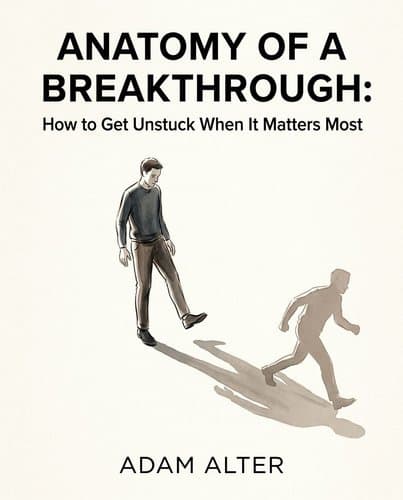
61272294_anatomy-of-a-breakthrough
by Adam Alter
Getting stuck isn't a character flaw—it's a predictable structural feature of ambitious pursuits with specific, fixable causes. Adam Alter reveals the hidden…
In Brief
Anatomy of a Breakthrough: How to Get Unstuck When It Matters Most (2023) draws on behavioral science and psychology to show that getting stuck is a predictable structural feature of ambitious goals, not a personal failure.
Key Ideas
Eliminate midpoint through artificial waypoints
Break extended goals into subgoals small enough to eliminate or shrink the midpoint — there is no midpoint slump if there is no midpoint. When a goal feels boundless, create artificial waypoints that force the goal-gradient effect to work in your favor.
Later ideas prove more original than early ones
Give yourself 50% more time than intuition suggests before seriously considering abandonment. The creative cliff illusion makes early difficulty feel like a dead end — but the research consistently shows later ideas are more original, not fewer.
One in five failures signals optimal challenge level
Calibrate the difficulty of what you're attempting by tracking your failure rate. Failing roughly one in five or six attempts is the signal you're in the productive stretch zone. Failing less often means you're not genuinely pushing; failing more often means the task is currently too hard.
Slow down and observe under pressure
When anxiety about performance spikes, the move is to slow down and observe — not to increase urgency. Messi walks for the first two minutes of every match to build a tactical map. Agassi watched Becker's tongue while everyone else focused inward. Pressure narrows attention exactly when breadth is needed.
System catches small problems better than willpower
Apply the aircraft ABC check to your health, relationships, and finances on a fixed schedule. Small problems that don't trigger psychological alarm bells are the ones most likely to compound into structural blocks — they need a system to catch them, not willpower.
Exploration phases reliably precede breakthrough periods
Before committing hard to any single path, explore widely: say yes to approaches outside your existing competency, work across different formats or domains, and follow unexpected threads. The research on hot streaks shows that exploration phases reliably precede breakthrough periods — and cannot be skipped.
Identity nouns activate better behavior than verbs
Stop describing your goals as verbs and start describing them as nouns. 'I'm a writer' activates different behavior than 'I write.' The noun encodes identity; the verb encodes an optional activity that requires motivation each time.
Pivot questions diagnose timing strategy and dead ends
When a path fails, run two pivot questions before abandoning: What is the best aspect of this attempt? What small tweak might have changed the outcome? These questions diagnose whether you are facing a timing problem (persist), a strategy problem (pivot), or a genuine dead end (release).
Who Should Read This
Curious readers interested in Behavioral Psychology and Cognitive Psychology and the science of how the mind actually works.
Anatomy of a Breakthrough: How to Get Unstuck When It Matters Most
By Adam Alter
10 min read
Why does it matter? Because everyone is stuck, and almost no one knows that everyone is stuck.
Here's what you're privately assuming: that other people have their momentum and their method, and you're the anomaly — the one who got stuck and can't seem to move.
Adam Alter ran a survey before the pandemic. Hundreds of people — broke ones, wealthy ones, Olympic champions, people trapped in bad marriages, people who couldn't stop spending money they didn't have. Every respondent was stuck in at least one area. Most pinpointed it in under ten seconds, because it was already burning at the front of their minds. And nearly all of them believed they were uniquely unlucky — that everyone else was making progress while they alone had stalled.
That assumption is the problem before the problem. Stuckness is not a verdict on you. It's a structural feature of ambitious goal pursuit, predictable enough to diagnose and specific enough to treat. That's what this book does.
Getting Stuck Is an Engineering Problem, Not a Character Flaw
Four miles from the finish line of the 2017 Dallas Marathon, Chandler Self's father waved at her from the crowd. She was in first place by a comfortable margin. She was so elated she skipped the next aid station — she didn't need water, she was winning. Then the finish line came into view, sitting at the top of a hill. Her legs stopped working.
Self collapsed. Then she got up and collapsed again. A seventeen-year-old running a relay inside the marathon stopped his own race and helped carry her across the line. She finished first, officially, because help from a competitor was legal. She had completed 99.57 percent of the race.
This wasn't weakness. It was miscalculation — the kind a German researcher named Hans-Volkhart Ulmer described in 1996 as teleoanticipation: the brain's continuous effort to budget energy against a known endpoint. Self had run that calculation for more than two and a half hours. It was off by a fraction of a percent.
What Self experienced has a name and a mechanism. So does every other major form of getting stuck. Clark Hull spent decades in the 1940s watching rats run mazes at Yale and kept seeing the same shape: animals moved quickly at the start, slowed in the middle, then accelerated near the end. He called it the goal gradient effect, and it operates within a single effort: a race, a stamp card, a maze run. A study of coffee loyalty cards confirmed the same shape in humans: the gap between the first and second stamp was twenty percent longer than between the ninth and tenth. Same mechanism, different species, different century.
The middle of any extended effort is its own problem. People proofreading nine essays found typos twenty percent more slowly on the fifth than on the second or eighth. Then there's the plateau, a different timescale entirely. A weightlifter adding five pounds every week will eventually hit a wall where the same load stops producing results: not from lack of effort, but because the body has adapted to that exact stimulus and needs a different one. Progress doesn't reverse; it stalls, until something changes.
Stuckness is not evidence of character. It's evidence that you are pursuing a goal.
The Body's Alarm System Is Calibrated for Lions, Not Creative Blocks
Of all these mechanisms, anxiety is the one most people try to turn into fuel. That makes it the one most worth understanding first.
Herbie Hancock arrived at Miles Davis's house in 1963 convinced he was auditioning for one of the most coveted spots in jazz. Standing in the living room were Tony Williams, Ron Carter, and George Coleman — three of the greatest musicians alive. Davis played a few notes, threw his trumpet on the couch, and disappeared upstairs. He didn't come back that day, or the next, or the day after that.
Hancock was twenty-three and terrified. He assumed he'd failed before he'd even started. What he learned years later: Davis had been listening the entire time, through an intercom in his bedroom. The absence was deliberate. Davis knew his presence transformed young musicians — dry-mouthed, sweaty-palmed, unable to think — into something closer to panicked prey than creative performers. So he left.
The counterintuitive part: the response that feels right when you're stuck (push harder, raise the stakes, refuse to relent) activates the same fight-or-flight physiology that evolved to help you sprint from predators. That system excels at mobilizing muscle. It degrades exactly the cognitive resources you need to break through a mental block: working memory, flexible thinking, the capacity to improvise. When the brain decides the situation is an emergency, it routes resources away from the prefrontal cortex toward motor systems preparing to act. More urgency produces less capacity for the kind of thinking that actually moves you forward.
Davis understood this with unusual precision. When guitarist John McLaughlin froze mid-rehearsal in 1969, sweating through his shirt and paralyzed by Davis watching, Davis didn't push harder. He told McLaughlin to "play it like you don't know how to play the guitar." Let twenty years of accumulated instinct take over. Stop consciously trying. McLaughlin played the melody. Davis loved it. McLaughlin later said Davis had pulled from him something he didn't know he possessed.
The tool was the deliberate removal of threat. A study Alter ran at Princeton showed the same dynamic: students from underrepresented high schools scored roughly 20 percent lower on a math test framed as measuring intellectual ability. When the identical test was renamed an "Intellectual Challenge Questionnaire," the gap disappeared entirely. Same students, same problems, different label. What shifted was whether the brain registered the situation as a judgment or an attempt.
Reducing pressure isn't giving yourself permission to fail. It's disabling the alarm system long enough for the actual work to happen.
Your Best Ideas Haven't Arrived Yet — Which Is Exactly When Most People Quit
That's the anxiety trap. A different failure mode waits inside the work itself.
When creative work gets difficult and ideas stop coming easily, most people treat that friction as a diagnostic signal: they've reached their ceiling, or the approach is flawed, or they lack the talent for this. That reading gets the direction exactly wrong. Difficulty is structurally where good ideas live.
Brian Lucas and Loran Nordgren, two psychologists, named the mistake the creative cliff illusion. They asked participants to spend ten minutes brainstorming unusual foods for a Thanksgiving dinner, then predict how many ideas they'd generate in a second ten-minute round. Most participants, feeling mentally depleted, expected a significant drop. They generated 66 percent more ideas than predicted — and those later ideas were rated higher in creativity by outside judges than the first batch. The pattern held for cardboard box uses, advertising slogans, and cartoon captions. Sketch comedians with years of training predicted decline. So did professional comedians. All of them confused effort with exhaustion.
The mechanism is concrete: your first ideas are your most cognitively accessible ones. Shared culture produces shared defaults — your opening ideas are the same ones everyone else has, which makes them less original by definition. Sustained effort clears the defaults away. What remains is structurally more novel.
Lucas's heuristic: give yourself 50 percent more time than gut instinct suggests before seriously considering abandonment.
The same pattern shows up at larger scale — not just ideas running out, but patience.
Josh Harris built working versions of YouTube, Facebook, and Twitter in the mid-1990s through a company called Pseudo Programs — and went bankrupt when it sold for $2 million in 2001. He'd been worth $85 million. Two years later, broadband subscriptions in the United States grew 50 percent. The vision was technically survivable. What ran out wasn't money or talent. It was patience.
The Harris story is the creative cliff illusion at company scale. Most people fold at the moment the research says they're entering the productive zone.
The Most Dangerous Problems Are the Ones That Don't Ring Any Alarms
On July 4, 1940, Robert Wadlow walked in a parade in Flint, Michigan. At just under nine feet tall — the largest human being in recorded history — he needed metal leg braces to stay upright. One was fitted incorrectly. By the end of the day, he had a blister on his right ankle.
Wadlow kept walking. So did his doctors. A blister is a blister. Nothing crossed the threshold where anyone thought: this needs attention now. Eleven days later, Wadlow was dead. The blister had become infected; the infection became septic shock. He was twenty-two.
The trap is subtler than the obvious kind. These problems don't disguise themselves as non-problems — they disguise themselves as small ones. The brain calibrates its alarm against size: a broken leg fires it immediately, a blister doesn't. That gap between actual severity and perceived urgency is exactly where catastrophe hides.
The failure is rational, not stupid. You can't treat every irritation as a crisis without exhausting yourself on things that never escalate. Most blisters heal. The problem is that some don't, and they look identical to the ones that will.
The fix is borrowed from aviation. Commercial aircraft run a tiered maintenance schedule: quick checks every ten days, moderate reviews every six months, deep inspections every few years. Not because every small issue will ground a plane, but because the system catches the ones that would. Before they do. You don't wait for an alarm you've already proved won't fire. You schedule the inspection. Applied to health, finances, relationships: the question isn't whether something feels urgent. It's whether you've looked recently enough to know. For a relationship, the inspection sounds like: When did I last check in with my partner, not during a conflict, just to ask whether things are okay? That question doesn't feel necessary. Neither did checking the leg brace.
Breakthroughs Require Exploring First — Committing Too Early Guarantees Barren Ground
Even a well-maintained system can stall permanently if it's pointed in the wrong direction.
Truffle hunters in Piedmont, Italy spend entire days walking through forests with trained dogs, covering enormous stretches of land that yield nothing. Most of the earth is barren. The truffles grow in tiny, unpredictable pockets, and you cannot know where those pockets are without covering the ground first. Commit to digging before you've located the vein, and you can work as hard as you like in entirely empty soil.
Most advice about breakthroughs treats commitment as the central virtue: find your lane, stay in it, grind. Dashun Wang and colleagues at Northwestern tracked thousands of artists, film directors, and scientists. The more common error, they found, runs the other direction. Most of them experienced one hot streak (a roughly 20-percent window of their career when they produced their most influential work). What triggered these bursts was sequence: first a period of exploration, deliberately trying things outside existing competency; then immediately a period of deep exploitation, concentrating that learning into something precise. Reversed, or separated, neither phase predicted a hot streak. Commit to exploitation before you've explored, and you're digging where no truffle grows.
The human version of this pattern is Dave Berkoff: a Harvard backstroke swimmer too short and light to compete on raw physiology, who noticed that swimmers move 82 percent faster underwater than on the surface. Nobody had exploited this gap because everyone swam the way everyone always had. That discovery came from questioning a convention most competitors never examined. Once Berkoff had it, he trained his body to stay under for 40 meters — 80 percent of the first lap — while his nervous system screamed for air. The exploration found the vein. The exploitation produced two world records and an Olympic medal.
After swimming's governing body capped underwater time at 15 meters following the 1988 Olympics, Berkoff didn't retire. He explored again, looking for advantages within the new rules, then built a training plan around them. He won medals at the 1992 Olympics too.
Count how often you're saying yes versus no. A default yes signals exploration: open to uncertainty, ranging across new ground. A default no signals exploitation: protecting the vein you've already found. Neither mode is wrong. But if you've been saying no for a long time without a hot streak to show for it, you may be digging loyally in barren soil.
Waiting to Feel Ready Is Itself the Mechanism Keeping You Stuck
Hamilton Naki was tending the grounds of the University of Cape Town when a surgeon asked the gardening foreman for help with lab work — someone to feed the animals, keep things clean. Naki was working that day. He said yes.
That's where it began. Not with training, not with a plan, not with any sense he belonged there. He was in his twenties, had left school at fourteen, and apartheid had made explicit what a Black South African man could and could not become. A surgeon was not on the list.
He fed the animals anyway. Then cleaned the cages. Then learned to anesthetize them. Then assisted on procedures of rising complexity. Each step followed from the one before, not because Naki had prepared for it, but because he'd done the previous thing enough times that the next became possible. Over years, he moved from the university's gardens to its operating theaters, mastering techniques that trained medical graduates struggled to perform. Heart surgeon Christiaan Barnard, who performed the world's first human-to-human heart transplant in 1967, said plainly that Naki's technical ability exceeded his own. Naki eventually taught thousands of medical students, having never attended a lecture himself.
Naki's story reverses a common assumption about readiness. Most people believe capability and confidence come first — you feel ready, then you act. What Naki's career shows is the opposite: capability doesn't precede action. It compounds through it. Waiting for readiness to arrive guarantees it never does, because the only mechanism that produces readiness is the thing you're waiting to feel ready to do.
The same pattern shows up in small daily choices too. People who describe themselves as "a voter" vote more reliably than people who say "I vote." The noun marks an identity built through repetition. That identity doesn't deliberate. You don't weigh whether to act. The act is already part of who you are.
Naki never felt ready. He fed the animals. The rest accumulated from there.
The Step That Creates the Readiness
The thing you're waiting to feel — ready, certain, worthy — won't arrive before you move. It arrives as a consequence of moving. Roger Bannister didn't feel like a sub-four-minute miler before he became one. Hamilton Naki didn't wait for apartheid to certify him before he started learning surgery. That feeling wasn't a prerequisite. It was a byproduct.
Every tool in this book is, underneath its specific mechanics, a version of the same instruction: start before the conditions are right, because starting is what makes conditions right. Which means the question worth sitting with, now that you've finished reading, is this: what have you been treating as your reward for resolving your stuckness — when it is, in fact, the mechanism that would resolve it?
Notable Quotes
“In 2017, she won the Dallas Marathon in a time of 2:53:57, though her victory came with an asterisk. Four miles from the end of the race Self passed her dad, who gestured to tell her she was in first place by a comfortable margin. Self was elated.”
“This is our winner, ladies and gentlemen,”
“This is not normally what you expect to see at the finish of a marathon.”
Frequently Asked Questions
- How does Adam Alter recommend breaking down ambitious goals to overcome the midpoint slump?
- Alter argues that the midpoint slump is preventable through strategic goal decomposition. "Break extended goals into subgoals small enough to eliminate or shrink the midpoint — there is no midpoint slump if there is no midpoint. When a goal feels boundless, create artificial waypoints that force the goal-gradient effect to work in your favor." By breaking ambitious objectives into smaller, measurable milestones, you activate the goal-gradient effect at multiple points, maintaining motivation throughout rather than hitting the dangerous middle phase where momentum typically falters.
- How long should you persist before abandoning a goal according to Adam Alter?
- Alter cautions against premature abandonment in creative pursuits by addressing the creative cliff illusion. "Give yourself 50% more time than intuition suggests before seriously considering abandonment. The creative cliff illusion makes early difficulty feel like a dead end — but the research consistently shows later ideas are more original, not fewer." This means extending your timeline beyond initial discomfort, as breakthrough typically lies ahead. Research demonstrates that ideas improve over time, meaning struggle in early stages often precedes your most original work.
- How should you calibrate difficulty when pursuing ambitious goals?
- Alter proposes a specific failure rate as the calibration metric for optimal challenge. "Failing roughly one in five or six attempts is the signal you're in the productive stretch zone. Failing less often means you're not genuinely pushing; failing more often means the task is currently too hard." Track your failure rate as concrete feedback to calibrate: if you're succeeding too consistently, increase ambition; if failures exceed this threshold, reduce complexity temporarily before scaling back up to rebuild sustainable momentum.
- Why does using noun identity language work better than verbs for pursuing goals?
- Alter emphasizes reframing goals through identity language rather than behavioral verbs. "Stop describing your goals as verbs and start describing them as nouns. 'I'm a writer' activates different behavior than 'I write.' The noun encodes identity; the verb encodes an optional activity that requires motivation each time." This distinction fundamentally alters psychological commitment. Noun-based identity goals bypass constant motivation by embedding the objective into your self-concept, making pursuit automatic. This shifts goals from discretionary activities requiring willpower to core aspects of who you are.
Related Book Summaries


Read the full summary of 61272294_anatomy-of-a-breakthrough on InShort