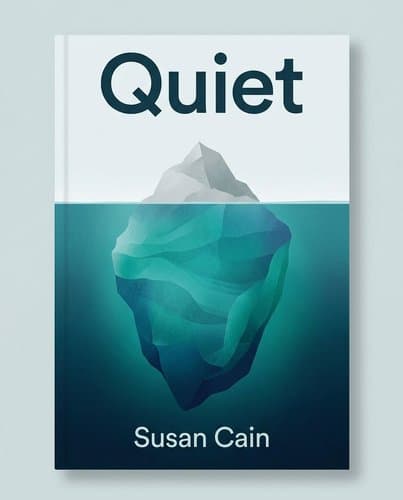
8520610_quiet
by Susan Cain
The world's most productive thinkers are often its quietest—yet modern culture systematically rewards performance over depth. Susan Cain exposes the invented…
In Brief
The world's most productive thinkers are often its quietest—yet modern culture systematically rewards performance over depth. Susan Cain exposes the invented myth of extroversion as competence, and shows introverts how to reclaim their natural strengths without pretending to be someone else.
Key Ideas
Individual input yields better group ideas
Before your next meeting, gather input individually before the group convenes — research shows group brainstorming produces fewer and lower-quality ideas than individuals working alone, and whichever voice speaks first anchors everyone else.
Extrovert Ideal is cultural not biological
The Extrovert Ideal emerged around 1920 as American workers moved into cities and began managing impressions among strangers. Recognizing it as a cultural invention — not human nature — gives you permission to question it rather than simply accept it.
Introversion and shyness are different traits
Introversion and shyness are different things: shyness is fear of social disapproval; introversion is a preference for lower stimulation. You can be a shy extrovert (Barbra Streisand) or a non-shy introvert (Bill Gates). Treating them as the same thing misdiagnoses both.
Align extroversion with core personal projects
Identify your 'core personal projects' — work you'd pursue unbidden, subjects you envy in others, things you loved before you cared what anyone thought — and reserve your performances of extroversion for those specifically. Acting out of character for work you don't believe in is self-negation, not adaptation.
Build restorative niches for sustained performance
Build restorative niches — specific times and places to return to your natural operating mode — into any sustained performance of extroversion. Without them, the cost accumulates physiologically, not just emotionally.
Caution and doubt are competitive edges
The FUD (Fear, Uncertainty, Doubt) that marks cautious, introverted thinkers is a competitive edge in complex decisions. The investors who flourished after 2008 were constitutionally diffident people who treated their own discomfort as a signal worth reading, not a weakness to suppress.
Who Should Read This
Curious readers interested in Social Psychology and Behavioral Psychology and the science of how the mind actually works.
Quiet
By Susan Cain
9 min read
Why does it matter? Because the traits we most reward in leaders, classrooms, and boardrooms have no proven link to the results we actually want.
Picture the most impressive person in the last meeting you attended. Chances are they spoke first, spoke most, and spoke with conviction. Chances are you believed them — I did. We do this constantly: translate volume into intelligence, speed into competence, confidence into authority. It feels like judgment. It turns out to be a reflex, one that's demonstrably, expensively wrong. The most talkative person in the room isn't the one with the best ideas. The most charismatic CEO doesn't run the best company. The institutions built to reward boldness — investment banks, business schools, open-plan offices — have the data to prove it, though not in ways they'd advertise. That discomfort wasn't a deficiency to fix. It was a signal worth listening to.
The Preference for Charismatic People Is a Cultural Invention — with a Dateable Origin
America's admiration for bold, magnetic, self-promoting people was invented around 1920. Before that, a different value system ran the show, and the contrast is sharper than you might expect.
The clearest evidence comes from a cultural historian named Warren Susman, who did something deceptively simple: he counted the words that appeared most frequently in American self-help guides across two different periods. The advice manuals of the nineteenth century returned again and again to the same vocabulary: duty, honor, integrity, morals, citizenship. These were qualities anyone could cultivate through private discipline. A popular 1899 guide celebrated a timid shop girl who gave her meager earnings to a freezing beggar and slipped away before anyone could witness her generosity. Her virtue lay precisely in her anonymity.
By the 1920s, the same genre had replaced that vocabulary entirely. The new guides no longer asked whether you were honorable; they asked whether you were magnetic. Fascinating. Dominant. Forceful. The earlier guides described qualities you worked on in private; the newer ones described qualities you either projected or didn't. You can study integrity. You can't really study magnetism.
The shift had a specific cause. Between 1790 and 1920, the share of Americans living in cities grew from 3 percent to more than a third. People stopped dealing with neighbors they'd known for decades and started dealing with strangers — employers, clients, colleagues — who had no prior basis for judging them. First impressions stopped being a social grace and became an economic tool. Dale Carnegie understood this with unusual clarity. He'd grown up an anxious, tongue-tied farm boy in Missouri, spent years losing college speaking contests before finally learning to win them, then built that personal transformation into a franchise: a public-speaking class at a Manhattan YMCA, then the Dale Carnegie Institute, then a book arguing that mastering public speaking was the single most powerful tool for getting ahead in modern commerce. He was both a product of the new culture and one of its architects.
If the preference for gregarious, magnetic, self-promoting people emerged from specific economic pressures at a specific historical moment, it carries a dateable origin — which means it can be questioned rather than simply accepted as the way things are. When we don't, we design schools and workplaces around a single temperament, then spend decades trying to fix the people who happen to have a different one.
The Loudest Voice in the Room Is Usually Running the Worst Idea
That bias plays out in real time. A Harvard Business School student is watching himself on videotape. His group just completed the Subarctic Survival Situation, a classroom exercise where teams rank fifteen items salvaged from a crash-landed float plane, racing to match an expert's survival priorities. One member had genuine experience in the northern backcountry. He knew how to rank the list. At one point, he'd suggested ranking the sleeping bag ahead of the matches. In wet subarctic conditions, staying warm matters more than starting fires. A louder voice had already said matches; the group had moved on before he could say why. Watching the playback, the student can see exactly what happened: every suggestion that would have kept them alive was overruled, not for being wrong, but for being offered without enough force behind it.
The exercise was designed to show something else: that teams outperform individuals, that group synergy pays off. What the tape reveals instead is simpler and darker. When knowledge and confidence compete in a room, confidence usually wins.
The pattern holds far beyond HBS. Studies consistently find that when strangers connect over the phone, the person who talks more gets rated as more intelligent, more attractive, and more trustworthy, regardless of what they actually say. In group problem-solving studies, students who speak first and most often are judged most capable, even when their answers are no better than those of the quieter ones. We don't read talkative confidence as a signal of competence. We experience it as the thing itself.
What turns this from unfair to genuinely unsettling is that the problem runs below the level of choice. In 2005, neuroscientist Gregory Berns scanned participants' brains as they either agreed with a group's clearly wrong answer or held their ground. If people were consciously deciding to go along while privately knowing better, you'd expect activity in the prefrontal cortex, which handles deliberate decisions. Berns found the opposite. Conformists showed heightened activity in the brain regions handling visual and spatial perception. The group hadn't just pressured people into silence; it had altered what they actually saw.
And the moments when participants resisted? Those lit up the amygdala, tied to fear of social rejection. Berns called it "the pain of independence." Disagreeing with the group doesn't just feel socially awkward. Neurologically, it registers as a threat.
That's what the HBS tape kept showing: not a failure of analysis, but a failure of architecture. Groups don't just miss the best ideas. They make the loudest ideas feel correct and make correction feel dangerous. The person who speaks most clearly and first doesn't get followed because they're right. They get followed because the brain has no fast way to tell the difference.
Introversion Isn't Shyness — It's a Measurably Different Nervous System
Could introversion be trained away with enough practice and willpower? Jerome Kagan's research at Harvard says no, and the reason begins in infancy.
In 1989, Kagan's team exposed 500 four-month-old babies to a battery of new experiences: taped voices, popping balloons, colorful mobiles, a cotton swab dipped in alcohol. About 20% cried and pumped their arms vigorously; another 40% stayed quiet and placid. Kagan made a counterintuitive prediction: the arm-pumpers would grow into introverts. Follow-up studies at ages 2, 4, 7, and 11 proved him right.
The mechanism is the amygdala — the same structure Berns watched light up at the threat of social rejection. Here it fires at novelty rather than social threat, but the wiring is the same. High-reactive infants had amygdalae that responded strongly to newness itself: not to people, not to social situations, but to a cotton swab, a spinning mobile. As those children grew, they carried a nervous system calibrated to process stimulation more deeply. That depth was a feature, not a timidity.
The same pattern appears in rhesus monkeys, who share about 95% of our DNA and live in elaborate social hierarchies. Some carry a gene variant linked to heightened emotional reactivity — the so-called short allele of the serotonin-transporter gene. Without a stable caregiver to help regulate all that incoming signal, these monkeys were overwhelmed by it and showed signs of depression. Raised by attentive mothers, the same monkeys outperformed genetically lower-risk peers at building alliances, handling conflict, and finding playmates. They often rose to lead their troops.
What made the difference? Stephen Suomi found that these high-reactive monkeys spent far more time watching from the edges before entering the group, absorbing the social rules at a depth others didn't bother with. The same sensitivity that made them fragile in harsh conditions made them extraordinarily attuned in good ones.
Introversion is a neurological profile: higher reactivity to stimulation, deeper alertness to novelty, a pull toward processing before acting. It was calibrated over evolutionary time for environments where careful observation beats bold charge. The arm-pumping baby at the cotton swab grows into the adult who reads a room before speaking, and sometimes leads it.
Wall Street Fired Its Immune System — and Then the Bill Came Due
The reward circuitry that evolution built for pursuing prey doesn't know it's now pursuing stock prices. In December 2008, a neuroscientist-turned-financial-psychiatrist named Janice Dorn took a call from a sixty-year-old Midwesterner named Alan. He had lost $700,000, nearly three-quarters of everything he and his wife had saved, chasing GM stock through the crash. The pattern was precise: every time the news turned bad and the stock fell, Alan bought more. Not despite the warning signals. Because of them. Each drop felt like an invitation — lower price, bigger upside, this is the moment. He sped up exactly when he should have braked.
Dorn calls this reward sensitivity: the old brain's dopamine system drowning out the new brain's deliberate calculation. The closer you get to a potential gain, the harder those circuits work to override everything else. Each time GM dropped another point, Alan's brain registered it as one step closer to the bottom, one step closer to the prize. The dopamine system doesn't distinguish between "I'm about to win" and "I'm about to ruin myself." His neocortex was probably screaming. His reward circuitry didn't care.
But Alan's story is one man's catastrophe. What Boykin Curry, a managing director at Eagle Capital, describes is the same mechanism running through entire institutions. For two decades before the crash, financial culture ran a slow-motion selection process. Each time an aggressive risk-taker pushed for more leverage, the bull market validated them: they got promoted, they controlled more capital. Anyone who hesitated, who ran the numbers and kept saying things didn't add up, was treated as a drag on returns, passed over, gradually edged out. Curry watched it happen year after year: the institutions weren't merely tolerating this. They were systematizing it. They ran their own immune systems out of the building.
Investment banks gave a name to what they'd purged: Fear, Uncertainty, and Doubt — FUD. Caution had become a disqualifying trait.
Seth Klarman ran Baupost Group on the opposite premise. He kept large cash reserves, skipped deals everyone else was chasing, and was widely regarded as paranoid. He named his racehorse "Read the Footnotes." In the two years following the crash, when most investors were fleeing hedge funds, Baupost nearly doubled its assets under management to $22 billion. His edge wasn't a smarter model or a faster algorithm. It was that he had never stopped treating fear as information. The industry had spent twenty years systematically selecting against people who did the same.
The institutions didn't collapse because smart people made bad decisions under pressure. They collapsed because they had spent years promoting the people most prone to speeding up at warning signals, and quietly removing the ones most likely to slow down and check.
You Can Act Like an Extrovert Without Becoming One — but Only for Work You Believe In
Brian Little, widely regarded as Harvard's most beloved teacher, is an introvert by every measure, including a physiological one. His lectures ended in standing ovations, and his students lined up outside office hours as if waiting for concert tickets. After each talk, he sprinted to the men's room and hid in a stall with his feet braced against the walls so colleagues couldn't identify his shoes. When a military officer once spotted them and struck up a conversation, Little silently raised his feet higher. Peter Gzowski, the host of Canada's most prominent talk show, heard the story and replied without missing a beat that he'd claimed stall number eight.
Little calls his framework Free Trait Theory: fixed traits don't change, but we can act out of character in service of what genuinely matters to us. He lectured the way he did because teaching was his core personal project. The bathroom stall was the cost of entry. For work he loved, it was worth it. Not all work qualifies.
After a Harvard Law School panel, two lawyers approached with what looked like the same problem: both were introverts performing extroversion at work, and one was failing. Alison, a litigator, kept losing final-round interviews; recruiters said she had the wrong personality. The real problem was that she didn't love the law — her interior monologue wasn't I'm doing this for work I believe in, it was success requires becoming someone I'm not. That's not adaptation. Jillian, a policy researcher, chaired occasional meetings she disliked but found the work itself satisfying. She acted out of character for her project. Alison acted against herself.
Little's term for the antidote is a restorative niche: a pocket of space or time to stop performing. A river walk. A closed door between meetings. Not retreat — recovery. Protect the moments that make tomorrow's performance possible.
The Paperbacks You Left in the Suitcase
There's a girl in Susan Cain's memory — thick glasses, a paperback, a summer camp cabin full of twelve-year-olds who'd decided that reading was social suicide. The girl opened her book anyway. They destroyed her for it. Ten-year-old Cain watched, then kept her own books in her suitcase for the whole summer. She felt guilty about it for years.
Cain wrote this book to undo that guilt — and maybe yours. Her grandfather was a shy Brooklyn rabbi who could barely hold eye contact from the pulpit. His apartment was so full of books they'd taken over the furniture. When he died, the neighborhood closed around him. The whole block came.
That's what quiet, properly inhabited, builds. Not despite what it costs you — but because of what it protects: the depth, the attention, the patient accumulation of what actually matters. Until the streets close.
Notable Quotes
“the highest accolade her seventh-grade classmates knew, higher even than”
“Let's go back a step. What are your numbers based on?”
“What if we structured the loan this way, do you think it might work?”
Frequently Asked Questions
- What is Quiet about?
- Quiet exposes how Western culture — especially American workplaces and institutions — came to equate extroversion with competence and introversion with deficiency, and makes the case that this bias is a cultural invention, not human nature. Drawing on psychology, neuroscience, and history, it gives introverts a framework for working with their nature rather than against it, and shows organizations what they lose by designing out quiet thinkers. Cain distinguishes introversion from shyness, noting that introversion is a preference for lower stimulation, while shyness is fear of social disapproval.
- How did the Extrovert Ideal emerge?
- The Extrovert Ideal emerged around 1920 as American workers moved into cities and began managing impressions among strangers. Recognizing it as a cultural invention — not human nature — gives you permission to question it rather than simply accept it. This cultural shift coincided with the rise of corporate culture and management schools that valued charisma and public-facing skills. Understanding this history is crucial because it reveals that the preference for extroversion in modern workplaces is a choice, not an inevitable reflection of what makes people or organizations successful.
- What is the difference between introversion and shyness?
- Introversion and shyness are different things: shyness is fear of social disapproval; introversion is a preference for lower stimulation. You can be a shy extrovert (Barbra Streisand) or a non-shy introvert (Bill Gates). Treating them as the same thing misdiagnoses both. This distinction is crucial for understanding how people function in social and professional settings. An introvert might be comfortable public speaking but still prefer solitude to recharge, while a shy person might be extroverted but anxious about social judgment. Recognizing these differences allows for better support and development strategies tailored to individual needs.
- What are the key takeaways from Quiet?
- Identify your 'core personal projects' — work you'd pursue unbidden, subjects you envy in others, things you loved before you cared what anyone thought — and reserve your performances of extroversion for those specifically. Acting out of character for work you don't believe in is self-negation, not adaptation. Build restorative niches — specific times and places to return to your natural operating mode — into any sustained performance of extroversion. Without them, the cost accumulates physiologically, not just emotionally. This approach helps introverts preserve their energy and authenticity while succeeding in environments that demand public engagement.
Related Book Summaries

Read the full summary of 8520610_quiet on InShort